1.6 dCi N-Vision SE SUV 5dr Diesel XTRON Euro 6 (s/s) (130 ps)
Submitted by dev_editor on
We have been very naughty car enthusiasts here in Britain.
We did not buy enough Z-cars, so Nissan did not bring its latest Nissan Z to the UK. Which is a shame, because the last car to grace our isles, the 370Z, is a distinctly appealing device.
You get a front-mid-mounted V6, a six-speed gearbox bolted behind it driving a rear axle located unfashionably and excitingly close to your coccyx, all in a package feeling ever smaller as other cars get bigger.
What’s not to like, you may by now be wondering. Well, the hum, rumble and roar of fat treads over Tarmac is one thing, the 370Z, and the 350 before it, generating road noise equivalent to the drone of a phalanx of machine-tools on a factory floor.
This Nissan might have the mechanicals for long-distance drives, but not the manners. It’s also a bit of a drinker, Autocar’s keen road test department discovering that while it could manage a not-that-great 26mpg when driven with circumspection, any temptation to exploit its not inconsiderable appetite for speed would flame a gallon in under 20 miles.
Nissan priced the 370Z usefully below the Cayman and Boxster when you, though not, it seems, usefully enough.
All of which means that the 370Z is quite a rare car and one that despite its noisy thirst will provide an awful lot of muscular, rear-drive entertainment.
The cheapest are well under £10,000 now and being Nissans, appear quite capable of big mileages without the expensive problems that occasionally afflict the Z’s Porsche nemesis.
Nissan’s last Primera was a symbol of a company losing its way.
Although it emerged after Nissan’s rescue by Renault and the triggering of new boss Carlos Ghosn’s masterful turnaround plan, its bones were formed before its maker’s near-extinction and recovery.
The last generation Primera was the third iteration of a model specifically designed to appeal to European tastes. But by the time it was launched in 2001, we pesky Euros were aiming our buying power elsewhere, mainly in Germany’s direction.
This was the era of what motor industry marketing types described as “the flight to premium”, buyers fast discovering the delights of BMW, Mercedes and Audi, whose cars were (usually) better made, decidedly more prestigious and perversely, cost less on a lease because they depreciated more slowly.
All of which meant that mainstream manufacturers had to fight harder to tempt customers into a sale. Most cars in the excitingly labeled “D” segment in which the Primera played were mostly sold into fleets, whose managers allowed their colleagues far more choice than in the days when they were issued with a Ford Cortina, like it or not.
For user-choosers, as those offered a selection of company cars became known, the Primera would have been an increasingly hard sell against a car with a double kidney grille.
The original 1990 Primera did reasonably well – certainly better than the potato-stodge Bluebird that it replaced – with its shapelier style and a remarkably good chassis. Nissan ripped off a couple of BMW design cues, including the Hofmeister kink curved rear side window and badge-flanking twin grilles, while for the second-gen Primera, BMW’s design policy of consistent, incremental change was also followed.
The result was to turn the blandly European style of the 1990 P10 original into the slightly tidier Euro-bland look of the 1996 P11 follow-up. A P11 facelift in 1999 introduced Nissan’s “flying wing” twin grilles, these still more redolent of a BMW. Like the P10 the P11 handled well, its way with corners underlined by British Touring Car championship wins in 1998 and 1999.
Laurel-festooned exploits on the track were not enough to tempt would-be BMW buyers however, and for the third P12 Primera Nissan abandoned its BMW-ish design strategy and aimed for the bold.
The design programme was led by the photogenic Stephane Schwarz, who even starred in a TV ad for the car too. His aim was to apply a coupe silhouette to a family car without sabotaging its space and flexibility. While the earlier Primeras had been offered as saloon, hatchback and estate, this one came only as a hatch or a wagon. Its sizeable tailgate revealed a boot big enough for a spot of flatpack hell, the cabin large enough for backbenchers to lounge and wonder at the Primera’s spacecraft dashboard architecture.
A Primera pilot now faced the same featureless grained plastic moulding as the passenger, topped with the graceful arc of a binnacle housing centrally arrayed instruments.
Beneath these were a big screen, and below that a near horizontal deck of knobs and buttons, also arranged in an arc. Back in 2001 this was novel, as was the Nissan’s provision of kit. The aim was to tempt those premium brand flirts not only with fresh design but plenty of high-tech equipment too.
The Primera was one of the very first “D” segment cars to have a reversing camera – and on almost every version, too – while three of its five trim grades provided sat nav. Rain-sensing wipers, cruise control, hands-free phone capability and a sub-woofer came with all bar the base model too.
Nissan’s mission was to woo with a feast of electronic kit, a quest it continues to this day. But for the Primera, this wasn’t enough, and nor was its brave-for-the-day styling. That it didn’t handle as sharply as its dynamically fine-tuned predecessors didn’t explain the decline – it was that flight to premium. Nissan needed to do something different, as slow sales of its smaller, thoughtfully dull Almera painfully underlined.
And it did, a massive offensive of intelligently interpreted market research creating the brief for the market-mashing Qashqai, whose design would again be led by Schwarz. As we all know, this trailblazing crossover was wildly successful. The last high-tech Primera, however, is almost completely forgotten.
Submitted by dev_editor on
Submitted by dev_editor on
Submitted by dev_editor on

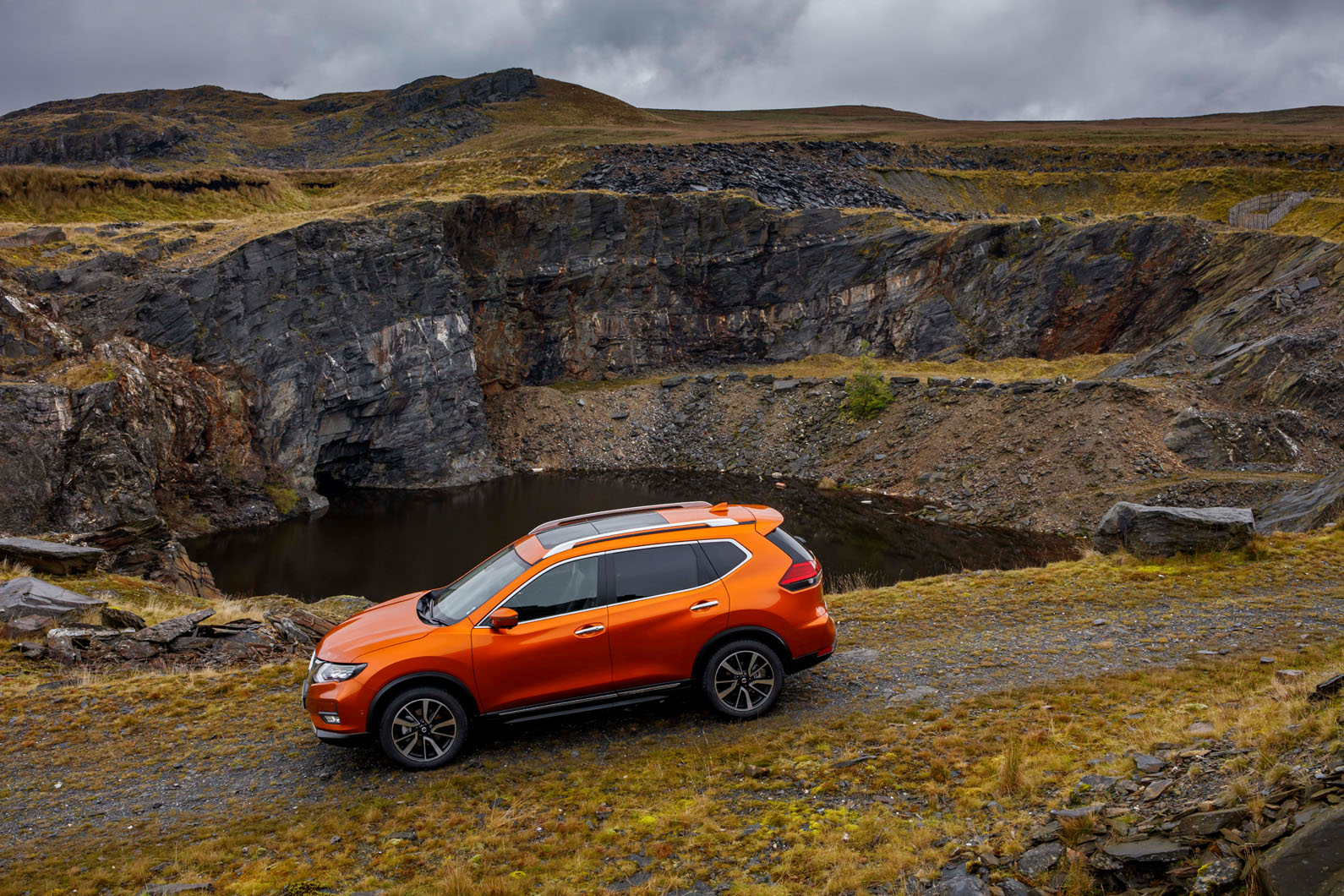
A lot happened in 2010: a volcano erupted; Apple launched the first iPad; Lady Gaga wore a meat dress. It was all going on.
I had a few memorable moments myself, even if I didn’t wear any bacon, get stranded due to Iceland’s geological exuberance or buy one of those newfangled touchscreen laptops that didn’t have a keyboard. They will never catch on…
Anyway, Milton Keynes was the backdrop to one of my most striking memories of that year. Amid the roundabouts and glassy frontages, I walked into a shopping centre to be greeted by a cheerfully bug-eyed, blobby Nissan.
Here began the world’s acquaintance with the electric car. Complete with a heady official range of 124 miles from a 24kWh battery and charging speeds of up to 46kW (if you could find a vanishingly rare DC car charger), the Mk1 Nissan Leaf was the first mainstream, mass-manufactured EV.
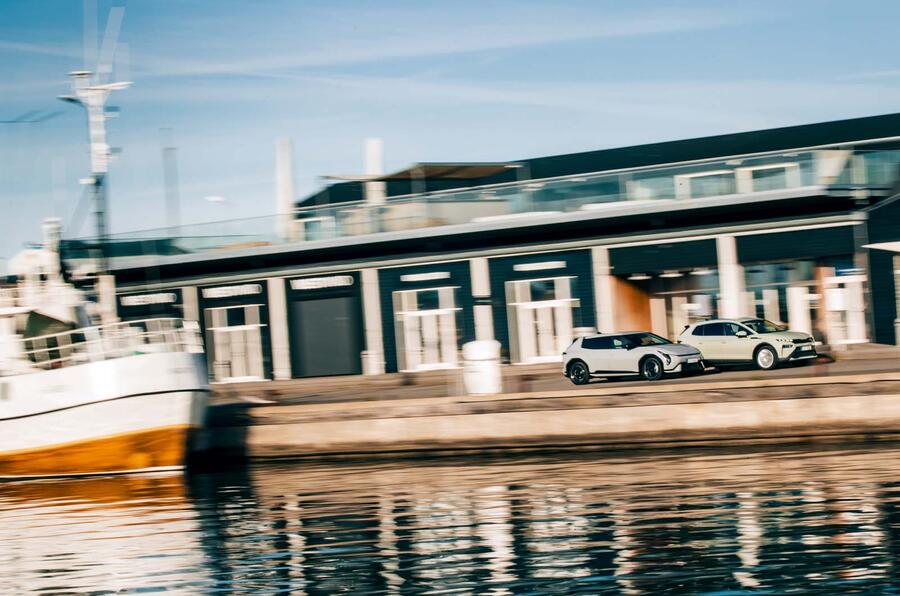
It was an oddity that went on to change the automotive world. Fast forward 15 years and here I am, on a windswept corner of northern Denmark, contemplating the all-new Mk3 Leaf against the backdrop of a UK electric car fleet of 1.6 million and a global electric car fleet of some 60 million.
Clearly, the new Leaf has a very different job to do in 2025 than the original did in 2010. Top of its to-do list is to persuade buyers that it’s better than the other two cars here with us: the Kia EV4 and the Skoda Elroq.
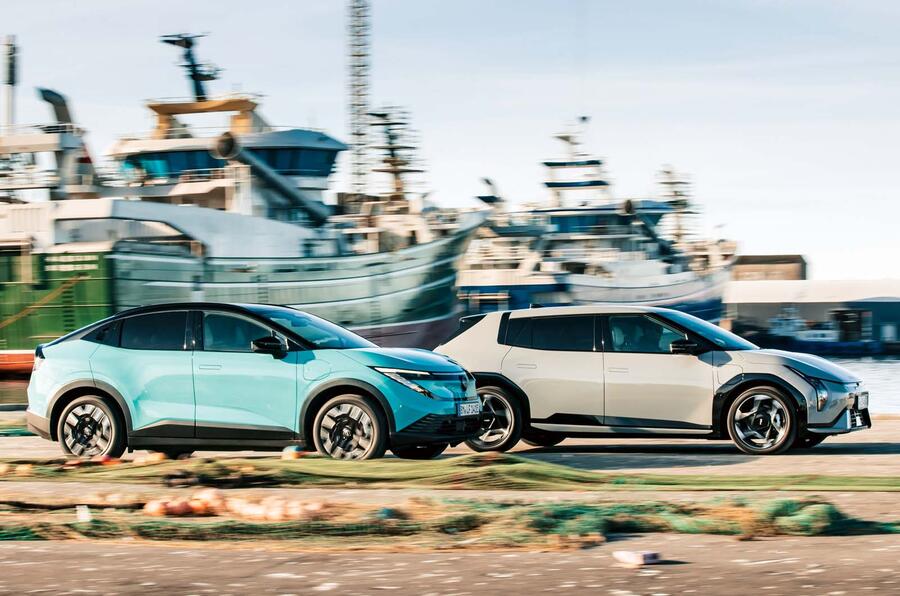
While these cars are all new this year, and deliveries of the Leaf won’t even begin until 2026, the Elroq has already established itself as the one to beat in the C-segment EV class. We gave it a four-and-a-half-star road test verdict for “having no compromise on efficiency, range, drivability or ride comfort”.
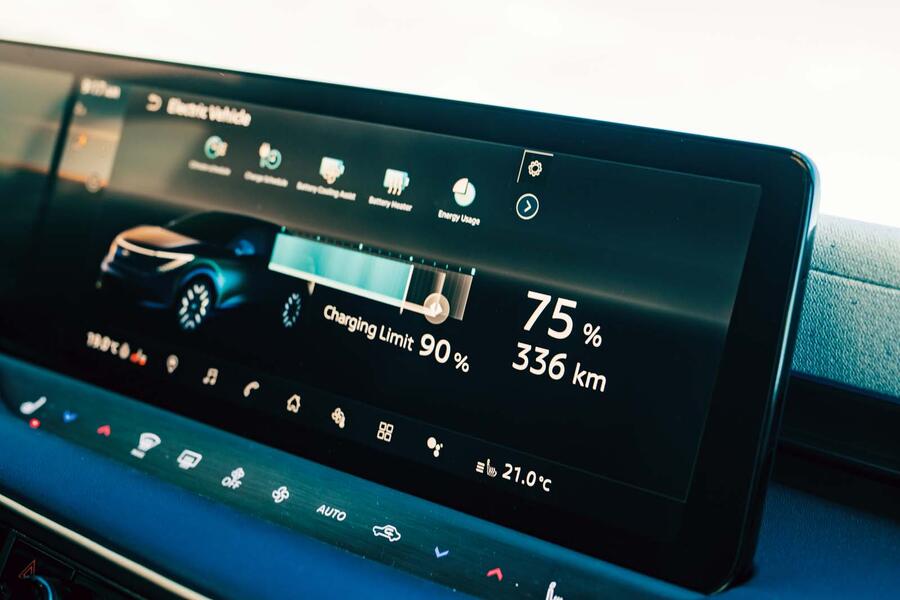
The EV4 and the Leaf have their work cut out, then, but they’re off to a good start, given that both improve on the Elroq 85’s official range of 349 miles. The EV4 manages up to 362 miles, according to the WLTP test cycle, while at 375 miles the Leaf has the longest range of the three, despite having the smallest usable battery capacity.
We should mention that this is an unusual test, given that it is being conducted in Denmark during Car of the Year longlist judging. As such, the Skoda test car is non-UK specification.
At the time of our test, UK pricing and specifications had yet to be announced for the Leaf, but it has since been confirmed to receive a full £3750 discount from the government's Electric Car Grant. That means it starts at £32,249, substantially cheaper than the £37k Elroq (that price including a £1500 grant) and the £39k EV4 (which doesn't recevie a discount).

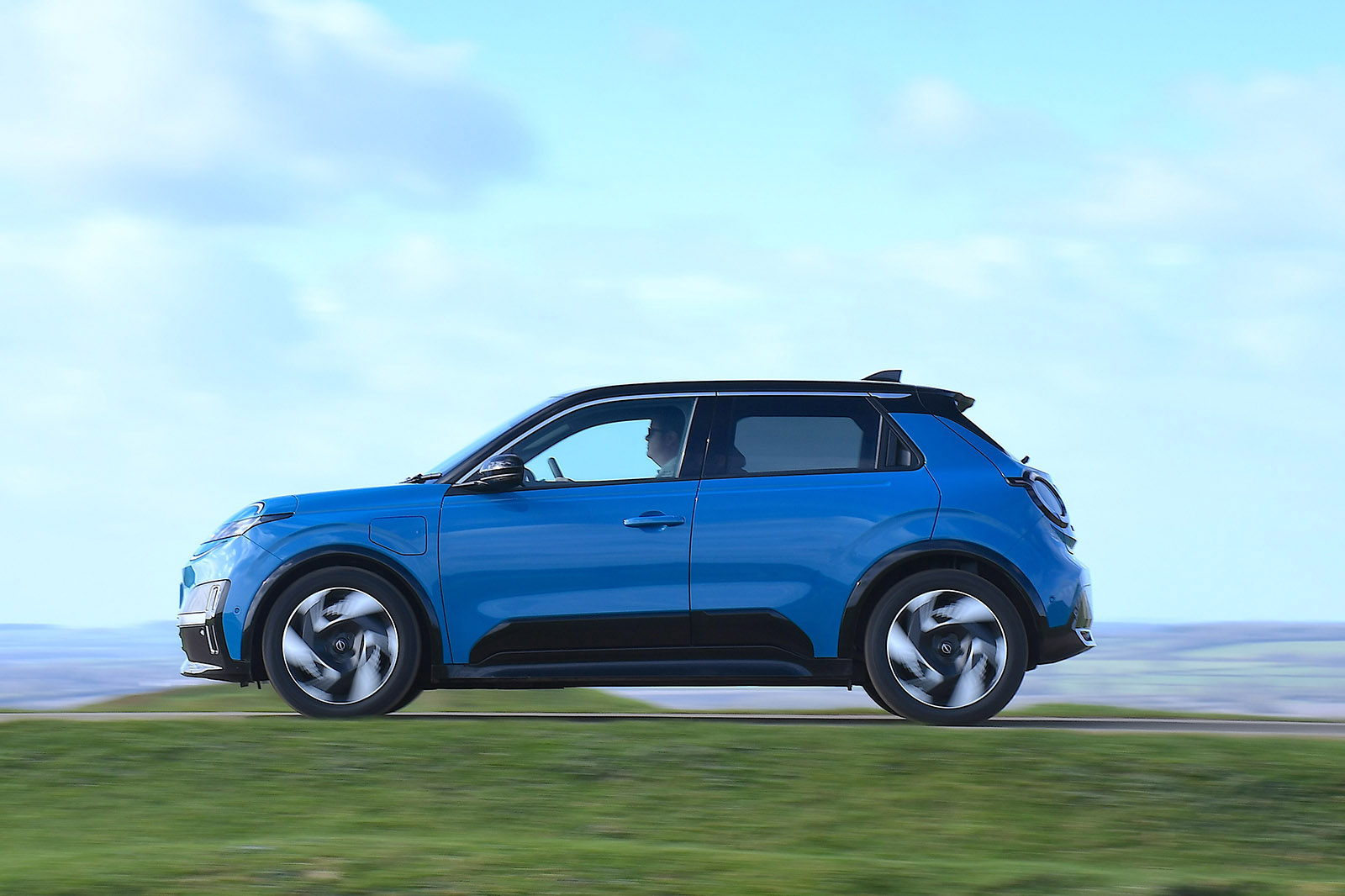
The immediate relief here is that the Nissan doesn’t just feel like a rehashed Renault Megane. Even with the same CMF-EV platform beneath it, the Leaf looks and feels every bit a ‘proper’ Nissan. I mean, is that a hint of 300ZX in the contrasting black panel at the back of the car?
As for how it drives, the Leaf has got a lovely, long-legged attitude as it soaks up the road surface, with the slim-rimmed two-spoke steering wheel allowing some of the road’s texture to reach your fingertips.
There’s no confusing this for something with hot hatch ambitions; it’s the friskier Megane or Cupra Born that you want. Instead, the Nissan eases down the road, feeling supple and controlled over bigger bumps. There is a bit of patter and suspension boom over eroded surfaces, but it’s still tidy and pliant.
Having said all of that, you will probably want to avoid Eco mode, which neuters the throttle response and 214bhp front-mounted electric motor to the point of it feeling like it has just shrugged and given up. Not accelerating at all would, after all, be quite efficient. But it can also result in some buttock clenching if you have assumed a modicum of accelerative response when exiting a junction.
Punch in Standard or Sport modes and the Nissan livens up and flows nicely, tilting keenly into corners so that it feels satisfying if still more comfort-oriented than some others in the class. After all, you do notice its weight moving around; none of these cars are lightweight, of course.
But the Nissan’s suspension travel is progressive and well controlled, without any jarring bump stops. It’s just a very precise and confident car to drive, if a way off outright fun, which matches the airy, tech- and comfort-first attitude of the interior, too. But before we delve into the cabin stuff, let’s talk about the EV4.

Blimey, Kia is on a roll, isn’t it? If the Elroq is the one to beat in this class, the marginally smaller EV4 isn’t far behind it for resounding capability. Let’s just say it: if anything makes you wonder what Nissan has been doing for the past 15 years, it’s Kia’s stratospheric rate of progress.
Do you know what Kia launched in 2010, while Nissan was pioneering the mainstream EV? The Optima. Yup: a bastion of mediocrity, if ever there was one. Yet here we are in 2025 wondering if Nissan (which has launched only one all-electric model since the Leaf, the Ariya mid-sized SUV of 2022) can compete with Kia (which is launching its fourth and fifth EVs in the next few months).
The good news for Nissan is that the Leaf absolutely can compete with the EV4. If anything, the Kia feels even more comfort-focused. If you can learn to love or at least live with the EV4’s droopy nose and blocky surfacing, it’s just as cushy and serene as the Leaf.
In fact, the suspension feels a touch slacker, for a loping stride over most road surfaces. It wallows a bit, but the ease with which it sponges over broken road surfaces – even the cobbles that feature in some of the Danish towns we pass through – is a delight in its own right. The general attitude of capable-yet-comfortable will be spot on for a lot of those considering a new family EV.
Mind you, for all of the EV4’s determined attempts to show its hatchback-ness, the driving position is still fairly high – not at all far off what you get in the crossover-ish Leaf. Both also have similarly narrow rear visibility and will probably make you want a glass roof to lighten things up for anyone sat in the back.
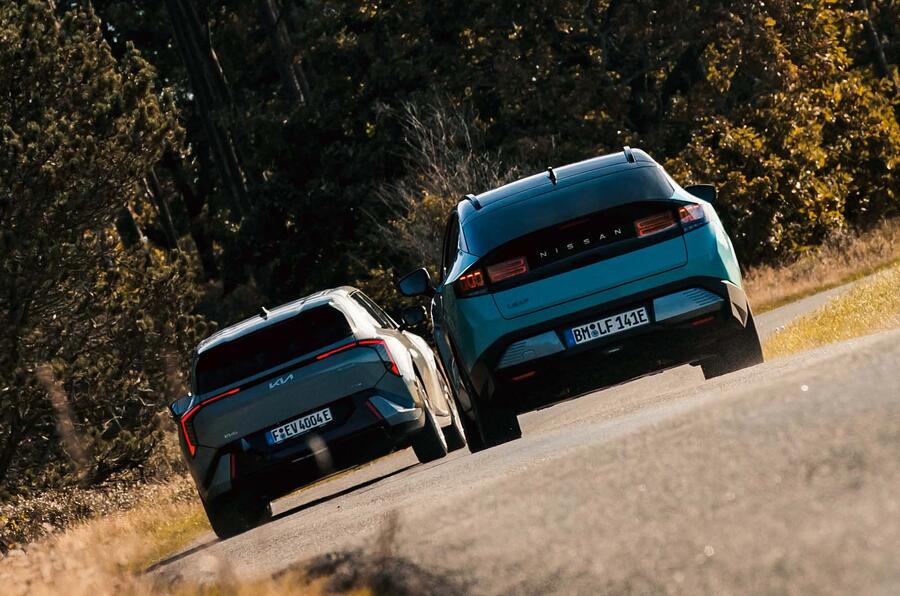
The EV4’s steering is a touch more remote than the Nissan’s. It’s still weighted well enough to be predictable, and with an appropriate wieldiness, but the EV4 always feels like a car that really doesn’t care to be driven briskly at all. It whirs up the road with cheerful eagerness, though, and Kia’s multi-level regenerative braking – which can be tweaked via steering wheel paddles with or without its adaptive function active – remains a benchmark. It’s all absolutely fit for purpose, and you can’t argue with that.
But Autocar has spent the past 130 years talking about how cars can be both comfortable and fun, and the rear-wheel-drive Elroq 85 proves that even your everyday family SUV can still do both.
Despite being the only car of our trio with a kerb weight in excess of two tonnes, the Skoda feels lighter on its feet than the other two. Its greater power and gutsier 6.5sec 0-62mph time are part of that, but it’s more about the better control weights, pleasantly tuned steering and rather brilliantly controlled suspension, all of which combine to make the Skoda feel slightly more on its toes than the others here.
Yes, I said it, and I’m not the only tester out here to think so: the closest thing to an SUV in this test is the nicest car to drive. Sorry about that.
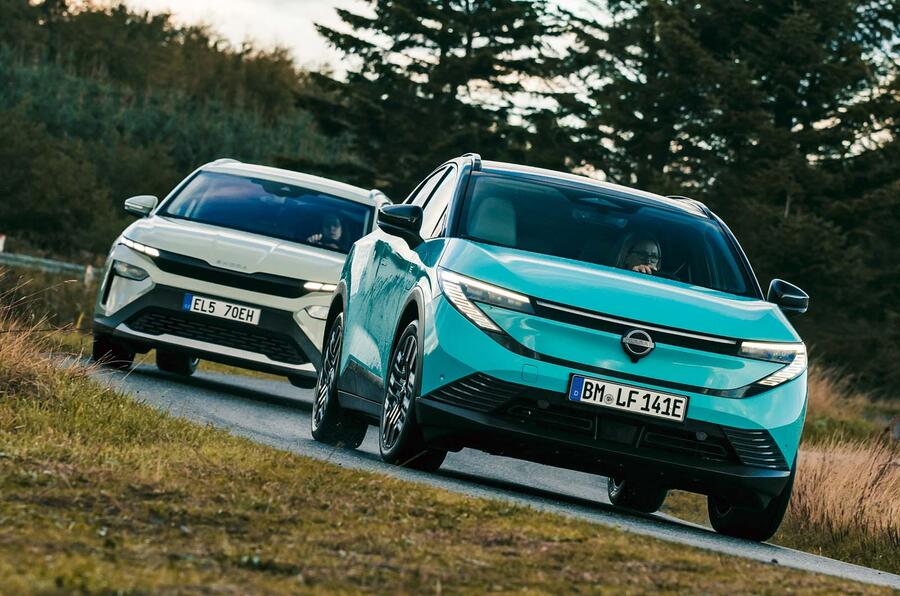
Perhaps a less gaspingly scandalous statement is that the Skoda is also the more practical, if not by a huge margin. Chiefly, it’s the fact that the Elroq offers a surprisingly low load lip and a spacious 470-litre boot, not to mention the best head room here for rear passengers.
The Kia and Nissan get a very serviceable 435 and 437 litres respectively, but both have surprisingly high load lips – particularly annoying given that you would assume the hatchback status would mean a lower one. Clearly the design departments won that argument… At least the Nissan gets a clever two-part, split boot floor that can be used to conceal your cable, as well as to separate the space and better secure the groceries after the big shop.
Less impressive is the Nissan’s rear passenger space. Slide into the back of the Kia and Skoda and you will find masses of leg and head room. By contrast, the Nissan’s roofline tapers enough to make taller adults feel a bit hemmed in, and leg room is also tighter than in the others. It will still be a very fine family car, but there’s no doubt that the Nissan is the least roomy compared with the high standards set by the other two EVs here.
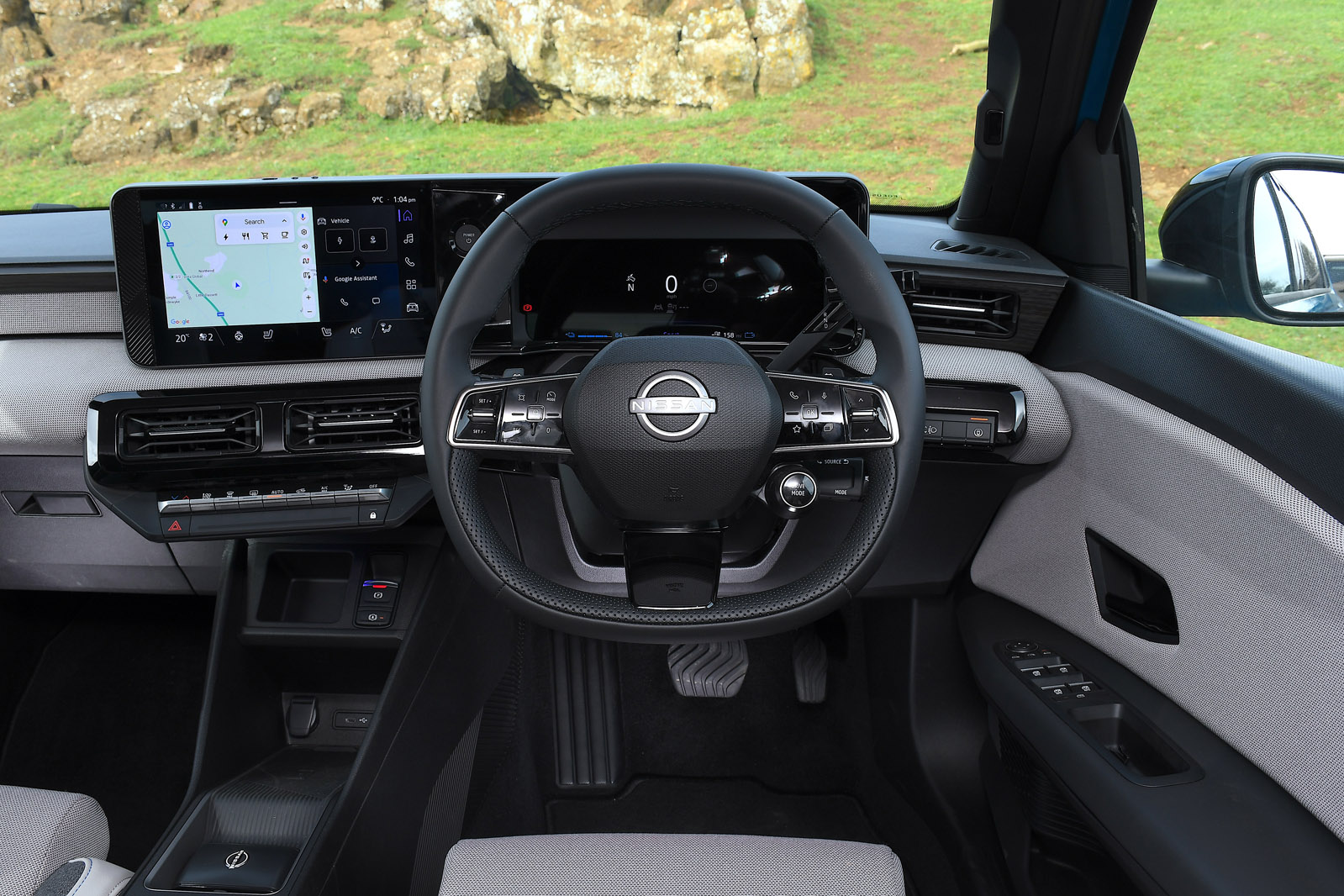
Up front, the Nissan does stand out with its textured white cloth inserts and purple leatherette dash. Yes, that’s right: purple. Don’t get me wrong, your Leaf interior isn’t going to make you think of Cadbury’s chocolate or Prince songs, but it’s still definitely a dark purple.
Overall, it’s a refreshingly bright, interesting blend of finishes, although I can see why some might prefer the more understated greys and monotones of the Kia – and especially the Skoda with its lovely, tactile textiles.
Sticking with the Nissan, the infotainment is good, not least as the shelf beneath the touchscreen makes the perfect wrist rest for more accurate prodding. Touch-sensitive shortcut buttons are an easy way of changing the temperature as well.
The EV4’s infotainment system is much the same as what we have seen in other Kias, and that’s no bad thing. It’s the most intuitive of all of these systems, although the weird air-con screen that’s hidden by the steering wheel is unnecessary.
Even so, all of the infotainment systems here are reasonably easy to use with a bit of familiarity, and all offer configurable shortcuts. Just mind out for that touch-sensitive volume bar that lurks at the bottom of the Skoda’s screen, ready to wake the baby up when you accidentally hit max volume when all you wanted was the air to be a degree cooler…
Other than that, all these high-spec test cars have the essential features, including navigation with a charger search function, wireless Apple CarPlay and Android Auto and over-the-air software updates.
The Nissan comes out of this test very well. It’s peachy to drive, with a bit more delicacy and involvement than the Kia, yet delivers a similar level of serenity and comfort. Its weakness chiefly concerns the more restricted passenger space, but otherwise it’s an oddly charming car.
It deserves to do well, not only because of its British-built status but also because it is a genuinely well-rounded and very capable electric crossover that has flashes of the ingenuity and creativity that Nissan is well known for. Is it the best here? Probably not.
While I would personally take the Nissan over the Kia (being able to tell everyone that my car has a purple interior is reason enough, surely), the EV4’s long, seven-year warranty and roomier cabin are hugely persuasive selling points.
But it is the Skoda that takes the win. It proved the most efficient of the three for real-world range, is the best to drive, is the most practical and remains a routinely brilliant all-rounder that few others in the class can compete with.
Submitted by dev_editor on