Currently reading: Ford to use Renault platform for two affordable EVs in Europe

Ford taps Renault 5 platform as basis for a pair of entry-level EVs, including a Fiesta replacement in 2028

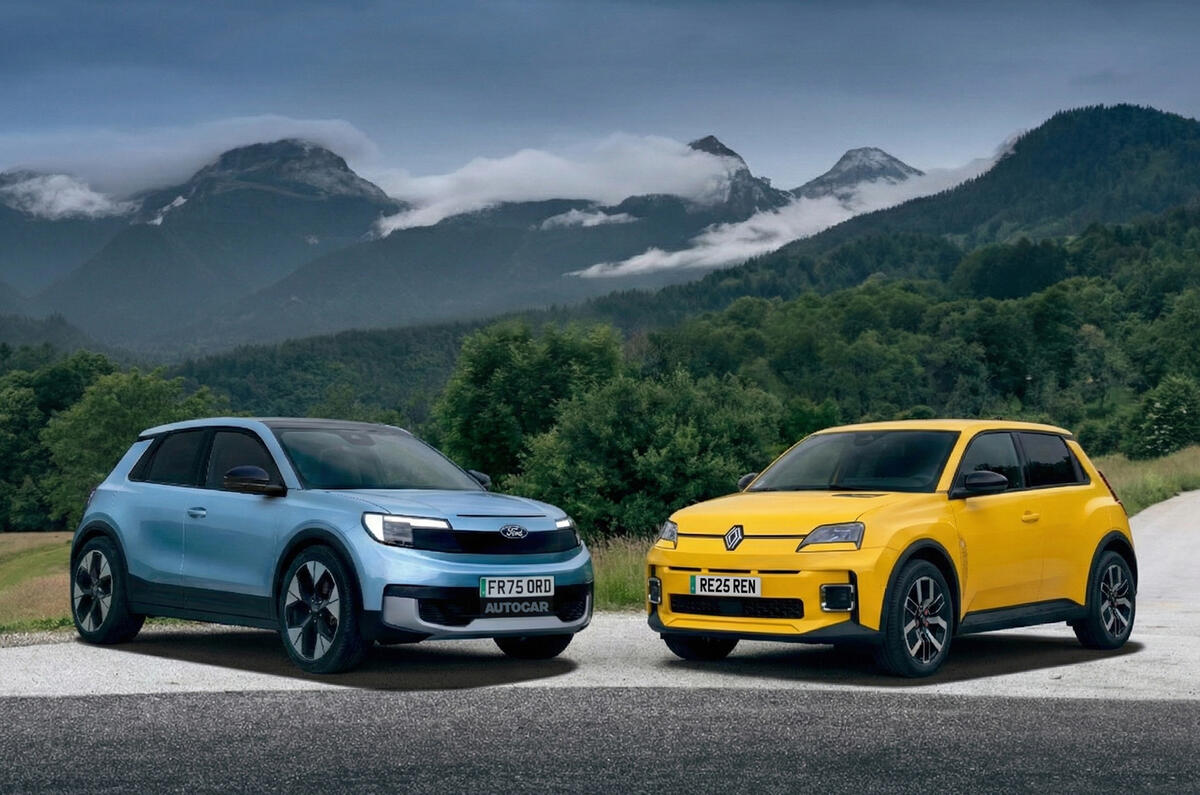
Ford has announced a landmark strategic partnership with Renault, setting it up to launch at least two new electric cars based on the French firm’s Ampr EV platform - including a Fiesta successor.

The first of these new “affordable” EVs will arrive in early 2028 and is expected to be a successor to Ford’s hugely popular supermini, closely related to the Renault 5 and built alongside it at the ElectriCity complex in Douai, France.

The second Ampr-based Ford EV is expected to be a small electric crossover derived from the Renault 4, which could replace the Puma Gen-E, but no timeframes or specific details for this car have yet been given.

Unlike the Nissan Micra, which is effectively a rebadged 5, Ford’s small EVs will be highly bespoke propositions, with the company pledging they will be “distinct Ford-branded electric vehicles” designed entirely in-house.

They will also “feature distinctive driving dynamics”, the American company said, with “authentic Ford-brand DNA and intuitive experiences”.

Otherwise, though, the new Ford EVs are likely to share most of the Renaults’ hardware, which means a motor on the front axle producing between 121bhp and 215bhp, depending on spec, and a choice of a 40kWh or 52kWh battery – which by 2028 will have been swapped from NMC chemistry to more cost-efficient LFP.

The supermini that comes first will take Ford back into a segment from which it has been absent since retiring the Fiesta – after eight generations and nearly half a century – in 2023 to make way for production of the Explorer and Capri electric SUVs at its factory in Cologne, Germany.

Ford has previously suggested it could return to the affordable supermini market as part of a plan to rebuild its market share in Europe (from a record high of around 12%, it currently has less than 4%) and compensate for lower-than-expected demand for its much more expensive electric crossovers.

Sales of the Capri and Explorer have been so slow that Ford was recently forced to cut up to 1000 jobs at Cologne and take the site down to a single-shift production pattern - having already reversed its decision to go all-electric in Europe by 2030 in light of the region’s EV uptake severely lagging earlier forecasts.

With Focus production having ended last month, Ford's car line-up in Europe is now composed almost exclusively of SUVs and MPVs based on different versions of the Transit van - and with prices starting at more than £26k, it's much more expensive on average than at any point in the firm's long history.

Back to top

Bringing back a Fiesta-sized model – presumably at a similar price to the £22k Renault on which it's based - will be crucial in restoring the brand to true mainstream status and helping it claw back the market share it's lost as a result of its shift upmarket - and doing so in the most cost-effective way possible, saving substantially on new model development. 

The new tie-up with Renault is Ford’s second such arrangement in Europe, the company having already used Volkswagen’s MEB architecture for the Capri and Explorer. The German firm's smaller MEB Entry platform – as used for the upcoming ID Polo and ID Cross – had been seen as a likely basis for a reborn Fiesta but was ultimately usurped by Renault's more cost-effective Ampr platform.

Ford’s strategic partnership with Volkswagen extends to commercial vehicles, with Ford building the Amarok pick-up and Transporter van in return, and its new arrangement with Renault extends to LCVs too.

No details have been given, however, beyond the confirmation that the two companies “will explore the opportunity to collaborate” in this area, with the potential to sell Ford- and Renault-badged versions of the same vans.

Ford CEO Jim Farley said: “The strategic partnership with Renault Group marks an important step for Ford and supports our strategy to build a highly efficient and fit-for-the-future business in Europe.

“We will combine Renault Group’s industrial scale and EV assets with Ford’s iconic design and driving dynamics to create vehicles that are fun, capable and distinctly Ford in spirit.”

His counterpart at the Renault Group, François Provost, hailed the agreement as a demonstration of “the strength of our partnership knowhow and competitiveness in Europe”.

The news comes as EU law makers mull delaying a ban on new ICE car sales from 2035 to 2040, in line with adjusted EV adoption forecasts – a move that Farley has said would be crucial to the survival of the region's car industry.

Back to top

Writing in the Financial Times earlier this week, Farley said the current framework for decarbonising the European car parc is "out of step with market reality".

He also attacked the UK's new pay-per-mile tax on EVs and PHEVs as another example of a counterintuitive measure, comparing it to having "one foot on the gas, one on the brake".

"We urgently need a regulatory framework for Europe that provides a realistic and reliable 10-year planning horizon," Farley wrote, adding that today's carbon mandates and mandatory electrification timelines are "decoupled from the reality of consumer demand" - and especially inhibitive in light of the influx of "state-subsidised EV imports from China, structurally designed to undercut European labour and manufacturing".

He called on EU law makers to recognise the juxtaposition between regulation and reality (EVs currently account for 16% of European car sales, well below Brussels' mandated 25% share for this year) and to implement an "urgent reset" to avoid Europe becoming "a museum of 20th-century manufacturing".

Join our WhatsApp community and be the first to read about the latest news and reviews wowing the car world. Our community is the best, easiest and most direct place to tap into the minds of Autocar, and if you join you’ll also be treated to unique WhatsApp content. You can leave at any time after joining - check our full privacy policy here.

Felix Page

Felix Page
Title: Deputy editor

Felix is Autocar's deputy editor, responsible for leading the brand's agenda-shaping coverage across all facets of the global automotive industry - both in print and online.

He has interviewed the most powerful and widely respected people in motoring, covered the reveals and launches of today's most important cars, and broken some of the biggest automotive stories of the last few years. 

Join the debate

Comments
3
Add a comment…
scrap 9 December 2025

If this just turns out like the Micra, what's the point?

Ford reduced to a finance deal and the convenience of your local dealer.

On the latter point, Ford has always had a strong presence in the UK, but how many of their dealers can afford to stay open? Their sales have absolutely tanked. 

FastRenaultFan 9 December 2025
Ha. Oh how Ironic. How the mighty Ford has fallen. Haven to go to VW and now Renault for platforms and the only real cars it has not selling because they are a half baked attempt.

I just hope that Renault are not given the platforms away to Ford and make sure they make some profit from it.

Ironic too that next year Ford will be in F1. This will either be good or bad for them depending on how there partnership with Red Bull goes and how the engine does. If its good it might help lift Fords profile but if its bad it could destroy it and makes Fords European recovery even harder.

Thekrankis 9 December 2025
How are the mighty fallen.

Fords European strategy has been an absolute disaster.

At least Ford are going to base these new cars on a decent Renault unlike their bloated VW lash ups.

It may still be too little too late.