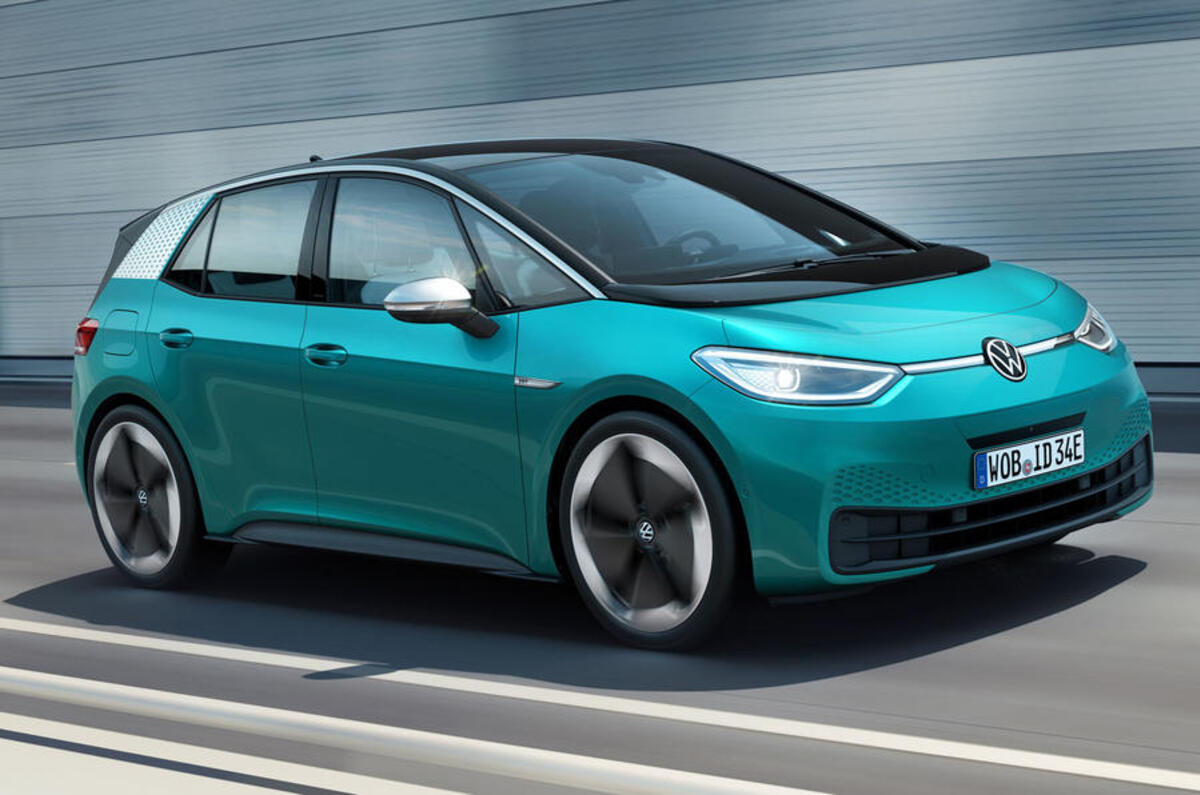

Volkswagen design chief Klaus Bischoff believes the freedom offered by electric technology means it would have been “the wrong decision” to develop vehicles with multiple powertrains rather than bespoke EVs such as the firm’s forthcoming ID 3.
The Volkswagen Group has developed the MEB platform as a dedicated electric architecture, which will be used for a range of ID-branded electric Volkswagens that will sit alongside its existing combustion-engined models. Sibling firms Audi, Seat and Skoda will also offer dedicated EVs built on the MEB platform.
By contrast, several of the VW Group’s major rivals, including the PSA Group, BMW and Volvo, have developed platforms that enable cars to be offered with multiple powertrains. For example, the Peugeot 208 and Volvo XC40 will be offered with pure-combustion, hybrid and full-electric variants.
Asked why Volkswagen has chosen to develop a separate range of EVs, Bischoff said electric technology offered “a lifetime chance to create a new user experience and design expression”.
He added: “The new architecture that electric vehicles offer gives designers the chance to come up with an entirely new design approach. We’re aiming for develop something that gives customers big advantages: a small footprint, big interior and fully digital architecture.
“To keep [an electric car] in the traditional space would have been the wrong decision.
"There is more freedom [with a bespoke EV] because the car’s architecture volume and proportions are different. With the internal combustion engine out of the game, you can really move the proportions and bodystyles and you have a lot more flexibility, particularly in terms of interior design."
Despite the greater design freedom afforded to electric vehicles by the absence of a large combustion engine, Bischoff said car designers needed to be careful not to go too radical, so they don't alienate potential buyers who are still adjusting to electric cars.
“We are on this journey together,” he said. “If you go too far outside and go into a field of design that’s different but not balanced or stylistic, then you can lose customers. You need to go brave, but do it step by step."
READ MORE
Autocar's Volkswagen ID 3 review