From £27,4956

Britain’s market-leading small EV gets a mid-life refresh with a new face, upgraded kit and bigger battery option

The early bird may well catch a few worms but, sooner or later, its becomes old news. That, in a nutshell, is what's happened to the Vauxhall Corsa Electric since it became one of the first superminis to launch in electrified form back in 2020.

It was the future, once - and led the ranks as those early adopters found their way into first-wave EVs. So is it now chopped liver? Not, predicatably enough, if Vauxhall can help it.

Having facelifted, refined and improved the car in 2023, the company has now boosted its value proposition further via a special edition called the Corsa Yes. As we'll go on to explain, this doesn't allow the car to keep up with newer, more fashionable rivals such as the Renault 5, Volkswagen ID Polo or Cupra Raval, some of which now qualify in full for the UK treasury's Electric Car Grant; nor quite to keep pace with the very cheapest opposition from emerging far eastern brands. But it does sweeten and improve a product offering that was good enough to have made the Corsa Electric one of Britain's best-selling small EVs for a while, towards the beginning of this decade.

Back then, it was also no mean feat for Vauxhall to have punched such a neat hole through the resistance of established competitors such as the Renault Zoe and BMW i3; to have beaten back fresher challengers such as the Mini Electric, Honda E and Mazda MX-30; and even to have scalped in-house relation the Peugeot e-208, in order to score that result.

Vauxhall's extensive dealer network will have had plenty to do with its success, of course. But what no doubt also helped was that this car, by its nature, is a simpler and more familiar kind of EV than some, designed and intended very much to make the switch to electric motoring easy. It isn’t a particularly quirky or different – and, as we’ll explain, it doesn’t look particularly alternative, doesn’t offer myriad, oddly titled trim levels, and doesn't come made of a host of recycled materials. 

Advertisement
Back to top

This is just a small, simple, usable electric car with a real-world range that might just suit your purposes, and very few airs or graces besides.

DESIGN & STYLING

7
Vauxhall Corsa Electric 002

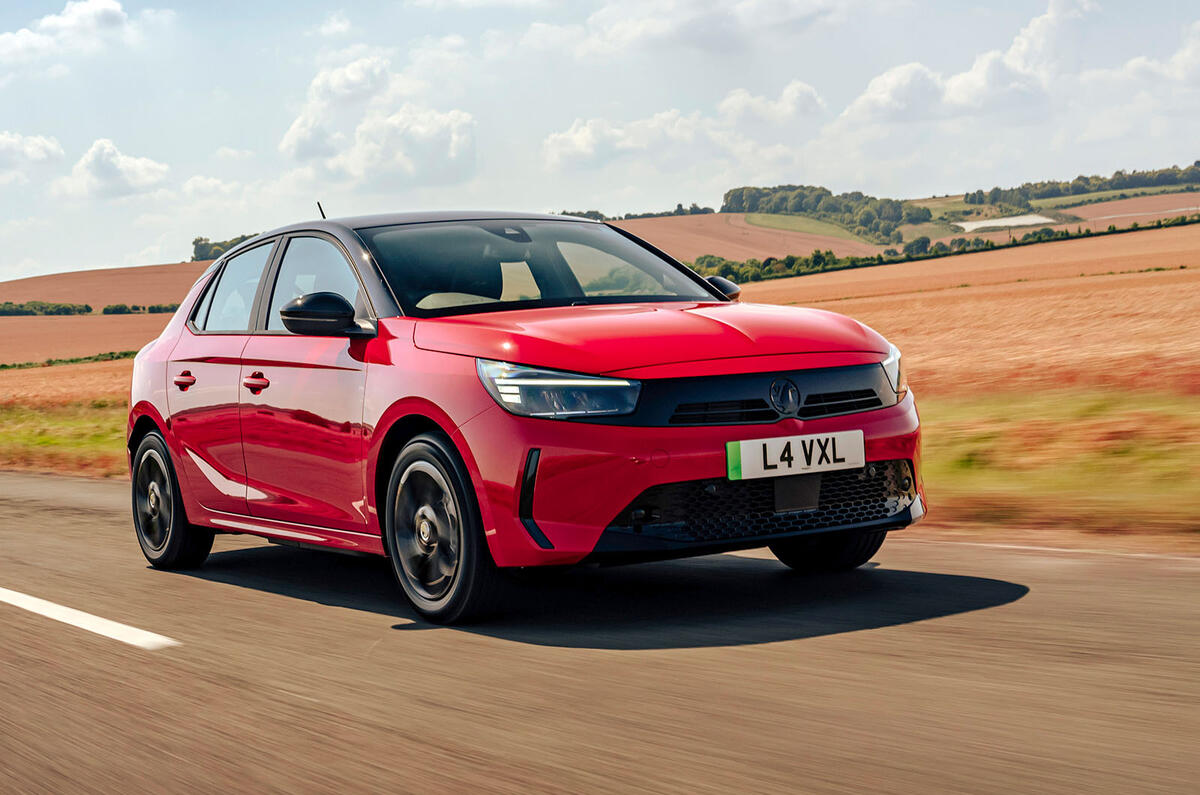
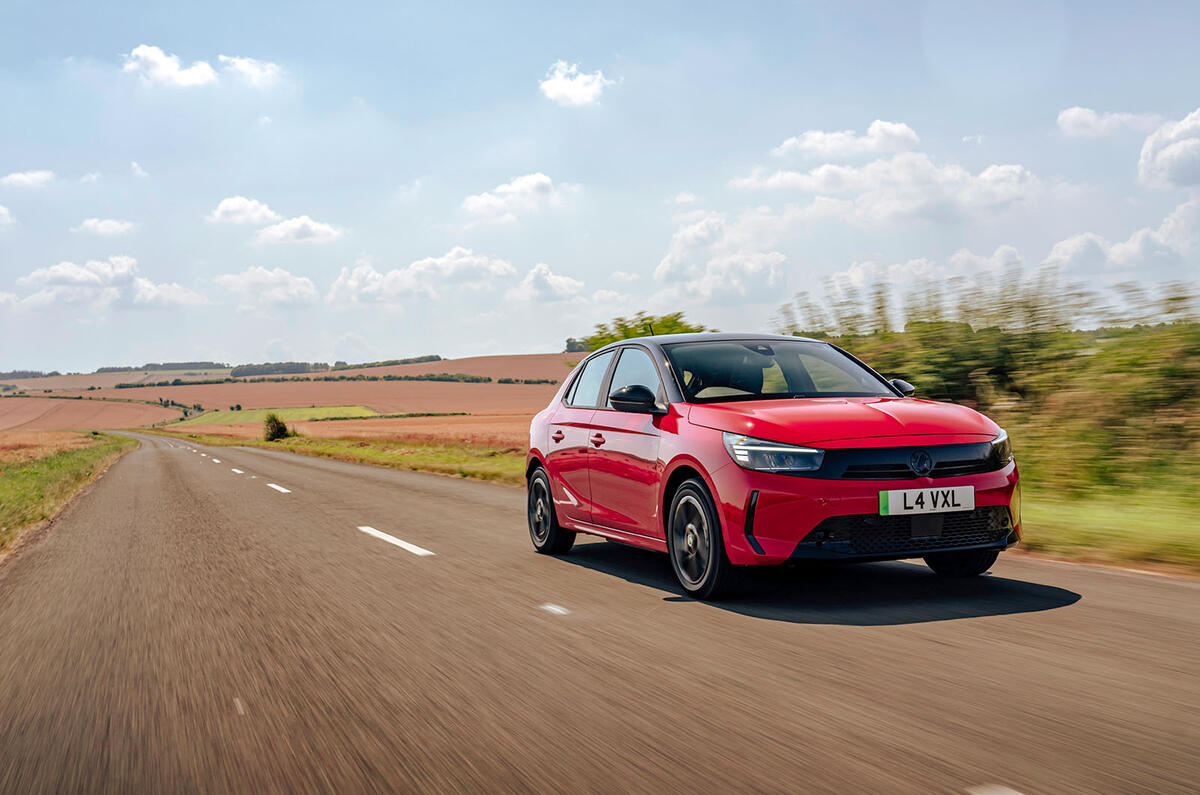
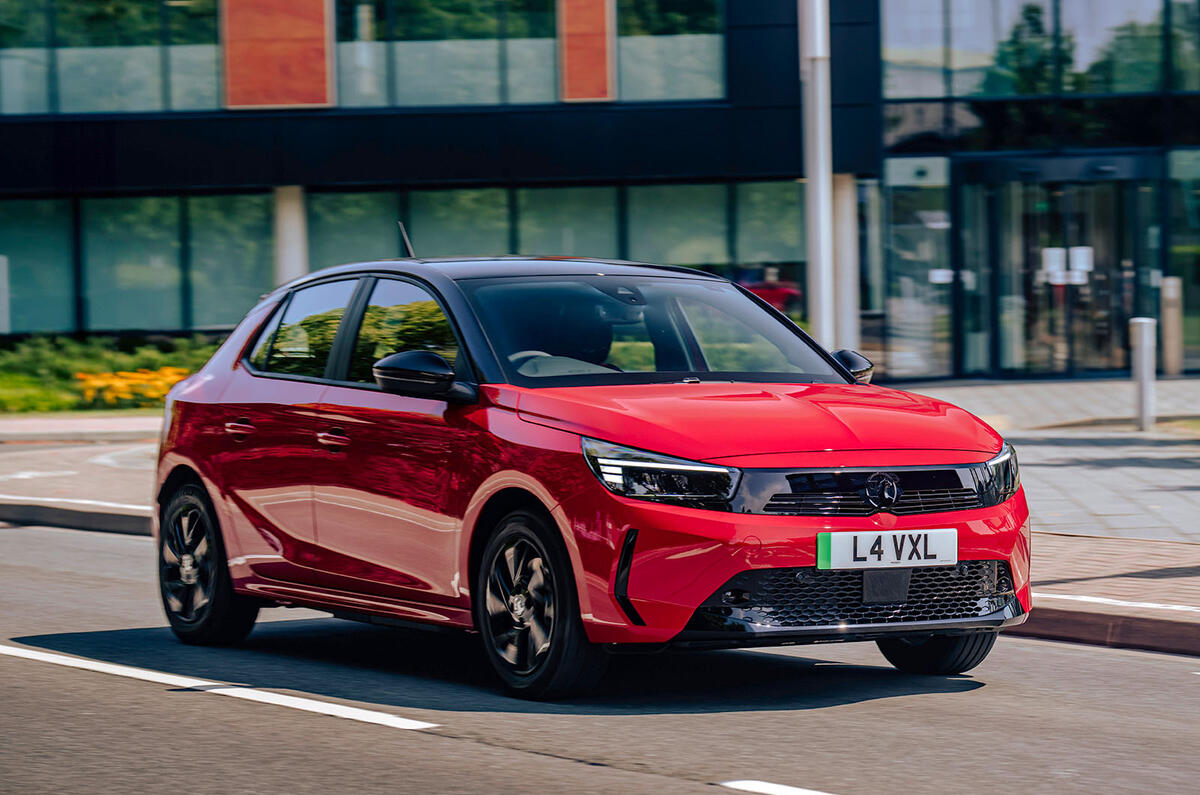
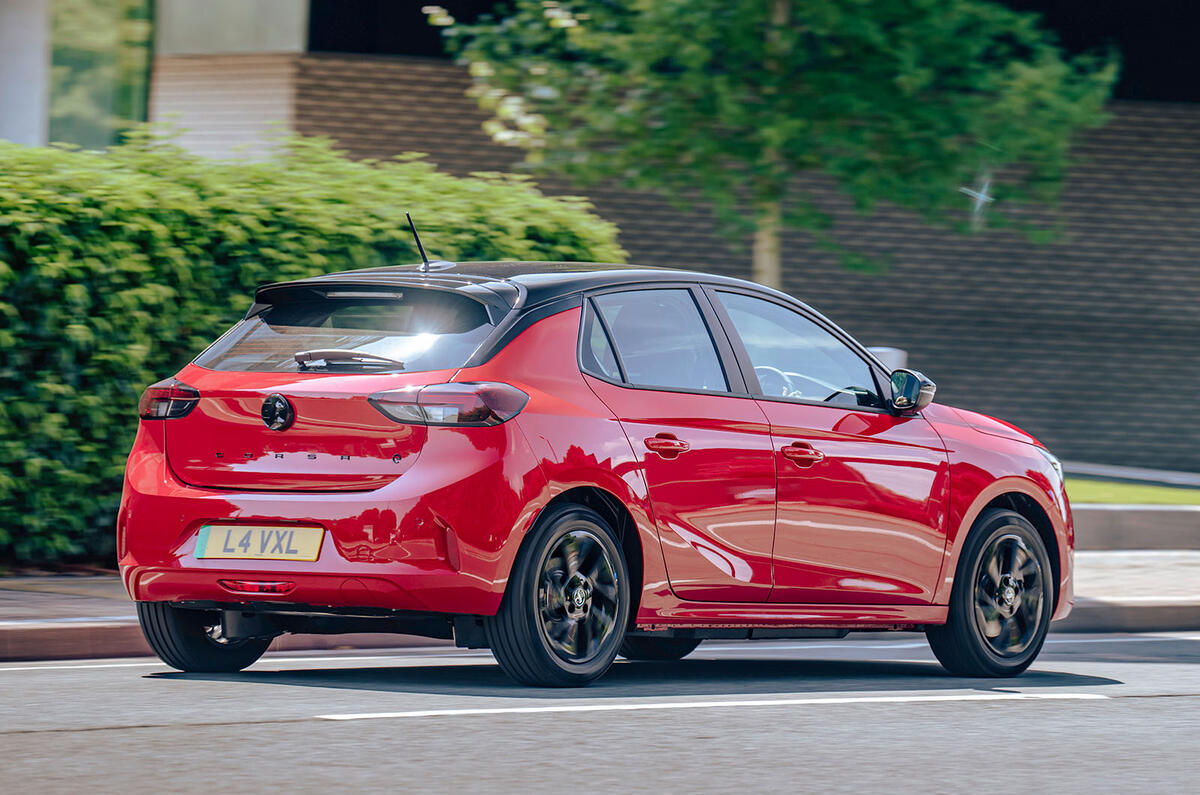
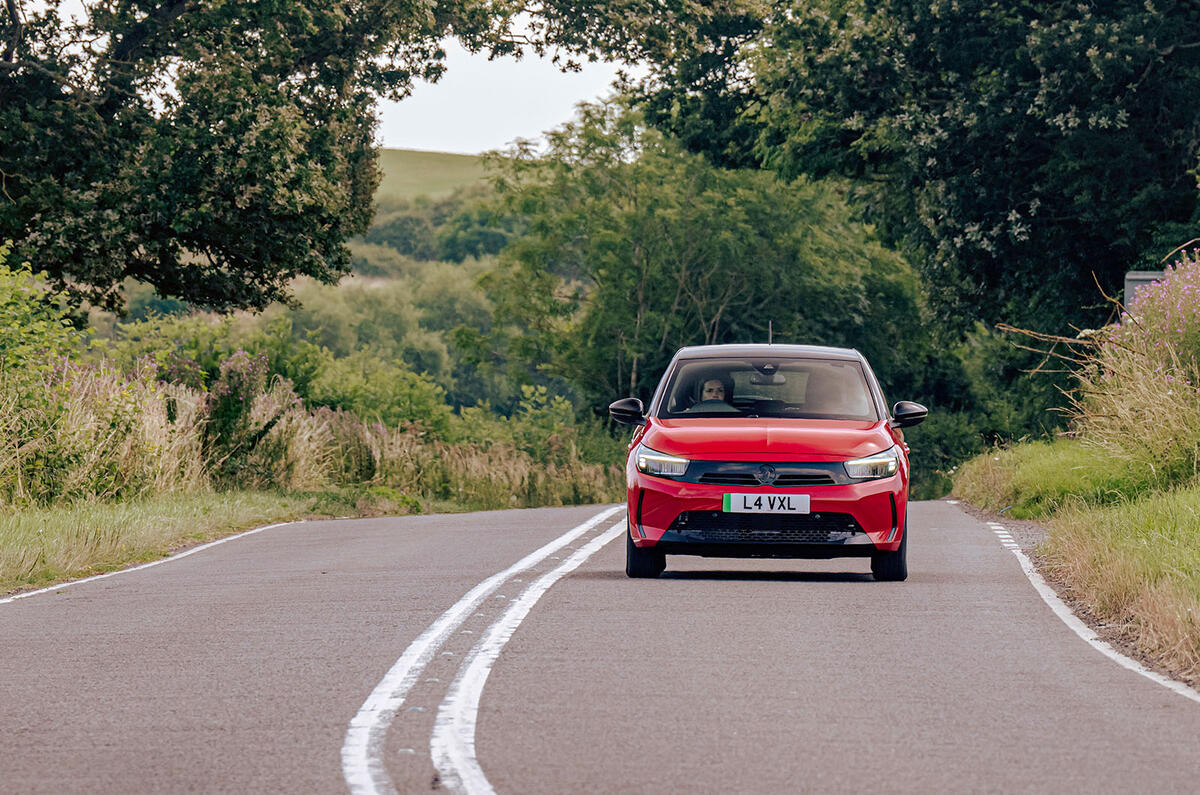
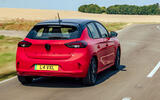
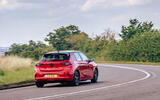
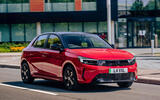
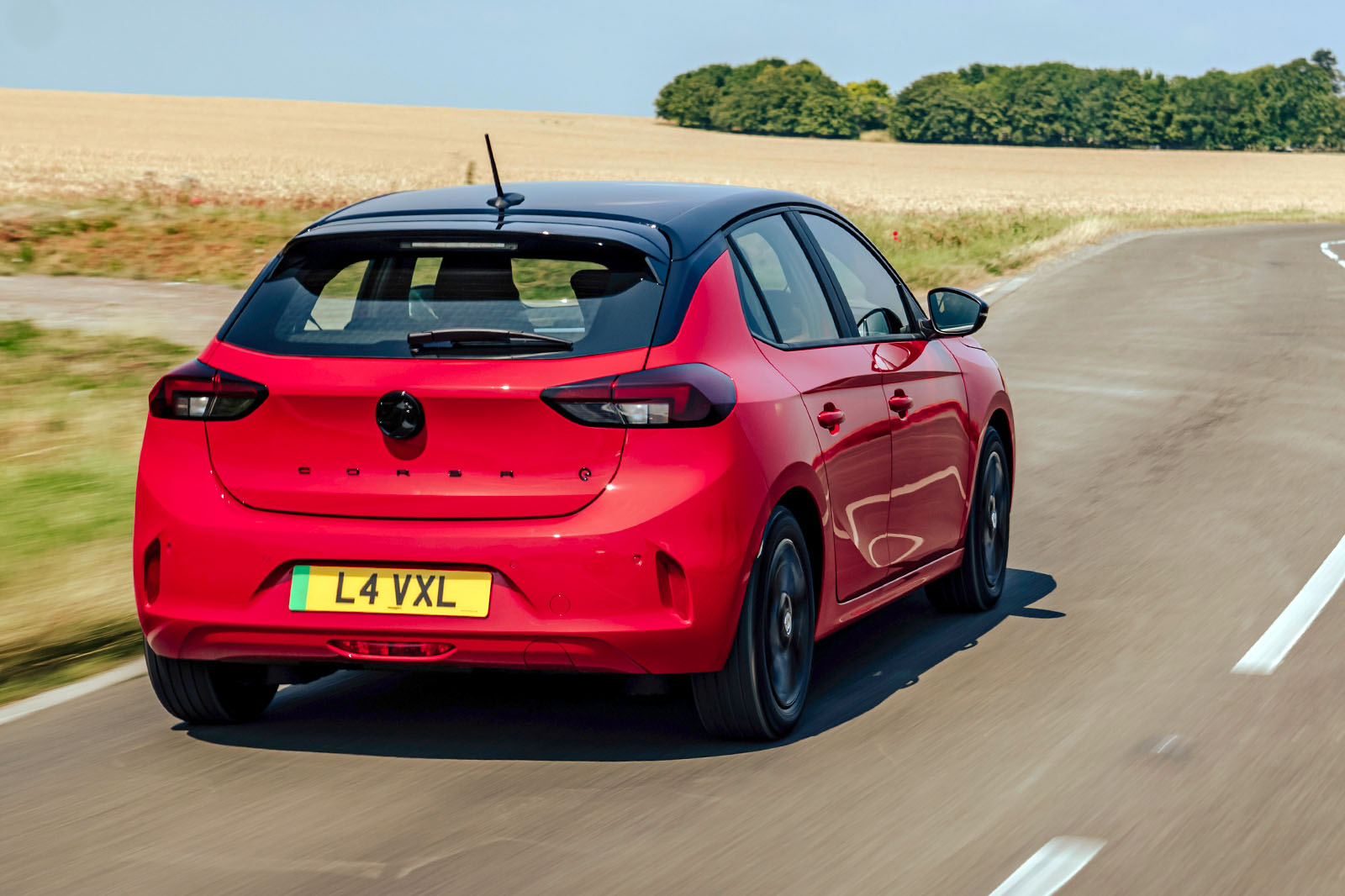
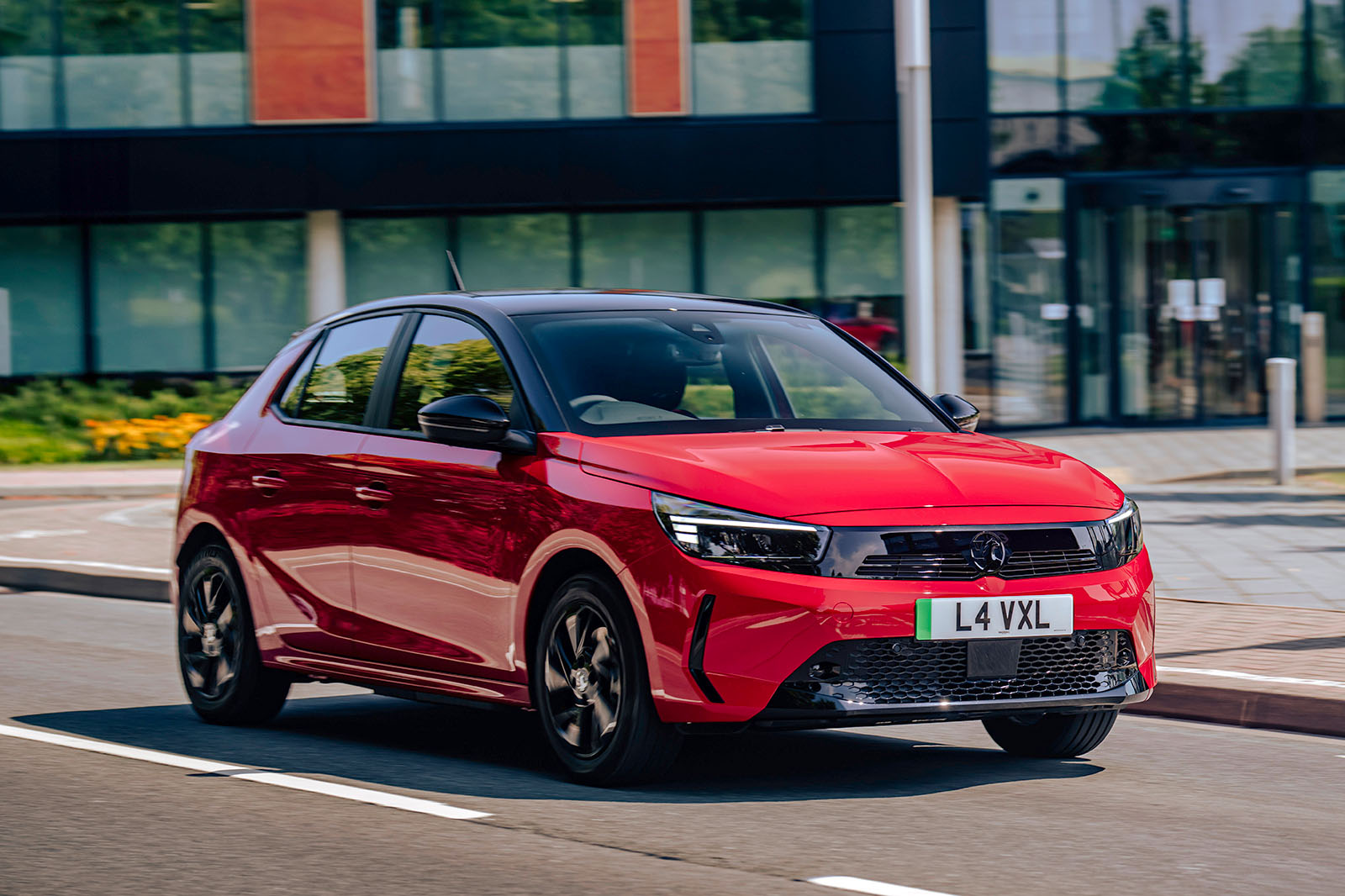
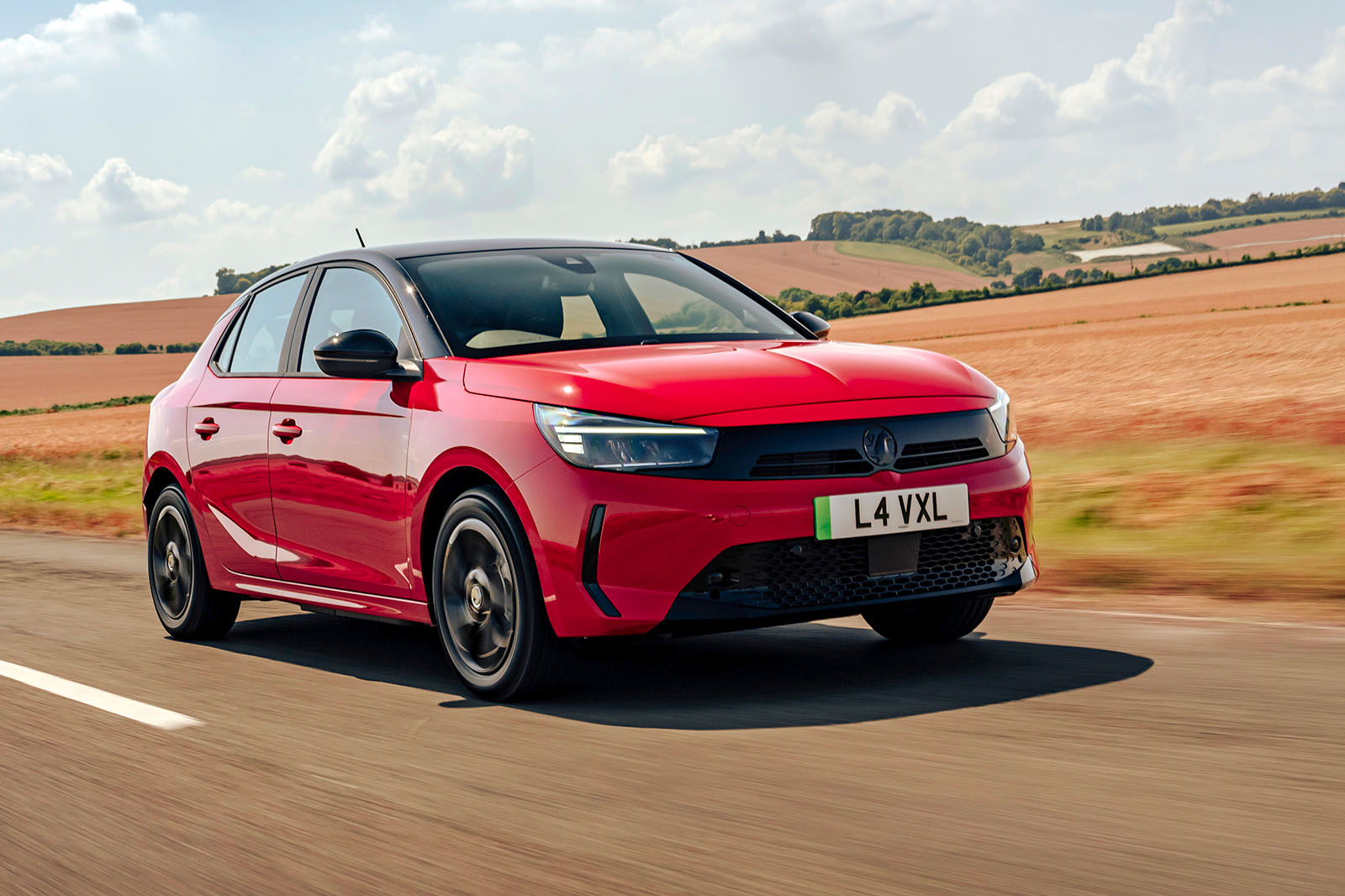
That fresh face was probably the most dramatic – and welcome – change to come as part of the Corsa’s mid-life refresh in 2023. The supermini became the final model in the Vauxhall range to be fitted with the brand’s 'Vizor' fascia: a black grille panel that replaces the model’s old front end, and brings it into line with the rest of the British brand’s model range. The Vizor originally made its debut on the Vauxhall Mokka.

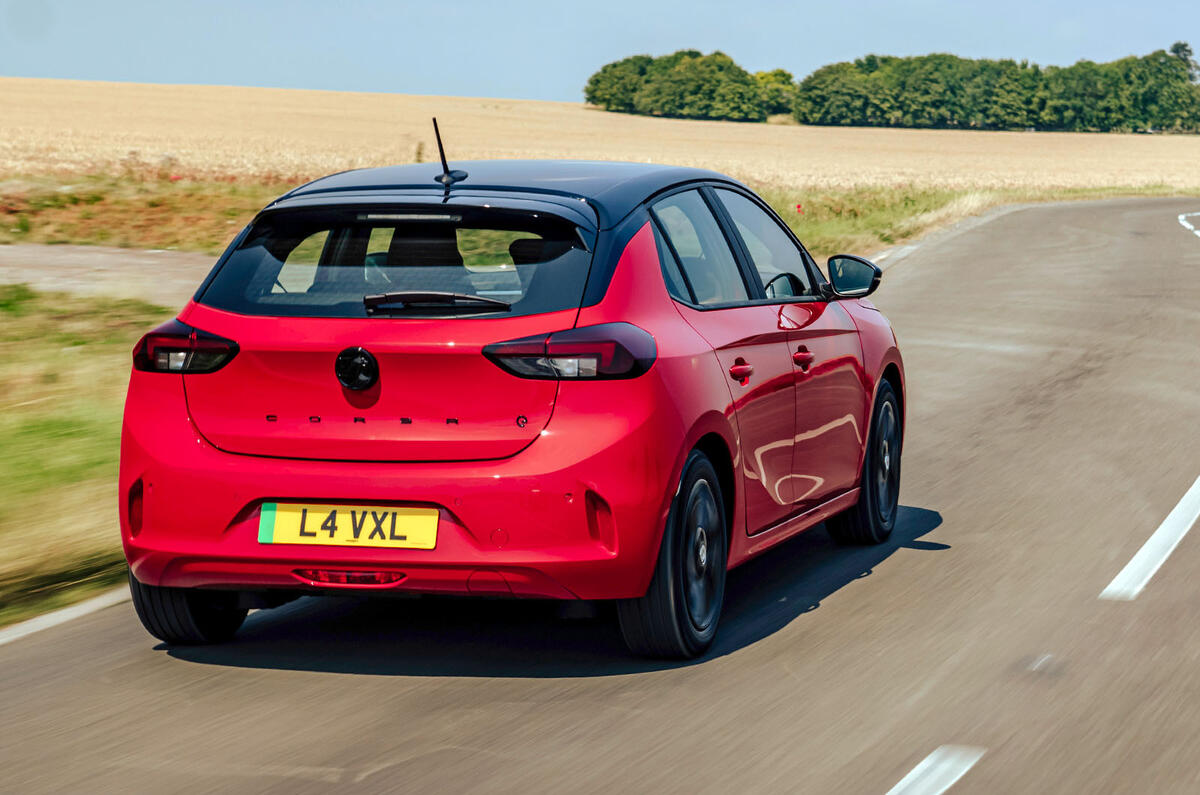
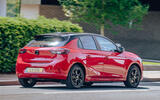
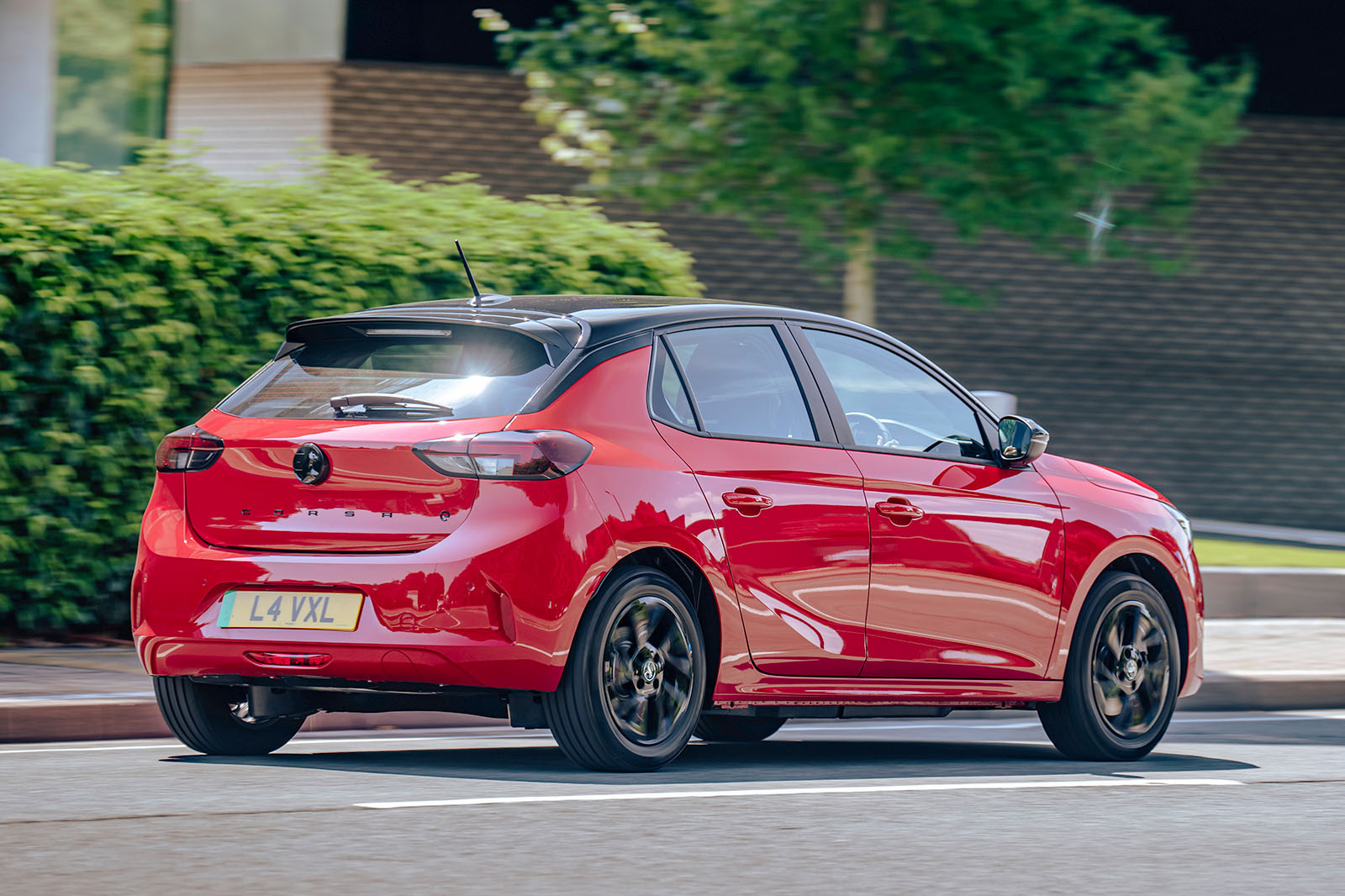
That new face came coupled with new LED lights (standard across the range), and some fresh ‘Corsa’ lettering at the rear, and made a reasonable impact in lifting the car's exterior design.

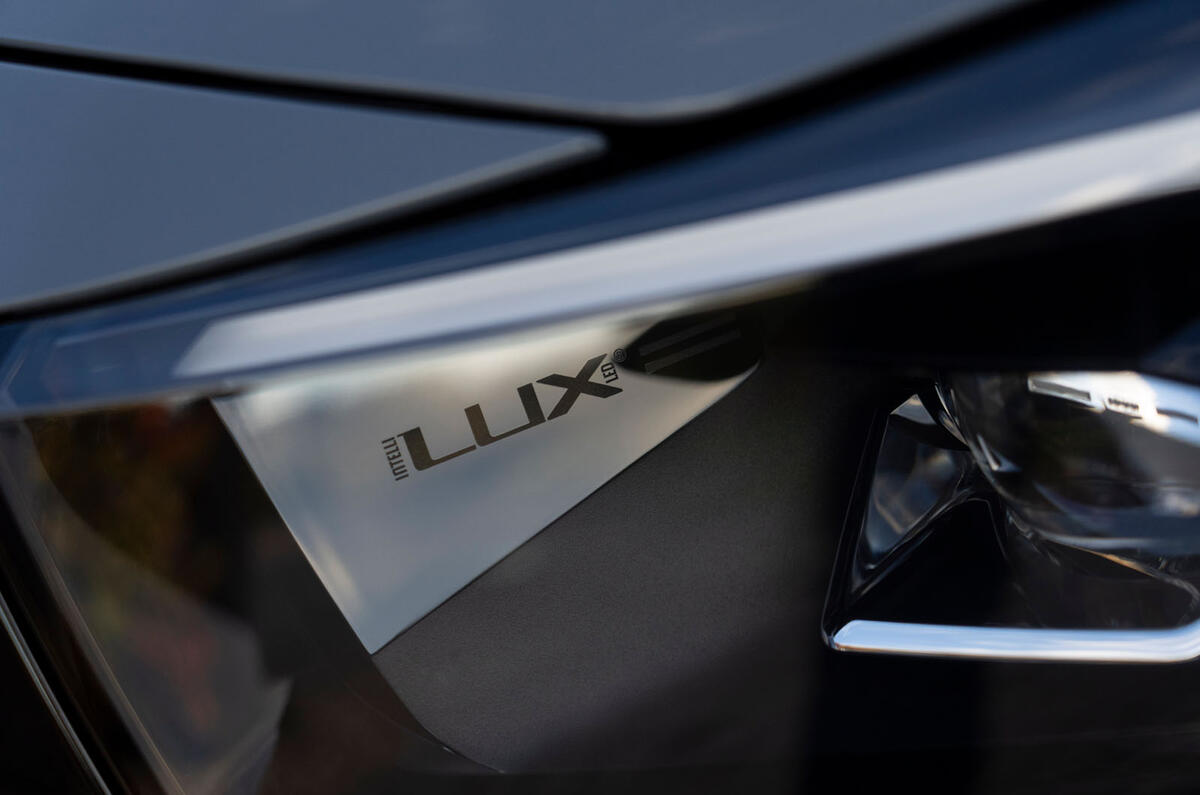
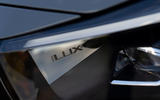
LED headlights are standard across the range, with adaptive LED matrix IntelliLux lamps – as Vauxhall claims, the best in the class – reserved for top-level trim.

Going back a little further, however, this sixth-generation Corsa (technically it's only the fifth-gen Vauxhall Corsa, because Opel's first Corsa was badged a Nova on our shores) was notably lower of roofline (by nearly 50mm) and had smaller, less monocabby proportions than its predecessor. It was less a supermini from the awkward squad - although that impacted more than just its exterior desirability, as we'll go on to explain.

At its launch in 2019, much was made of the weight loss delivered by the new Corsa’s PSA Group (as it then was, pre-Stellantis merger) Common Module Platform, which took the lightest petrol-engined examples below a tonne on unladen kerb weight. Not so for the EVs, not to surprisingly; the 50kWh and new, longer-ranged 51kWh versions don't come close to such a mark. Claimed kerb weight for those is from 1469kg. That’s still lighter than both a Honda E and a Mazda MX-30, interestingly, but heavier than a Mini Electric.

Part of that weight can be explained by the fact that the Corsa Electric has a stiffer, more widely braced body structure than a regular Corsa supermini. Because its nickel manganese cobalt battery is carried in a sideways ‘H’ arrangement under its front and rear seats and along its transmission tunnel, it also has a centre of gravity that's 57mm lower than the normal Corsa's (although lowering a car’s major masses even that much doesn’t offset the addition of half a tonne of ballast).

Or, rather, batteries. The fact is, in now offering the new 51kWh of electricity storage, the Corsa Electric is one of the better-served cars in its class for electric range, rated as it is for up to 246 miles on the WLTP combined cycle.

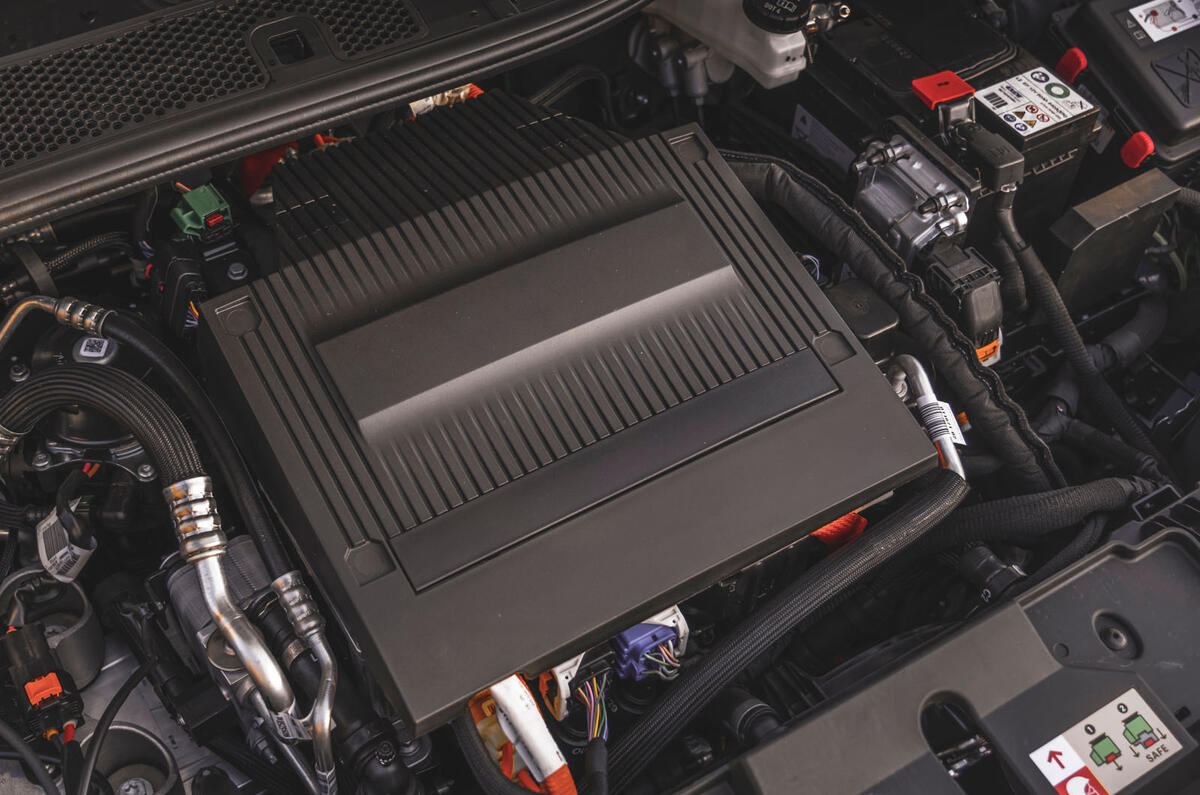
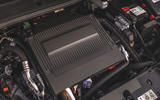
The Corsa Electric 51kWh Long Range models are powered by Stellantis’s new front-mounted, AC synchronous, electrically excited drive motor that produces 154bhp – first used on the Vauxhall Astra Electric, Peugeot e-308 and Citroën ë-C4, and also set to be fitted to the updated Peugeot e-208. For smaller-battery models, the previous car’s 134bhp motor remains. Both produce 192lb ft of torque. The front axle is made up of MacPherson struts, and the rear of a torsion beam and Panhard link (the latter helps to better locate the rear wheels under cornering load).

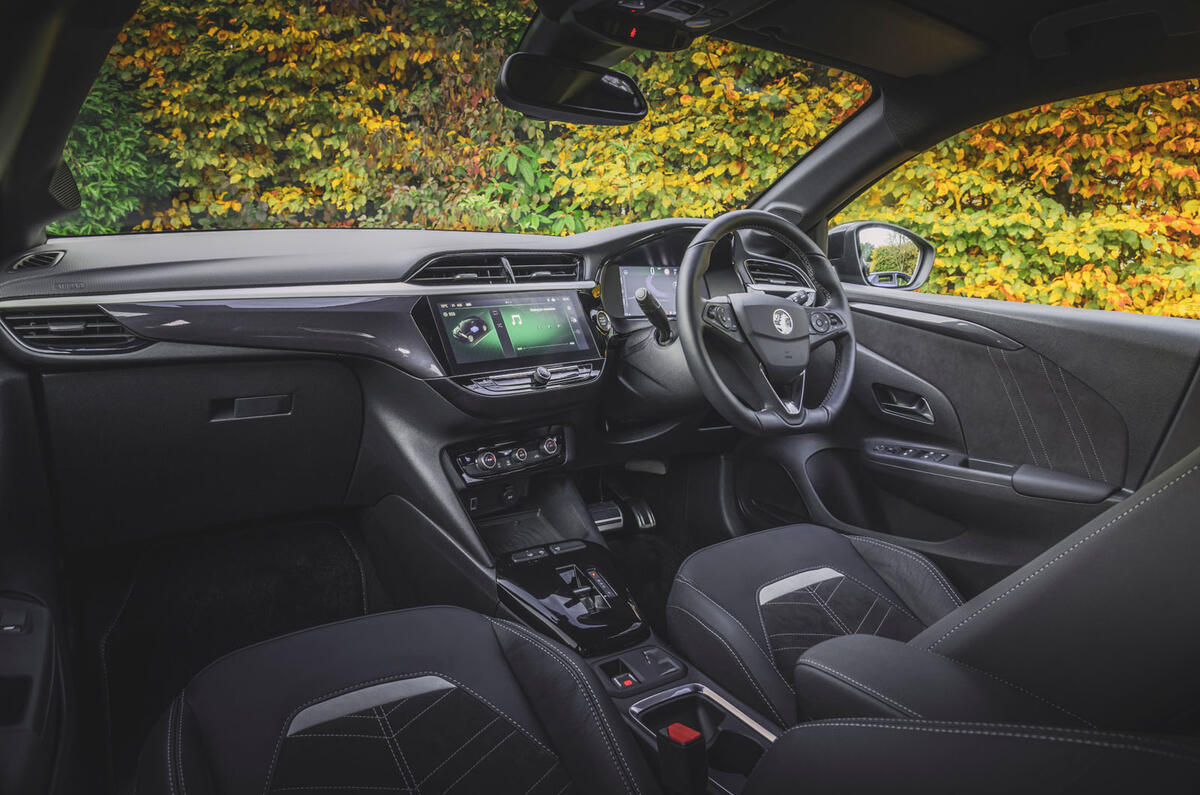
As part of the facelift, the model’s trim levels have been simplified. The Corsa Electric range is now offered with the new entry-level Design specification, which rises to GS and then tops out at Ultimate. Most cars get a 7.0in digital instrument display and 10.0in infotainment screen, though the base-level Design trim drops the 10.0in screen for a 7.0in one. The car gets 17in alloy wheels on all but Design, and heated sports seats, a reversing camera and tinted windows are among the equipment lures of top-level trim.

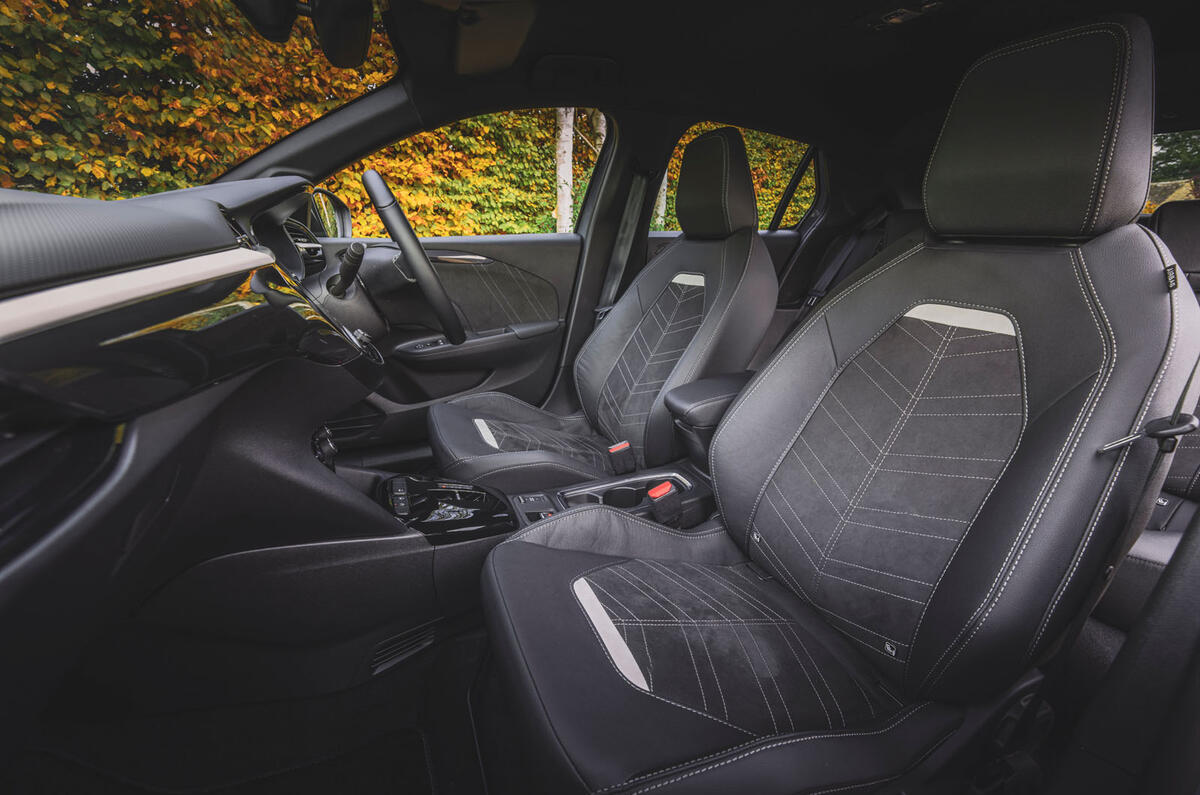
The new Corsa Yes 2025 special edition slots in at the bottom of the price range, however; but into the middle of the trim strata. So, while a Corsa Yes costs about £3500 less than an equivalent GS model, it builds on the equipment level of a Design - adding a bigger set of digital instruments, racier and more colourful seats and interior trims, and sportier exterior bodystyling (on Corsa Electric, the Yes has effectively replaced the Design trim level; on Corsa petrols, it exists alongside it).

INTERIOR

6
vauxhall corsa electric review 2023 05 drviing

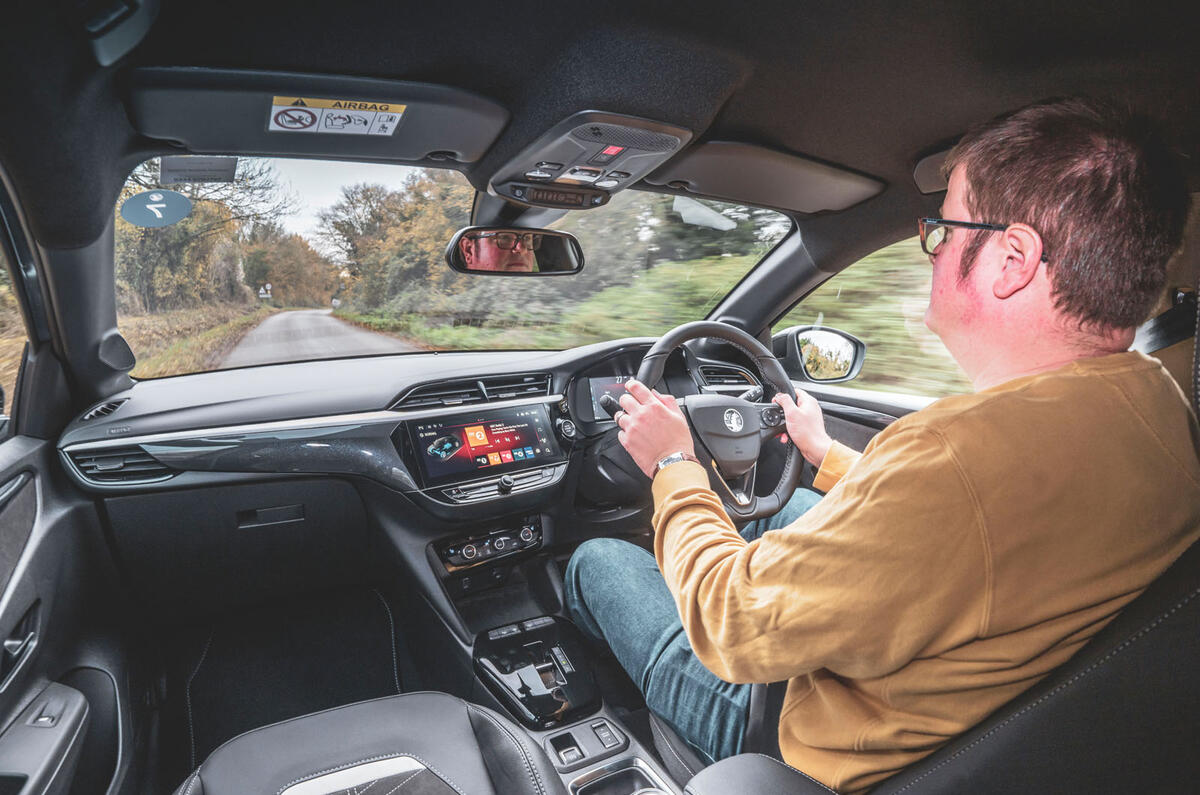
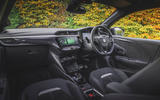
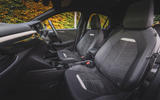
For the previous couple of generations, the Corsa was positioned as one of the supermini class’s extra-practical options, offering plenty of interior space within a slightly lofty, high-rise body. Well, no longer.

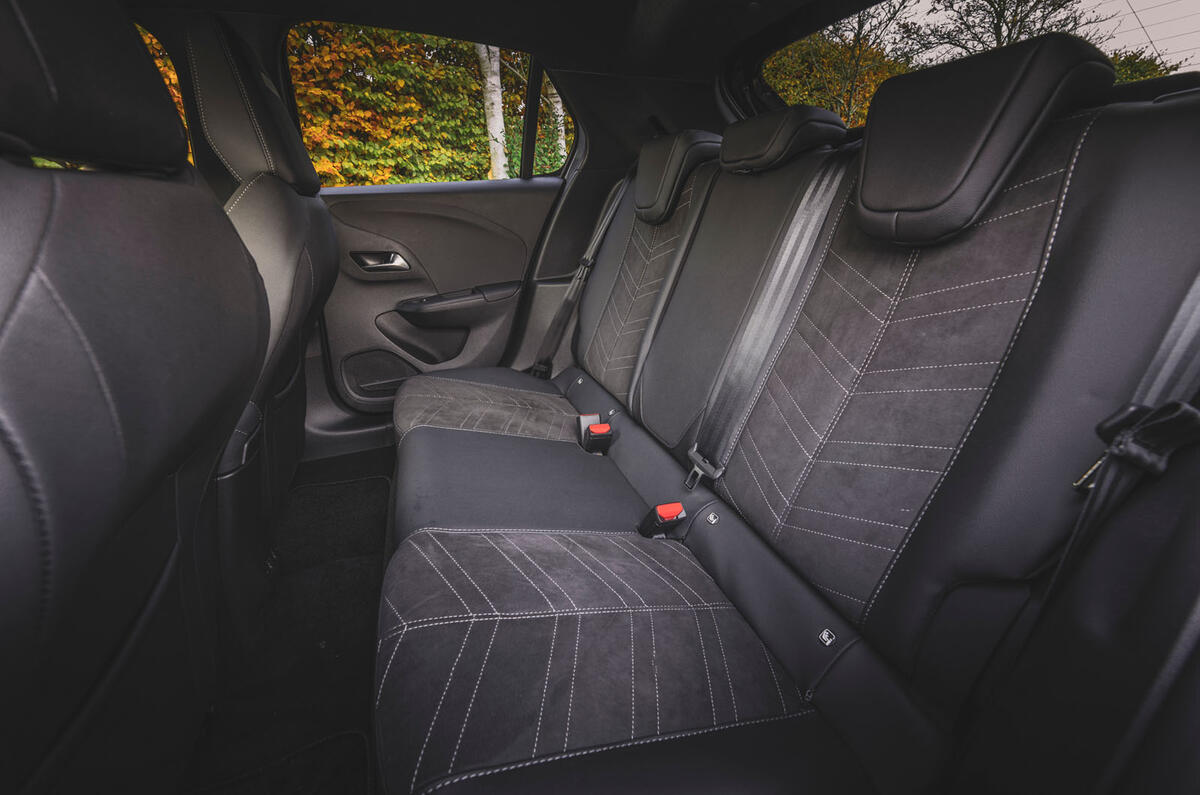
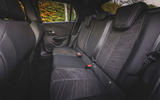
Even in the front, the Corsa Electric instantly feels like a lower, tighter fit for taller drivers than its predecessors ever did. In the back seats, there’s really only room for children and younger teenagers. The car is no more meanly accommodating as an EV than it is as a piston-engined car, it’s worth pointing out – and it is a five-door. But it certainly isn’t one of the roomier superminis in terms of cabin space, and shallow footwells with close-set pedals also make it difficult for the driver even to sacrifice much front leg room in order to make extra space for someone in the back.

The best superminis have developed way beyond the compromised, long-armed and short-legged driving positions their predecessors had 25 years ago – but the Corsa’s primary ergonomics have yet to fully follow suit.

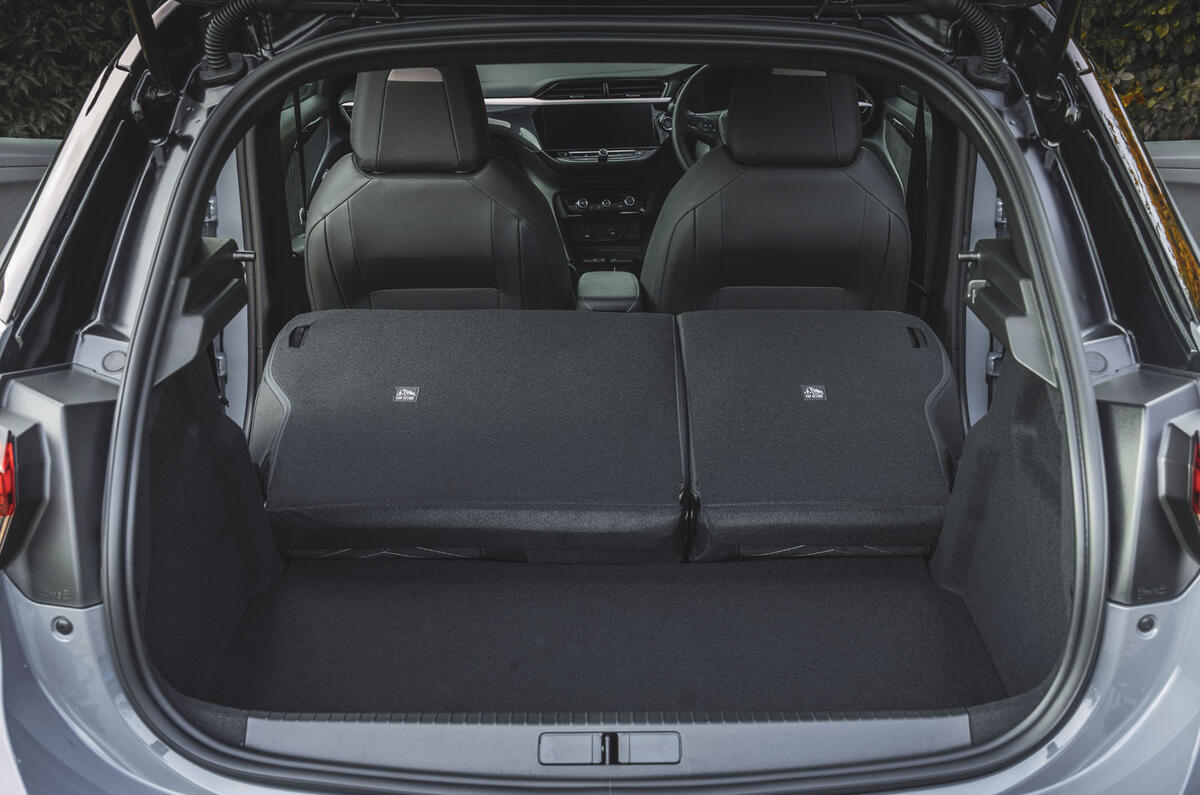
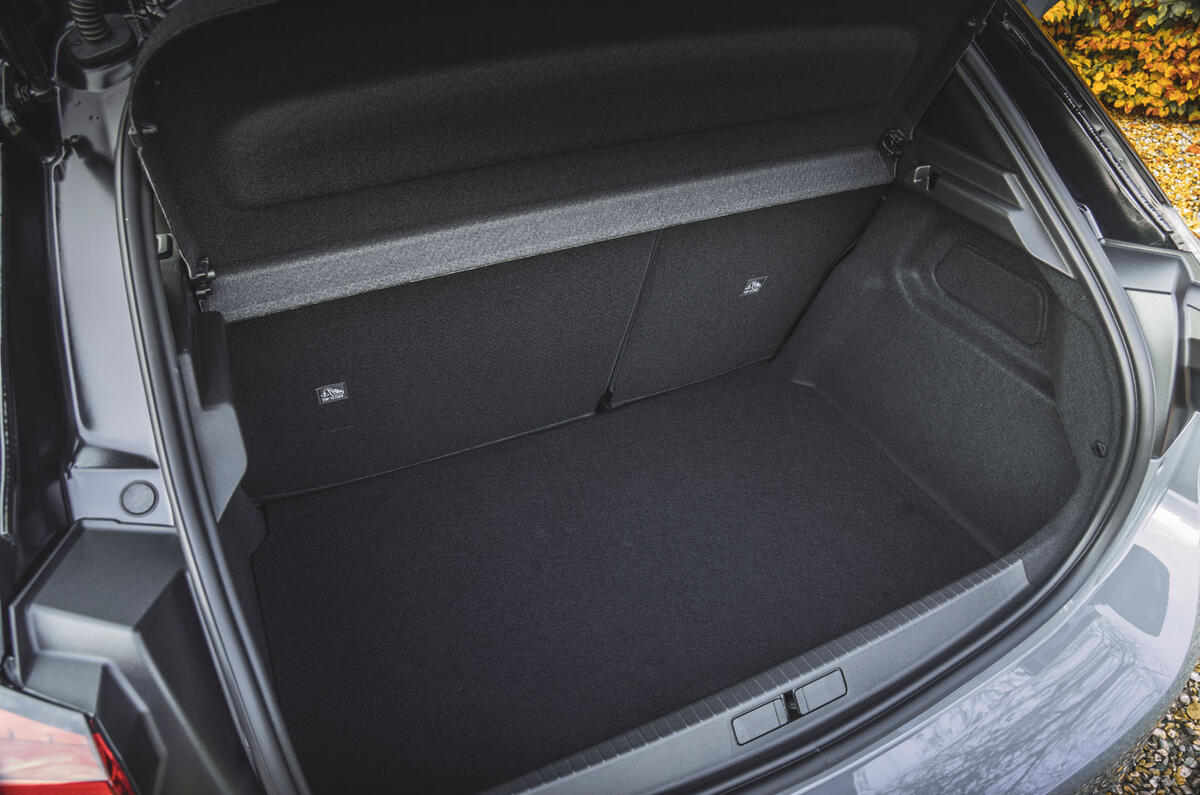
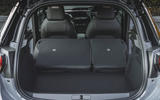
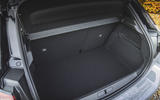
Vauxhall’s logic here may be that supermini owners typically prefer a car with a smaller second row but a bigger boot. In a regular Corsa, you get 309 litres of storage under the parcel shelf, but in the Corsa Electric, that drops to 267 litres. It’s more carrying space than some rivals offer; enough to get a buggy in or to temporarily stow a child seat – just – but there is quite a deep lip to lift items over on the way in and out, and there’s no under-floor storage for a spare wheel (you get ‘tyre fix’ foam instead) or for the car’s charging cable.

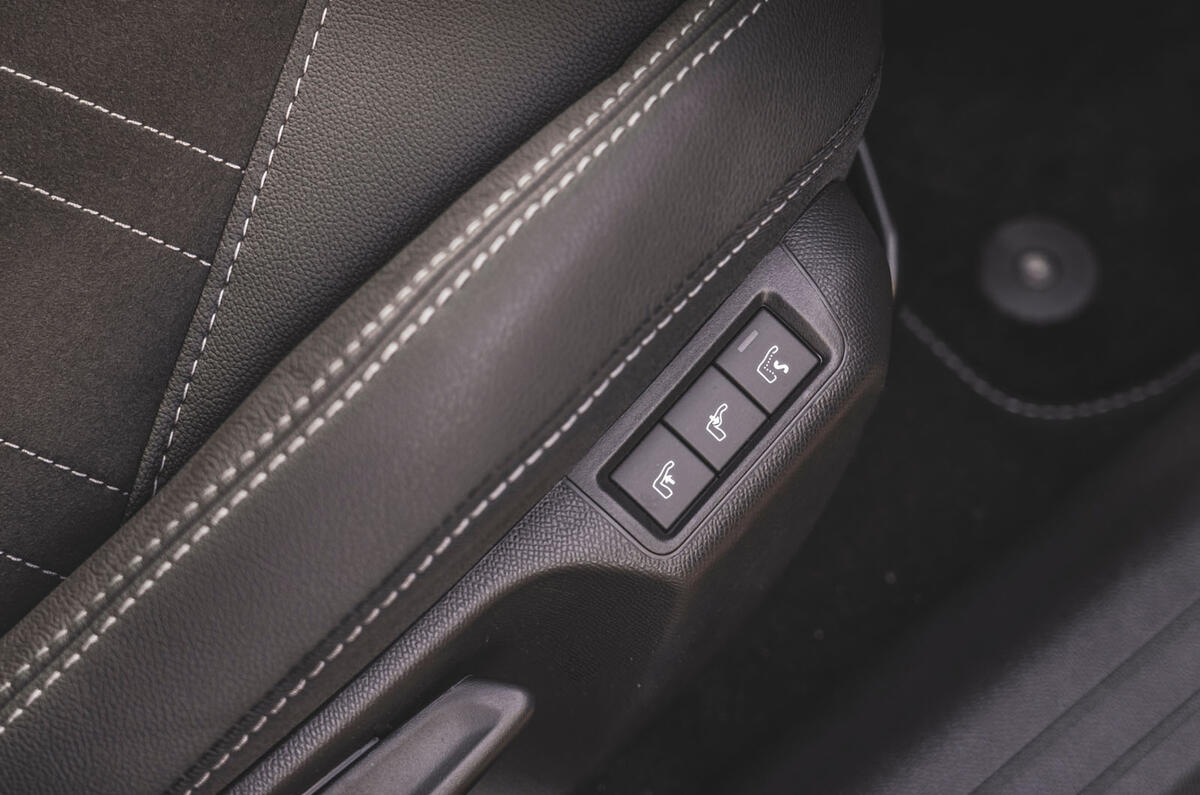
All versions of the car get the same Comfort-specification driver’s seat, which adjusts for cushion height as well as for reach and backrest angle, but doesn’t offer adjustable lumbar support. It’s a decently comfortable seat, and sufficiently wide to accommodate and locate bigger drivers well enough.

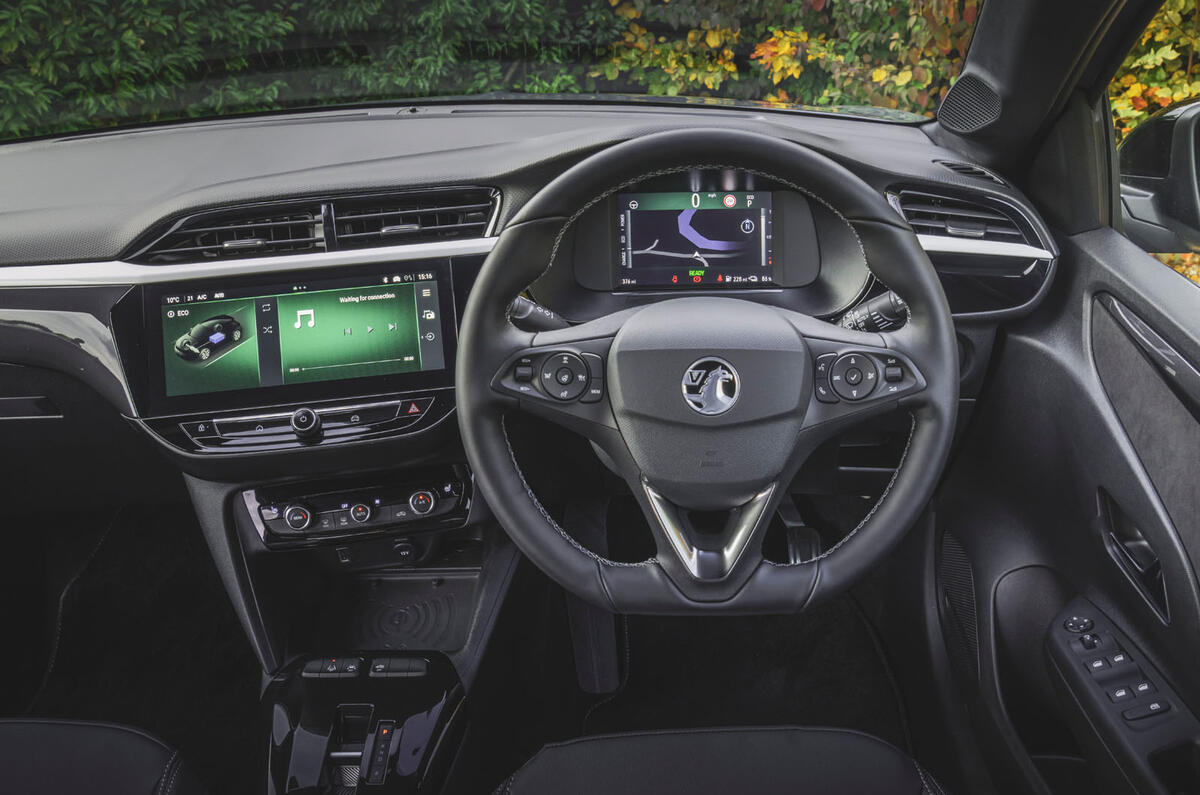
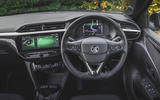
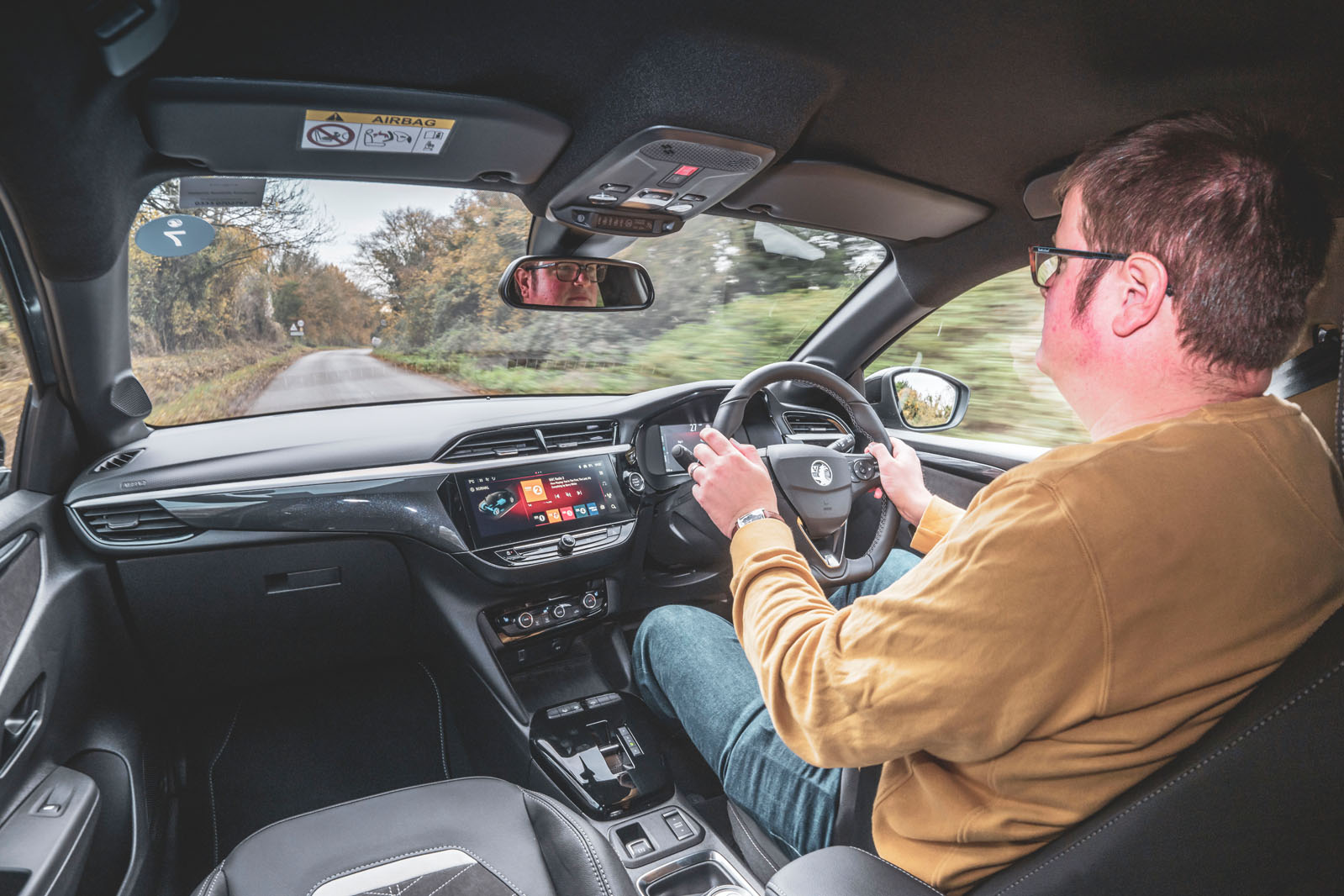
Sitting in the front, you’re met by a fairly high, bluff fascia. The instruments are fully digital on all trim levels. It’s a simplified but adaptable layout, giving you a digital speedometer, an electric range indicator and a power flow meter as a bare minimum, but configurable to show driver assistance or trip computer information if you want it. The instrument displays are all anti-reflective materials, but there’s also a good-sized cowl to prevent any reflections hitting the screen. Display clarity is good.

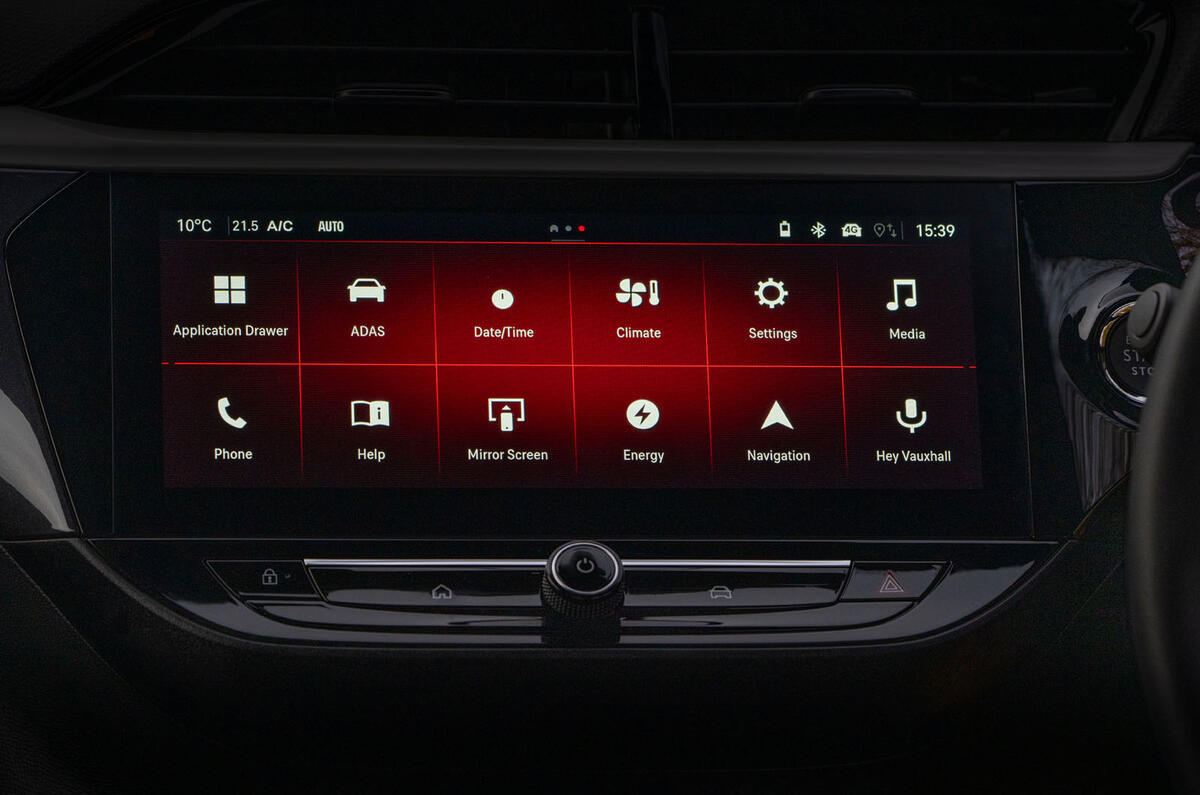
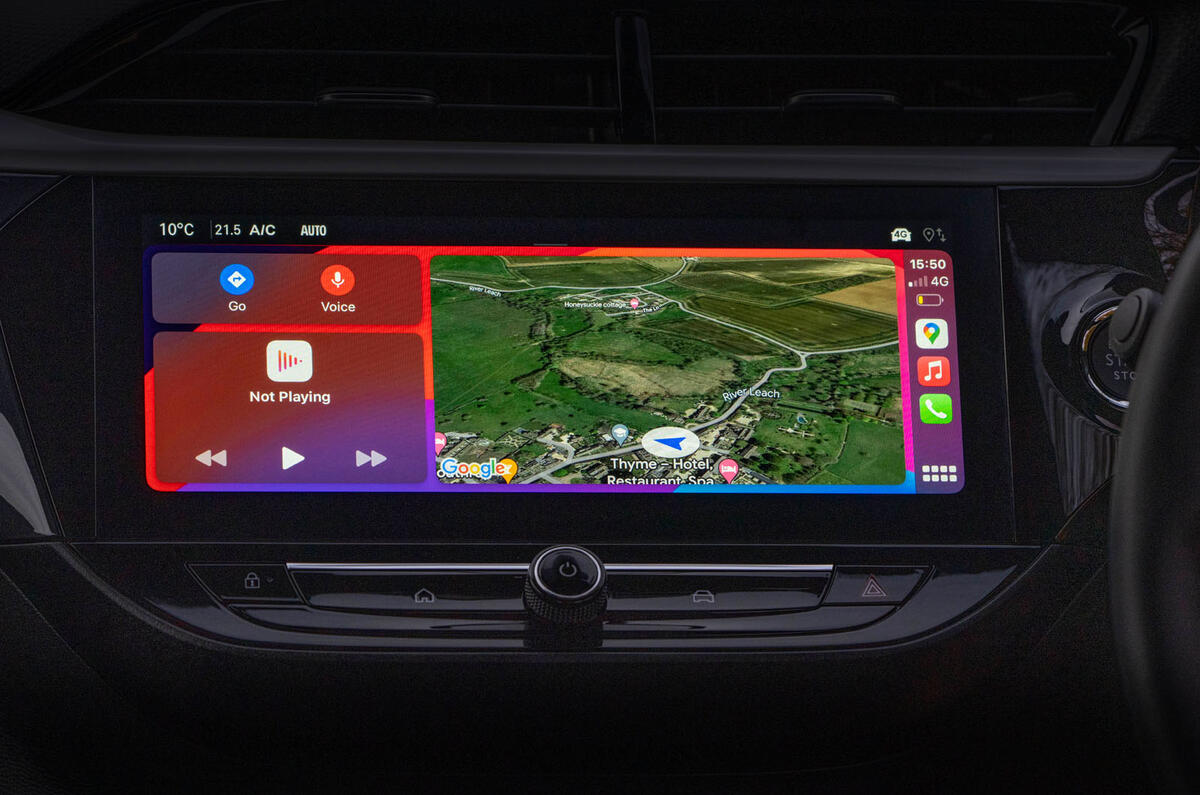
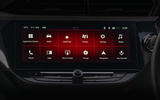
The big update for the facelifted model over its predecessor was the infotainment. The cabin now has a 10.0in Snapdragon-powered infotainment screen. It offers two physical buttons below the screen for quick access to the car’s settings, important for an EV; but it also makes hopping in and out of smartphone mirroring mode easy.

Usability is good, with the touchscreen offering quickish responses and a clear display. The sat-nav is decent (though it has some curious, irritating auto zoom setting quirks in some map orientation modes), but the wireless offerings for Apple Car Play and Android Auto make using better navigation apps – which most people who have the option to do so will use – a breeze.

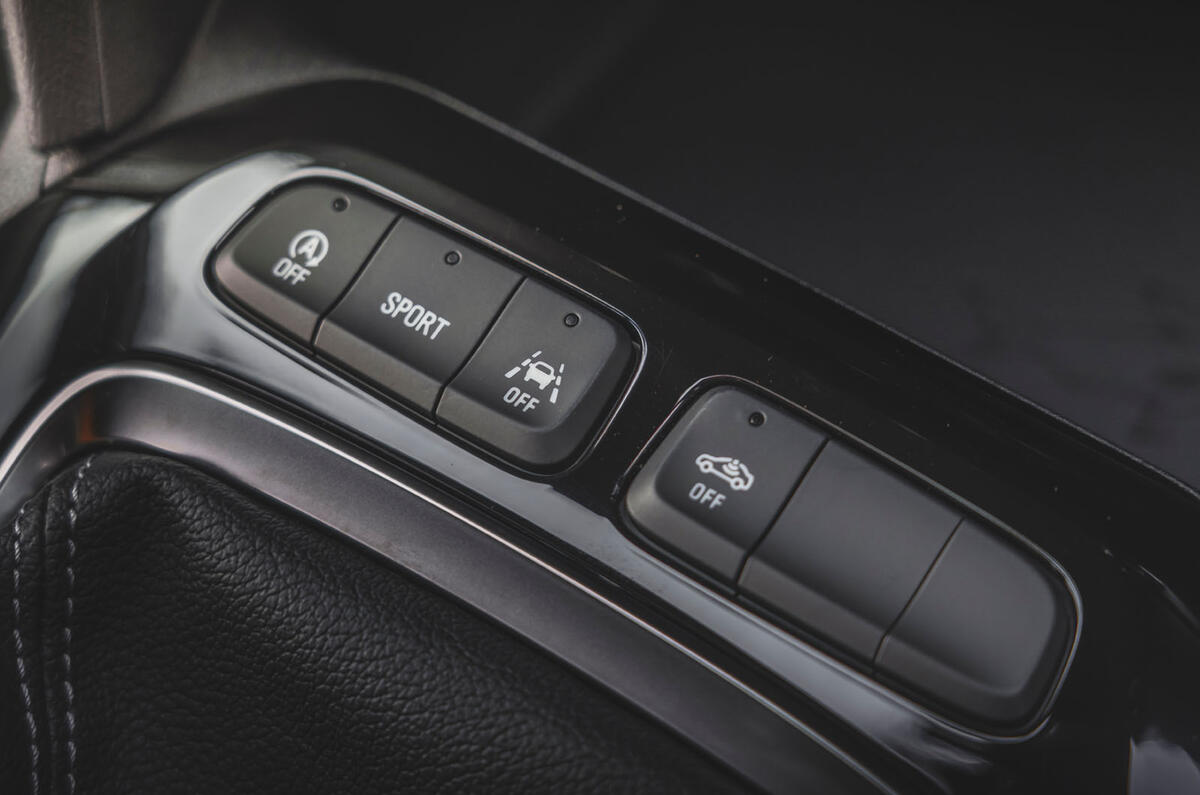
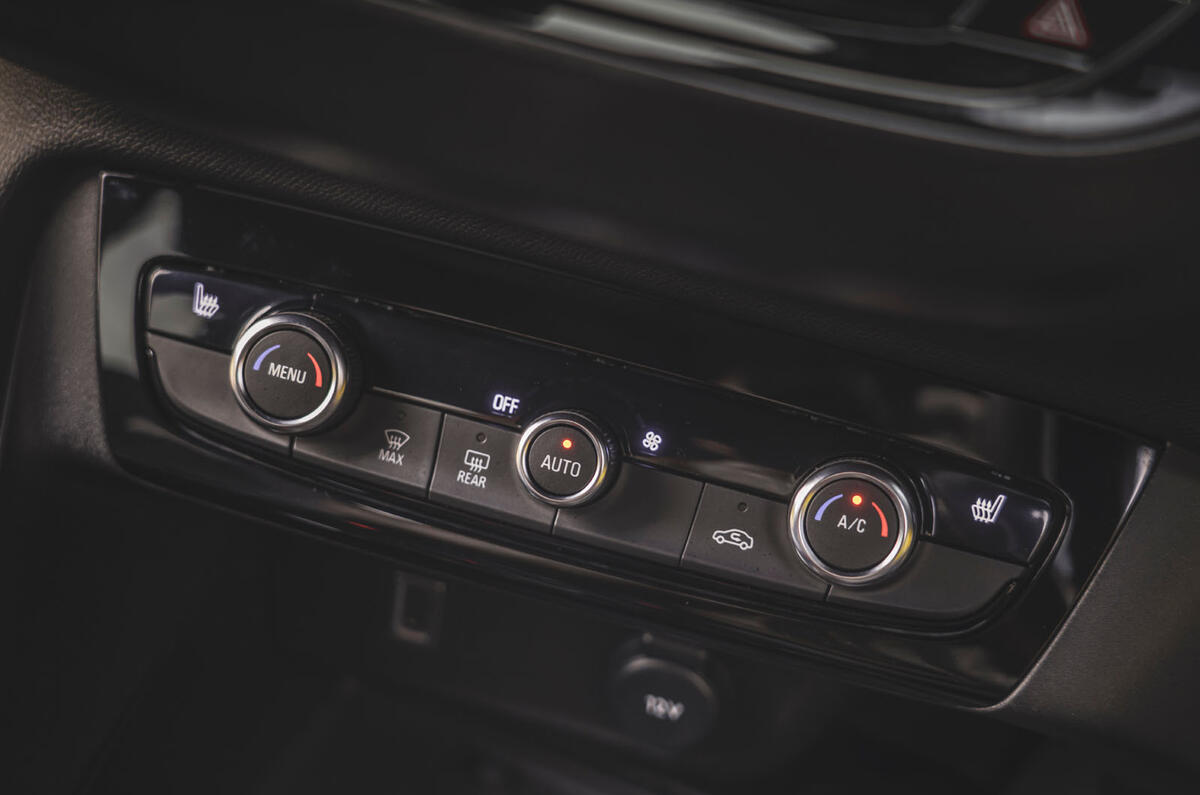
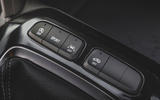
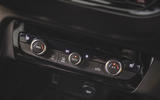
There are separate climate controls below the screen, which are very handy, although the temperature figure is displayed on the screen itself, which feels like a misstep (but in the interests of saving money, you can understand the decision). There’s a physical switch too for the lane-keeping assist system. Unlike with some Stellantis relations, then, you don’t have to scroll through the touchscreen interface to find the control for every little thing.

ENGINES & PERFORMANCE

7
Vauxhall Corsa Electric 005

The long-range Corsa Electric uses a more densely packed and efficient 51kWh battery than the regular one; and Vauxhall's quick to stress that this 1kWh makes more of a difference in the real world than it may seem on paper. It boosts range from 222- to 246 miles - which, in a car in the Corsa's class where sub-200-mile ranges are par for the course, is something of a strength.

The bigger battery is paired with Stellantis’s new front-mounted, AC synchronous, electrically excited drive motor, which produces 154bhp in Sport driving mode; but, perhaps more importantly, is also more capable of running more efficiently at higher cruising speeds than the lesser Corsa Electric's 134bhp permanent magnet motor. The more powerful model is good for a 0-62mph sprint of 8.2sec.

This is a pretty efficient, usable small EV, but it won’t be long until you wish you could control its energy regen that bit more closely. Judicious coasting is key to making cars like this cover distance, and the Corsa Electric doesn’t quite allow it.

Compared with the lesser Corsa Electric’s 134bhp powertrain – which is still offered, but only in lower trims – it feels basically the same at lower speeds, albeit with a tad more power under foot above 50mph, which is where the car needed the extra performance. Motorway authoritativeness aside, it's the extra range that customers are likely to be searching for.

What is apparent is that both powertrains are the sort you can get on with easily. The car doesn’t offer the more sophisticated control options of some EVs, which people on their third or fourth electric car might hope for - but it won’t unsettle or confuse either, and it drives well both in town and out of it.

While electric cars with greater power and torque can sometimes struggle to deploy it through economy tyres and only one driven axle, the Corsa Electric has strong but well-balanced performance and traction. Like most EVs, this one pulls away in responsive, smooth and keen fashion, and keeps going in the same vein up to about 50mph - at which point the lesser-powered model's ebbing power makes it perform a little more meekly.

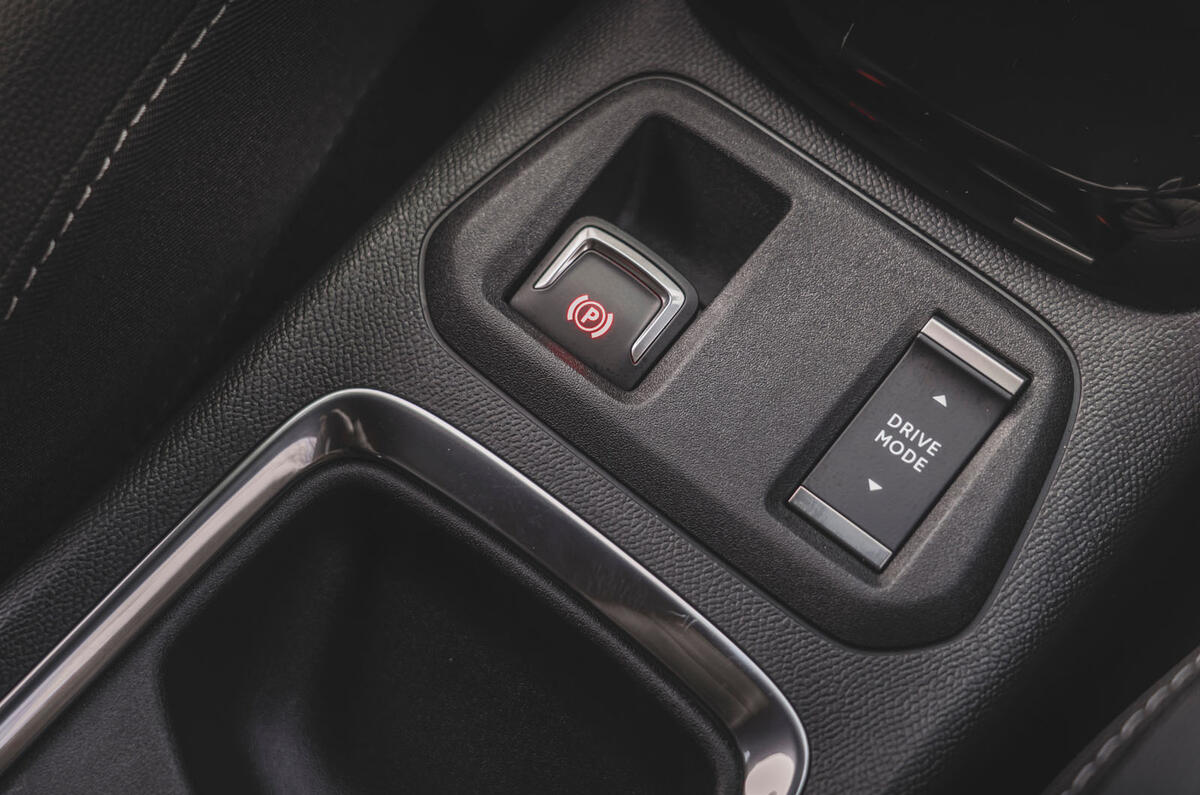
You’re offered Sport and Eco driving modes in addition to the car’s default Normal one, and Eco is alleged to boost real-world battery range by up to 40%. In reality, it only does that by softening throttle calibration and capping the car’s performance, as well as by dialling down the power consumption of the ancillary systems.

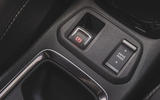
It does not alter the car’s tendency to either coast or regenerate energy on a trailing throttle (it tends to do the latter lightly at lower speeds and more at faster ones). With no wheel-mounted paddle controls, the only way you can increase regen is by using the ‘B’ button on the gear selector – now a toggle rather than a switch, like in the bigger Astra – although not quite by enough to allow a one-pedal driving style.

By bringing that battery regen in early as you lift off the accelerator, that ‘B’ mode improves the car’s drivability under deceleration. It simply gives the brake pedal less to do in otherwise blending up motor regen before incorporating the friction brakes. In ‘D’ mode, the brake pedal can frustrate by needing a split second to make the drive motor respond and begin to slow the car, causing the pedal to feel spongy and dead, and often making momentum harder than it need be to manage at low speeds.

As for real-world range, Vauxhall's claims are to be believed. A heat pump is fitted to both versions of the car as standard and, from the upper-level car, economy returns of between 3.8 and 4.4mpkWh can be expected, the latter giving the Corsa Electric real-world autonomy - off the motorway, and a little dependent on warmish weather - of better than 230 miles.

The Corsa Electric’s 50kWh, 134bhp powertrain, which we tested before in the UK, returned an average of 3.7mpkWh over the full course of our road test (that efficiency figure, as ever, including the influence of track testing). From a drive battery of 47kWh of usable capacity, that would make for just under 175 miles of range in mixed daily use and possibly 190 miles or more at an efficiency-optimised 40-50mph cruise.

Although it might not be enough for everyone, that’s a relatively strong showing on range for a supermini EV; and might well be worth paying a little bit extra than some rivals might cost.

RIDE & HANDLING

7
Vauxhall Corsa Electric 006

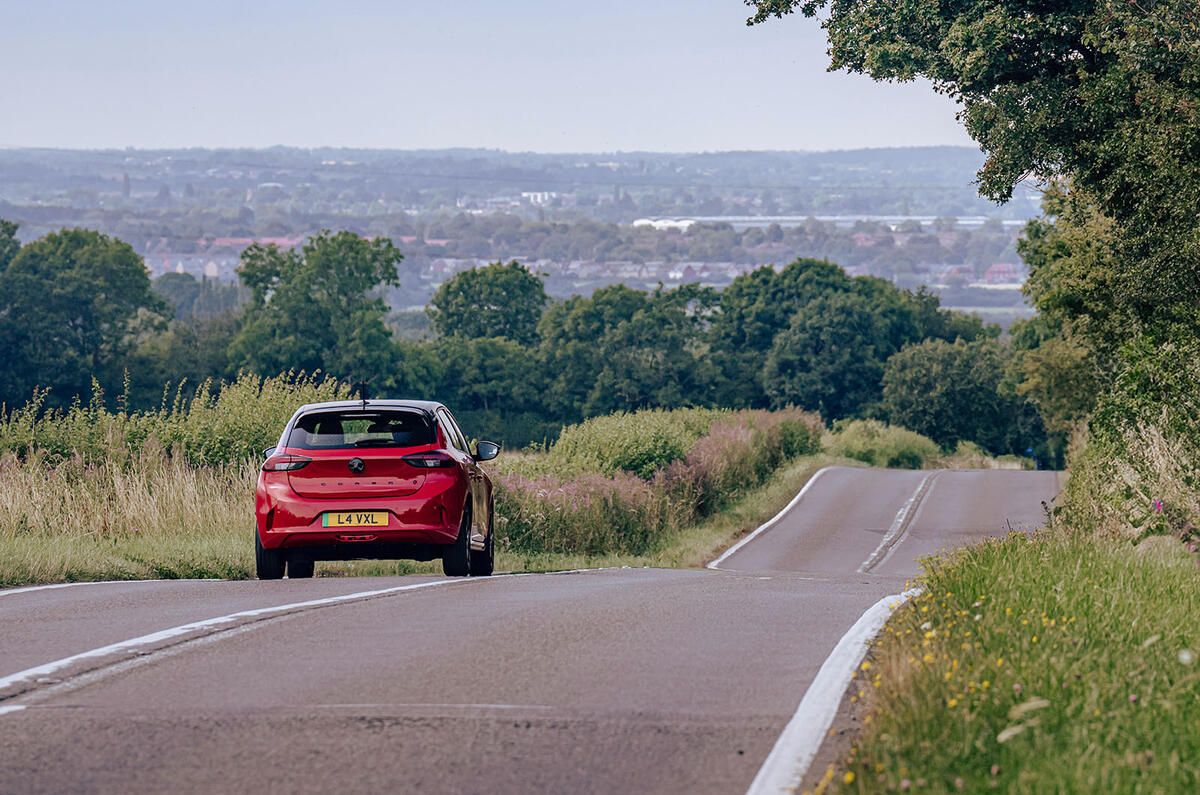
Just as there’s moderation in the way the Corsa Electric performs, so too is the same present in the car’s handling. Vauxhalls have typically aimed for a more mature, secure and stable dynamic character over the years than sportier-feeling Fords or softer-set French equivalents, of course. Although it's built on a PSA Group model platform (from pre-Stellantis days), the Corsa Electric maintains that characteristic positioning in the dynamic middle ground.

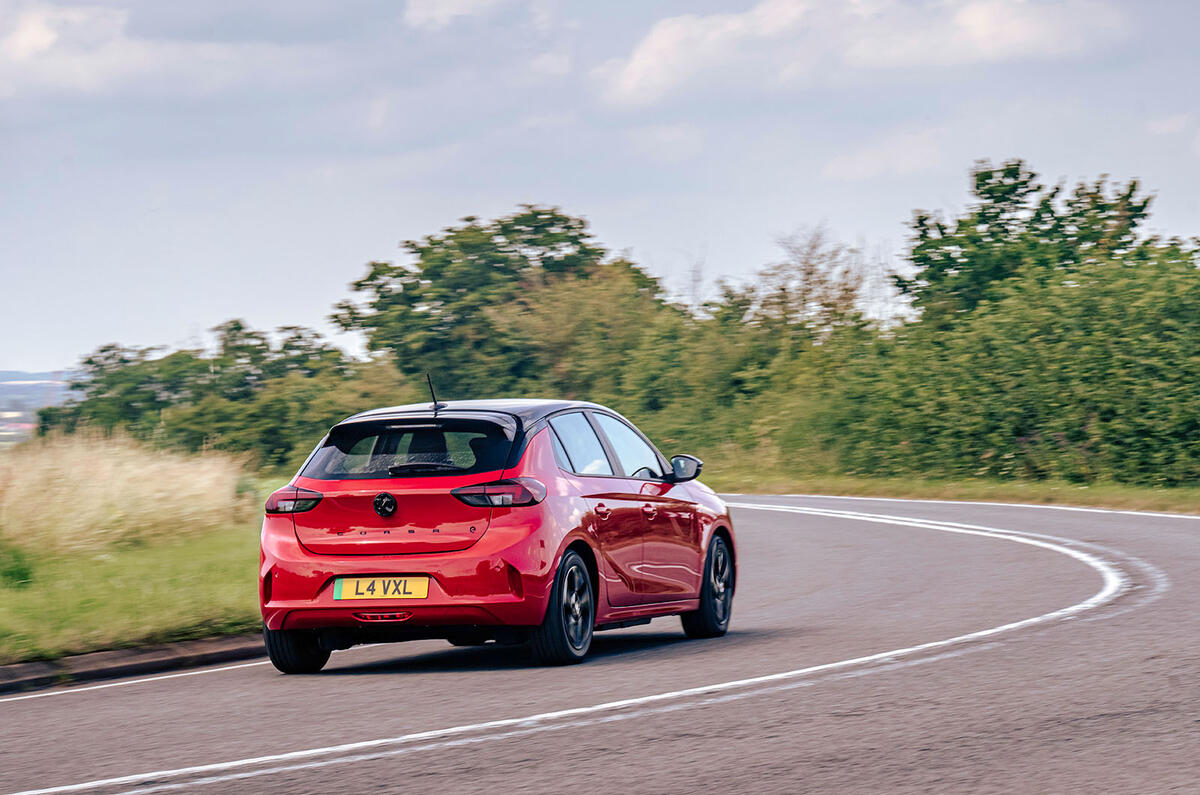
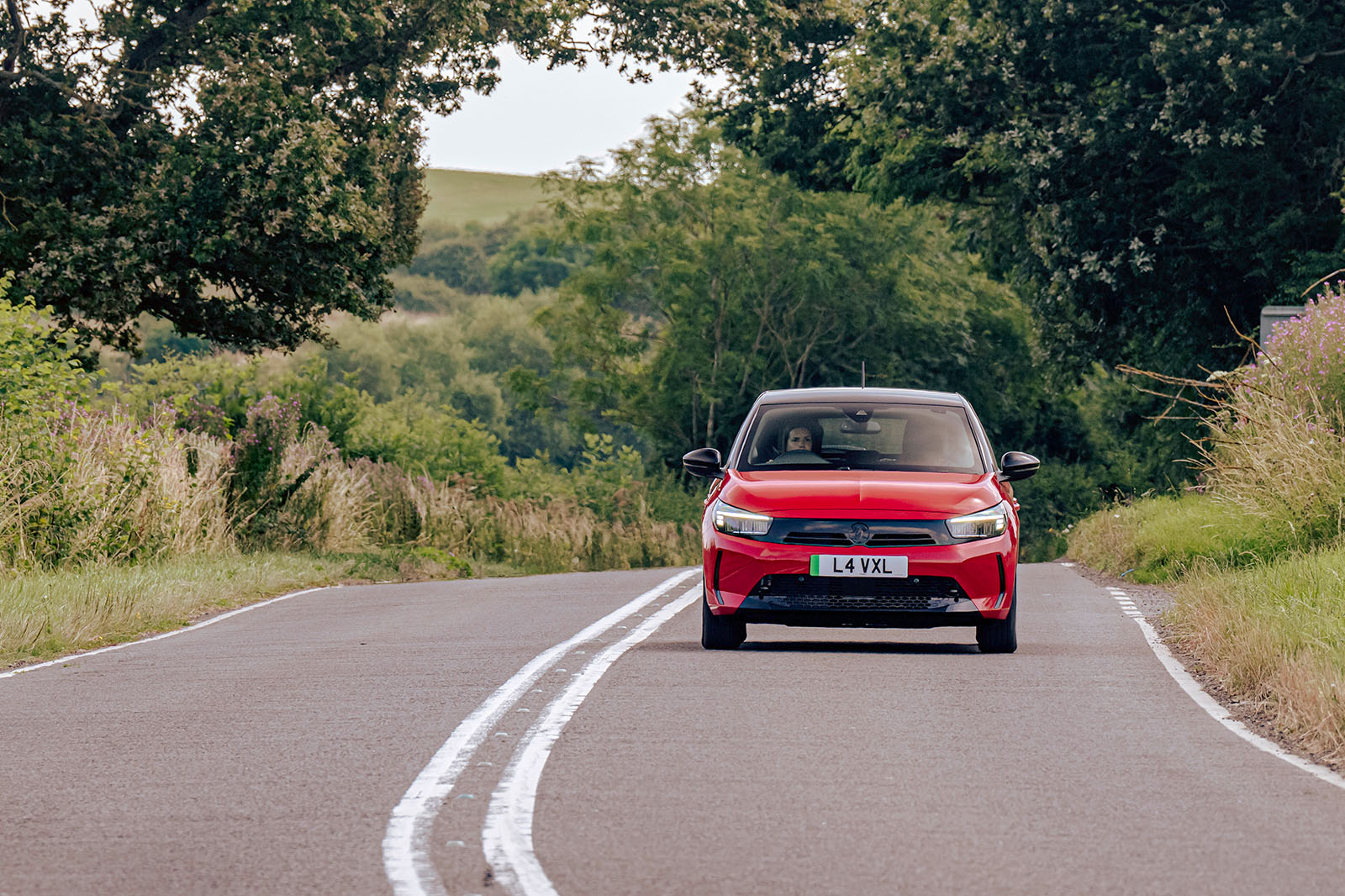
Medium-paced steering (with 2.85 turns between locks) and compliant but not wallowing body control are the car’s top-level hallmarks. The chassis has a slight but perceptible sense of suppleness and isolation to it, dealing with sharper edges and broken Tarmac without abruptness, and keeping road noise and vibration quite low. Due to its weight, it feels softer sprung than the petrol-powered Corsa, and certainly delivers better rolling refinement than some electric rivals. But it also handles with reasonable agility and precision, maintaining good enough body control to be nipped securely around a bend, rolling as your speed builds, but keeping stable and communicating its limits clearly. You wouldn't call this a fun, diverting small EV to drive, like a Mini Cooper SE or Renault 5; but it's a respectable, pretty comfortable and qiute versatile one.

The related Peugeot e-208 is probably a marginally more enigmatic-handling car than this, and a Mini Electric would be a lot more fun, but the Corsa Electric has good dynamic versatility.

The car’s grip level isn’t particularly high on its Michelin Primacy economy tyres, but the chassis and steering are well attuned to it. The Corsa Electric tucks in to a faster corner fairly willingly and without much initial roll. That roll builds as lateral forces rise, and as it does so a modicum of stabilising roll understeer comes along with it, obliging you to add a little extra steering angle in order to stay on your intended line if you’re hurrying along. But the electronic stability and traction control systems (which are effectively always active, although they can be dialled back at low speeds) keep a close but subtle rein on the car’s drive motor and braking systems, working to keep its path neat and tidy without intruding much.
Vertical body control isn’t quite as cleverly managed as the lateral handling. Since the Corsa Electric does carry more mass than most cars of its size, it begins to heave and pitch a little on testing country roads, although not as markedly as some small EVs might. Its close body control isn't as good as the standard Corsa's, again due to the weight it carries. The Corsa Electric’s tendency to oscillate over its torsion beam rear axle, whose tuning makes for quite an accommodating ride elsewhere, is the main sign the car will give you that it’s running out of composure over bigger long-wave lumps and bumps. It threatens to run out of travel at times, although only the very ambitious or daft would actually make it do so.

MPG & RUNNING COSTS

8
Vauxhall Corsa Electric 001

The Corsa Electric’s boosted range is a welcome, and could help when it comes to convincing a customer concerned about the practicability of charging that it could work as real-world transport. In 2026, however, it's more likely to be a slightly fringier choice than a default one; because cars like the Renault 5, which qualify for all of the UK government's £3500 Electric Car Grant, effectively wield a price advantage of several thousand pounds over it.

In day-to-day use, the car requires a little attention, the right usage pattern, and a favourable ambient temperature in order to match Vauxhall’s 246-mile range claim for it – but, in mixed short- and longer-range use, it wouldn’t often miss that figure too much. The car’s energy efficiency isn’t market leading for an affordable EV, but it’s close; and, even on the motorway, you could probably bank on getting 190- to 200 miles of range out of the car - which is quite rare in this class.

Vauxhall corsa electric review 202309 charger

To add a sprinkle of reassurance, the battery also comes with an eight-year, 100,000-mile warranty (the wider car’s cover is for three years and 60,000 miles, and for six years against body perforation by rust), and it guards against both battery failure and degradation of usable capacity below 70% of Vauxhall’s showroom claim. That, too, is increasingly typical of electric cars.

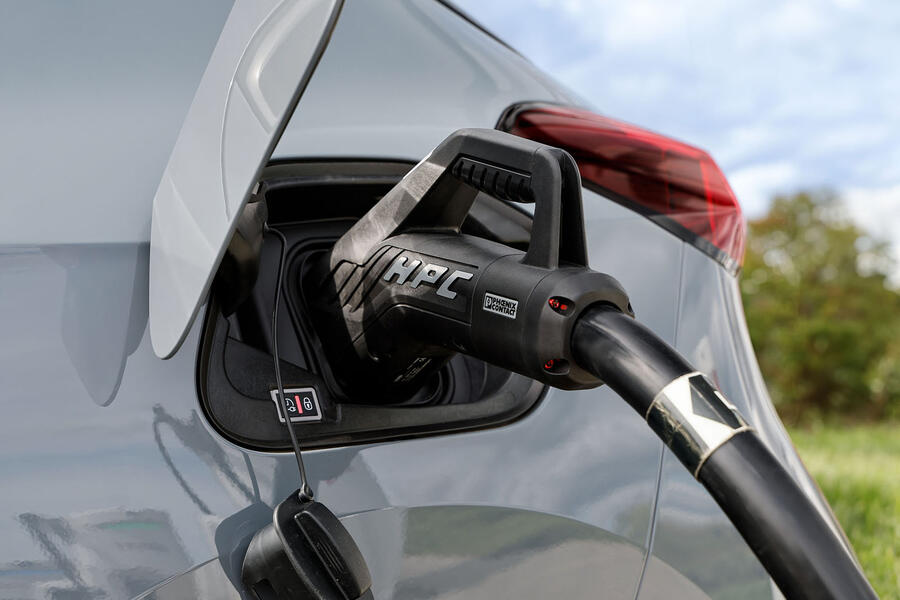
The Corsa Electric comes as standard with a Mode 3, 7.4kW seven-pin charging cable, which, plugged into a home charger of the same power rating, will take it from empty to full in less than eight hours. A three-pin ‘granny’ charging cable can be bought as an option. Via a 100kW rapid charger, it can charge from 0-80% in 30 minutes.

VERDICT

6
Vauxhall Corsa Electric 008

There’s a likeable pragmatism about the Vauxhall Corsa Electric. It addresses the primary concerns that new-adopting electric car owners are likely to have when switching from a traditional combustion-engined car to an EV. Will it go far enough between charges? Will I get on with it? You've a good chance of answering both in the affirmative here; though the fact is, in 2026, you'll need to be willing to pay more than some rivals to be able to do so.

This car goes further on a charge than many of its current competitors, making that step across from ICE to electric easier than most (basically because it’s the same car, bar the obvious). The Corsa Electric is very easy to operate and drive, with little extra quirkiness or complication than any EV really needs, and having good performance and drivability.

On the negative side, there's an element of dowdiness to consider with any car as popular as a Corsa; and, while the current model's design adds a note of premium appeal, it can only do so much. To drive and to inhabit, the car is perfectly competent if a bit plain and ordinary. Rivals offer better second-row cabin space; and plenty of them will cost you less.

Additional testing by Will Rimell

Matt Saunders

Matt Saunders Autocar
Title: Road test editor

As Autocar’s chief car tester and reviewer, it’s Matt’s job to ensure the quality, objectivity, relevance and rigour of the entirety of Autocar’s reviews output, as well contributing a great many detailed road tests, group tests and drive reviews himself.

Matt has been an Autocar staffer since the autumn of 2003, and has been lucky enough to work alongside some of the magazine’s best-known writers and contributors over that time. He served as staff writer, features editor, assistant editor and digital editor, before joining the road test desk in 2011.

Since then he’s driven, measured, lap-timed, figured, and reported on cars as varied as the Bugatti Veyron, Rolls-Royce PhantomTesla RoadsterAriel Hipercar, Tata Nano, McLaren SennaRenault Twizy and Toyota Mirai. Among his wider personal highlights of the job have been covering Sebastien Loeb’s record-breaking run at Pikes Peak in 2013; doing 190mph on derestricted German autobahn in a Brabus Rocket; and driving McLaren’s legendary ‘XP5’ F1 prototype. His own car is a trusty Mazda CX-5.