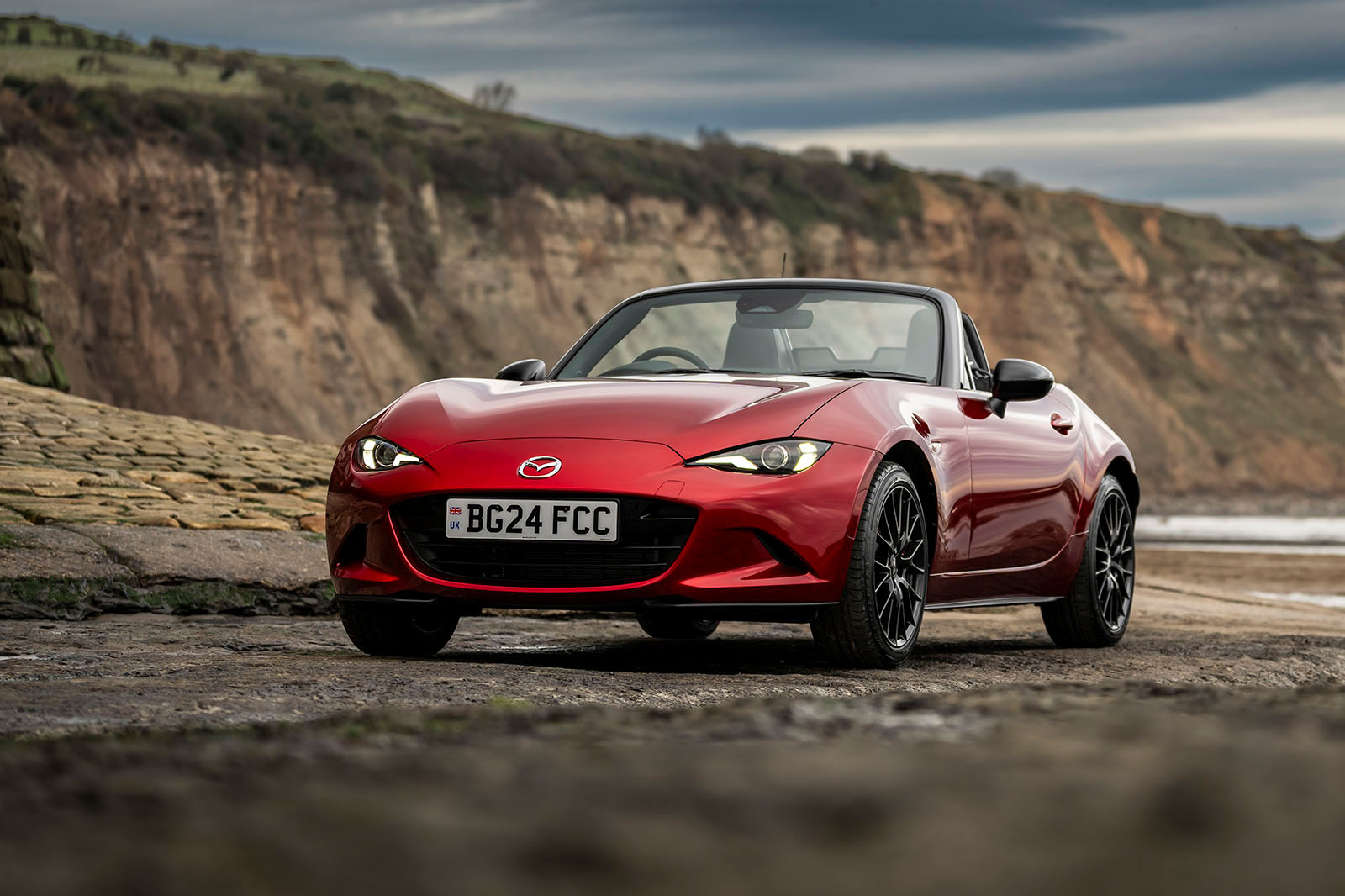
From £28,58510

Is the affordable sports car icon still at the top of its game in 2026?

For many people, there has been a Mazda MX-5 on sale for as long as they can remember. By and large, the current, fourth generation of the convertible sports car performs much the same role as its ancestor did in 1989. The MX-5 has been such a constant in the lives of car enthusiasts that it’s difficult to imagine a world without it.

Mazda clearly treasures its icon, because it has been diligent at keeping it alive. Not only has it managed to keep it compliant with changing safety and emissions demands, but it has also made gradual improvements over the ‘ND’ generation’s now 11-year life.

We already know that the MX-5 is one of our favourite cars on sale – it had a starring role in a recent top-five feature last week – but the last time we ran the numbers on one was all the way back when the ND was launched in 2015, and that was with the humble 1.5-litre engine. High time, then, for a closer look at the 2.0-litre version.

Advertisement

DESIGN & STYLING

10
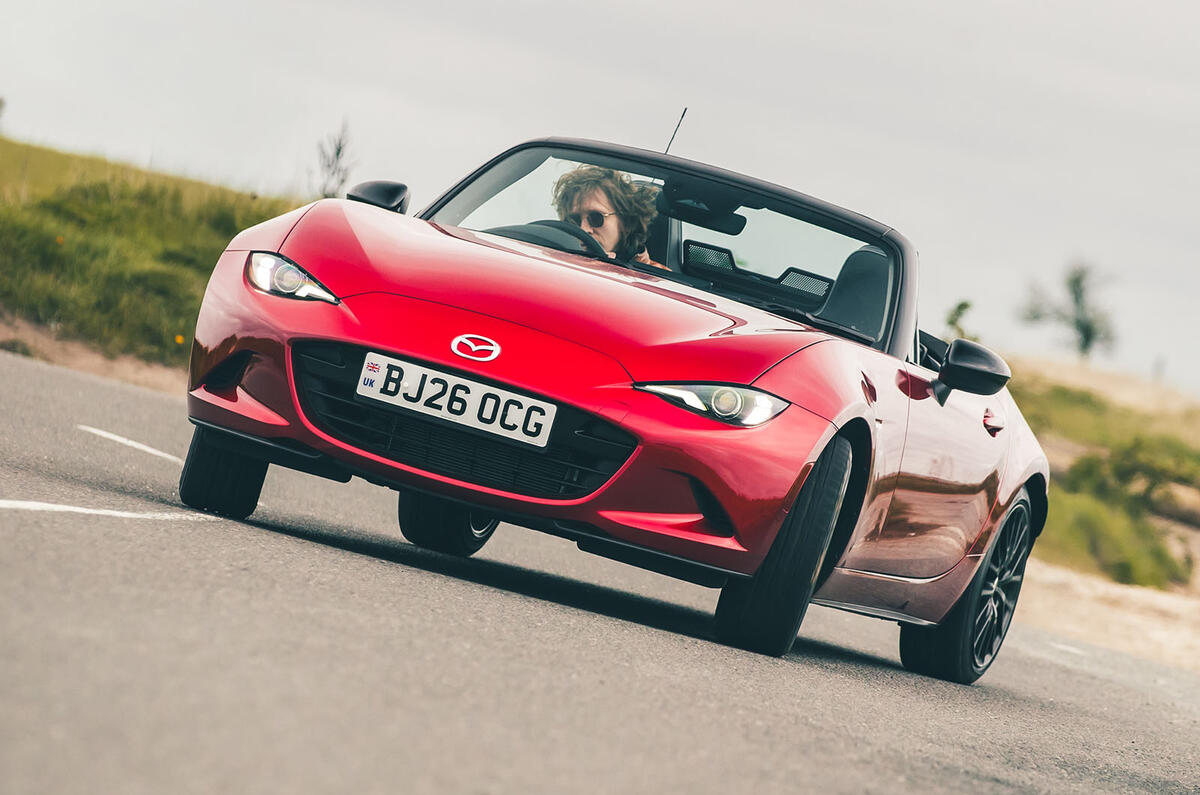
Mazda MX 5 2026 002

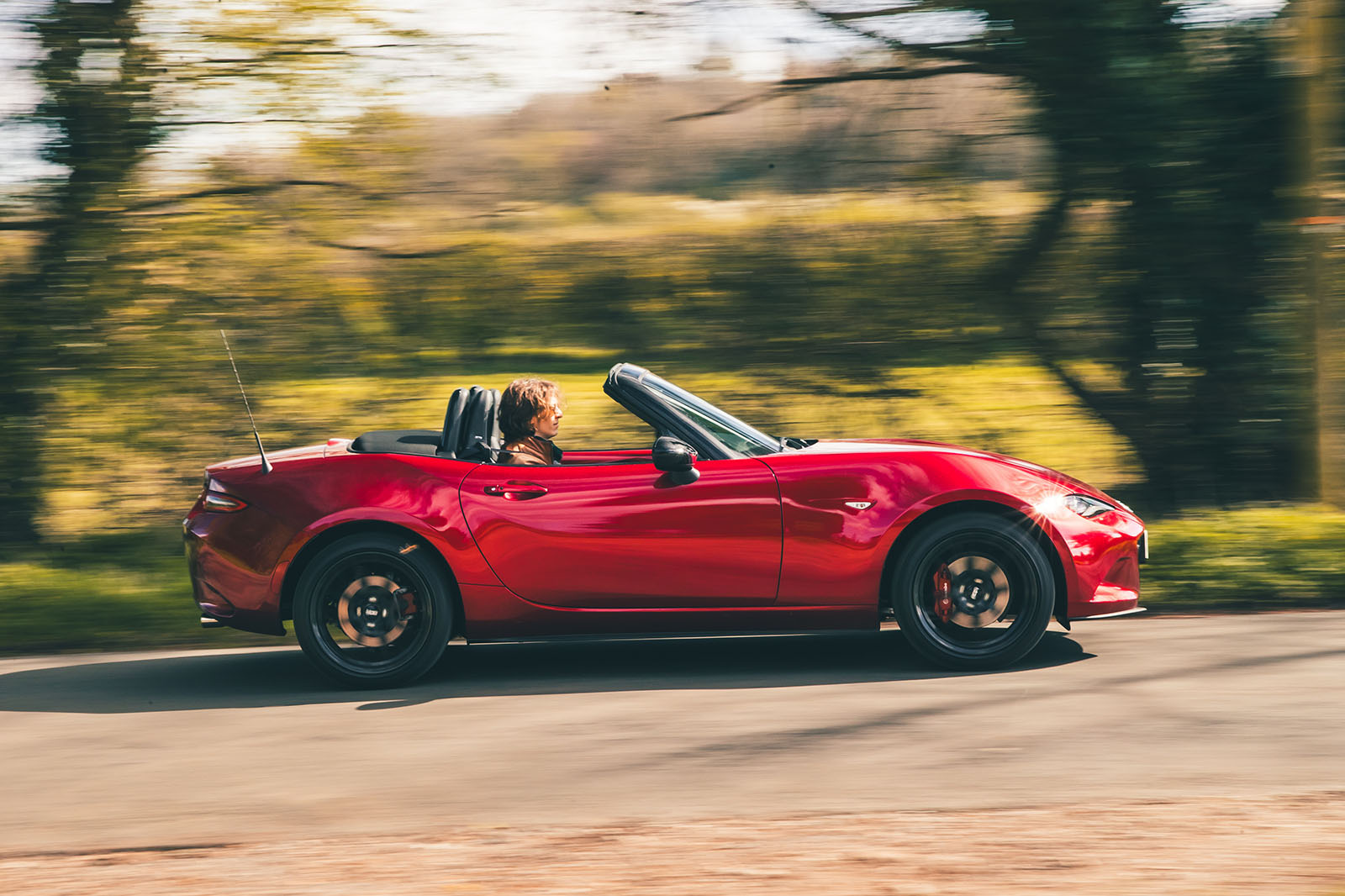
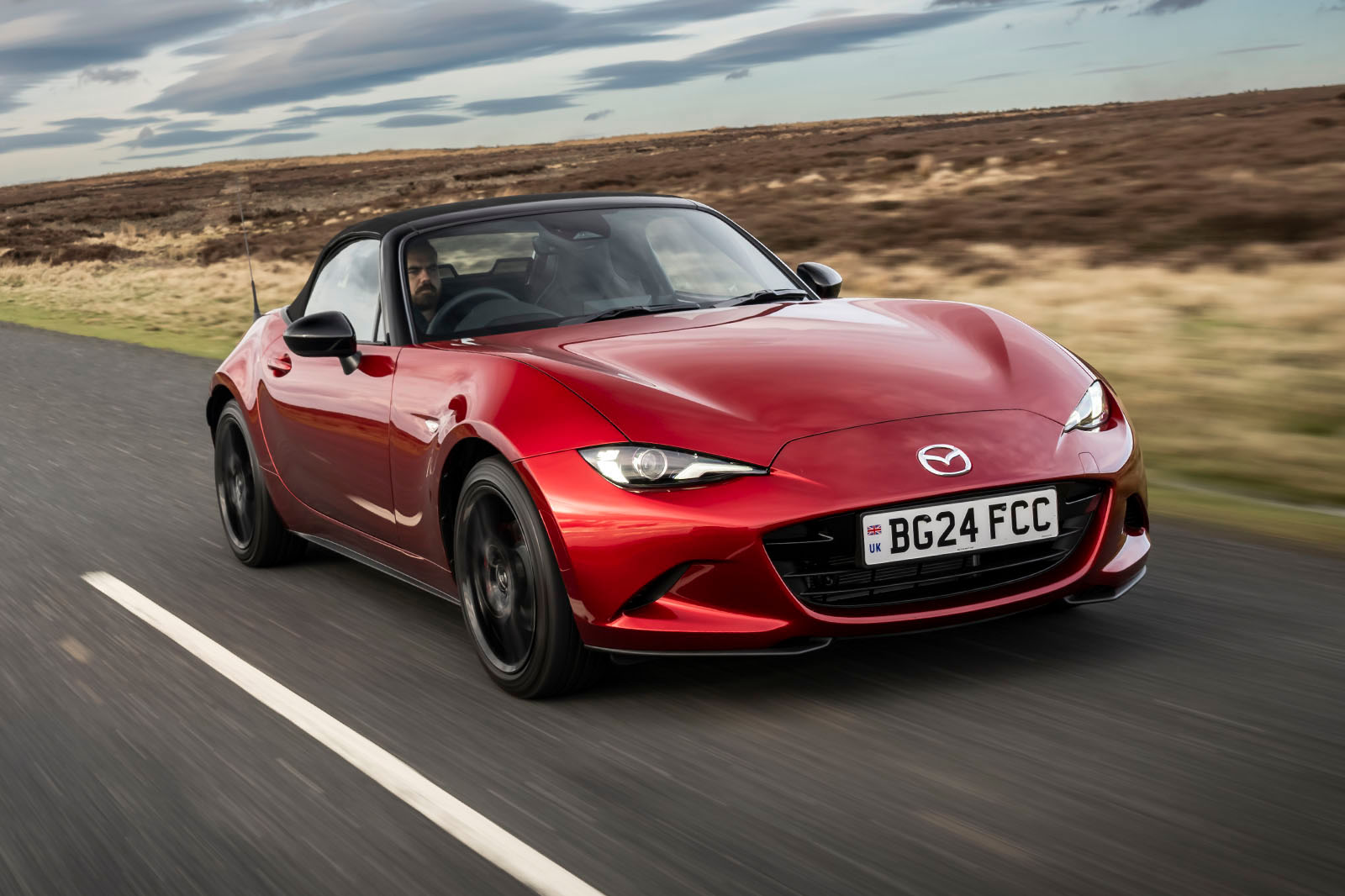
The MX-5 has become an incredibly rare thing: a mainstream sports car on its own bespoke platform. Mazda did manage to offset the development costs by sharing; it built the turbo-engined Fiat 124 between 2016 and 2019, but since that deal ended the MX-5 shares very little with any other car.

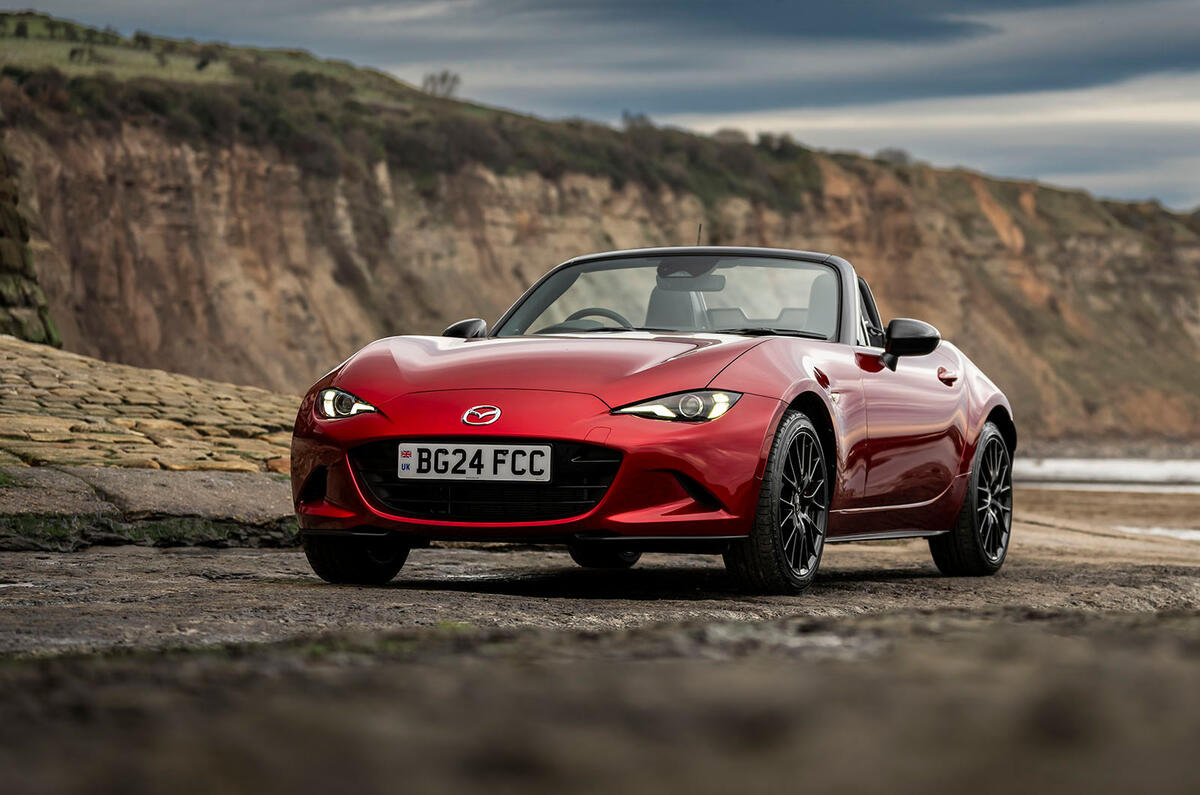
That sort of focused engineering does pay dividends. Being designed from the outset as a convertible means a lot of strength has been built into the centre tunnel. The front and rear crash structures, the bonnet, bootlid and front wings are aluminium, focusing weight around the centre of the car and reducing the polar moment of inertia. Then again, there’s not all that much weight to focus. Our high-spec 2.0-litre roadster came in at just 1060kg, and even the porkiest MX-5 weighs a mere 1096kg. That’s the RF (for Retractable Fastback), with its electrically folding targa roof.

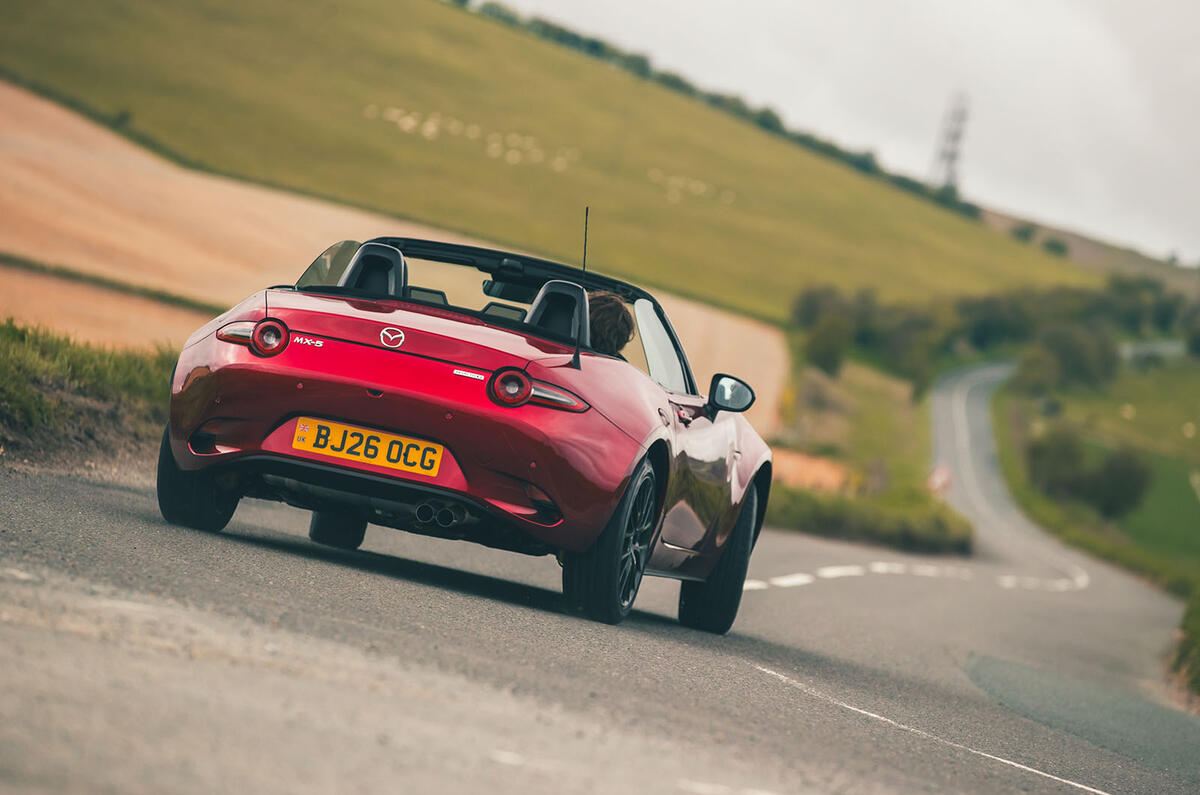
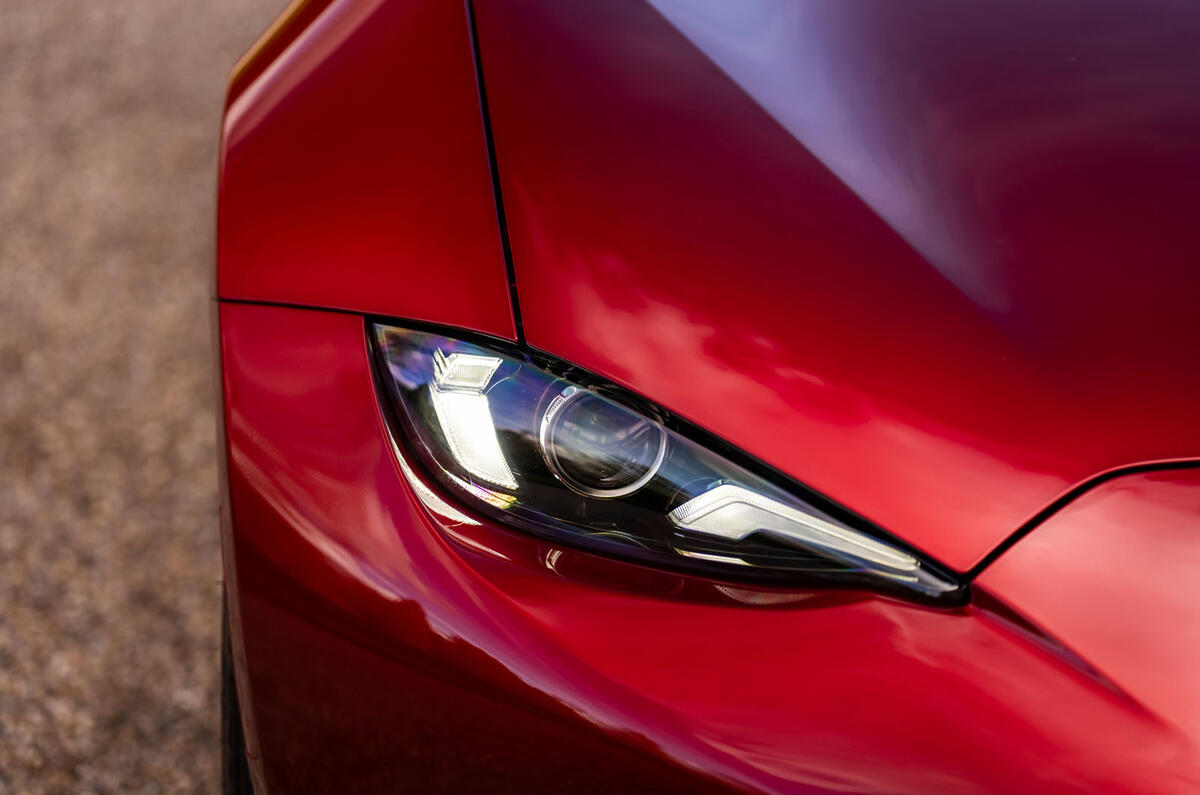
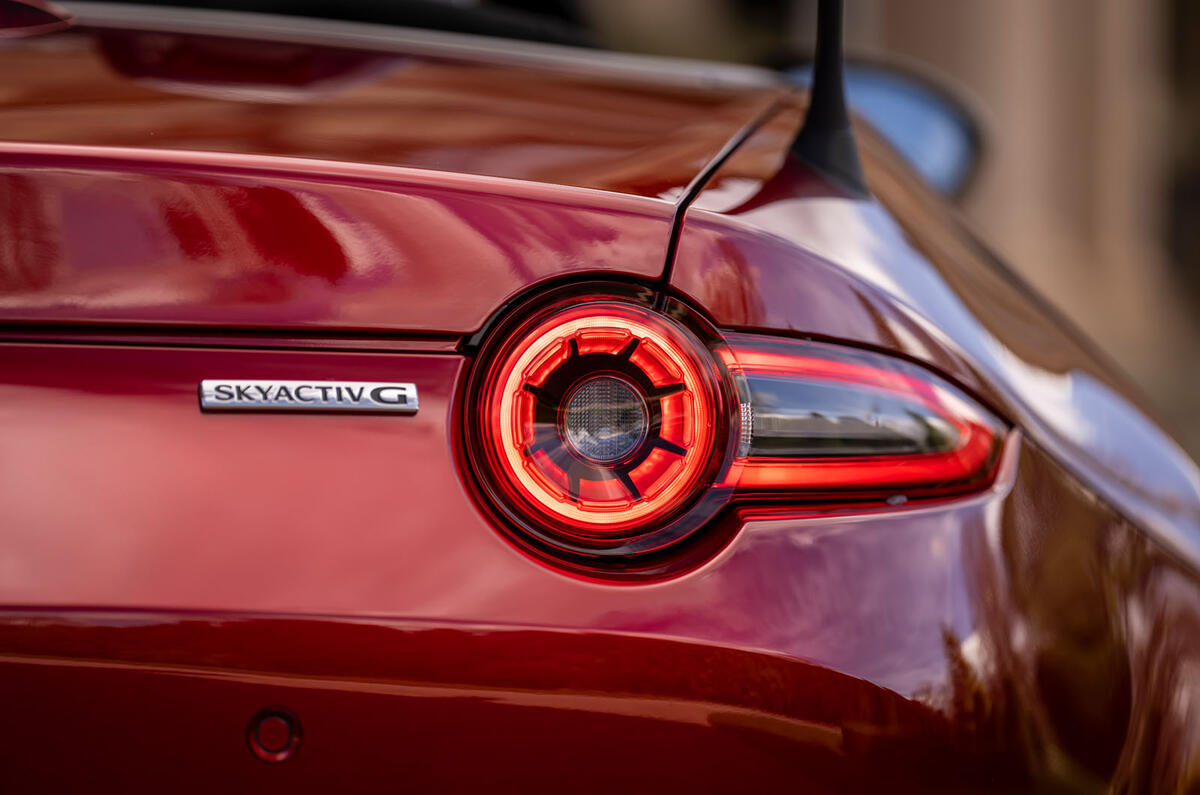
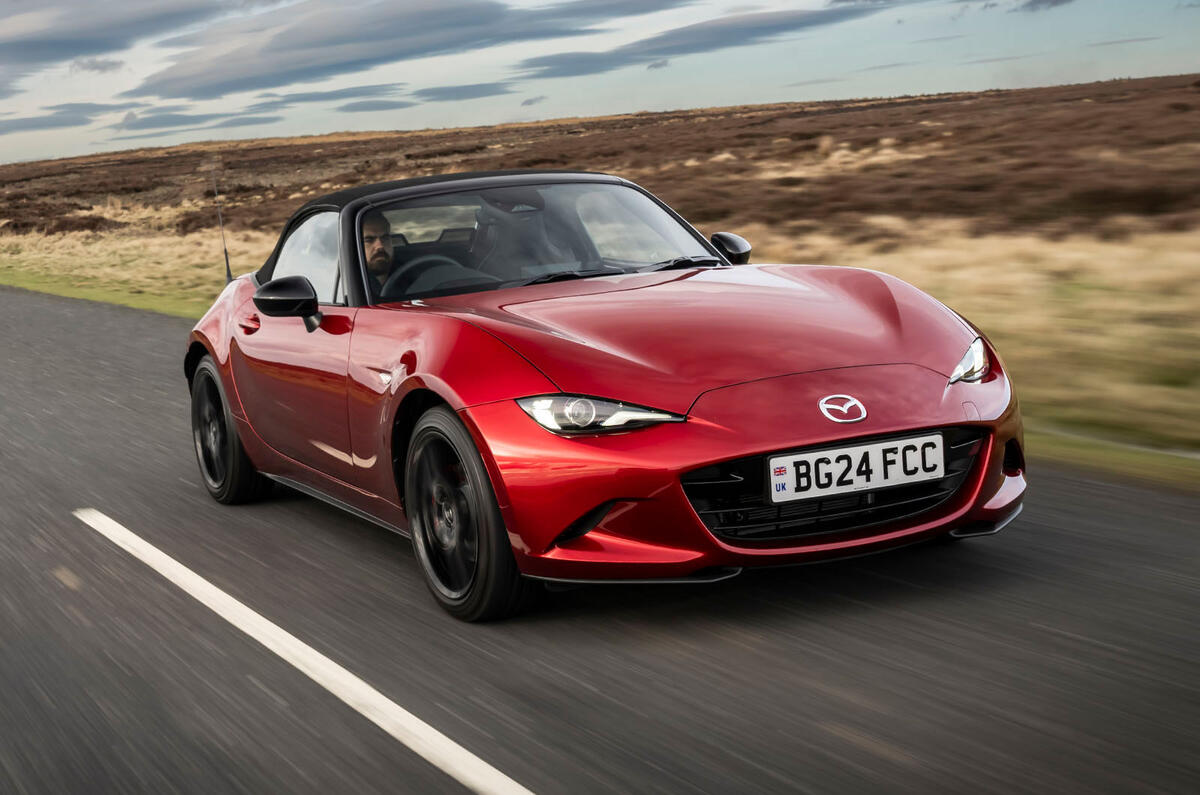
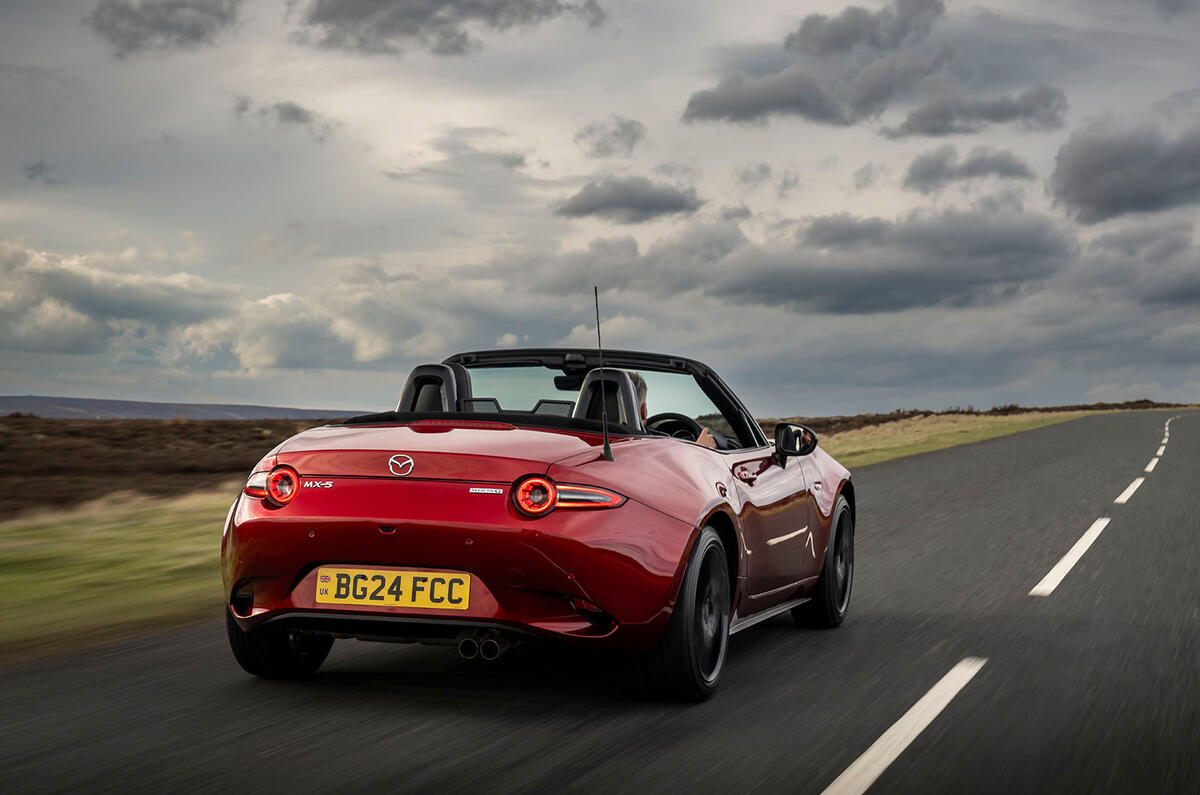
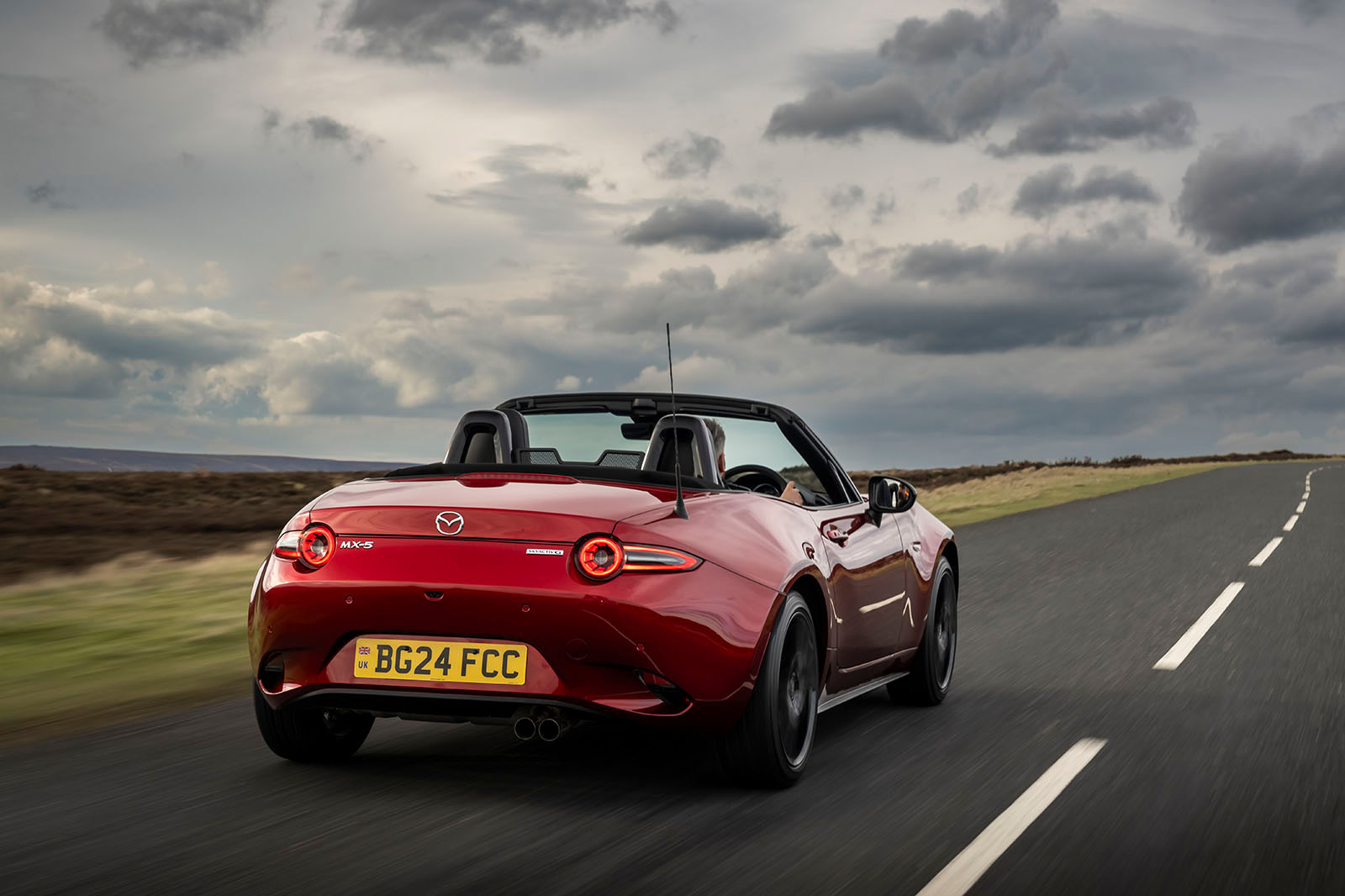
The design of the ‘ND’ MX-5 hasn’t changed much over the past 10 years, but you can tell you’re looking at an ND3 by the more intricate headlights and tail-lights. The rear lights gain a sort of jet engine pattern, while the headlights have a few more LED running light swishes.

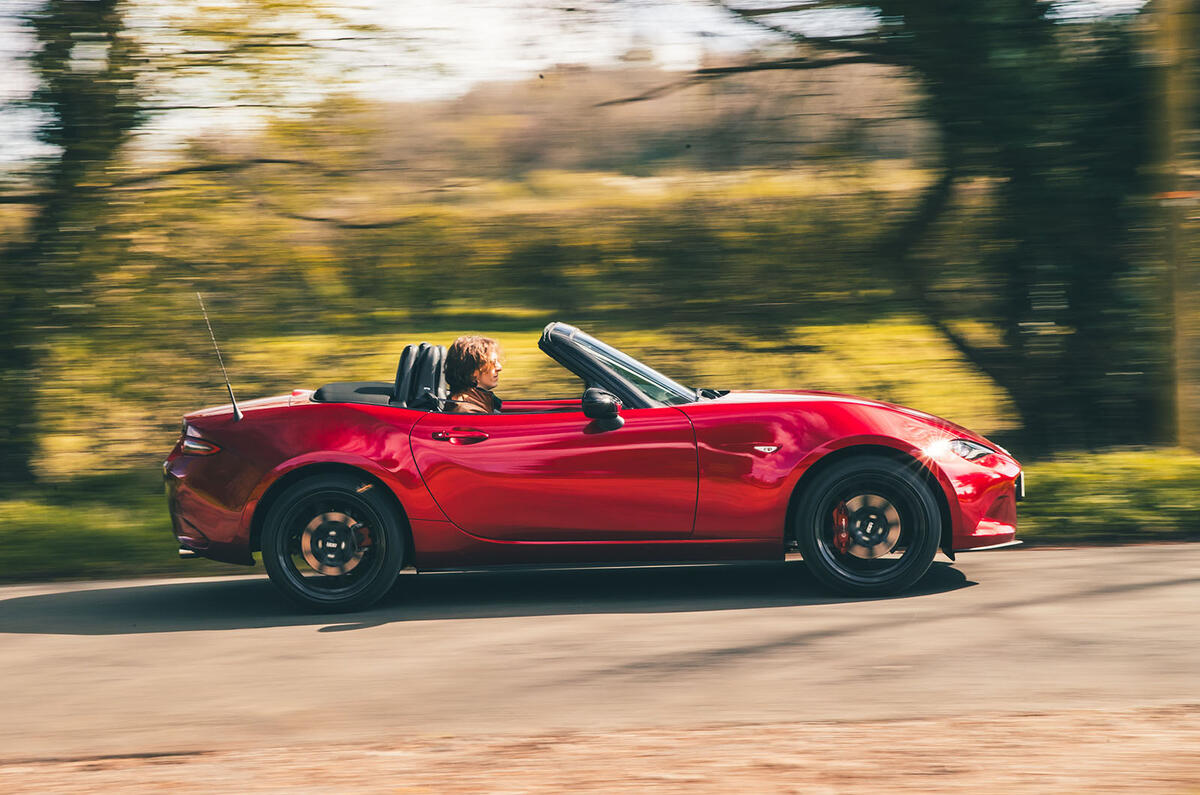
We would always go for the roadster, because the difference in refinement with the roof closed isn’t that big, and only the roadster gives you the full open-top experience. Its soft-top mechanism is also an astoundingly elegant piece of engineering that knows no equal – manual or electric. The way it’s sized, sprung and hinged means it needs just a single clip in the centre of the windscreen that you can undo with one hand, throw the whole thing back and click it down into place, even on the move. The reverse operation is just as easy. With a bit of practice, it’s possible to get the whole thing down to about five seconds.

In its mechanical specification, the MX-5 follows the classic sports car playbook, with a longitudinal engine, a six-speed manual gearbox and rear-wheel drive. The 1.5-litre and 2.0-litre naturally aspirated four-cylinder engines are derived from Mazda’s normal Skyactiv-G range, but most components are different compared with the ones you might have found in the 2 and 3, in order to make them suitable for the north-south installation. The gearbox is bespoke to the MX-5, and different from the one in the previous generation.

The MX-5 cognoscenti like to refer to the various generations as NA, NB, NC and ND, with big revisions indicated by a number. As such, we’re now up to the ND3. On the ND’s launch in 2015, the 1.5 felt like the engine the MX-5 was supposed to have despite its modest 130bhp output, as it revved both higher and more freely than the 2.0. For the ND2 in 2018, the 2.0-litre got a big upgrade, with lighter pistons and connecting rods, and revised camshafts, exhaust valves, fuel injectors and intake. This boosted power from 156bhp to 180bhp and gave it the same 7500rpm redline as the 1.5.

More recently, in 2024, the MX-5 was treated to some further updates. You’ll recognise the ND3 by the slightly more intricate LED lights, but more interesting are the mechanical upgrades. On all versions, Mazda has reduced the friction of the electromechanical steering rack for “more fluid and natural response”.

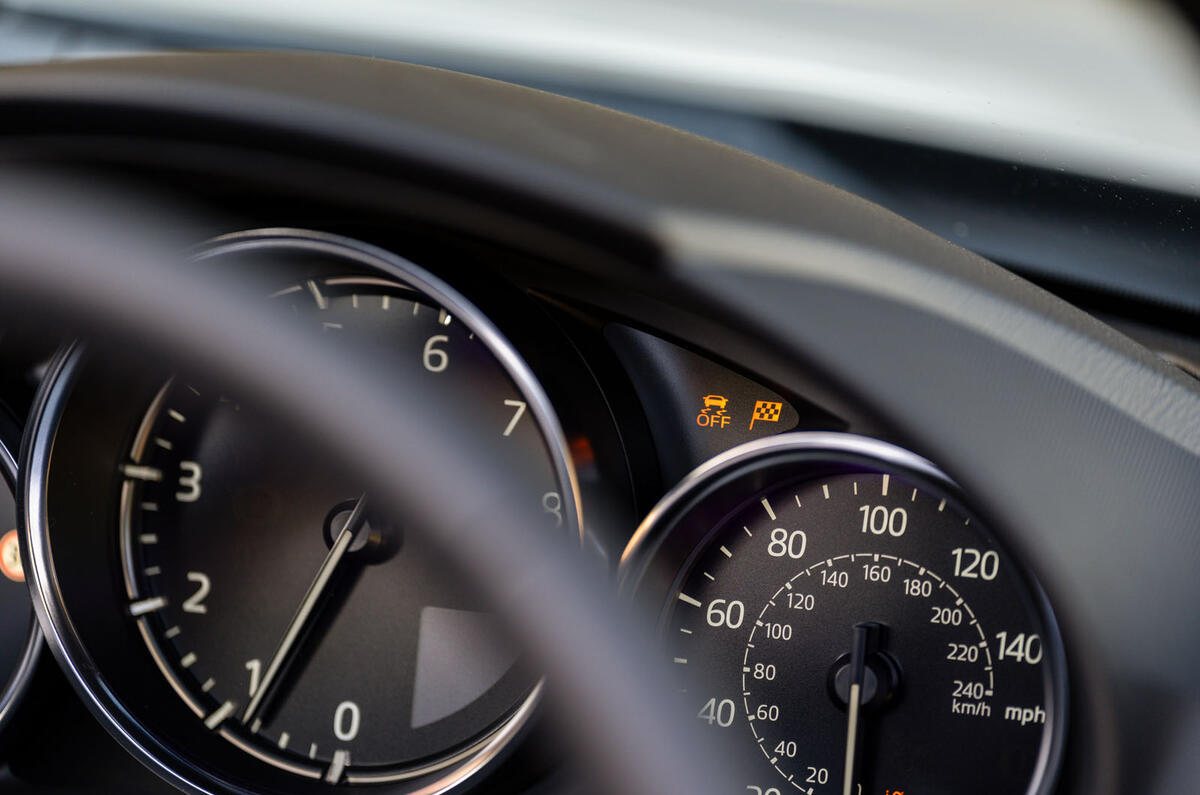
Specifically for the 2.0-litre, there’s a new ‘asymmetric’ limited-slip differential. It’s still mechanical, but a cam mechanism has been added to the conical clutch to make the locking force stronger on deceleration than acceleration, to quell the MX-5’s excessive keenness to rotate on a trailing throttle. Also new is the halfway-house Track mode for the dynamic stability control.

INTERIOR

8
Mazda MX 5 2026 007

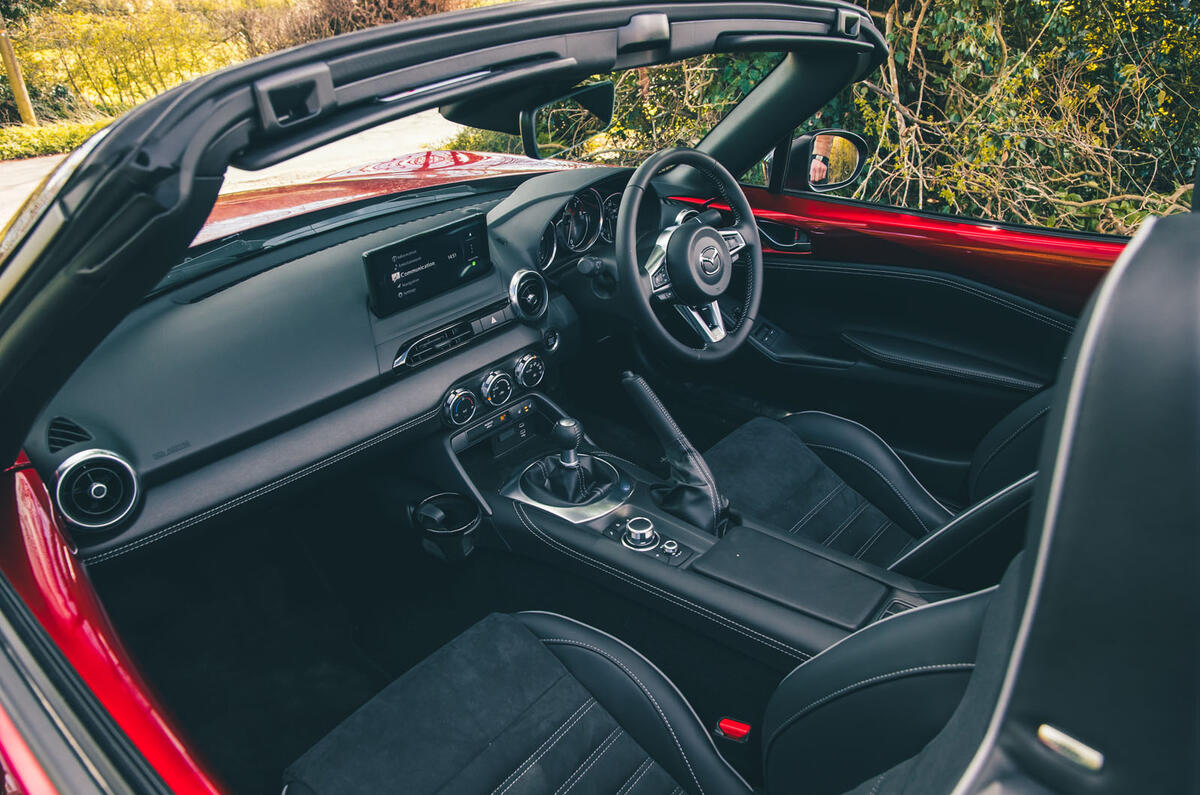
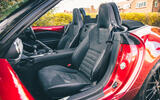
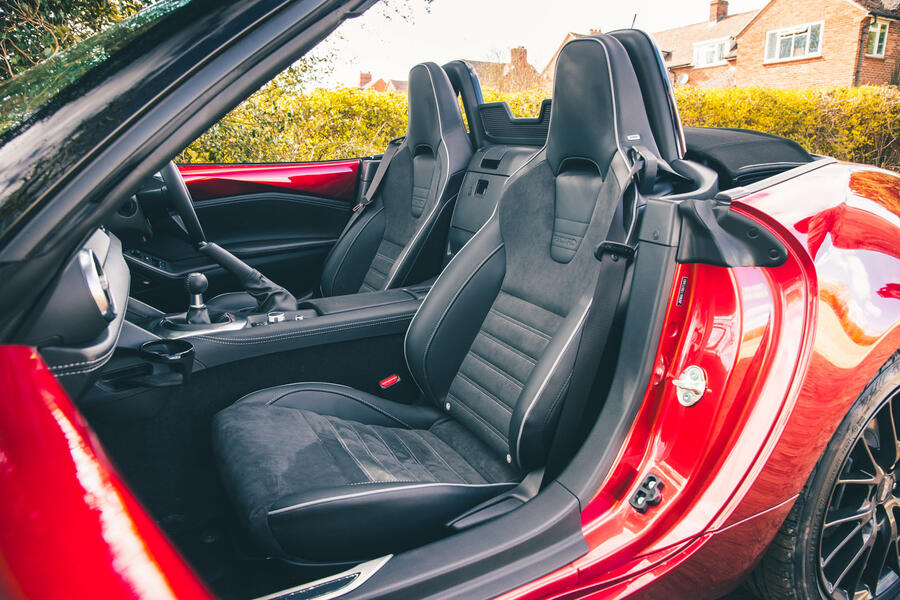
At a mere 3915mm in length (a BMW 2 Series coupé is 4537mm), yet packing a longitudinal engine under that long bonnet, the MX-5 doesn’t leave a great deal of space for occupants, so anyone coming from, say, a modern hot hatch might be shocked, on opening the door to an MX-5, at how cosy the interior is. As our leg and head room measurements show (1070mm and 930mm, versus 1180mm and 1025mm for the BMW 220i Coupé), there are limits to how big or tall you can be.

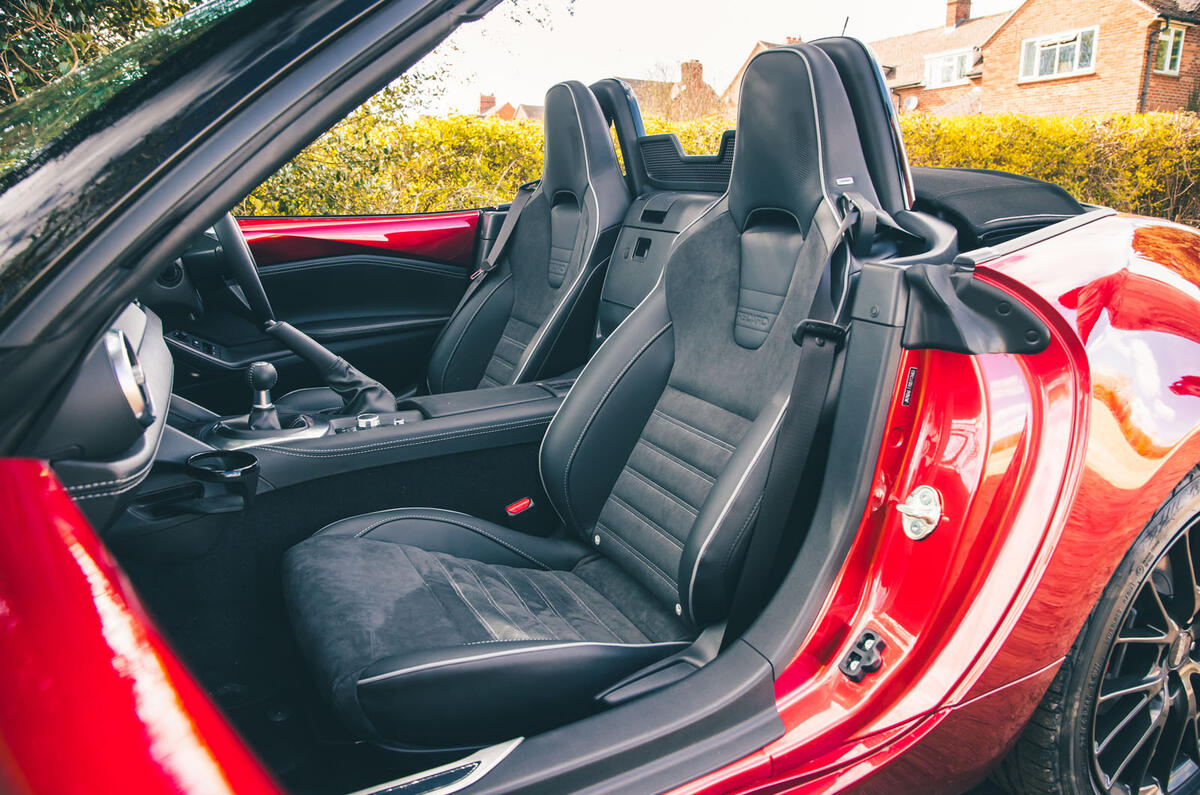
If you fit, though, you’ll probably be quite comfortable, thanks to plenty of reach adjustment in the steering (this was introduced on the ND2) and good thigh support from the seats. In this respect, it helps to buy a car with the Recaro seats, which come with Homura trim and also appeared on a few special editions in the past. These lower the driving position slightly (head room with the standard seats is only 880mm), offer better lateral support and generally have more comfortable padding.

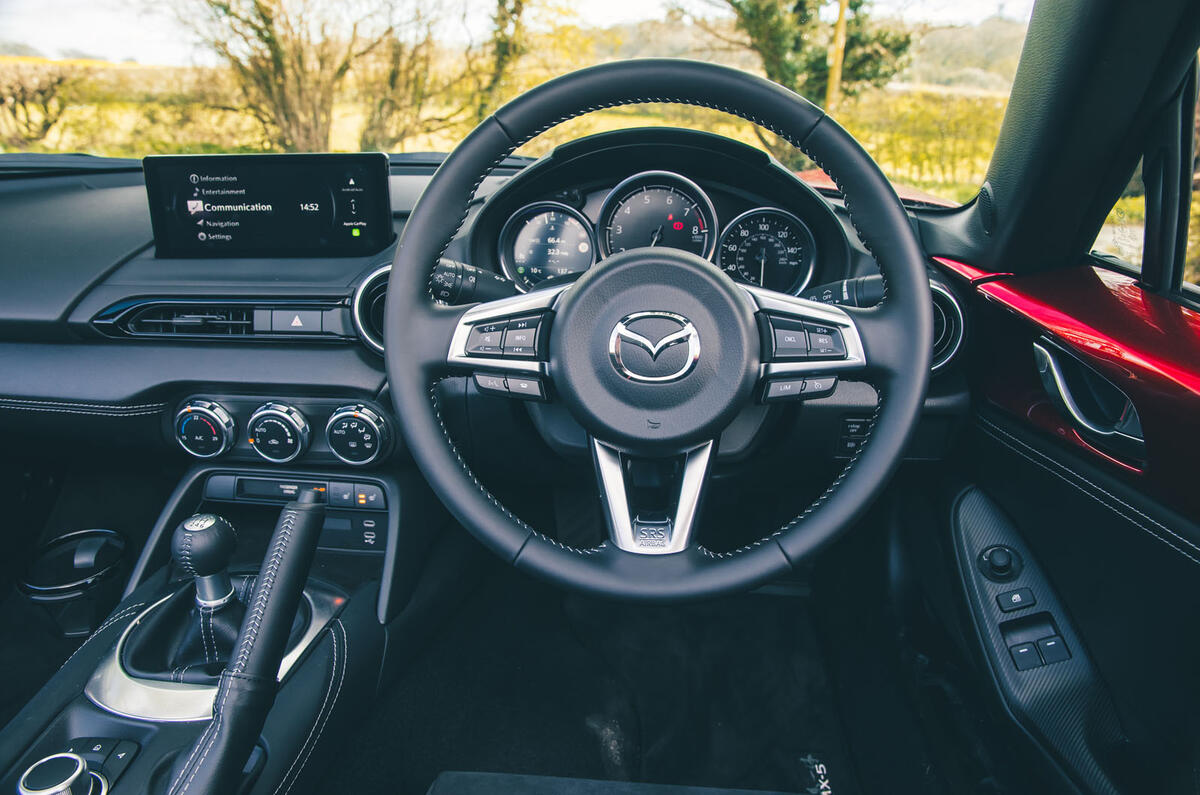
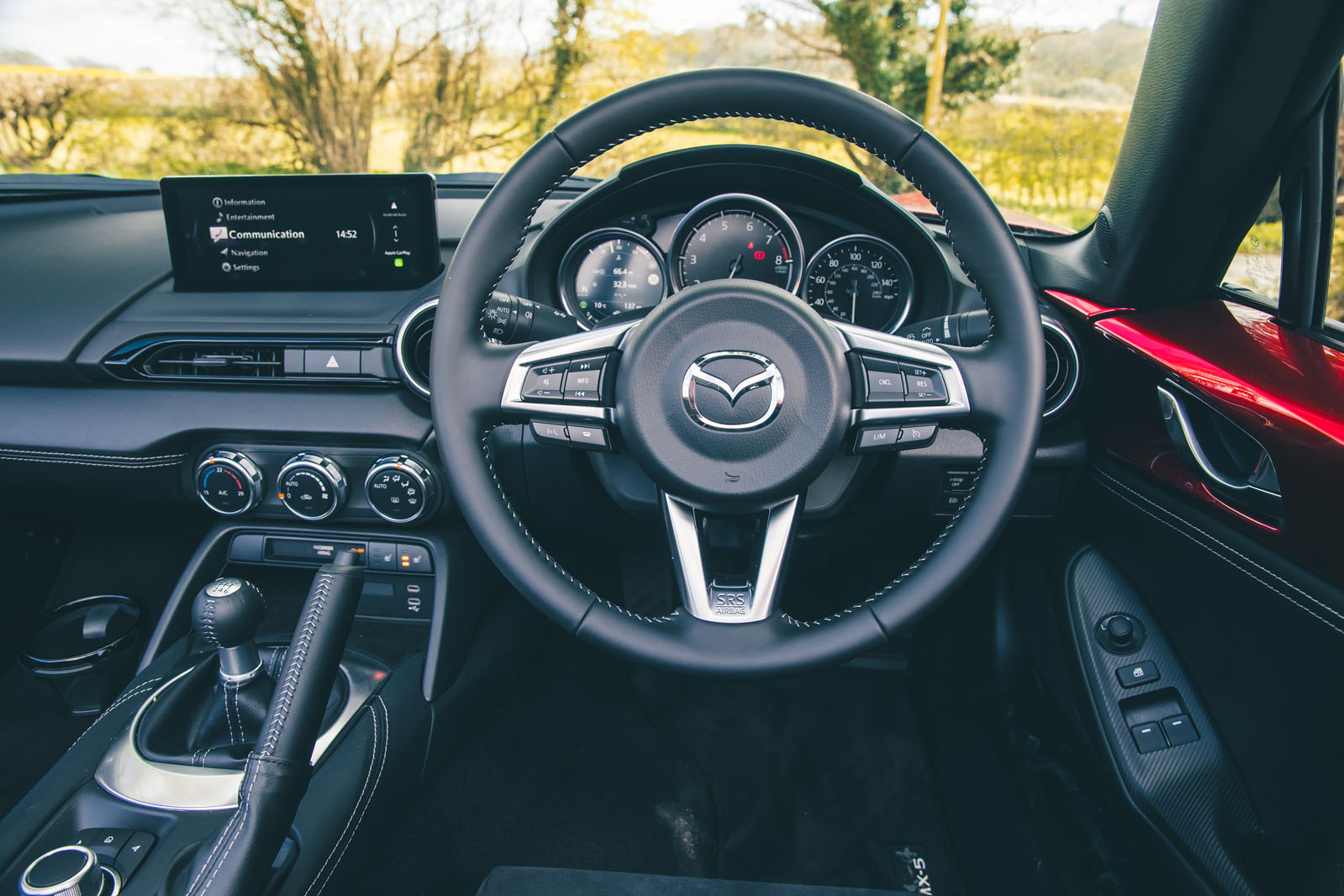
The steering wheel might be the best on the market: round, with the perfect diameter and a thin, firm rim. The selection of buttons it features is sensibly chosen, tactile and responsive.

The dashboard architecture is similar to that of the departed Mazda 2, which is no bad thing. More than 10 years on, the combination of organic curves and sharp angles remains attractive as it’s characteristically Mazda. You’ll have to look hard for soft-touch materials, but somehow it all manages to feel no-nonsense rather than cheap thanks to solid build quality and careful use of brightwork. Even so, it can’t be denied that the MX-5 wore its hard plastics more comfortably when its base price started with a one than it does today.

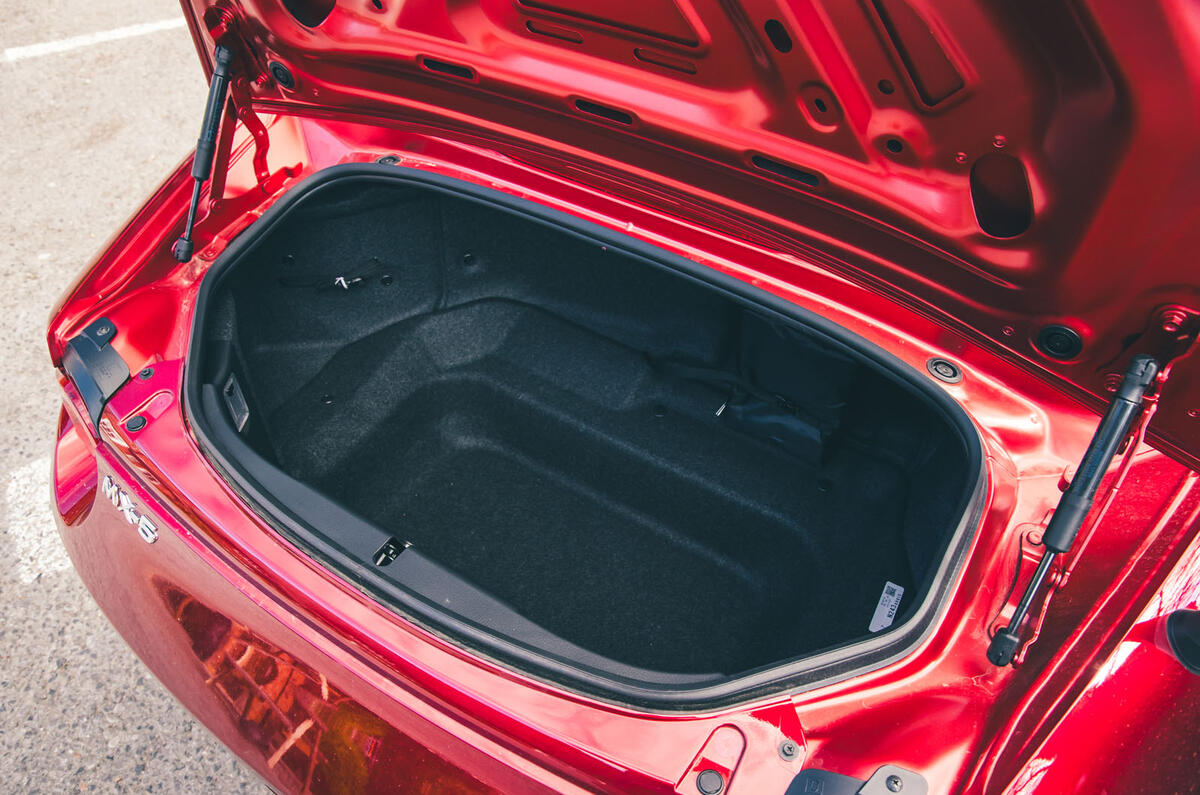
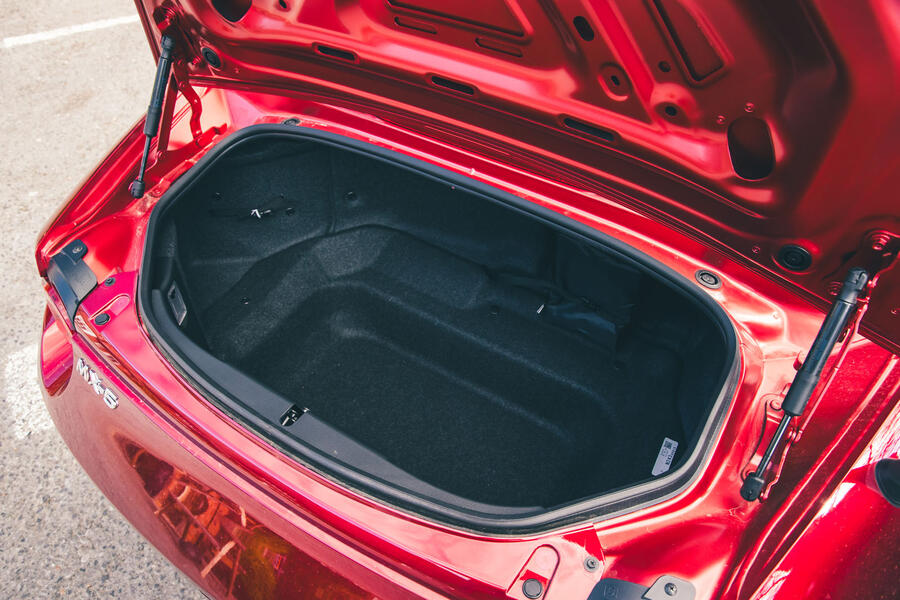
Such a compact car is also necessarily compromised on storage space. The only real cubby in the interior is the glovebox-sized one between the seats. The boot is somewhat unevenly shaped but fairly wide. With a bit of careful packing, a weekend away for two should be no problem at all. If you do need more, a variety of luggage racks exist on the aftermarket. The MX-5’s soft top folds away into its own dedicated compartment in front of the boot, so it doesn’t rob further space when it’s down.

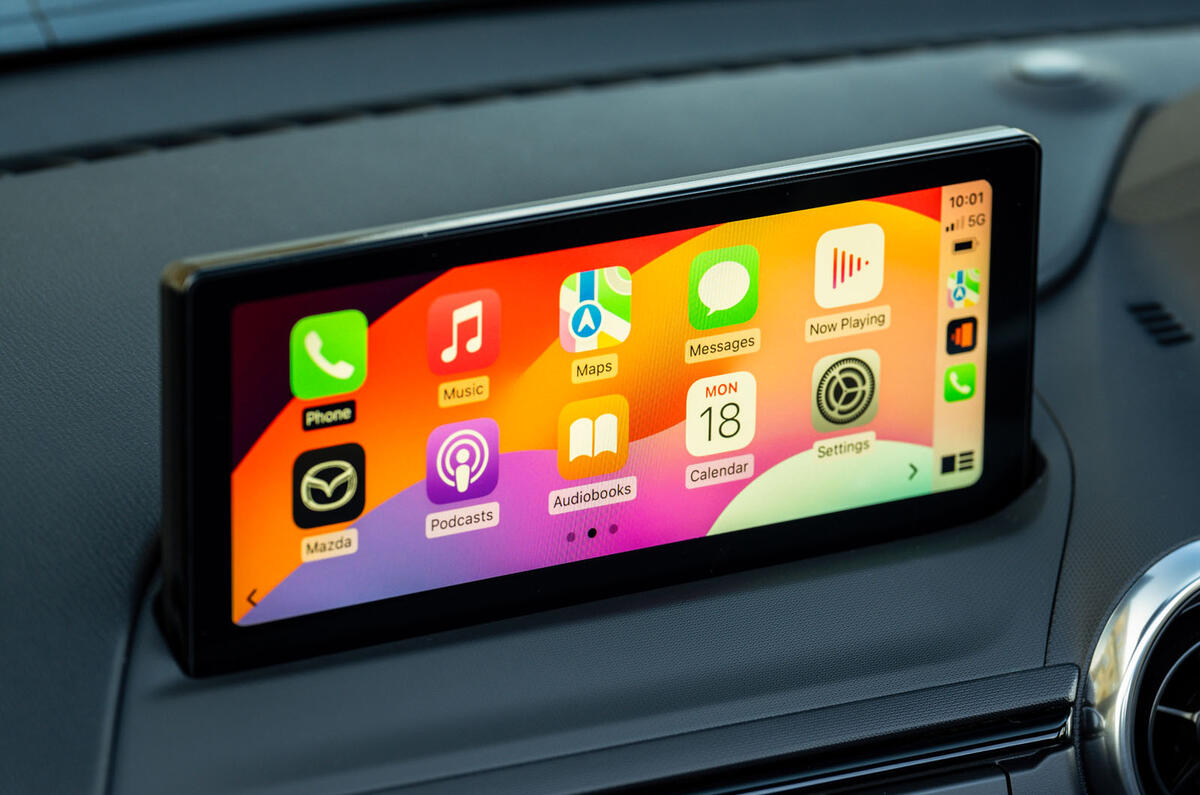
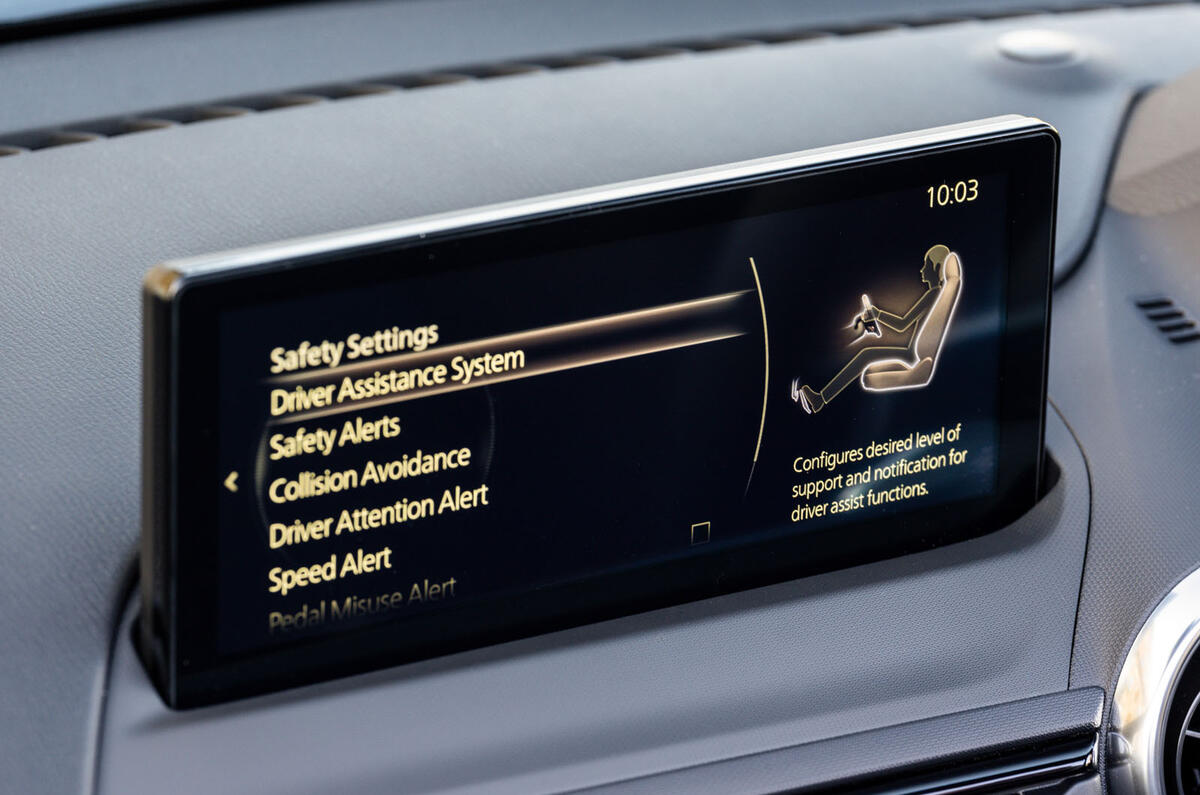
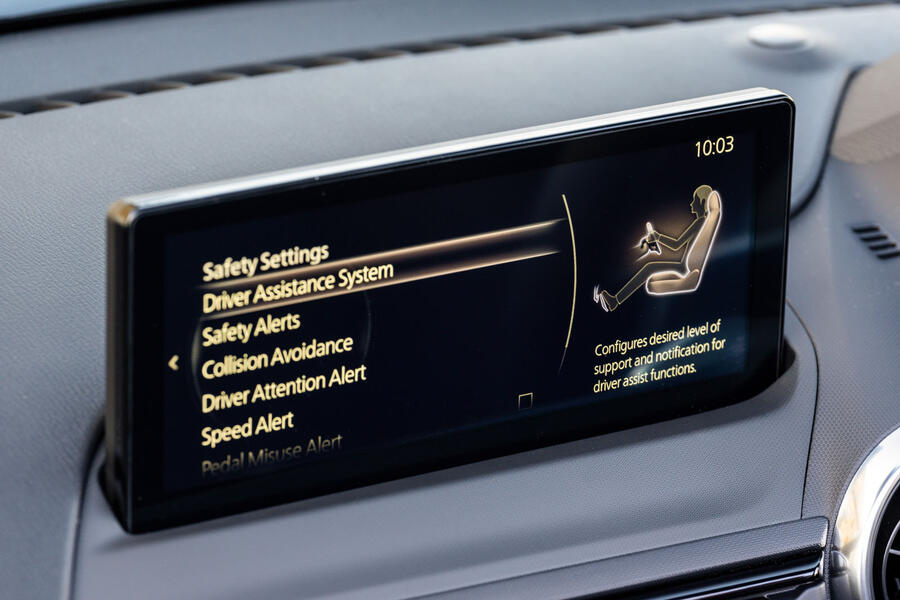
In terms of digital tech, the MX-5 gets the same infotainment system as most Mazdas, which is simple, elegant and easy to understand. The native menus are controlled exclusively with the rotary controller, whereas the wireless Apple CarPlay and Android Auto can be operated by touch, albeit only when stationary. This is slightly annoying, but easy enough to get used to.

ENGINES & PERFORMANCE

9
Mazda MX 5 2026 016

If you’ve never driven an MX-5 – or another modern petrol Mazda – pressing the clutch and thumbing the start button might elicit the question: ‘Is it supposed to sound like that?’ Mazda’s four-cylinders have a distinctive dry, nasal tone to them at low revs. Not unlike a Porsche GT engine that sounds broken at idle, then sings to the redline, the MX-5’s engine is smooth, and remains so when you wind the engine out to 7500rpm. Drop the roof, and the mechanical noise is overlaid with a decently rorty exhaust note from the twin pipes. All of this is true for both the 1.5 and the post-2018 2.0.

We were moderately impressed with the 2.0-litre MX-5’s straight-line performance at the proving ground. It’s easy to launch with just a bit of wheelspin, and the six-speed gearbox will slice through the gears about as quickly as you can move your wrist. Our test car hit the claimed 6.5sec 0-62mph time exactly and carried on with relative ease from there. Overall, it’s quite a bit quicker than a BMW 220i, and can just about keep up with the typical junior hot hatch. Being naturally aspirated, the MX-5 is left behind by turbo rivals in the 30-70mph in fourth gear metric. Indeed, if your goal is to go very fast in a straight line with minimal effort, you could buy a 429bhp MG 4 XPower for similar money, but the mechanical interaction is entirely the point of the MX-5. It’s all about the joy you get from revving out the engine and putting your best foot forward with the gearchanges.

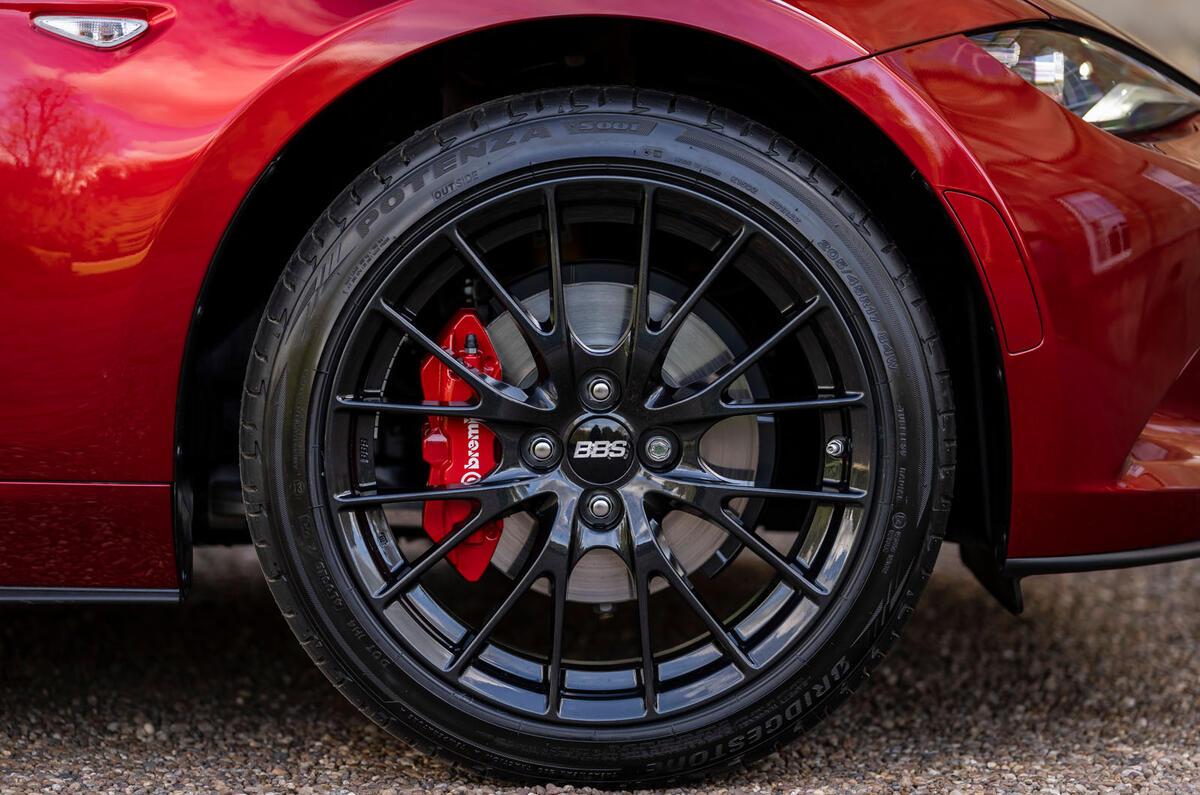
Wheel selection depends on the engine and trim. All 2.0-litre Homuras get these 17in BBS wheels. Mid-range Exclusive-Line comes on bi-colour 17in alloys with the 2.0-litre engine, or 16in with the 1.5. Prime-Line always gets 16s. Tyres are Bridgestone or Yokohama.

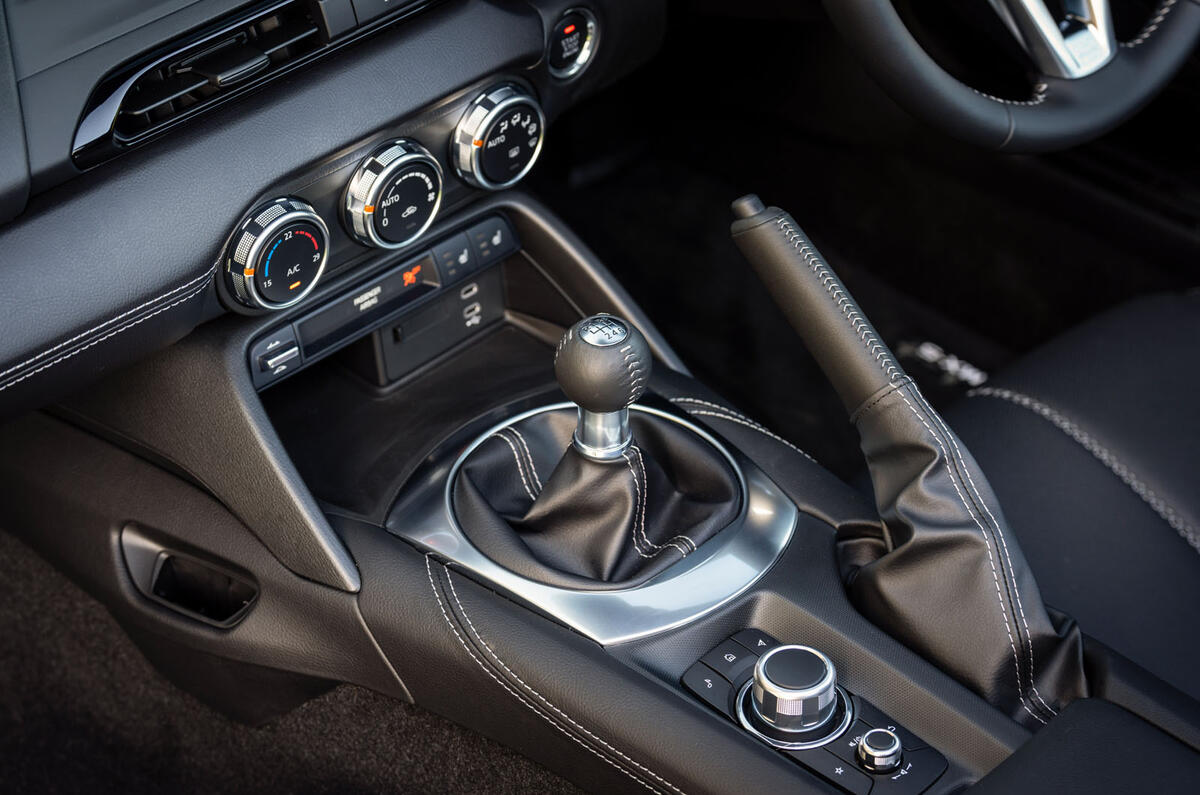
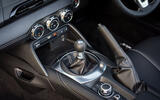
With the lever going almost straight into the ’box, rather than through long linkages, it’s probably the best manual gearchange on sale: short and with plenty of mechanical feedback, yet light and easy. Unlike on most other remaining manual driver’s cars, you actually get to use the gearbox a lot, since the MX-5 compensates for its dearth of torque with short, closely spaced ratios. It’s the same for the pedals. You get used to the right-offset soon enough, and the positioning of the accelerator and brake pedals makes heel-toe rev-matching supremely easy. The clutch pedal is light enough never to be a chore, but not so light and indistinct that it feels disconnected. An MX-5 is simply huge fun, even when you’re just trundling through town, which is unheard of in modern cars.

We do have one major criticism, and it concerns the braking performance. The pedal is firm and progressive, and with the upgraded four-piston front calipers on Homura trim (other versions get single-piston calipers), we observed no notable fade. However, a braking distance in the dry from 70mph of 49.5m is about 5m longer than we would expect, particularly for a car that is likely to be used on track. Braking distances in the wet were acceptable. We are tempted to blame the Bridgestone Potenza S001 tyres, which are now several generations old.

RIDE & HANDLING

10
Mazda MX 5 2026 017

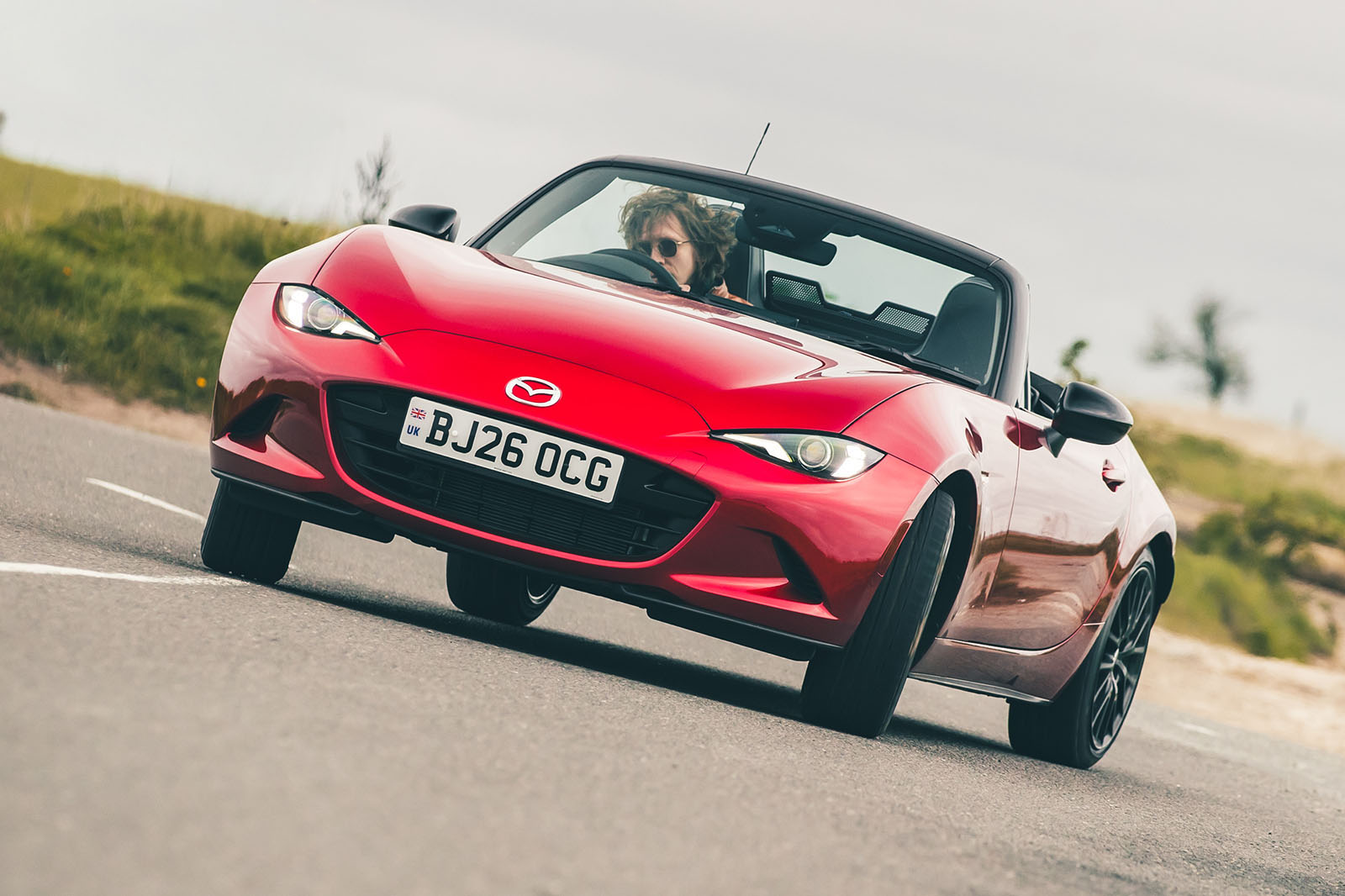
The MX-5’s engine and gearbox combination already makes it one of the most fun cars on sale today, and the handling is equally enjoyable. Just like Mazda could probably have made it faster at the expense of engagement, it has prioritised fun over outright capability in the chassis. In purely objective terms, lateral grip is limited and there’s a lot of body roll. But while that would be inappropriate on a BMW M5, the MX-5 makes a virtue out of its playfulness, because you don’t need to drive it especially fast to feel like something is going on. The relatively light, calm steering constantly feeds back subtle messages about load and grip levels through the thin-rimmed wheel, which lets you exploit the outstanding balance. Because you sit quite low, you tune into the body roll quickly enough, and you can play with the weight transfer. The MX-5 responds very well to planting the nose on the entry to a corner. Thereafter, your right foot determines whether you exit the corner neatly, with just a hint of oversteer, or sideways. The way it adopts a bit of yaw through faster corners is a rare delight.

Mazda says the new DSC Track mode was specified with “first-time track drivers in mind”, but we found it ideal for the road, letting you freely enjoy the MX-5’s handling, with a safety net that stops any slides from getting especially big. If you do take your MX-5 onto a circuit, you’ll find a brilliantly instructive track car. Anything you may want to learn about rear-drive balance, understeer, oversteer and weight transfer is there for the taking. The more experienced driver is still in for a great time making the most of the MX-5’s power and grip levels, or throwing into drifts at will. The really serious track-day enthusiast will of course wish for a bit more power, grip and body control – the MX-5 ultimately lacks some precision and can fall into clumsy oversteer even when you’re not provoking it. That’s where the aftermarket comes in.

It's delicate and perfectly balanced, although the ride lacks some of the original's fluency.

A brief note on the 1.5 version: it feels superficially similar, but its open differential and modest power mean it rewards conservation of momentum over throttle-adjustability. Some might call it purer, but we find it a little more one-dimensional – still highly enjoyable, but we would always go for the 2.0-litre if offered the choice.

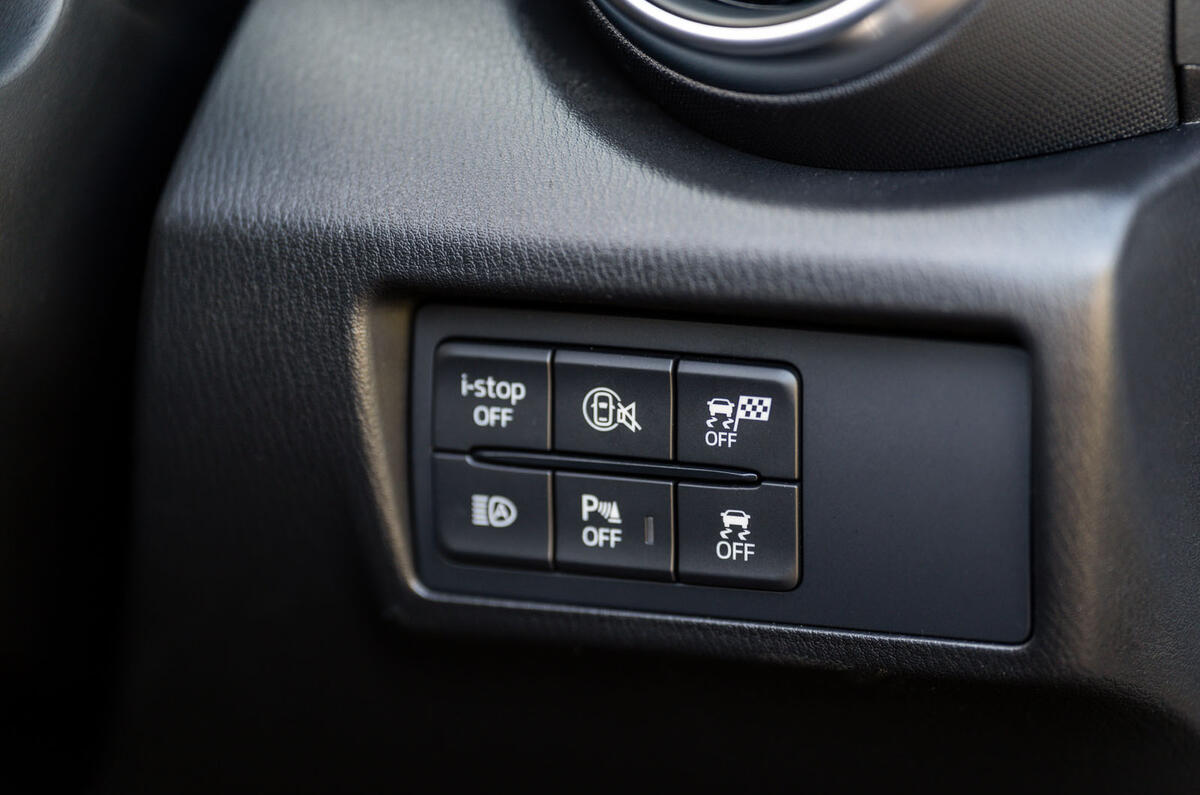
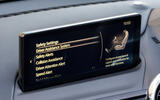
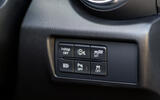
On ADAS, the MX-5 is almost good. Mazda keeps things basic, with normal cruise control rather than anything adaptive, but there are useful things like blindspot monitoring and quite effective adaptive headlights. The overspeed warning can be disabled with a press of a physical button, but the lane keeping assistance is rather more persistent. There’s a setting in two different menus that needs to be turned off. On the upside, it’s not the worst we have experienced when left on, and setting the stability control to Track mode (via a physical button) also turns off the lane keeping assistance.

Comfort and isolation

Comfort may not be your first priority for a sports car, but again, the MX-5’s fundamentally sound set-up means it is remarkably free of compromise. The soft suspension gives it a very compliant ride that soaks up both rough town roads and big bumps on B-roads.

Some will wish Mazda made a coupé version, because it would solve two of the MX-5’s issues. The first is the wind and road noise at a cruise that penetrates the soft top. Second, there are some shimmies and shakes from the structure when you hit various bumps, but then some torsional rigidity issues are inevitable with a convertible that isn’t built around a tub. Subjectively, the RF isn’t actually that much better in either area.

MPG & RUNNING COSTS

9
Mazda MX 5 2026 001

The MX-5 is available with three trim levels and two engines. We would recommend the 2.0-litre Homura. All 2.0-litres get sport suspension with Bilstein dampers, a strut brace and the limited-slip diff, but Homura adds the upgraded brakes, lighter BBS wheels and Recaro seats. That said, the £28,605 1.5-litre Prime-Line is still the most fun you can have for the money.

Unlike some fun cars, which are only available in limited numbers, you can walk into most Mazda dealers and drive away in an MX-5. Given the engines aren’t Euro 7-compliant, it remains to be seen for how long that can continue. Since the Toyota GR86 was discontinued in 2024, the MX-5 has no direct rivals left in the affordable two-door sports car space. The BMW 220i Coupé and Mini Cooper are the closest two-door sporty cars but offer very different experiences. Beyond that, you’re at the mercy of the used market.

These days, the MX-5 is well equipped whichever trim level you go for.

By contrast, a new MX-5 should be fairly painless to own. It falls under the same six-year/100,000-mile warranty as all other Mazdas, and they tend to be very reliable. It will do 40mpg on the motorway, and even if you thrash it on a track day, the fuel consumption shouldn’t break the bank.

LONG-TERM REPORTS

Read our full long-term report here

How comfortable were the seats?

My long-term MX-5 came with Recaro seats – part of the Homura specification. They’re the best that Mazda offers, as they’re just the right side of firm and very supportive. 

The seating position - low and centred - is nigh-on perfect and the benchmark for sports cars. I drove the car from London to Wales, completed a track night, then drove back to London the following morning and experienced nothing but comfort.

Did real-world fuel efficiency match the manufacturer's claims?

My long-termer has the 2.0-litre engine. Mazda claims a WLTP figure of 41.5mpg. My test of around 2000 miles included motorway town and track drive, and it resulted in 39.1mpg.

This is really strong. So often we see manufacturer’s WLTP figures being fairly unachievable in real-world conditions, but the MX-5 excels here, because of its lightweight and long sixth gear, meaning it’s pulling below 3000rpm at motorway speeds.

Was the infotainment system responsive and intuitive?

The infotainment screen is fast and responsive, and I never had any issues hooking up with Apple CarPlay. 

But I found it irritating, because the touchscreen can’t be used on the go and you have to use a rotary controller. This turns some functions, such as switching between Spotify and Google Maps on Apple CarPlay, into about 15-20 turns of a controller rather than two prods of a screen.

How practical was it for regular use and trips?

The MX-5 is not a large car. The boot is quite narrow, but it’s big enough for a typical shop for someone without kids. There’s a little bit more storage inside the cabin, with a lockable box behind the seats. 

It has two cupholders too, although these are slightly awkward to get to. They’re behind the driver, so you need to make a conscious effort to turn your torso rather than simply extend an arm.

Were there any hidden costs or unexpected foibles?

There were no hidden costs whatsoever. The Mazda was truly reliable during my time with it. The only slightly unexpected thing was the regularity of which I needed to top up with windscreen wash. The reservoir is tiny.

Aftermarket company MX5 Parts sells a fabrication that gains another litre for about £350, which I think is well worth it.

VERDICT

Mazda MX 5 2026 018

Apart from the hardcore Caterham Seven, the MX-5 is now the only sports car left under £50,000. Even if it wasn’t the class leader by default it would have a good shot at it, because with a brilliant rear-wheel-drive chassis, a delightful manual gearbox and proper sports car packaging and style, it’s an outstanding two-seat roadster.

Like any car that is built to a price, there are certain compromises. The interior won’t fit everyone, and some will wish for a wider range with a coupé, and more power, grip and precision. But the bottom line is this: you will struggle to have more fun in a new car with a warranty for twice the money that Mazda charges for an MX-5, let alone for the same money. An MX-5 can be a daily driver, Sunday cruiser or track toy, or all of the above. It is the definitive sports car.

On most cars, if you have the ESC in Sport mode, engaging the cruise control turns it back on. In the MX-5, the same happens, but when you then disengage the cruise again, the ESC goes back to Track mode. It means you can easily use cruise control in between nice roads. Little details like this show that the MX-5 was made by and for driving enthusiasts.

Illya Verpraet

Illya Verpraet Road Tester Autocar
Title: Road Tester

As a road tester, Illya drives everything from superminis to supercars, and writes reviews and comparison tests, while also managing the magazine’s Drives section. Much of his time is spent wrangling the data logger and wielding the tape measure to gather the data for Autocar’s in-depth instrumented road tests.

He loves cars that are fun and usable on the road – whether piston-powered or electric – or just cars that are very fit for purpose. When not in test cars, he drives an R53-generation Mini Cooper S or a 1990 BMW 325i Touring.