Currently reading: New Jaguar GT driven: it rides like an XJ, drifts like an F-Type

The Type 00 EV is an entirely new kind of Jaguar – but still a Jaguar nevertheless

There was a misconception - and I think they unwittingly or not contributed to it - that Jaguar's bosses weren't interested in its past.

The messaging was all new new new; the design chief's line was that Jaguar had "no brand equity"; the old shapes had gone; the old logos had gone; car production was stopping. Everything old had been cast aside in a frenzy of a pastel moonscape future.

The truth of it, at least from the perspective of Jaguar's engineers, was rather different. They understood that things needed to change (had the company been selling 100,000 or more cars a year, they might not have done), but their preparation work on this, a new electric luxury Jaguar, didn't involve abandoning everything that had come before.

By the time we had seen the adverts, the new car's final design had already been picked. From some 17 different full-size clay model options, the bosses had chosen this one. (Whether you would prefer to alternatively end that previous sentence with a question mark and/or an exclamation mark is entirely up to you.)
The task from that point was to decide on the car's character and to help shape that, senior designers and engineers pulled an array of previous Jaguars from their collections and from the Jaguar Daimler Heritage Trust and spent days poring over their details, their characters and, just as importantly, their dynamics, as they set out to define how exactly a modern Jaguar should drive.

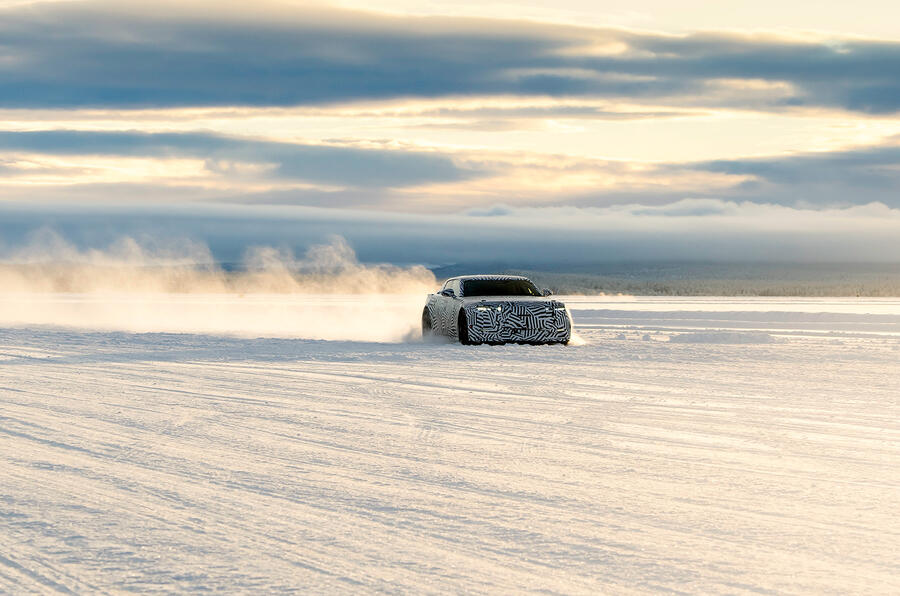
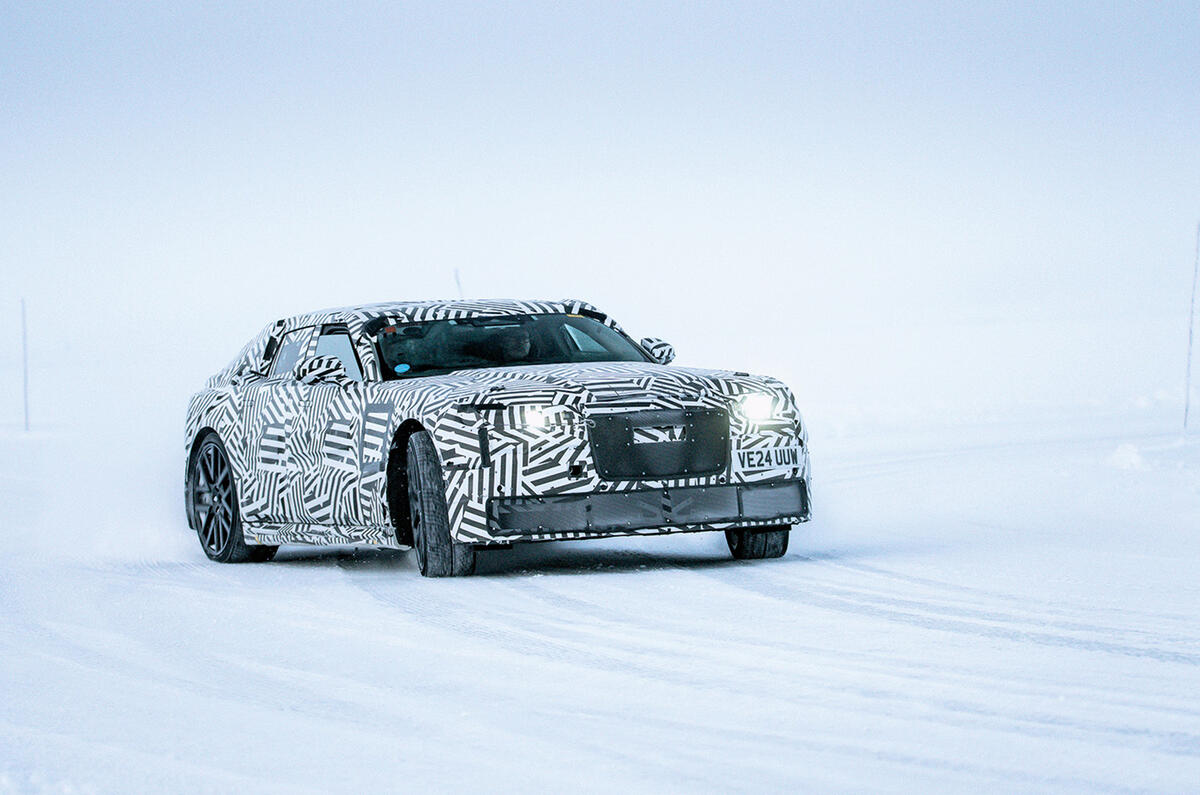
Which brings us now to Revi in northern Sweden, 60 miles shy of the Arctic Circle, and to the million square metres of frozen lake where JLR conducts its winter testing. A small number of the 150 Jaguar prototypes (it's still officially unnamed, so let's go with Type 00, the name of the concept) are here now, alongside various Land Rovers and 80-90 JLR engineers.

The British company has been coming to this area near Arjeplog for more than 40 years, like the rest of the European car industry and more besides, because of the consistent conditions for making sure that things work as they should. Unlike my nose hairs, which, rather unsettlingly, have frozen in the -15deg C weather.

Jaguar's people introduce the car to us with lots of use of the word 'about' – approximations of numbers that will be confirmed later. We won't see the finished Type 00 until late summer, you won't be able to order one until the autumn and it won't reach people's driveways until next spring.

But there are new things we will find out now. Including what it's like to drive – in these conditions, at least.

Back to top

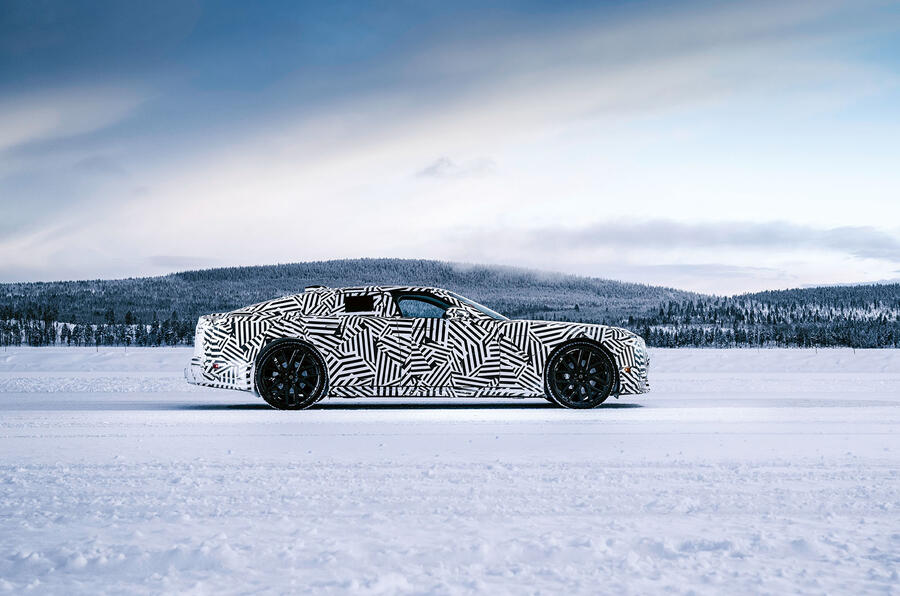
So what is the new Jaguar? 'A four-door GT' is the distilled answer. At just over 5.2m long, it's a lengthy car, but at less than 1.4m tall, it's a low one too.

There's no word on width yet – although it feels quite wide – and it has a long bonnet, a short (877mm) front overhang, a 3.2m wheelbase and a 1158mm rear overhang.

Some of these things you might be able to tell just by looking at this still-disguised prototype – but there's more. Chief engineer Jon Darlington and head of propulsion James Matthews raise a prototype, with its left-hand wheels removed, on a vehicle lift in one of JLR's on-site workshops that borders the lake edge to show me around and underneath the new car, which sits on JLR's new Jaguar Electric Architecture (JEA).

Because of the demands and complexities of the Type 00, "there was not an [existing] architecture internally that we could use", says Darlington.

This walkaround demonstration gives me a good sense of scale and where things sit. There's a full 903mm between the front axle and the driver's footwell, which looks like and I'm told is a big distance by automotive standards. The driver's hip point is back where front and rear doors meet, a long way farther rearward than would be normal in a luxury car too. There are conventionally opening doors and B-pillars, due to JLR's internal roof-crush standards (at least twice the regulatory minimum, because Land Rovers are designed to crash off road), which wouldn't allow a pillarless cabin of this length.

Back to top

The centre of gravity – low on most EVs but particularly on a shallow-bodied one like this – is 60mm below the hip point. The yaw centre, about which the car turns, is roughly where the front occupants sit and the weight distribution is 50:50 front to rear.

There are two-chamber air springs all round, double wishbones at the front, an integral-link arrangement at the rear, Bilstein DT Sky adaptive dampers ("basically an industry benchmark", says Matthews) and, thanks to the low centre of gravity, relatively thin and passive anti-roll bars.

Active bars are cumbersome and munch valuable 12V electrical power; the Type 00 being so low means they're unnecessary.

Jaguar is promising at least 1000bhp from the launch model (other variants may follow), via one 350bhp electric motor at the front, where torque vectoring comes via mechanical braking, and 950bhp from two rear motors, which vector torque in new, much faster and better-responding digital fashion: the motors are monitored 1000 times a second for wheel slip.

Calculating full power isn't as simple as adding the three motor outputs together, but torque is: there's 959lb ft. There will be three drive modes, which will adjust the suspension settings, steering weight and, probably more importantly, torque distribution.

The Type 00 is 50-75% rear-biased in rain, ice or snow, 54-80% in Comfort mode and 65-98% in Dynamic mode. Jaguar would like the car to have rear-driven feel with the security of four-wheel drive.

Back to top

All the motors are permanent magnet ones, but the front one is wound differently to be a little more efficient, and at a motorway cruise the car can drive on just that alone to maximise range.

A battery of about 120kWh capacity will give the Type 00 a range of around 400 miles (on the Americans' more representative EPA test cycle; it will be 430 miles according to WLTP).

The JEA doesn't have a typical skateboard-like layout: there's a 19kWh (32-cell) pack near the cabin's front, then another four stacks of 42 cells further back. Because the cells aren't arranged in one big piece (unlike, say, in BMW's new Neue Klasse EV platform), Jaguar has been able to keep the car's occupants lower. Rear passengers have a footwell between the rear packs, while the front seats (which will have the thinnest bases of any Jaguar) nestle reclined slightly into this gap too.

As a result, "the driving posture is only a handful of millimetres from the F-Type's", explains Darlington. And because the battery is at bum rather than foot level, the packs can be taller than in some cars while maintaining a low roof. "Every 1mm of additional battery height is worth an extra 1kWh of battery size," says Matthews.

From underneath, you can see that there isn't a lot of wasted space in what is Jaguar's stiffest car to date, at 50,000Nm/degree of torsional rigidity, and its most aerodynamically efficient, having a Cd figure of less than 0.25.

Back to top

With that short front overhang and an upright stacked 'electric machine' at the front (motor on top of reduction gearset), there's limited crushable space there, so a large aluminium casting each side, locating everything from the front suspension to the A-pillar bases (a much greater distance than is normal, remember), helps dissipate frontal crash forces outwards to the sills.

The battery packs are stressed too, of course. In a side impact test, their structures absorb 70% of all crash energy.

There's no stowage space under the bonnet. Only at the very rear, where clearly there's no need for an exhaust, is what you might consider dead space. Jaguar has fitted a deeper boot box in there, big enough for a pair of overnight cases.

Shall we spend a few quick words on the recent newspaper report that JLR had asked its engineers to develop a range-extender powertrain for the Type 00?

JLR is adamant that one isn't coming, and indeed if you were looking to put a combustion engine in here, something else would have to go. A compact engine that replaced the front motor would be perhaps the most (only) sensible option, with a fuel tank where the foremost battery would be, or a small generator might fit under the boot floor. But this is clearly an electric car, and if you went looking for signs that the platform has V8-and-propshaft capability baked into it, you wouldn't find any.

The Type 00's wheels are huge, 23in as standard, with Pirelli summer, all-season and winter tyre options, all developed bespoke for this car and sized 255/35 at the front, 295/30 at the rear.

There will be a no-cost 21in option for some markets with particularly crummy roads (insert joke about the UK's here), but "it's not compromised on 23s", says Matthews. "We want the car to ride the best when it looks the best."

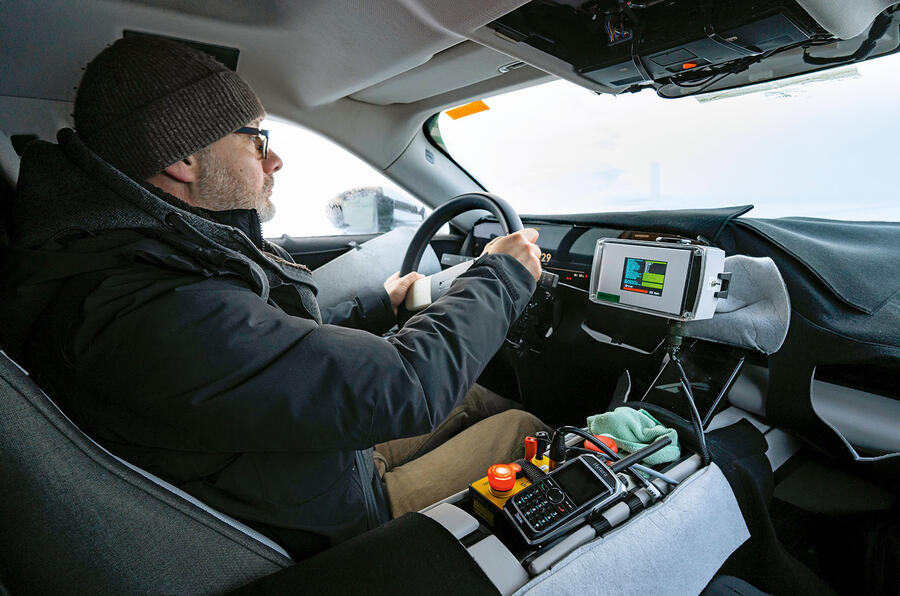
So let's see. I'm going to drive two different prototypes: one built in 2024, a vehicle dynamics team's car with stability systems switchable, and a later prototype built in October 2025 in 'key-on' mode, meaning all systems active, which is also one of two 'golden cars' – prototypes with all of the latest software and hardware fitted to them.

Back to top

The Type 00 is a car you sit down into. It's not easy to gauge accessibility and roominess when you're wearing so many layers and overcoats and the interior is still bagged up with disguises, but what is clear is that this is a car with a high window and low roofline. It's coupé-like, much more Aston Martin Rapide than BMW 7 Series, although stowage space and airiness will no doubt be improved when the wraps come off.

The rear door aperture is particularly limited. But the driving position is good, the steering wheel is almost round and you can see lots of that square bonnet stretching into the distance. This normally helps you place a car on the road, but the next road nearest to this is owned by Mercedes-AMG on the other side of the lake, and if I reach that, something has gone very wrong.

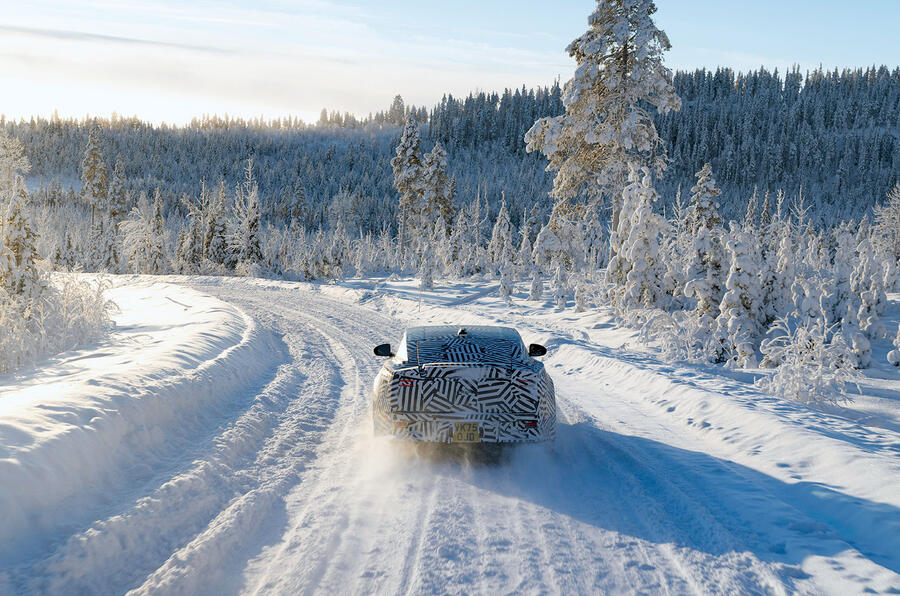
I tend to assume tracks carved onto frozen lakes will be entirely smooth, but such is the need for continual grading to clear snow and the way water and ice move that there's a ripple effect underwheel, a bit like running over a washboard, which the Type 00 smothers well.

Again, it's not easy to get a true feel for road conditions when the road is so very unusual and the grip level so low, but for an hour or so I try a series of manoeuvres at anything up to around 50mph, from a handling track to a 300m-diameter circle.

In such an environment one can't shift a car's weight around and use body movements and momentum like one can on grippier surfaces, but I think the inherent character of a car can show through.

Back to top

The Type 00 steers with precision, light-middling in weight, and it's the first Jaguar with a variable-ratio rack: it's relatively steady around straight ahead for stability, moving to really quick later on in the 2.4 turns from lock to lock.

There's a generous, 43deg amount of front-wheel lock and 6deg of rear steering, which combine for an 11.5m turning circle – the same as a Nissan Qashqai's.

But it's the integration of those dynamics systems that will be key to making the Type 00 feel natural to drive, which is the aim of Jaguar's engineers. I can say that the steering didn't feel unnaturally non-linear to me, nor could I tell what, or when, the rear steering was doing. (In my experience, JLR and Porsche are the best at tuning rear-steer systems to feel normal.)

Those traction and stability systems on the rear motors are excellent. There's barely any wheel slip before they start metering power incredibly deftly – a feeling that can't be matched at the front, where torque distribution is dealt with via mechanical braking. The Type 00 can climb mixed-surface slippery hills where a car with a conventional open differential would flounder.

As such, one should expect really good traction on the road.

On a large steering pad where the Type 00 was willing to hold decent lateral g-force, I could feel a degree of body roll with the suspension in its comfort setting. A nice amount, I'd say. It will be interesting to see how much that translates to in higher-grip conditions.

Back to top

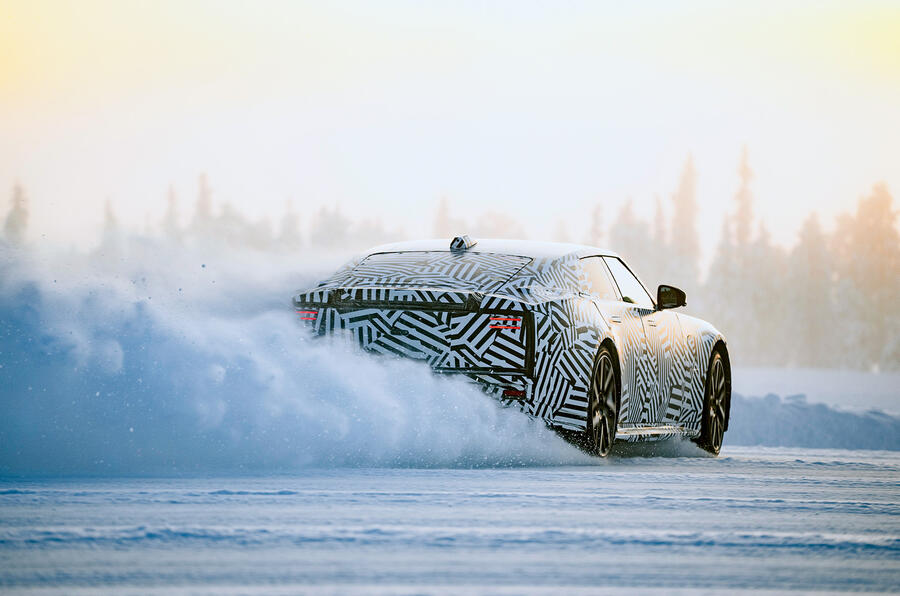
In easy-going mode, the Type 00 could be really easy-going, but this meant I could lean into it and play with a chassis that feels inherently well balanced, with the surfeit of power pushing it sideways and keeping it there.

Only in extreme conditions do Jaguar's engineers want it to feel like the front end is pulling the car back to safety.

Ultimately, though, in its balance and its compliance, the Type 00 feels like a Jaguar. If I had climbed directly from the most recent XJ into this and, ignorant of the past six years' worth of Jaguar rigmarole, been told that this was its direct replacement, I'd have believed it.

While the hype, the adverts, the turmoil and the commentariat's hot takes have been going on around them, Jaguar's engineers have looked at the past, looked at the future and laboured to produce an authentic Jaguar.

Join our WhatsApp community and be the first to read about the latest news and reviews wowing the car world. Our community is the best, easiest and most direct place to tap into the minds of Autocar, and if you join you’ll also be treated to unique WhatsApp content. You can leave at any time after joining - check our full privacy policy here.

Matt Prior

Matt Prior
Title: Editor-at-large

Matt is Autocar’s lead features writer and presenter, is the main face of Autocar’s YouTube channel, presents the My Week In Cars podcast and has written his weekly column, Tester’s Notes, since 2013.

Matt is an automotive engineer who has been writing and talking about cars since 1997. He joined Autocar in 2005 as deputy road test editor, prior to which he was road test editor and world rally editor for Channel 4’s automotive website, 4Car. 

Into all things engineering and automotive from any era, Matt is as comfortable regularly contributing to sibling titles Move Electric and Classic & Sports Car as he is writing for Autocar. He has a racing licence, and some malfunctioning classic cars and motorbikes. 

Join the debate

Comments
1
Add a comment…
Symanski 2 February 2026

The question was never that Jaguar couldn't do such a car, but if it should?


Just imagine if the engineers were let loose and the desginers tasked with creating a modern and accessible Jaguar?   Not something that tells 99.9% of Jaguar customers where to go?


That was what was needed, with more entry points to the Jaguar brand.   A 1-Series or A-Class rival added to the mix, increaing the sales.   Because remember Jaguar never competed 1:1 with the German marques.   It always had both arms held behind its back.


And one of the problems that Jaguar had was marketing.   They've already had a class leading EV - the I-Pace.   But their marketing department were absolutely clueless in how to sell the car; how to educate the customers on why it was so good.


Not forgetting the board were negligent in letting Thierry Bollore continue with a plan that had already got him fired.   And Renault are now doing very well by comparison.   The answer was never to do the "Type-O".   The answer was to let Callum and the engineers create a modern and efficient car that did rival those from Germany and elsewhere.