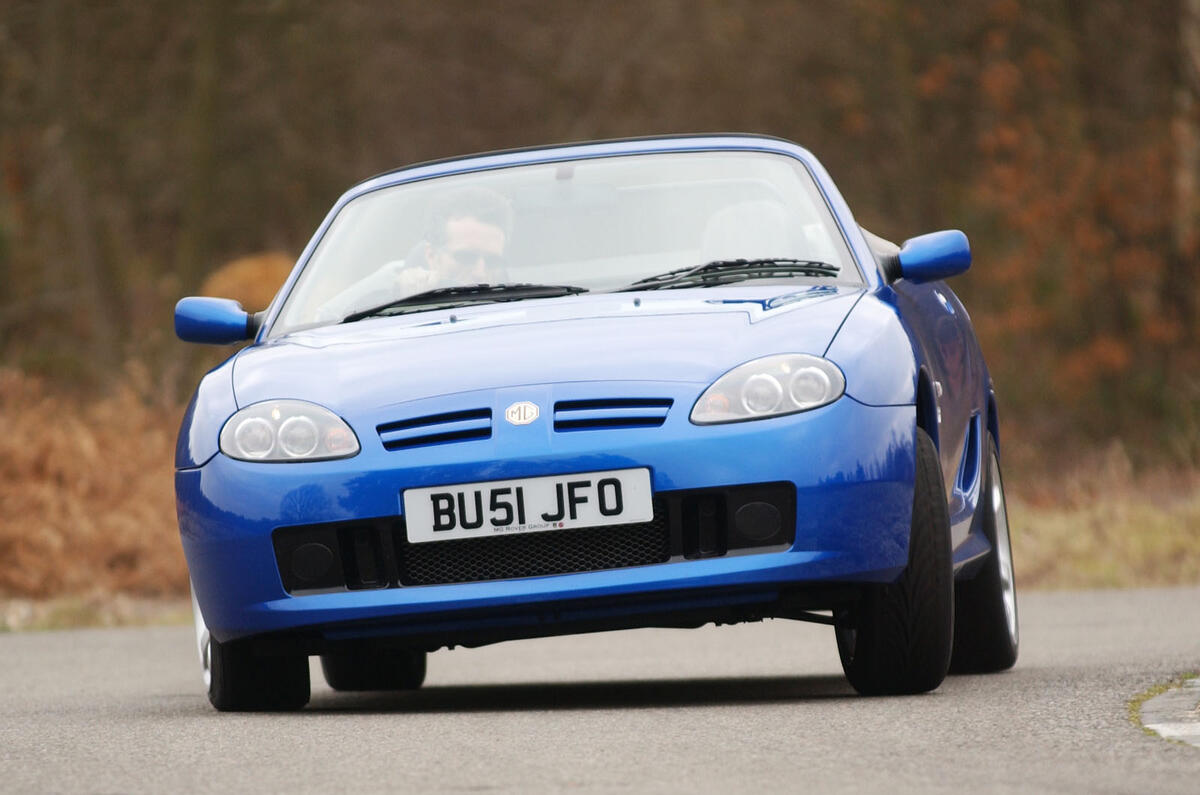

Not a fashionable ride right now, the MG TF, which is why you can install yourself in a runner for under £2000. And less still, if you’re willing to take on one needing a little work.
The TF, you’ll recall, was MG Rover’s 2002 facelift of the 1995 MG F, and a surprisingly extensive rework it was, too. Not many cars undergo a change of springing medium part-way through their lives. The MG F’s springs were Hydragas, so bumps were absorbed by nitrogen spheres, and fluid interconnection and clever valving provided the damping effect. The F had a remarkable ride and impressive handling as a result, but the cost of manufacturing these complex units in fairly low quantities eventually made a switch to conventional coil springs and dampers desirable.
The TF’s ride was never quite as good as the Hydragas F managed and it was made worse by the fact that the optional, stiffer sports suspension pack was inadvertently built into 1000s of TFs. But there were upsides to this update, not the least being a bodyshell that was 20% stiffer, sharper handling and a more connected feel via the electric power steering. MG Rover design chief Peter Stevens took the chance to update the MG’s look, too, reshaping it for a slightly more aggressive flavour.
Most obvious was the grille, now presenting body-coloured horizontal slots rather than the more traditional two-piece mesh grille, while the air intakes aft of the rear doors were reshaped with sharper, more defined lines, as were the bumpers, whose air intakes and extractors looked more business-like. The headlight internals were updated with small, circular lenses that were trendy at the time and the engine lid’s lip spoiler was more emphatically sculpted.
Inside, all was much the same, except that the seats were part-trimmed with a faux Alcantara suede that had the durability of a cheap T-shirt, the grey material soon resembling wet mouse fur. But that slightly unsavoury detail would emerge later.
When it was launched, the TF was considered to be an astute update of Britain’s best-selling sports car – yes, the MG F consistently outsold the Mazda MX-5 – and, indeed, in facelifted form, MG’s two-seater continued to hold the title.
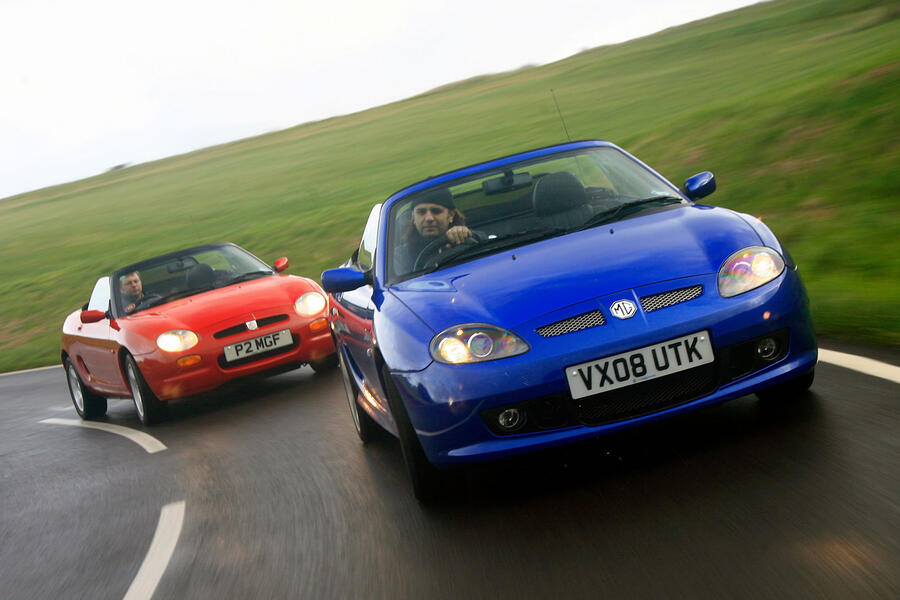
It’s one reason why they are so cheap now: there are plenty of them, they have long been cheap enough to be used as a household’s second or third car, receiving minimal maintenance, and this in turn has accelerated the race to the bottom and a quickening attrition rate.
There are other reasons, of course, most infamously the head gasket troubles of the all-alloy K-Series engine, which will almost certainly undergo at least one off-with-its-head moment during the car’s life. The MG F and TF are more prone to this failure than the front-drive Rovers for which the engine was designed. That’s largely a result of the challenges of cooling a power unit deliberately designed to run with less coolant, to save weight and speed warm-up, being amplified by sandwiching it in the middle of the car. This failing certainly depresses prices but also means there are bargains to be had because people are put off, despite there being plenty of specialists who can fix MG Fs for sensible money.