
(Dual Motor) Performance SUV 5dr Electric Auto 4WDE (460 ps)
Submitted by dev_editor on
Submitted by dev_editor on
You might have read about sightings of a strange alien craft on Wimbledon Common earlier this month.
For anyone unfamiliar with it, the Southside Hustle, which takes place in Wimbledon Village, south-west London, on the first Sunday of every month, has in the few short years it has been running become a mecca for petrolheads keen to show their cars—everything from wheezy classics to the latest exotics—to an admiring throng of fellow enthusiasts.
It was to this quasi-religious gathering that Sam Seppälä drove his Tesla Cybertruck a four-wheel-drive, tri-motor Cyberbeast variant, specced in limited-edition Foundation trim. Autocar joined him for the ride and the experience of showing his 833bhp Musk monster to the combustion faithful. How would it be received? Would they cheer or sneer?
Seppälä imported the Beast from California in January. Very few Cybertrucks have made the same journey because, for a variety of reasons, including concerns about its drive-by-wire steering system and safety standards, the DVSA won't grant the model Individual Vehicle Approval, the final obstacle that a vehicle must clear before it can wear UK numberplates.
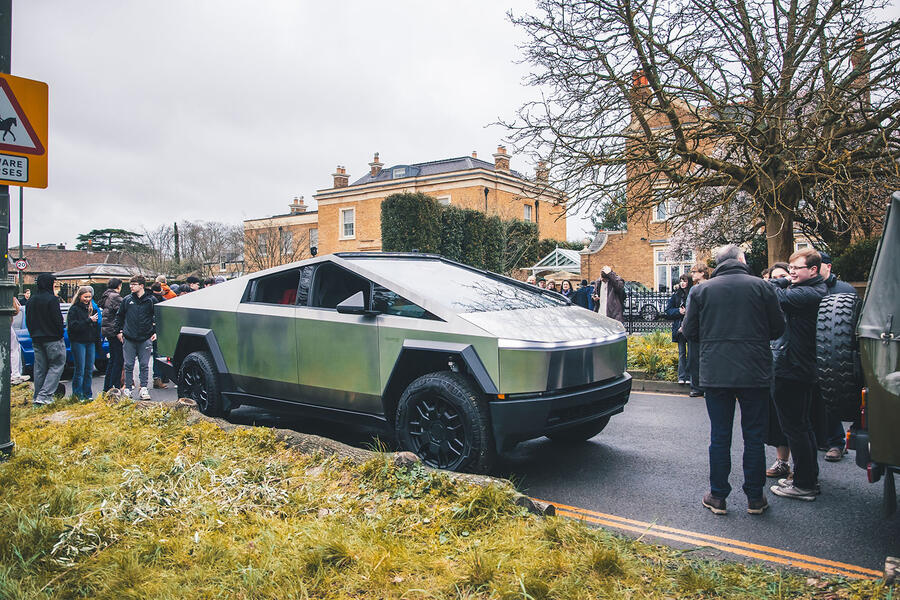
"No Cybertruck has passed IVA and so cannot be driven on UK roads as a DVLA-registered vehicle," a DVSA spokesman told Autocar.
'DVLA-registered' is the important bit here. If the vehicle is taxed, registered and insured in its home country, it's permissible to drive it in the UK for a maximum of six months.
In fact, when I meet Seppälä at his home not far from Wimbledon, he explains that he can have the vehicle here for 12 months and during that time drive it for a total of six months. As a result, he's under no pressure to get a return on his not-inconsiderable shipping costs by driving the Beast solidly from January to July. In fact, he tells me that today's drive to the Hustle will be the first time he's driven it on UK roads.
Of course, the question uppermost in my mind is: why? Why bother to bring his Cybertruck here only to have to return it to the US in December? Seppälä explains that, as a tech entrepreneur living here and in California, the Tesla fascinates him.
"I love the reactions, both good and bad, that it provokes," he says. "It drives and handles really well, too—not at all like other American cars. And it has a wealth of safety tech. In fact, it's a very safe car."
In the US he uses the Cybertruck to, among other things, tow his Bruder off-road caravan, when its range falls from 300 to 100 miles. (For other days he has a Ferrari 488 Spider, a Ford F-350 pick-up, a Volkswagen Type 1 split-screen van and a John Deere 4066 tractor.) It has full autonomous functionality, too, so it can chauffeur him to a friend's home, two hours away, elsewhere in California. The feature doesn't work in the UK, of course.
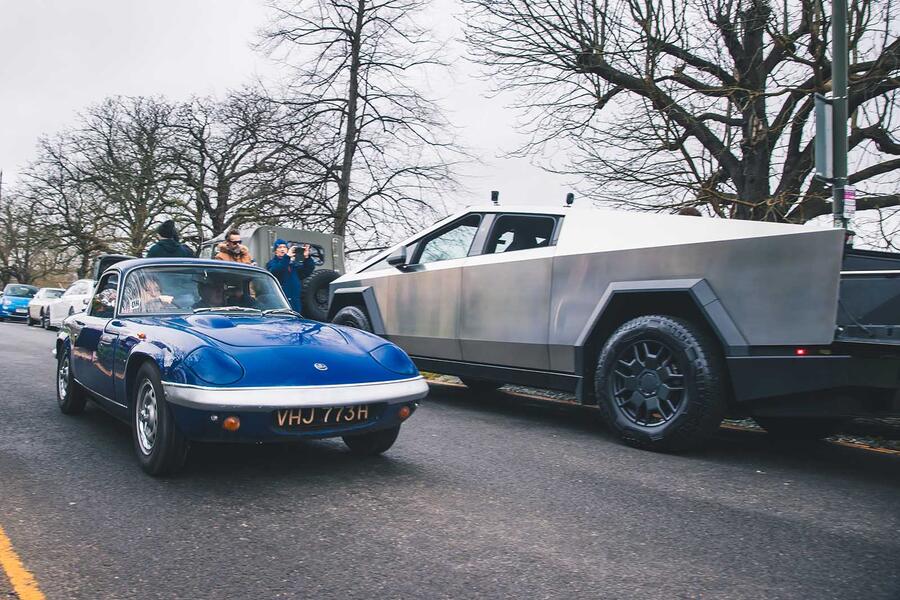
What did the enthusiasts think?
“It’s too big. Yes, it looks different, but I wouldn’t have one. I think you’ll struggle to get anyone who likes it here.” Dave Selby
“It’s different. It’s a crazy car – the size and the weight – but I wouldn’t want to see thousands of them on the roads.” Chris Amos
“The fact that someone has made this car and put it on the road is incredible. It’s like the Nissan Cube and Fiat Multipla: individual designs in a sea of uniformity.” Lucas Cochrane
“I saw the Cybertrucks at the International Concours of Elegance in St Moritz recently, where they looked better than this one does here on a dreary March morning. Still, it does look amazing, although the sharp corners make me worry for pedestrians.” Matthew Robinson
“I’ve been here a few times and the Cybertruck has attracted the biggest crowd I’ve seen. But it’s just straight lines and straight edges. It’s cool but not cool.” Edward Whitehouse
The compact exec has always been the first choice of company car drivers looking to cut a dash, but the tax-slashing benefits of going electric mean that corporate tastes have changed.
The Tesla Model 3 has become the user-chooser's first choice, its blend of tech, range, fast charging and rock-bottom tax bills making it a perennial sales chart fixture since it arrived here in 2018. Moreover, it has been joined in the past year or so by a growing number of upstart EV rivals keen to take a slice of this profitable pie.
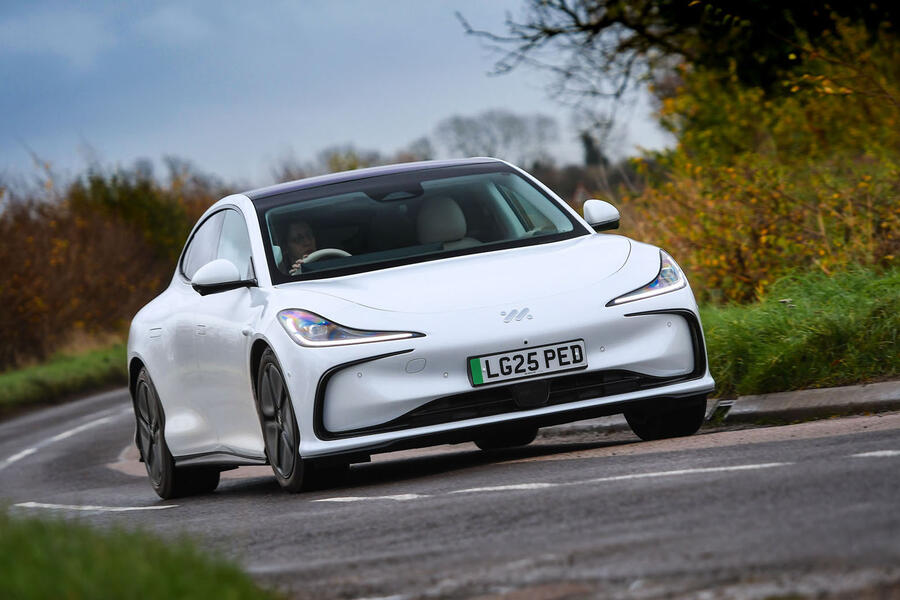
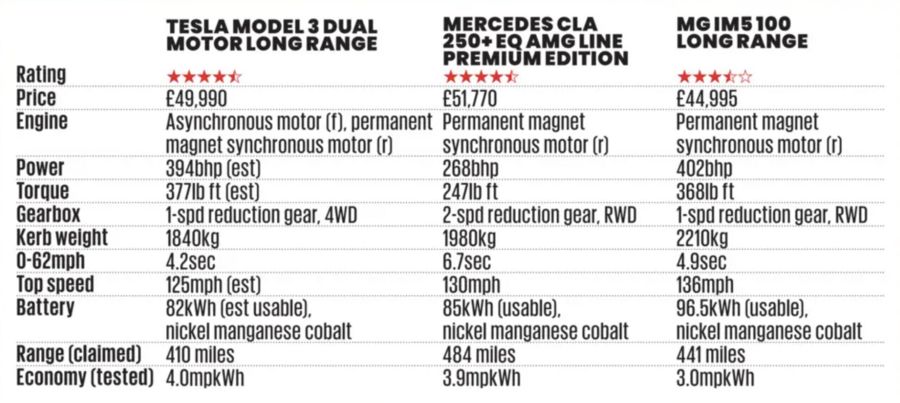
One of the latest to land is the MG IM5, which actually isn't an MG at all. (You will search in vain for any sign of an octagonal Morris Garages logo.) Instead, it's a rebadged Intelligence in Motion L6, a slick executive saloon that's the product of a joint venture with MG owner SAIC. No matter what it's called, it's hard to ignore the car's sleek lines, massive 100kWh battery, 441-mile range and £44,995 price, plus a tech spec that runs to four-wheel steer and 800V architecture.
The old guard aren't giving up without a fight, though. Like many European brands, Mercedes-Benz has been hampered by legislative flip-flopping and shackled by the need to deliver both battery-powered and combustion-engined models, often offering two totally bespoke machines in effectively the same class (the E-Class and EQE, for example).
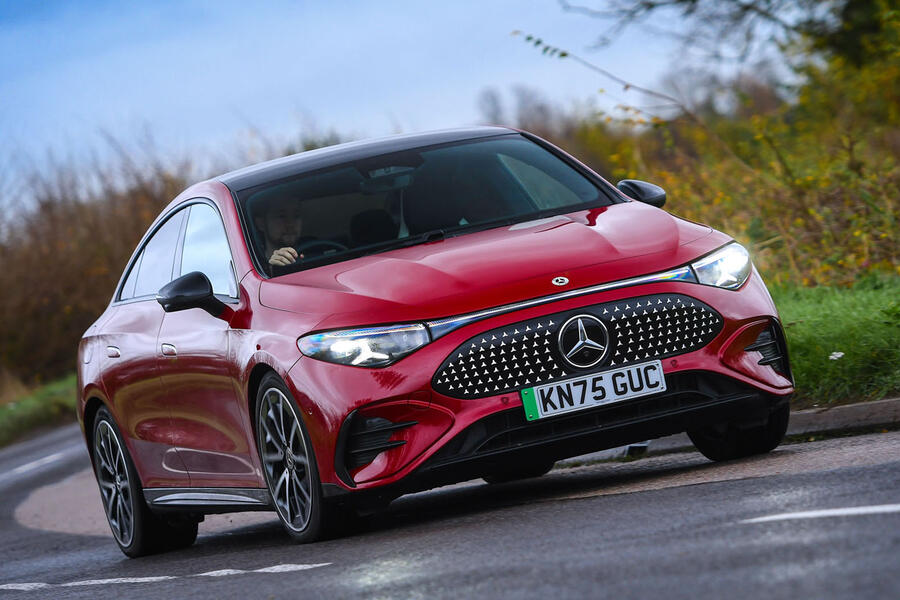
With the new CLA, however, it's taking a more joined-up approach. The first car to be built on the brand's new MMA architecture, it's engineered to seamlessly accept any powertrain. For this CLA 250+, that means a highly efficient 85kWh nickel-manganese-cobalt battery and a clever, rear-mounted 268bhp motor with a silicon-carbide inverter that offers lower weight and a more compact size.
There's also a Porsche Taycan-style two-speed transmission and 800V architecture for an ability to charge at 320kW (behind the MG's 396kW but ahead of the Tesla's 250kW). Oh, and a not insignificant claimed range of 484 miles, which is enough to calm the nerves of even the most anxious long-distance traveller.
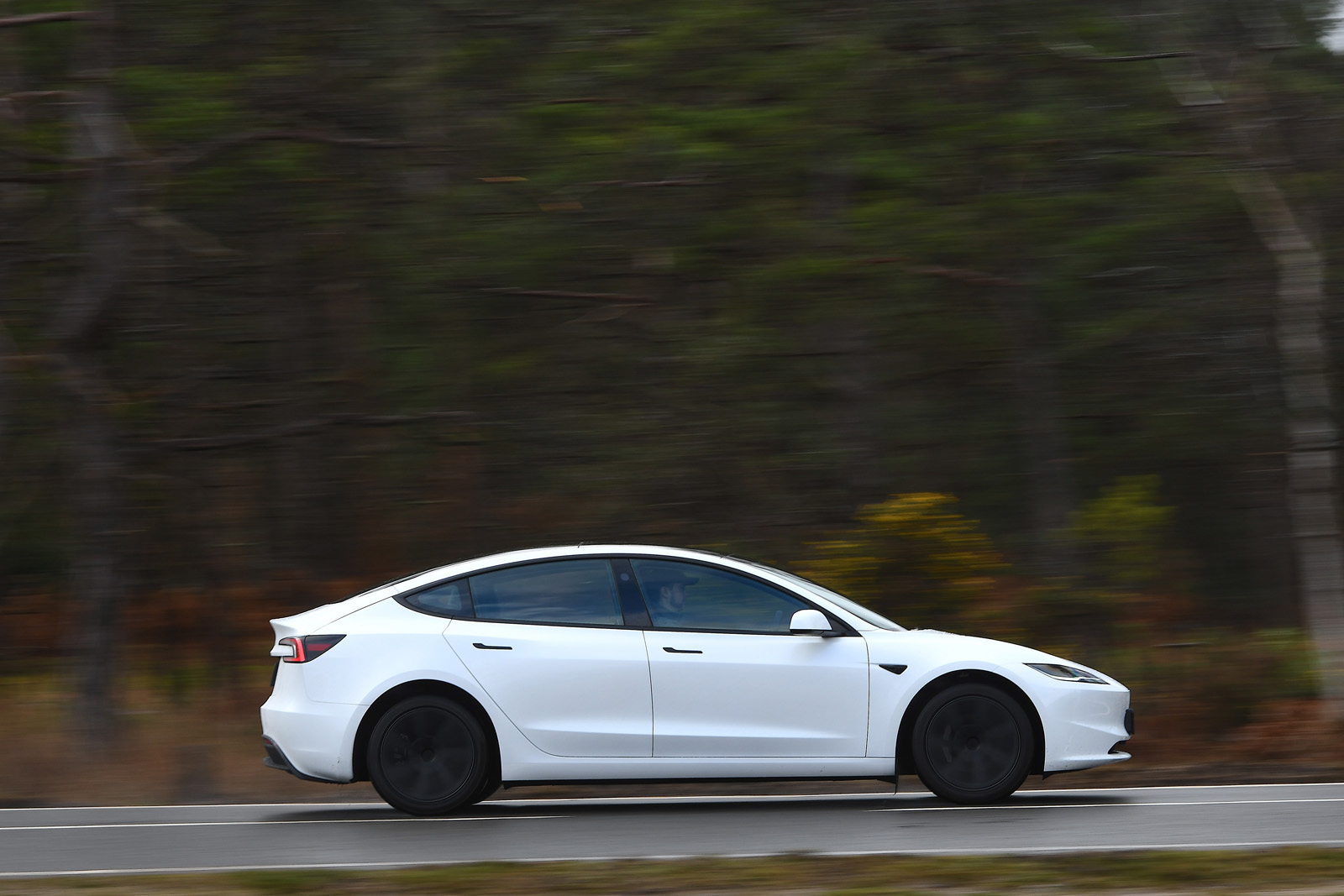
Alive to the dangers of this challenge to its supremacy, Tesla has revised the Model 3 with an upgraded battery (it's the same size, but software tweaks have made it more efficient) and, praise be, the addition of an indicator stalk, which was bizarrely deleted when the new model was launched just under two years ago.
The Single Motor Long Range version we requested for this test can now travel up to 466 miles between charges. The more expensive and powerful Dual Motor that actually turned up at our offices offers a still impressive 410 miles.
Despite being the newest model here, the Merc looks the most conventional, with its vast three-pointed-star-emblazoned 'radiator' and a slinky silhouette that owes a lot to its predecessor. It's also the slipperiest, cleaving through the air with a Cd of just 0.21. Meanwhile, the sweeping and strobing light show put on by its LED-encrusted grille when unlocking the car prompted one young passer-by to declare it "low-key sick". Praise does not come much higher, apparently.
What the MG lacks in eye-dazzling illuminations it makes up for in sheer presence. At 4931mm long, the IM5 is actually closer in size to cars from the class above, such as the BMW i5. It's not exactly distinctive, but the curvaceous and low-slung Chinese saloon does just enough to claim premium credentials.
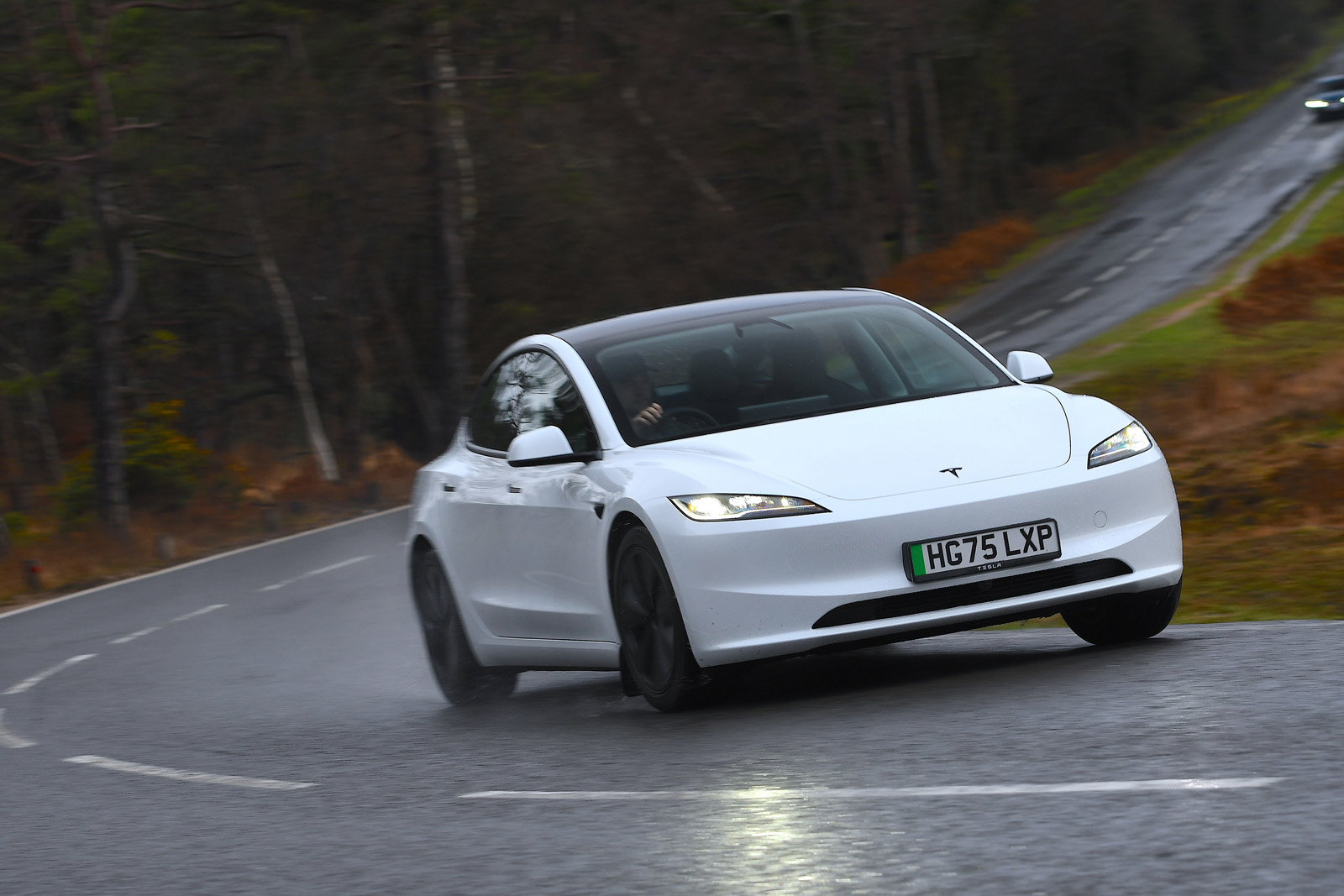
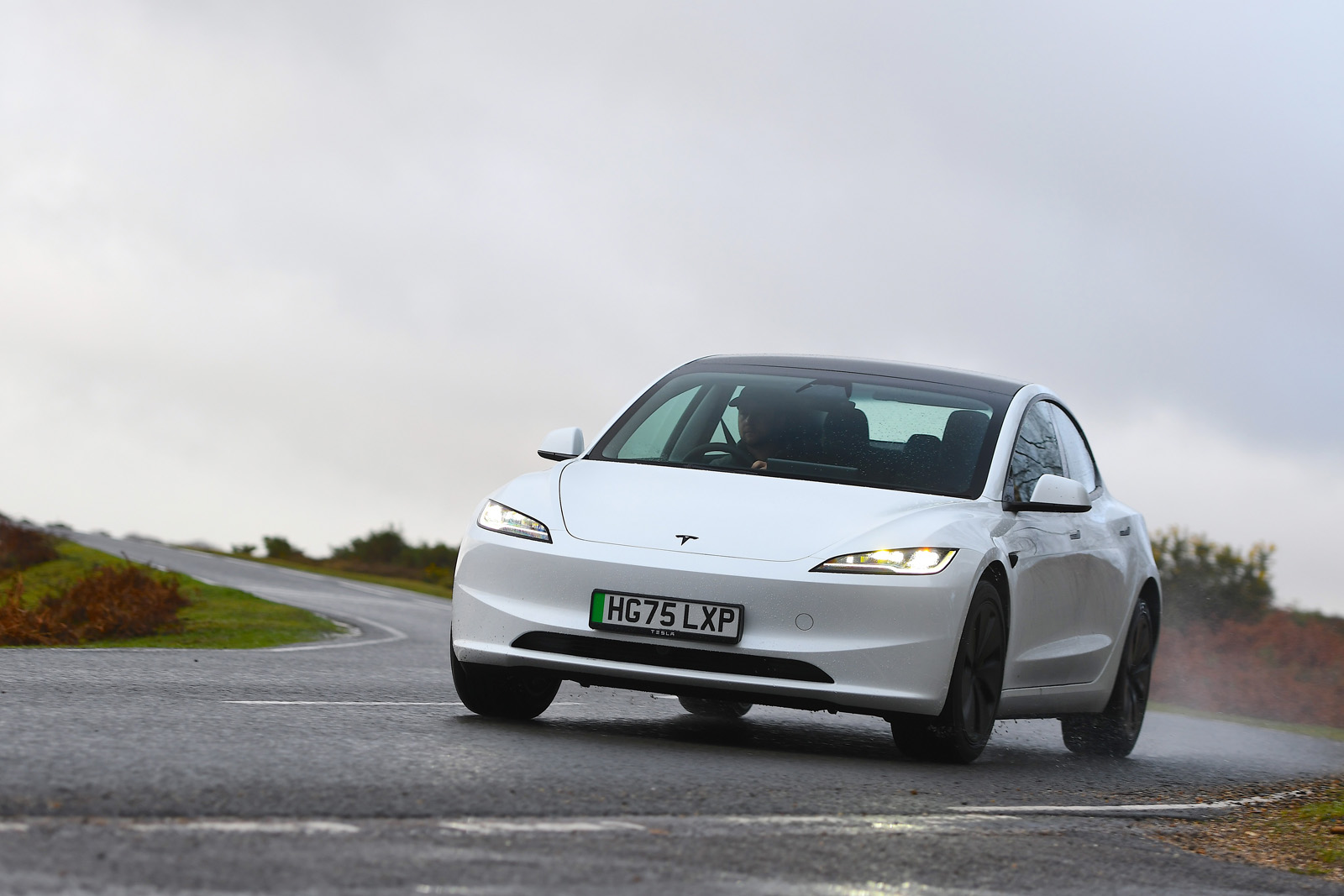
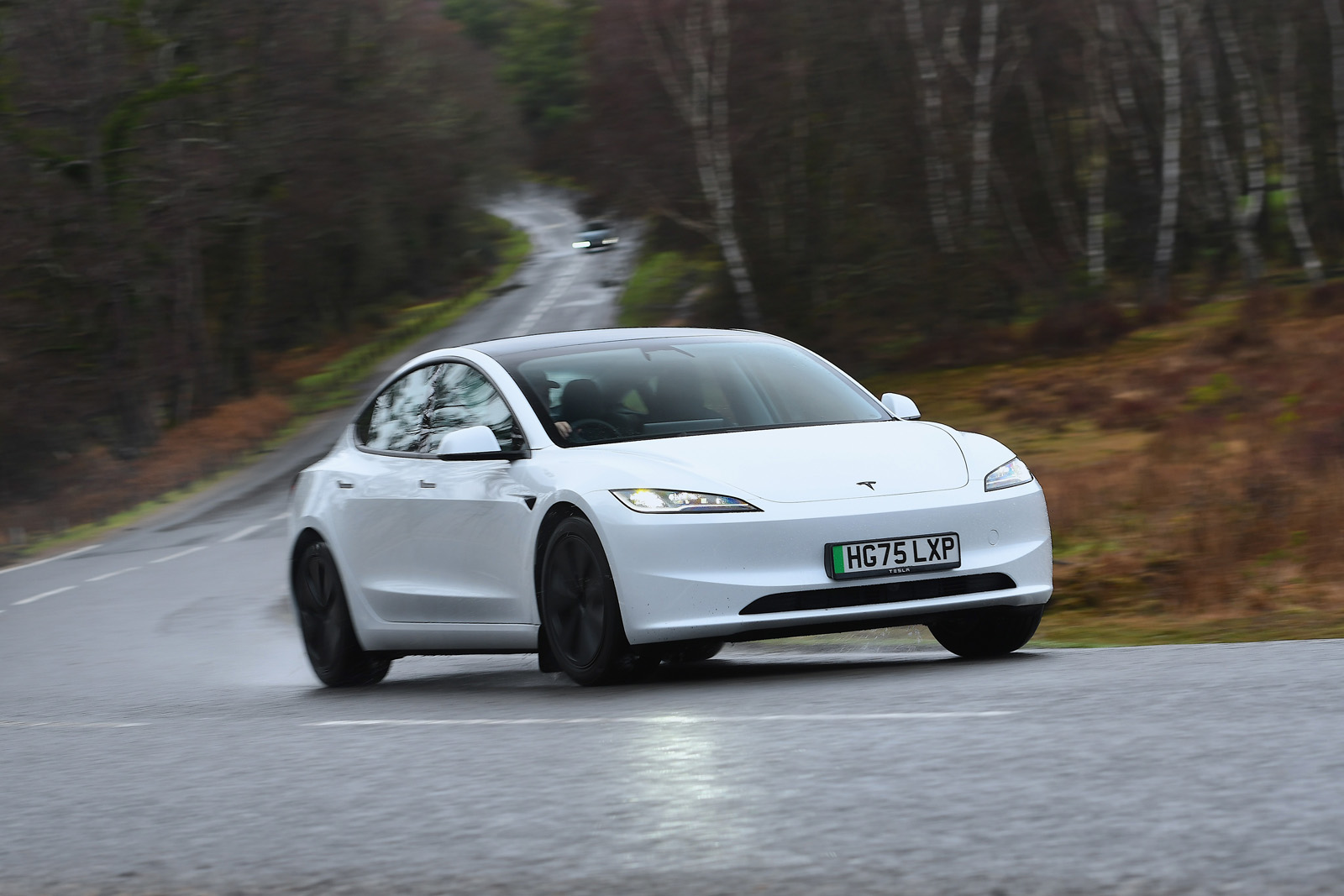
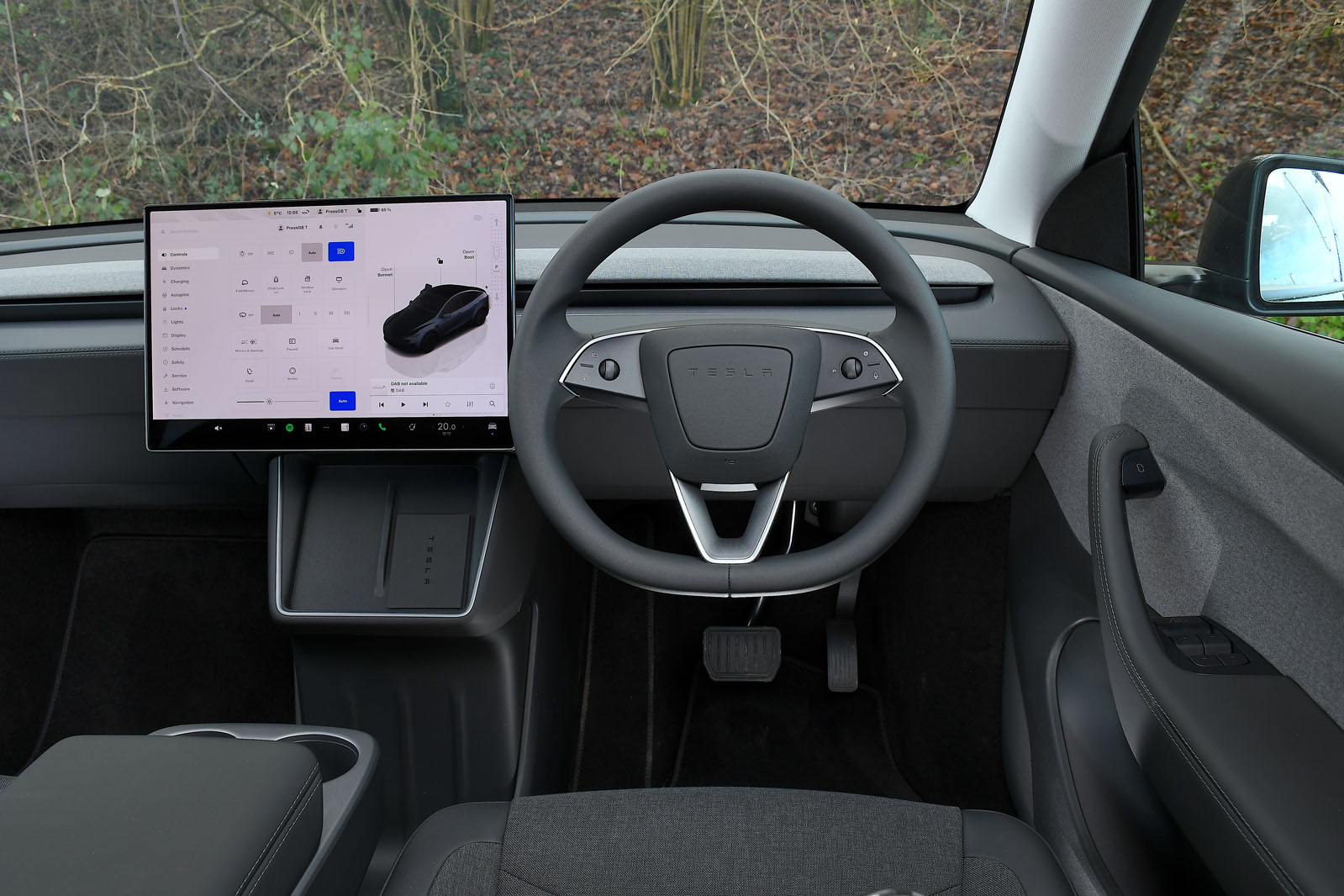
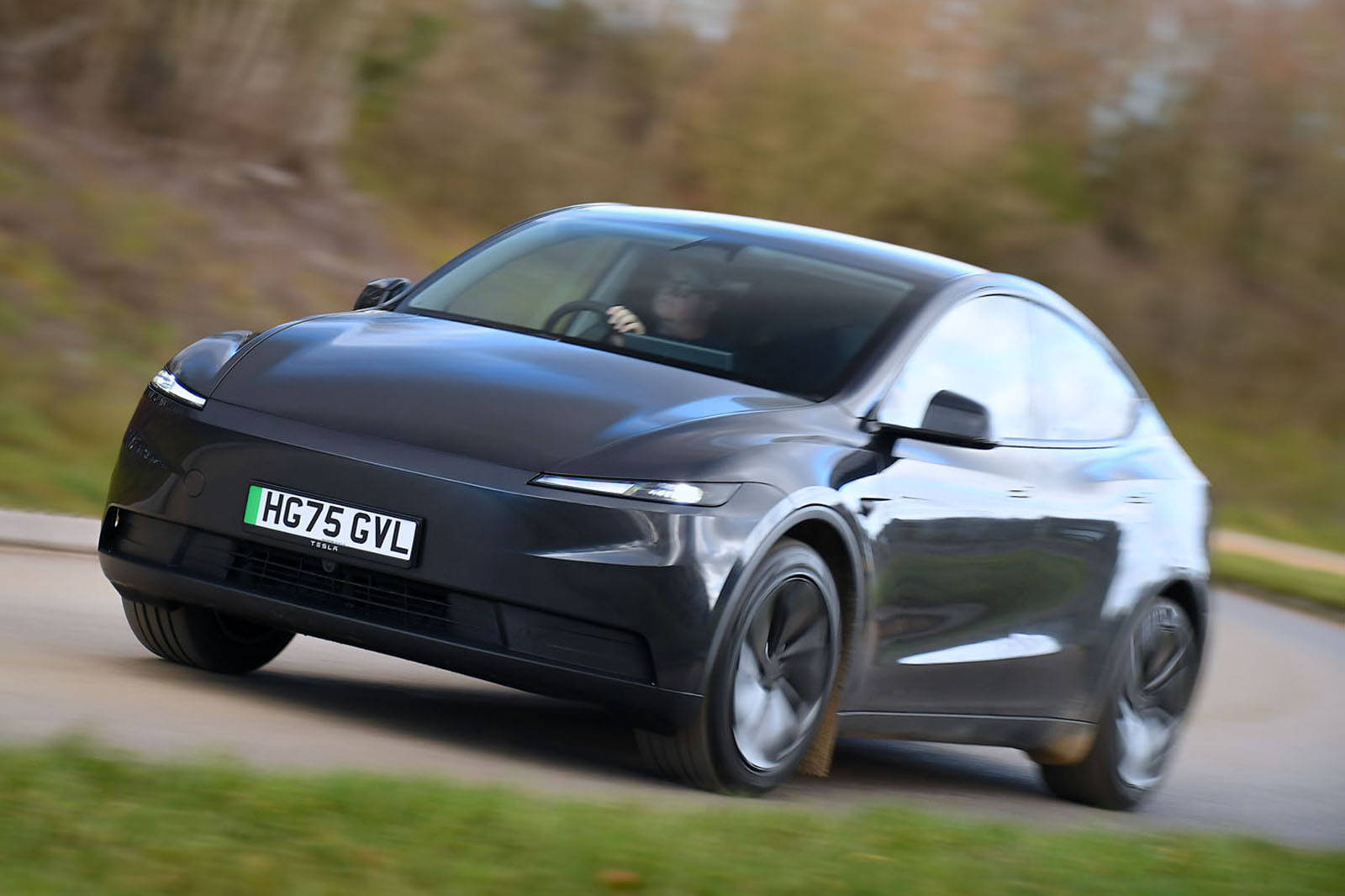
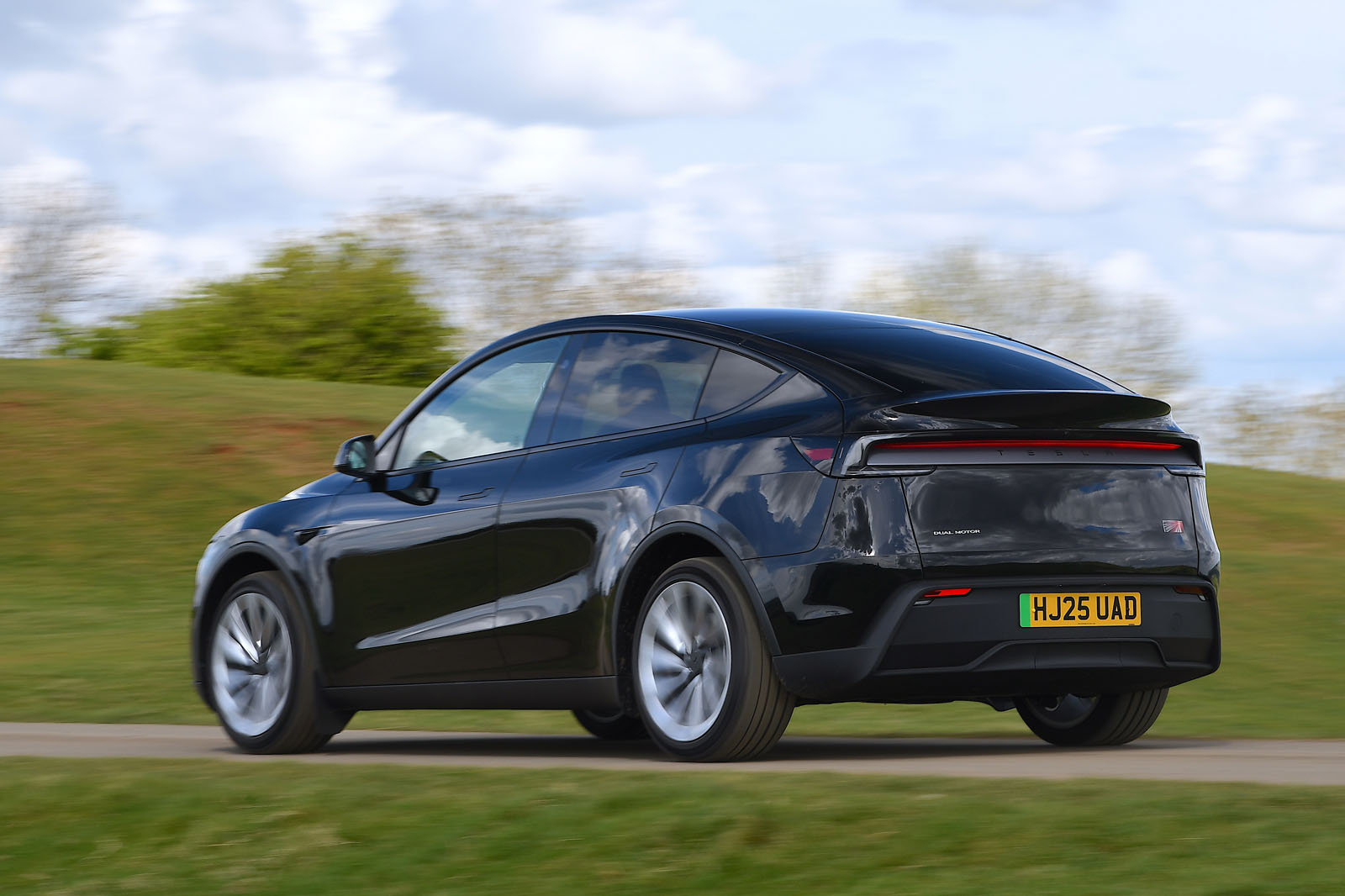
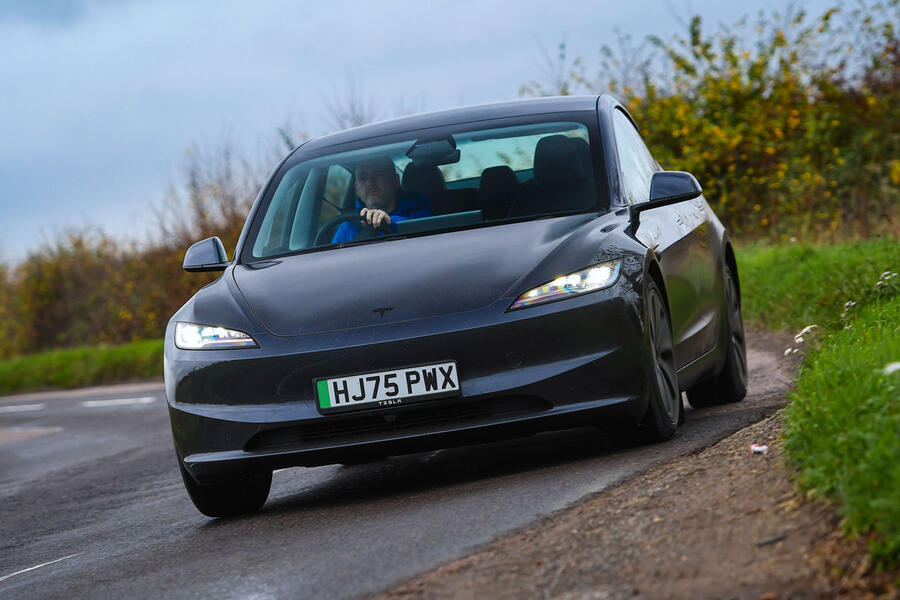
And the Tesla? The slimmer lights, introduced as part of the 'Highland' update, have kept the Model 3 looking fresh, but such is the car's ubiquity that it fails to get a look-in alongside its newer rivals. That said, the old-stager manages to turn the tables on its rivals when it comes to interior style.
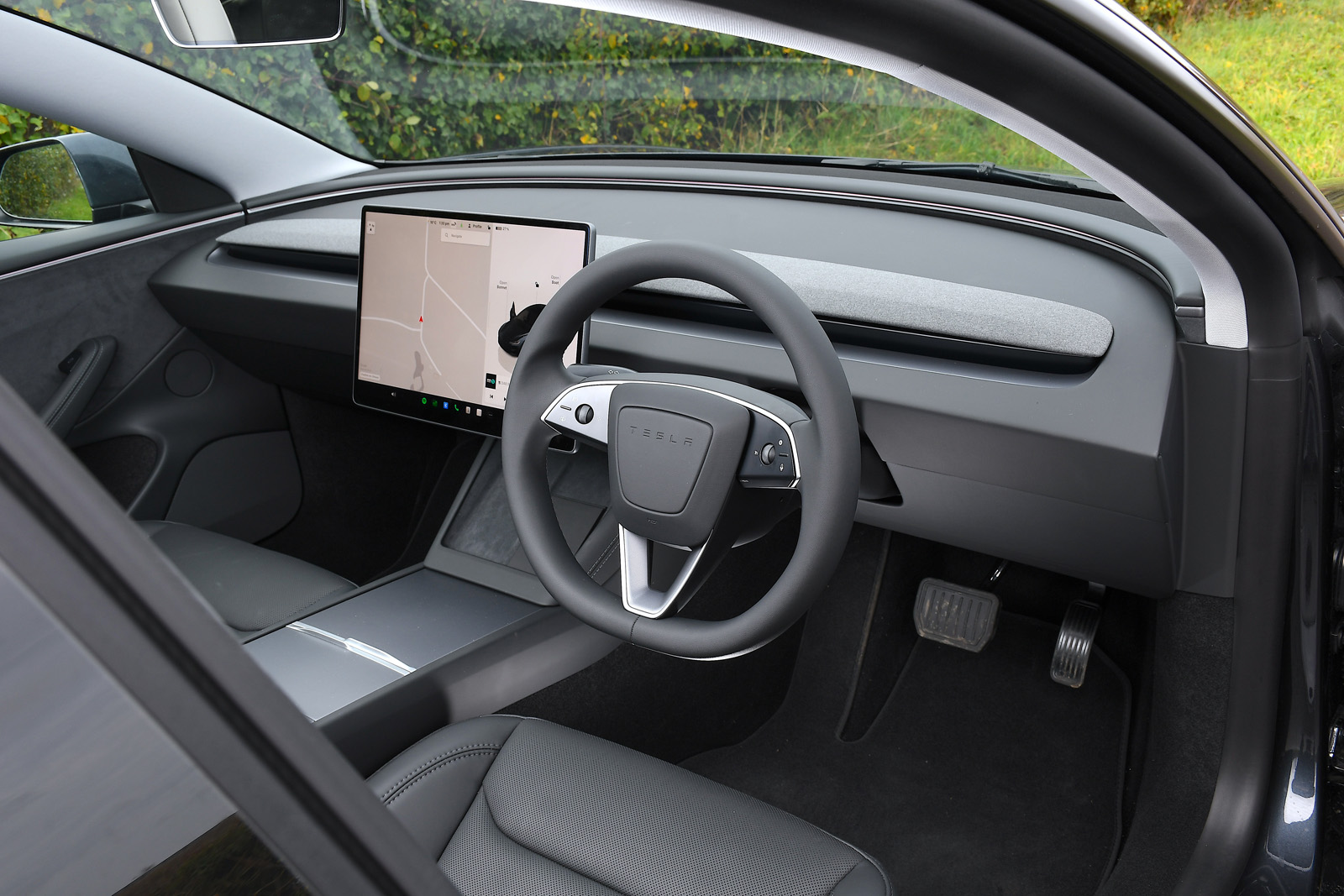
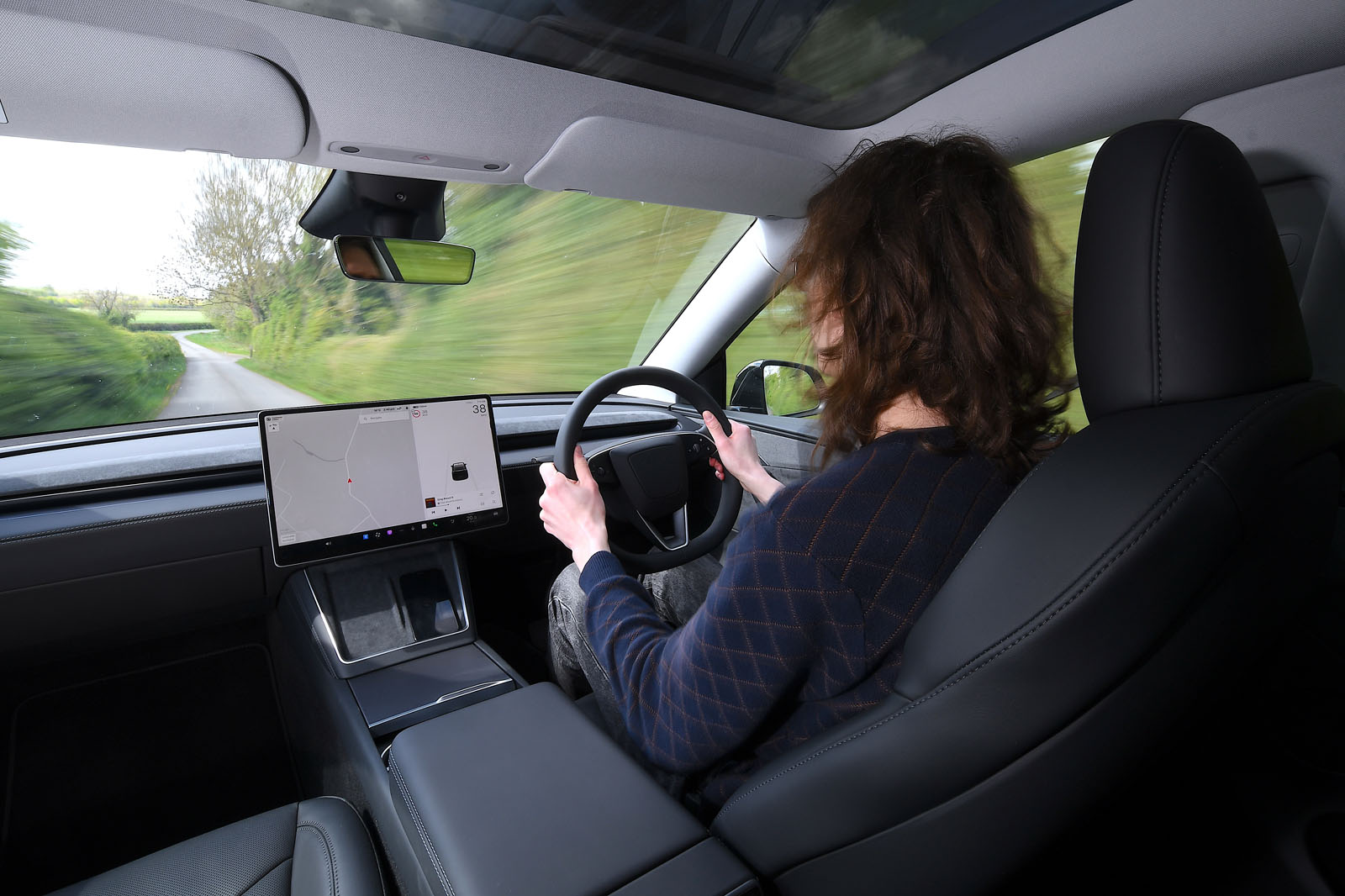
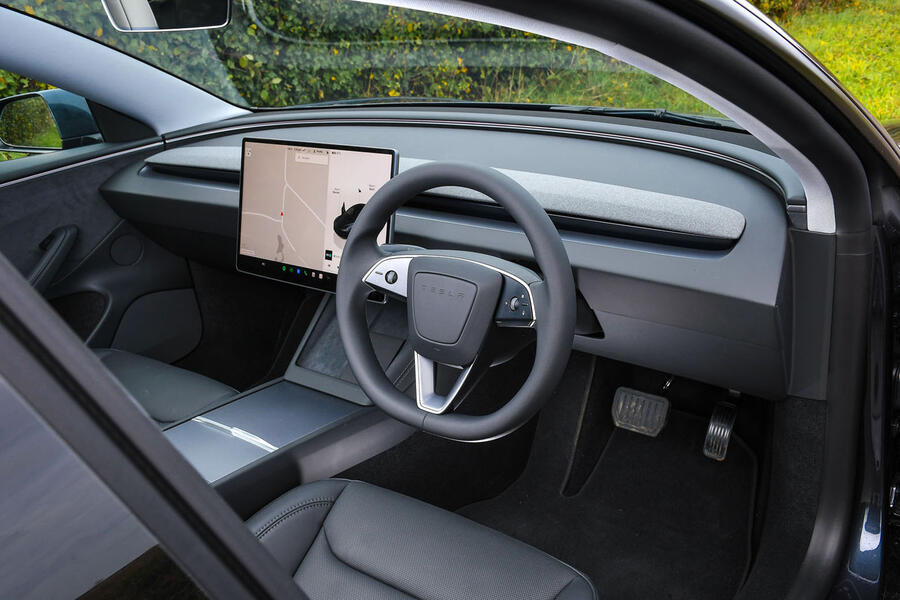
Tesla's minimalist design ethos and large glasshouse - it's the only one with a true panoramic roof, the glass stretching from the top of the windscreen to the base of the rear window - create a bright and airy feel, while the quality and fit and finish of the materials finally match Tesla's premium aspirations.
As ever, the dashboard is dominated by the large touchscreen, which is the easiest to operate here, with crisp responses and logical menus. And did we mention there's now an indicator stalk?
As with its exterior, the Merc's cabin is the most showy, particularly in our test car's garish black and white finish, complete with ambient lighting seemingly lifted from a Stuttgart nightclub. The slab-fronted dash looks a little tacked on and the glossy black finish isn't as upmarket as the brand imagines, but the infotainment almost matches Tesla for slick operation and there are even some physical buttons.
Sitting between these two is the MG, which on first impressions certainly looks and feels the part. Soft-touch materials are everywhere and build quality is easily on a par with its rivals here. Yet it's all a little generic and the impressive-looking touchscreens are fiddly to use (even simple operations keep your eyes off the road long enough for the driver distraction warning to squawk at you), as are the unmarked steering wheel-mounted rollers.
Perhaps most surprising, given its imposing external dimensions, the MG feels a little cramped inside. Those in the rear get no more space than in the more compact CLA, and neither can quite match the roomier Model 3 for occupant accommodation.
The IM5 hits back with a more practical hatchback opening for the luggage area, but all three provide around 500 litres of carrying capacity (the Tesla closer to 700), if you take into account overspill space in the various frunks. So much for practicality.
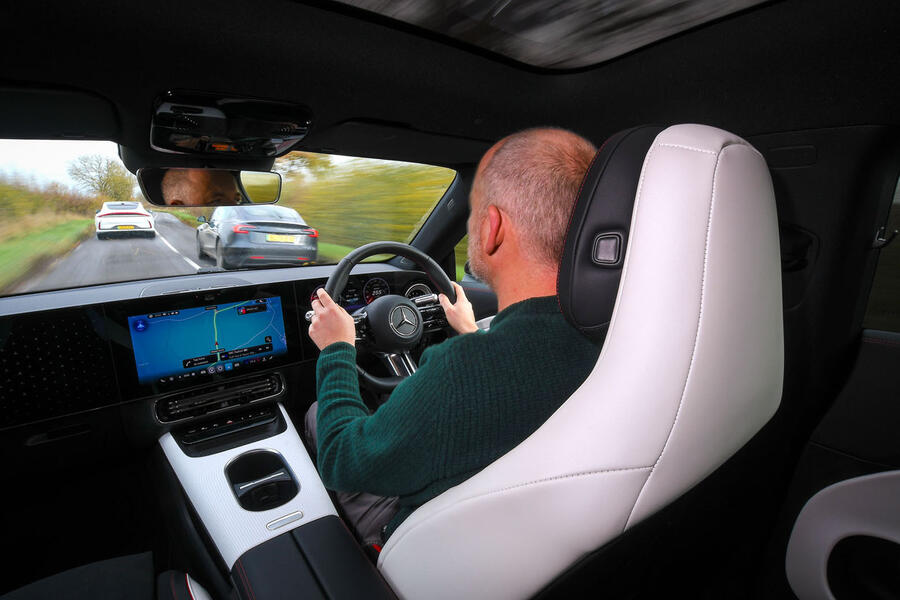
It's time to drive. First up is the MG and initial reactions are positive. You sit nice and low in the car while, with 402bhp on tap, performance is quick, almost matching the dual-motor Model 3 for instant, horizon-reeling urge. At 2210kg, it is the heaviest here but will still fire from standstill to 62mph in 4.9sec. Sport mode adds some extra zest to the throttle mapping, even if it offers no more actual pace.
Of more concern is the lack of traction, on the wet and greasy roads of our test route at least. Squeeze the throttle with intent and the MG's rear end can slip and slide briefly before the traction control abruptly and scrappily gets a handle on the situation. Incredibly you can actually partially disengage the safety net, which results in enough tyre smoke to impress a Santa Pod season ticket holder.
Obviously there are no such issues with the all-wheel-drive, dual-motor Tesla, which takes the drag strip spoils here. Combining a remarkably low 1840kg mass with 394bhp, it will zip to 62mph in just 4.2sec. Yet our experience of the 315bhp Single Motor version suggests that choosing the cheaper model won't leave you feeling less exhilarated as it matches the MG, to the tenth, in the benchmark sprint.
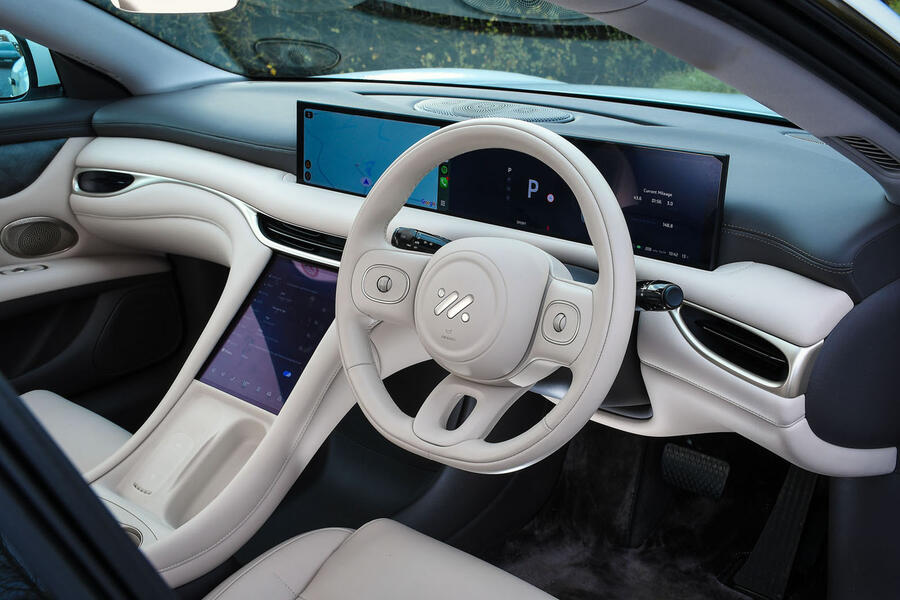
What's more remarkable is that it combines this turn of speed with an incredibly modest appetite for electricity. We managed an impressive 4.0mpkWh during our hard-driven time with the car and the two-wheel-drive version will be more parsimonious still. The lower-powered Merc came closest to matching it, with 3.9mpkWh. The MG trailed both by a significant margin, with 3.0mpkWh.
Given its relatively lowly 268bhp and a kerb weight of 1980kg, it's no shock to discover the Mercedes is the least swift of our three, requiring nearly two seconds longer than the IM5 to rush to 62mph. Yet, as with all EVs, the CLA's instant low-speed response means it feels faster than the numbers suggest, and the jolt you get as the transmission shifts between its two gears adds a little drama to proceedings.
However, knockout performance is part and parcel of the EV experience these days. Of more importance for any car wanting to rise above its rivals in the compact exec class is the ability to match its pace to a carefully balanced blend of handling elan and soothing comfort.
With its four-wheel steering, the IM5 has a neat technical trick up its sleeve to try to offset its extra mass and length. This lends the car remarkable agility around town, where it feels as wieldy as the smaller CLA. It also gives the MG a heightened sense of tippy-toed agility when the roads get faster because little steering input is required for it to slice cleanly through corners with nicely neutral composure.
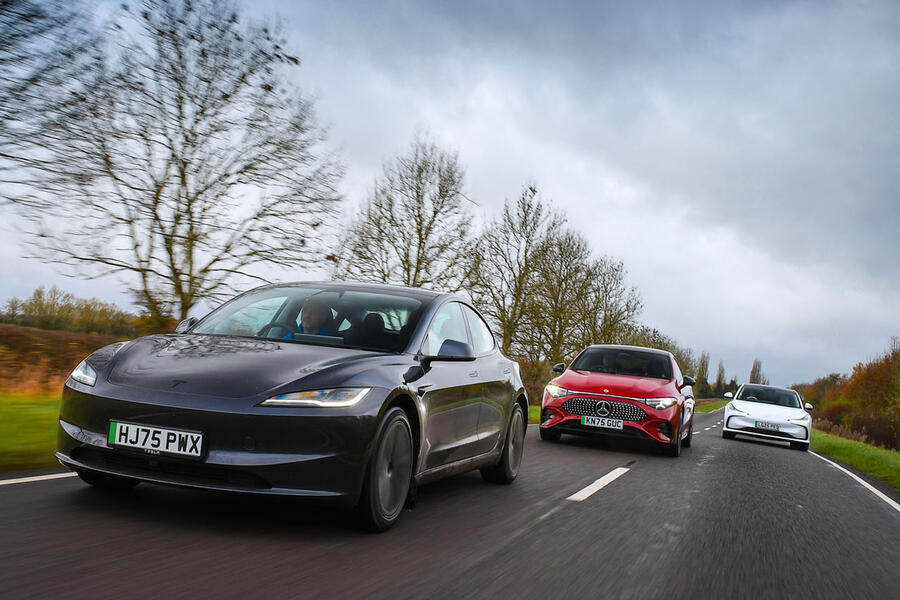
There's decent weighting to the steering too, while the body stays incredibly level and grip levels in the dry are high. In the wet, that lack of traction means you need to be wary, even with the safety systems engaged. Yet while it's precise and fairly well composed, the MG fails to engage or entertain, simply going where you point it with clinical efficiency. It's effective and accurate, but fairly humourless.
On the plus side, it's extremely relaxing at a cruise, with low noise levels and, over smoothly surfaced roads, an effortlessly languid gait. On more torn Tarmac, however, the car starts to feel a little unsettled and jittery. The adaptive dampers and air springs from the larger IM6 wouldn't go amiss here.
By contrast, the CLA has a firmer ride but its greater damping control means it nicely rounds off the sharper edges of nastier surface imperfections. It's equally quiet too. That wind-cheating shape allows it to slip effortlessly through the air, while road and suspension intrusions are kept to a minimum.
So it comes as a surprise that the mollifying Merc is up for a laugh when you're in the mood for something more energetic. The steering is the lightest here, even in Sport mode, and it has the slowest-paced rack, but tip the CLA into a corner and you will find taut body control and a front end that bites convincingly while the rest of the car pivots pleasingly around your hips.
More impressively, careful calibration of the motor's mapping means that you can even tighten your line using the throttle. With the ESP disengaged, the CLA will actually indulge in a little gigglesome power oversteer. There's genuine fun to be had here.
Sitting somewhere between the Mercedes and the MG is the Tesla. The double-wishbone set-up is still on the firm side, but it's never anything other than comfortable and the well-judged matching of control weights makes the Model 3 easy to rub along with from the moment you slide behind the wheel.
The standard two-wheel-drive car feels slightly sweeter and fleeter of foot, but this dual-motor model shares the same keen turn-in, impressive resistance to roll and an almost mid-engined willingness to change direction. It's not quite as expressive as the Mercedes, but the Tesla gives you options to subtly trim your line mid-corner.
Regardless of the version, you still can't change its one-pedal regenerative braking but it's the most natural-feeling here. By contrast, in its most aggressive setting the CLA's retardation is so severe as to be unpleasant and near enough unusable. The Model 3 also has the best brake feel here, with a firm and positive action. The MG's stoppers can be a little grabby, the Merc's pedal a little squishy.
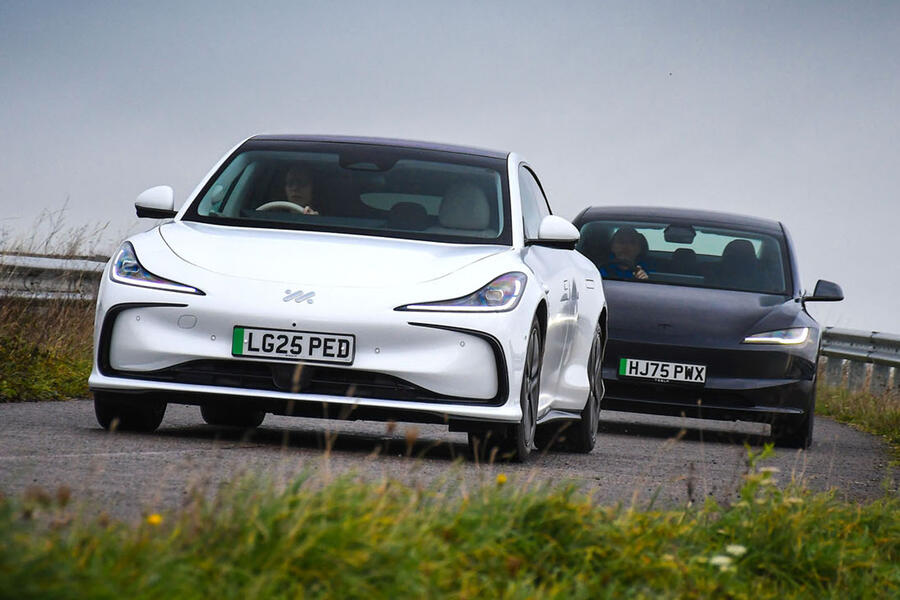
So, another win for Tesla? Well, yes, but it's certainly close. In its current form, the Model 3 remains one of the best electric all-rounders in the business, and that's before you take into account its remarkable efficiency, eye-catching pricing and 0% finance deals.
Yet the Mercedes pretty much matches the Tesla for trailblazing EV tech while also offering a little more dynamic polish and even greater driver engagement. Only in outright urge does the CLA trail the Model 3, plus it costs a little more. But if you were to choose it over the Tesla, we would completely understand.
That leaves the IM5 in third place, but you should be in no doubt that the Chinese newcomer already has the raw ingredients to make life difficult for legacy brands, which now have to include Tesla among their number. For what is effectively a first attempt to topple the compact executive elite, this is a seriously impressive effort.
Factor in the rate of improvement already shown by companies like MG and established operators should be worrying that their 3 Series moment might not be far away.
1st: The current Model 3 remains Tesla's most mature offering, with a compelling blend of talents and strong practicality. It's also attractively priced now.
2nd: Good to drive, packed with kerb appeal and promising impressive efficiency, the CLA shows that the old guard isn't ready to throw in the towel just yet.
3rd: The big MG is comfortable, quick and competent, plus it's bursting with tech. But there are some dynamic rough edges and it lacks character.
The compact exec has always been the first choice of company car drivers looking to cut a dash, but the tax-slashing benefits of going electric mean that corporate tastes have changed.
The Tesla Model 3 has become the user-chooser's first choice, its blend of tech, range, fast charging and rock-bottom tax bills making it a perennial sales chart fixture since it arrived here in 2018. Moreover, it has been joined in the past year or so by a growing number of upstart EV rivals keen to take a slice of this profitable pie.
One of the latest to land is the MG IM5, which actually isn't an MG at all. (You will search in vain for any sign of an octagonal Morris Garages logo.) Instead, it's a rebadged Intelligence in Motion L6, a slick executive saloon that's the product of a joint venture with MG owner SAIC. No matter what it's called, it's hard to ignore the car's sleek lines, massive 100kWh battery, 441-mile range and £44,995 price, plus a tech spec that runs to four-wheel steer and 800V architecture.
The old guard aren't giving up without a fight, though. Like many European brands, Mercedes-Benz has been hampered by legislative flip-flopping and shackled by the need to deliver both battery-powered and combustion-engined models, often offering two totally bespoke machines in effectively the same class (the E-Class and EQE, for example).
With the new CLA, however, it's taking a more joined-up approach. The first car to be built on the brand's new MMA architecture, it's engineered to seamlessly accept any powertrain. For this CLA 250+, that means a highly efficient 85kWh nickel-manganese-cobalt battery and a clever, rear-mounted 268bhp motor with a silicon-carbide inverter that offers lower weight and a more compact size.
There's also a Porsche Taycan-style two-speed transmission and 800V architecture for an ability to charge at 320kW (behind the MG's 396kW but ahead of the Tesla's 250kW). Oh, and a not insignificant claimed range of 484 miles, which is enough to calm the nerves of even the most anxious long-distance traveller.
Alive to the dangers of this challenge to its supremacy, Tesla has revised the Model 3 with an upgraded battery (it's the same size, but software tweaks have made it more efficient) and, praise be, the addition of an indicator stalk, which was bizarrely deleted when the new model was launched just under two years ago.
The Single Motor Long Range version we requested for this test can now travel up to 466 miles between charges. The more expensive and powerful Dual Motor that actually turned up at our offices offers a still impressive 410 miles.
Despite being the newest model here, the Merc looks the most conventional, with its vast three-pointed-star-emblazoned 'radiator' and a slinky silhouette that owes a lot to its predecessor. It's also the slipperiest, cleaving through the air with a Cd of just 0.21. Meanwhile, the sweeping and strobing light show put on by its LED-encrusted grille when unlocking the car prompted one young passer-by to declare it "low-key sick". Praise does not come much higher, apparently.
What the MG lacks in eye-dazzling illuminations it makes up for in sheer presence. At 4931mm long, the IM5 is actually closer in size to cars from the class above, such as the BMW i5. It's not exactly distinctive, but the curvaceous and low-slung Chinese saloon does just enough to claim premium credentials.
And the Tesla? The slimmer lights, introduced as part of the 'Highland' update, have kept the Model 3 looking fresh, but such is the car's ubiquity that it fails to get a look-in alongside its newer rivals. That said, the old-stager manages to turn the tables on its rivals when it comes to interior style.
Tesla's minimalist design ethos and large glasshouse - it's the only one with a true panoramic roof, the glass stretching from the top of the windscreen to the base of the rear window - create a bright and airy feel, while the quality and fit and finish of the materials finally match Tesla's premium aspirations.
As ever, the dashboard is dominated by the large touchscreen, which is the easiest to operate here, with crisp responses and logical menus. And did we mention there's now an indicator stalk?
As with its exterior, the Merc's cabin is the most showy, particularly in our test car's garish black and white finish, complete with ambient lighting seemingly lifted from a Stuttgart nightclub. The slab-fronted dash looks a little tacked on and the glossy black finish isn't as upmarket as the brand imagines, but the infotainment almost matches Tesla for slick operation and there are even some physical buttons.
Sitting between these two is the MG, which on first impressions certainly looks and feels the part. Soft-touch materials are everywhere and build quality is easily on a par with its rivals here. Yet it's all a little generic and the impressive-looking touchscreens are fiddly to use (even simple operations keep your eyes off the road long enough for the driver distraction warning to squawk at you), as are the unmarked steering wheel-mounted rollers.
Perhaps most surprising, given its imposing external dimensions, the MG feels a little cramped inside. Those in the rear get no more space than in the more compact CLA, and neither can quite match the roomier Model 3 for occupant accommodation.
The IM5 hits back with a more practical hatchback opening for the luggage area, but all three provide around 500 litres of carrying capacity (the Tesla closer to 700), if you take into account overspill space in the various frunks. So much for practicality.
It's time to drive. First up is the MG and initial reactions are positive. You sit nice and low in the car while, with 402bhp on tap, performance is quick, almost matching the dual-motor Model 3 for instant, horizon-reeling urge. At 2210kg, it is the heaviest here but will still fire from standstill to 62mph in 4.9sec. Sport mode adds some extra zest to the throttle mapping, even if it offers no more actual pace.
Of more concern is the lack of traction, on the wet and greasy roads of our test route at least. Squeeze the throttle with intent and the MG's rear end can slip and slide briefly before the traction control abruptly and scrappily gets a handle on the situation. Incredibly you can actually partially disengage the safety net, which results in enough tyre smoke to impress a Santa Pod season ticket holder.
Obviously there are no such issues with the all-wheel-drive, dual-motor Tesla, which takes the drag strip spoils here. Combining a remarkably low 1840kg mass with 394bhp, it will zip to 62mph in just 4.2sec. Yet our experience of the 315bhp Single Motor version suggests that choosing the cheaper model won't leave you feeling less exhilarated as it matches the MG, to the tenth, in the benchmark sprint.
What's more remarkable is that it combines this turn of speed with an incredibly modest appetite for electricity. We managed an impressive 4.0mpkWh during our hard-driven time with the car and the two-wheel-drive version will be more parsimonious still. The lower-powered Merc came closest to matching it, with 3.9mpkWh. The MG trailed both by a significant margin, with 3.0mpkWh.
Given its relatively lowly 268bhp and a kerb weight of 1980kg, it's no shock to discover the Mercedes is the least swift of our three, requiring nearly two seconds longer than the IM5 to rush to 62mph. Yet, as with all EVs, the CLA's instant low-speed response means it feels faster than the numbers suggest, and the jolt you get as the transmission shifts between its two gears adds a little drama to proceedings.
However, knockout performance is part and parcel of the EV experience these days. Of more importance for any car wanting to rise above its rivals in the compact exec class is the ability to match its pace to a carefully balanced blend of handling elan and soothing comfort.
With its four-wheel steering, the IM5 has a neat technical trick up its sleeve to try to offset its extra mass and length. This lends the car remarkable agility around town, where it feels as wieldy as the smaller CLA. It also gives the MG a heightened sense of tippy-toed agility when the roads get faster because little steering input is required for it to slice cleanly through corners with nicely neutral composure.
There's decent weighting to the steering too, while the body stays incredibly level and grip levels in the dry are high. In the wet, that lack of traction means you need to be wary, even with the safety systems engaged. Yet while it's precise and fairly well composed, the MG fails to engage or entertain, simply going where you point it with clinical efficiency. It's effective and accurate, but fairly humourless.
On the plus side, it's extremely relaxing at a cruise, with low noise levels and, over smoothly surfaced roads, an effortlessly languid gait. On more torn Tarmac, however, the car starts to feel a little unsettled and jittery. The adaptive dampers and air springs from the larger IM6 wouldn't go amiss here.
By contrast, the CLA has a firmer ride but its greater damping control means it nicely rounds off the sharper edges of nastier surface imperfections. It's equally quiet too. That wind-cheating shape allows it to slip effortlessly through the air, while road and suspension intrusions are kept to a minimum.
So it comes as a surprise that the mollifying Merc is up for a laugh when you're in the mood for something more energetic. The steering is the lightest here, even in Sport mode, and it has the slowest-paced rack, but tip the CLA into a corner and you will find taut body control and a front end that bites convincingly while the rest of the car pivots pleasingly around your hips.
More impressively, careful calibration of the motor's mapping means that you can even tighten your line using the throttle. With the ESP disengaged, the CLA will actually indulge in a little gigglesome power oversteer. There's genuine fun to be had here.
Sitting somewhere between the Mercedes and the MG is the Tesla. The double-wishbone set-up is still on the firm side, but it's never anything other than comfortable and the well-judged matching of control weights makes the Model 3 easy to rub along with from the moment you slide behind the wheel.
The standard two-wheel-drive car feels slightly sweeter and fleeter of foot, but this dual-motor model shares the same keen turn-in, impressive resistance to roll and an almost mid-engined willingness to change direction. It's not quite as expressive as the Mercedes, but the Tesla gives you options to subtly trim your line mid-corner.
Regardless of the version, you still can't change its one-pedal regenerative braking but it's the most natural-feeling here. By contrast, in its most aggressive setting the CLA's retardation is so severe as to be unpleasant and near enough unusable. The Model 3 also has the best brake feel here, with a firm and positive action. The MG's stoppers can be a little grabby, the Merc's pedal a little squishy.
So, another win for Tesla? Well, yes, but it's certainly close. In its current form, the Model 3 remains one of the best electric all-rounders in the business, and that's before you take into account its remarkable efficiency, eye-catching pricing and 0% finance deals.
Yet the Mercedes pretty much matches the Tesla for trailblazing EV tech while also offering a little more dynamic polish and even greater driver engagement. Only in outright urge does the CLA trail the Model 3, plus it costs a little more. But if you were to choose it over the Tesla, we would completely understand.
That leaves the IM5 in third place, but you should be in no doubt that the Chinese newcomer already has the raw ingredients to make life difficult for legacy brands, which now have to include Tesla among their number. For what is effectively a first attempt to topple the compact executive elite, this is a seriously impressive effort.
Factor in the rate of improvement already shown by companies like MG and established operators should be worrying that their 3 Series moment might not be far away.
1st: The current Model 3 remains Tesla's most mature offering, with a compelling blend of talents and strong practicality. It's also attractively priced now.
2nd: Good to drive, packed with kerb appeal and promising impressive efficiency, the CLA shows that the old guard isn't ready to throw in the towel just yet.
3rd: The big MG is comfortable, quick and competent, plus it's bursting with tech. But there are some dynamic rough edges and it lacks character.
The compact exec has always been the first choice of company car drivers looking to cut a dash, but the tax-slashing benefits of going electric mean that corporate tastes have changed.
The Tesla Model 3 has become the user-chooser's first choice, its blend of tech, range, fast charging and rock-bottom tax bills making it a perennial sales chart fixture since it arrived here in 2018. Moreover, it has been joined in the past year or so by a growing number of upstart EV rivals keen to take a slice of this profitable pie.
One of the latest to land is the MG IM5, which actually isn't an MG at all. (You will search in vain for any sign of an octagonal Morris Garages logo.) Instead, it's a rebadged Intelligence in Motion L6, a slick executive saloon that's the product of a joint venture with MG owner SAIC. No matter what it's called, it's hard to ignore the car's sleek lines, massive 100kWh battery, 441-mile range and £44,995 price, plus a tech spec that runs to four-wheel steer and 800V architecture.
The old guard aren't giving up without a fight, though. Like many European brands, Mercedes-Benz has been hampered by legislative flip-flopping and shackled by the need to deliver both battery-powered and combustion-engined models, often offering two totally bespoke machines in effectively the same class (the E-Class and EQE, for example).
With the new CLA, however, it's taking a more joined-up approach. The first car to be built on the brand's new MMA architecture, it's engineered to seamlessly accept any powertrain. For this CLA 250+, that means a highly efficient 85kWh nickel-manganese-cobalt battery and a clever, rear-mounted 268bhp motor with a silicon-carbide inverter that offers lower weight and a more compact size.
There's also a Porsche Taycan-style two-speed transmission and 800V architecture for an ability to charge at 320kW (behind the MG's 396kW but ahead of the Tesla's 250kW). Oh, and a not insignificant claimed range of 484 miles, which is enough to calm the nerves of even the most anxious long-distance traveller.
Alive to the dangers of this challenge to its supremacy, Tesla has revised the Model 3 with an upgraded battery (it's the same size, but software tweaks have made it more efficient) and, praise be, the addition of an indicator stalk, which was bizarrely deleted when the new model was launched just under two years ago.
The Single Motor Long Range version we requested for this test can now travel up to 466 miles between charges. The more expensive and powerful Dual Motor that actually turned up at our offices offers a still impressive 410 miles.
Despite being the newest model here, the Merc looks the most conventional, with its vast three-pointed-star-emblazoned 'radiator' and a slinky silhouette that owes a lot to its predecessor. It's also the slipperiest, cleaving through the air with a Cd of just 0.21. Meanwhile, the sweeping and strobing light show put on by its LED-encrusted grille when unlocking the car prompted one young passer-by to declare it "low-key sick". Praise does not come much higher, apparently.
What the MG lacks in eye-dazzling illuminations it makes up for in sheer presence. At 4931mm long, the IM5 is actually closer in size to cars from the class above, such as the BMW i5. It's not exactly distinctive, but the curvaceous and low-slung Chinese saloon does just enough to claim premium credentials.
And the Tesla? The slimmer lights, introduced as part of the 'Highland' update, have kept the Model 3 looking fresh, but such is the car's ubiquity that it fails to get a look-in alongside its newer rivals. That said, the old-stager manages to turn the tables on its rivals when it comes to interior style.
Tesla's minimalist design ethos and large glasshouse - it's the only one with a true panoramic roof, the glass stretching from the top of the windscreen to the base of the rear window - create a bright and airy feel, while the quality and fit and finish of the materials finally match Tesla's premium aspirations.
As ever, the dashboard is dominated by the large touchscreen, which is the easiest to operate here, with crisp responses and logical menus. And did we mention there's now an indicator stalk?
As with its exterior, the Merc's cabin is the most showy, particularly in our test car's garish black and white finish, complete with ambient lighting seemingly lifted from a Stuttgart nightclub. The slab-fronted dash looks a little tacked on and the glossy black finish isn't as upmarket as the brand imagines, but the infotainment almost matches Tesla for slick operation and there are even some physical buttons.
Sitting between these two is the MG, which on first impressions certainly looks and feels the part. Soft-touch materials are everywhere and build quality is easily on a par with its rivals here. Yet it's all a little generic and the impressive-looking touchscreens are fiddly to use (even simple operations keep your eyes off the road long enough for the driver distraction warning to squawk at you), as are the unmarked steering wheel-mounted rollers.
Perhaps most surprising, given its imposing external dimensions, the MG feels a little cramped inside. Those in the rear get no more space than in the more compact CLA, and neither can quite match the roomier Model 3 for occupant accommodation.
The IM5 hits back with a more practical hatchback opening for the luggage area, but all three provide around 500 litres of carrying capacity (the Tesla closer to 700), if you take into account overspill space in the various frunks. So much for practicality.
It's time to drive. First up is the MG and initial reactions are positive. You sit nice and low in the car while, with 402bhp on tap, performance is quick, almost matching the dual-motor Model 3 for instant, horizon-reeling urge. At 2210kg, it is the heaviest here but will still fire from standstill to 62mph in 4.9sec. Sport mode adds some extra zest to the throttle mapping, even if it offers no more actual pace.
Of more concern is the lack of traction, on the wet and greasy roads of our test route at least. Squeeze the throttle with intent and the MG's rear end can slip and slide briefly before the traction control abruptly and scrappily gets a handle on the situation. Incredibly you can actually partially disengage the safety net, which results in enough tyre smoke to impress a Santa Pod season ticket holder.
Obviously there are no such issues with the all-wheel-drive, dual-motor Tesla, which takes the drag strip spoils here. Combining a remarkably low 1840kg mass with 394bhp, it will zip to 62mph in just 4.2sec. Yet our experience of the 315bhp Single Motor version suggests that choosing the cheaper model won't leave you feeling less exhilarated as it matches the MG, to the tenth, in the benchmark sprint.
What's more remarkable is that it combines this turn of speed with an incredibly modest appetite for electricity. We managed an impressive 4.0mpkWh during our hard-driven time with the car and the two-wheel-drive version will be more parsimonious still. The lower-powered Merc came closest to matching it, with 3.9mpkWh. The MG trailed both by a significant margin, with 3.0mpkWh.
Given its relatively lowly 268bhp and a kerb weight of 1980kg, it's no shock to discover the Mercedes is the least swift of our three, requiring nearly two seconds longer than the IM5 to rush to 62mph. Yet, as with all EVs, the CLA's instant low-speed response means it feels faster than the numbers suggest, and the jolt you get as the transmission shifts between its two gears adds a little drama to proceedings.
However, knockout performance is part and parcel of the EV experience these days. Of more importance for any car wanting to rise above its rivals in the compact exec class is the ability to match its pace to a carefully balanced blend of handling elan and soothing comfort.
With its four-wheel steering, the IM5 has a neat technical trick up its sleeve to try to offset its extra mass and length. This lends the car remarkable agility around town, where it feels as wieldy as the smaller CLA. It also gives the MG a heightened sense of tippy-toed agility when the roads get faster because little steering input is required for it to slice cleanly through corners with nicely neutral composure.
There's decent weighting to the steering too, while the body stays incredibly level and grip levels in the dry are high. In the wet, that lack of traction means you need to be wary, even with the safety systems engaged. Yet while it's precise and fairly well composed, the MG fails to engage or entertain, simply going where you point it with clinical efficiency. It's effective and accurate, but fairly humourless.
On the plus side, it's extremely relaxing at a cruise, with low noise levels and, over smoothly surfaced roads, an effortlessly languid gait. On more torn Tarmac, however, the car starts to feel a little unsettled and jittery. The adaptive dampers and air springs from the larger IM6 wouldn't go amiss here.
By contrast, the CLA has a firmer ride but its greater damping control means it nicely rounds off the sharper edges of nastier surface imperfections. It's equally quiet too. That wind-cheating shape allows it to slip effortlessly through the air, while road and suspension intrusions are kept to a minimum.
So it comes as a surprise that the mollifying Merc is up for a laugh when you're in the mood for something more energetic. The steering is the lightest here, even in Sport mode, and it has the slowest-paced rack, but tip the CLA into a corner and you will find taut body control and a front end that bites convincingly while the rest of the car pivots pleasingly around your hips.
More impressively, careful calibration of the motor's mapping means that you can even tighten your line using the throttle. With the ESP disengaged, the CLA will actually indulge in a little gigglesome power oversteer. There's genuine fun to be had here.
Sitting somewhere between the Mercedes and the MG is the Tesla. The double-wishbone set-up is still on the firm side, but it's never anything other than comfortable and the well-judged matching of control weights makes the Model 3 easy to rub along with from the moment you slide behind the wheel.
The standard two-wheel-drive car feels slightly sweeter and fleeter of foot, but this dual-motor model shares the same keen turn-in, impressive resistance to roll and an almost mid-engined willingness to change direction. It's not quite as expressive as the Mercedes, but the Tesla gives you options to subtly trim your line mid-corner.
Regardless of the version, you still can't change its one-pedal regenerative braking but it's the most natural-feeling here. By contrast, in its most aggressive setting the CLA's retardation is so severe as to be unpleasant and near enough unusable. The Model 3 also has the best brake feel here, with a firm and positive action. The MG's stoppers can be a little grabby, the Merc's pedal a little squishy.
So, another win for Tesla? Well, yes, but it's certainly close. In its current form, the Model 3 remains one of the best electric all-rounders in the business, and that's before you take into account its remarkable efficiency, eye-catching pricing and 0% finance deals.
Yet the Mercedes pretty much matches the Tesla for trailblazing EV tech while also offering a little more dynamic polish and even greater driver engagement. Only in outright urge does the CLA trail the Model 3, plus it costs a little more. But if you were to choose it over the Tesla, we would completely understand.
That leaves the IM5 in third place, but you should be in no doubt that the Chinese newcomer already has the raw ingredients to make life difficult for legacy brands, which now have to include Tesla among their number. For what is effectively a first attempt to topple the compact executive elite, this is a seriously impressive effort.
Factor in the rate of improvement already shown by companies like MG and established operators should be worrying that their 3 Series moment might not be far away.
1st: The current Model 3 remains Tesla's most mature offering, with a compelling blend of talents and strong practicality. It's also attractively priced now.
2nd: Good to drive, packed with kerb appeal and promising impressive efficiency, the CLA shows that the old guard isn't ready to throw in the towel just yet.
3rd: The big MG is comfortable, quick and competent, plus it's bursting with tech. But there are some dynamic rough edges and it lacks character.
The compact exec has always been the first choice of company car drivers looking to cut a dash, but the tax-slashing benefits of going electric mean that corporate tastes have changed.
The Tesla Model 3 has become the user-chooser's first choice, its blend of tech, range, fast charging and rock-bottom tax bills making it a perennial sales chart fixture since it arrived here in 2018. Moreover, it has been joined in the past year or so by a growing number of upstart EV rivals keen to take a slice of this profitable pie.
One of the latest to land is the MG IM5, which actually isn't an MG at all. (You will search in vain for any sign of an octagonal Morris Garages logo.) Instead, it's a rebadged Intelligence in Motion L6, a slick executive saloon that's the product of a joint venture with MG owner SAIC. No matter what it's called, it's hard to ignore the car's sleek lines, massive 100kWh battery, 441-mile range and £44,995 price, plus a tech spec that runs to four-wheel steer and 800V architecture.
The old guard aren't giving up without a fight, though. Like many European brands, Mercedes-Benz has been hampered by legislative flip-flopping and shackled by the need to deliver both battery-powered and combustion-engined models, often offering two totally bespoke machines in effectively the same class (the E-Class and EQE, for example).
With the new CLA, however, it's taking a more joined-up approach. The first car to be built on the brand's new MMA architecture, it's engineered to seamlessly accept any powertrain. For this CLA 250+, that means a highly efficient 85kWh nickel-manganese-cobalt battery and a clever, rear-mounted 268bhp motor with a silicon-carbide inverter that offers lower weight and a more compact size.
There's also a Porsche Taycan-style two-speed transmission and 800V architecture for an ability to charge at 320kW (behind the MG's 396kW but ahead of the Tesla's 250kW). Oh, and a not insignificant claimed range of 484 miles, which is enough to calm the nerves of even the most anxious long-distance traveller.
Alive to the dangers of this challenge to its supremacy, Tesla has revised the Model 3 with an upgraded battery (it's the same size, but software tweaks have made it more efficient) and, praise be, the addition of an indicator stalk, which was bizarrely deleted when the new model was launched just under two years ago.
The Single Motor Long Range version we requested for this test can now travel up to 466 miles between charges. The more expensive and powerful Dual Motor that actually turned up at our offices offers a still impressive 410 miles.
Despite being the newest model here, the Merc looks the most conventional, with its vast three-pointed-star-emblazoned 'radiator' and a slinky silhouette that owes a lot to its predecessor. It's also the slipperiest, cleaving through the air with a Cd of just 0.21. Meanwhile, the sweeping and strobing light show put on by its LED-encrusted grille when unlocking the car prompted one young passer-by to declare it "low-key sick". Praise does not come much higher, apparently.
What the MG lacks in eye-dazzling illuminations it makes up for in sheer presence. At 4931mm long, the IM5 is actually closer in size to cars from the class above, such as the BMW i5. It's not exactly distinctive, but the curvaceous and low-slung Chinese saloon does just enough to claim premium credentials.
And the Tesla? The slimmer lights, introduced as part of the 'Highland' update, have kept the Model 3 looking fresh, but such is the car's ubiquity that it fails to get a look-in alongside its newer rivals. That said, the old-stager manages to turn the tables on its rivals when it comes to interior style.
Tesla's minimalist design ethos and large glasshouse - it's the only one with a true panoramic roof, the glass stretching from the top of the windscreen to the base of the rear window - create a bright and airy feel, while the quality and fit and finish of the materials finally match Tesla's premium aspirations.
As ever, the dashboard is dominated by the large touchscreen, which is the easiest to operate here, with crisp responses and logical menus. And did we mention there's now an indicator stalk?
As with its exterior, the Merc's cabin is the most showy, particularly in our test car's garish black and white finish, complete with ambient lighting seemingly lifted from a Stuttgart nightclub. The slab-fronted dash looks a little tacked on and the glossy black finish isn't as upmarket as the brand imagines, but the infotainment almost matches Tesla for slick operation and there are even some physical buttons.
Sitting between these two is the MG, which on first impressions certainly looks and feels the part. Soft-touch materials are everywhere and build quality is easily on a par with its rivals here. Yet it's all a little generic and the impressive-looking touchscreens are fiddly to use (even simple operations keep your eyes off the road long enough for the driver distraction warning to squawk at you), as are the unmarked steering wheel-mounted rollers.
Perhaps most surprising, given its imposing external dimensions, the MG feels a little cramped inside. Those in the rear get no more space than in the more compact CLA, and neither can quite match the roomier Model 3 for occupant accommodation.
The IM5 hits back with a more practical hatchback opening for the luggage area, but all three provide around 500 litres of carrying capacity (the Tesla closer to 700), if you take into account overspill space in the various frunks. So much for practicality.
It's time to drive. First up is the MG and initial reactions are positive. You sit nice and low in the car while, with 402bhp on tap, performance is quick, almost matching the dual-motor Model 3 for instant, horizon-reeling urge. At 2210kg, it is the heaviest here but will still fire from standstill to 62mph in 4.9sec. Sport mode adds some extra zest to the throttle mapping, even if it offers no more actual pace.
Of more concern is the lack of traction, on the wet and greasy roads of our test route at least. Squeeze the throttle with intent and the MG's rear end can slip and slide briefly before the traction control abruptly and scrappily gets a handle on the situation. Incredibly you can actually partially disengage the safety net, which results in enough tyre smoke to impress a Santa Pod season ticket holder.
Obviously there are no such issues with the all-wheel-drive, dual-motor Tesla, which takes the drag strip spoils here. Combining a remarkably low 1840kg mass with 394bhp, it will zip to 62mph in just 4.2sec. Yet our experience of the 315bhp Single Motor version suggests that choosing the cheaper model won't leave you feeling less exhilarated as it matches the MG, to the tenth, in the benchmark sprint.
What's more remarkable is that it combines this turn of speed with an incredibly modest appetite for electricity. We managed an impressive 4.0mpkWh during our hard-driven time with the car and the two-wheel-drive version will be more parsimonious still. The lower-powered Merc came closest to matching it, with 3.9mpkWh. The MG trailed both by a significant margin, with 3.0mpkWh.
Given its relatively lowly 268bhp and a kerb weight of 1980kg, it's no shock to discover the Mercedes is the least swift of our three, requiring nearly two seconds longer than the IM5 to rush to 62mph. Yet, as with all EVs, the CLA's instant low-speed response means it feels faster than the numbers suggest, and the jolt you get as the transmission shifts between its two gears adds a little drama to proceedings.
However, knockout performance is part and parcel of the EV experience these days. Of more importance for any car wanting to rise above its rivals in the compact exec class is the ability to match its pace to a carefully balanced blend of handling elan and soothing comfort.
With its four-wheel steering, the IM5 has a neat technical trick up its sleeve to try to offset its extra mass and length. This lends the car remarkable agility around town, where it feels as wieldy as the smaller CLA. It also gives the MG a heightened sense of tippy-toed agility when the roads get faster because little steering input is required for it to slice cleanly through corners with nicely neutral composure.
There's decent weighting to the steering too, while the body stays incredibly level and grip levels in the dry are high. In the wet, that lack of traction means you need to be wary, even with the safety systems engaged. Yet while it's precise and fairly well composed, the MG fails to engage or entertain, simply going where you point it with clinical efficiency. It's effective and accurate, but fairly humourless.
On the plus side, it's extremely relaxing at a cruise, with low noise levels and, over smoothly surfaced roads, an effortlessly languid gait. On more torn Tarmac, however, the car starts to feel a little unsettled and jittery. The adaptive dampers and air springs from the larger IM6 wouldn't go amiss here.
By contrast, the CLA has a firmer ride but its greater damping control means it nicely rounds off the sharper edges of nastier surface imperfections. It's equally quiet too. That wind-cheating shape allows it to slip effortlessly through the air, while road and suspension intrusions are kept to a minimum.
So it comes as a surprise that the mollifying Merc is up for a laugh when you're in the mood for something more energetic. The steering is the lightest here, even in Sport mode, and it has the slowest-paced rack, but tip the CLA into a corner and you will find taut body control and a front end that bites convincingly while the rest of the car pivots pleasingly around your hips.
More impressively, careful calibration of the motor's mapping means that you can even tighten your line using the throttle. With the ESP disengaged, the CLA will actually indulge in a little gigglesome power oversteer. There's genuine fun to be had here.
Sitting somewhere between the Mercedes and the MG is the Tesla. The double-wishbone set-up is still on the firm side, but it's never anything other than comfortable and the well-judged matching of control weights makes the Model 3 easy to rub along with from the moment you slide behind the wheel.
The standard two-wheel-drive car feels slightly sweeter and fleeter of foot, but this dual-motor model shares the same keen turn-in, impressive resistance to roll and an almost mid-engined willingness to change direction. It's not quite as expressive as the Mercedes, but the Tesla gives you options to subtly trim your line mid-corner.
Regardless of the version, you still can't change its one-pedal regenerative braking but it's the most natural-feeling here. By contrast, in its most aggressive setting the CLA's retardation is so severe as to be unpleasant and near enough unusable. The Model 3 also has the best brake feel here, with a firm and positive action. The MG's stoppers can be a little grabby, the Merc's pedal a little squishy.
So, another win for Tesla? Well, yes, but it's certainly close. In its current form, the Model 3 remains one of the best electric all-rounders in the business, and that's before you take into account its remarkable efficiency, eye-catching pricing and 0% finance deals.
Yet the Mercedes pretty much matches the Tesla for trailblazing EV tech while also offering a little more dynamic polish and even greater driver engagement. Only in outright urge does the CLA trail the Model 3, plus it costs a little more. But if you were to choose it over the Tesla, we would completely understand.
That leaves the IM5 in third place, but you should be in no doubt that the Chinese newcomer already has the raw ingredients to make life difficult for legacy brands, which now have to include Tesla among their number. For what is effectively a first attempt to topple the compact executive elite, this is a seriously impressive effort.
Factor in the rate of improvement already shown by companies like MG and established operators should be worrying that their 3 Series moment might not be far away.
1st: The current Model 3 remains Tesla's most mature offering, with a compelling blend of talents and strong practicality. It's also attractively priced now.
2nd: Good to drive, packed with kerb appeal and promising impressive efficiency, the CLA shows that the old guard isn't ready to throw in the towel just yet.
3rd: The big MG is comfortable, quick and competent, plus it's bursting with tech. But there are some dynamic rough edges and it lacks character.
The compact exec has always been the first choice of company car drivers looking to cut a dash, but the tax-slashing benefits of going electric mean that corporate tastes have changed.
The Tesla Model 3 has become the user-chooser's first choice, its blend of tech, range, fast charging and rock-bottom tax bills making it a perennial sales chart fixture since it arrived here in 2018. Moreover, it has been joined in the past year or so by a growing number of upstart EV rivals keen to take a slice of this profitable pie.
One of the latest to land is the MG IM5, which actually isn't an MG at all. (You will search in vain for any sign of an octagonal Morris Garages logo.) Instead, it's a rebadged Intelligence in Motion L6, a slick executive saloon that's the product of a joint venture with MG owner SAIC. No matter what it's called, it's hard to ignore the car's sleek lines, massive 100kWh battery, 441-mile range and £44,995 price, plus a tech spec that runs to four-wheel steer and 800V architecture.
The old guard aren't giving up without a fight, though. Like many European brands, Mercedes-Benz has been hampered by legislative flip-flopping and shackled by the need to deliver both battery-powered and combustion-engined models, often offering two totally bespoke machines in effectively the same class (the E-Class and EQE, for example).
With the new CLA, however, it's taking a more joined-up approach. The first car to be built on the brand's new MMA architecture, it's engineered to seamlessly accept any powertrain. For this CLA 250+, that means a highly efficient 85kWh nickel-manganese-cobalt battery and a clever, rear-mounted 268bhp motor with a silicon-carbide inverter that offers lower weight and a more compact size.
There's also a Porsche Taycan-style two-speed transmission and 800V architecture for an ability to charge at 320kW (behind the MG's 396kW but ahead of the Tesla's 250kW). Oh, and a not insignificant claimed range of 484 miles, which is enough to calm the nerves of even the most anxious long-distance traveller.
Alive to the dangers of this challenge to its supremacy, Tesla has revised the Model 3 with an upgraded battery (it's the same size, but software tweaks have made it more efficient) and, praise be, the addition of an indicator stalk, which was bizarrely deleted when the new model was launched just under two years ago.
The Single Motor Long Range version we requested for this test can now travel up to 466 miles between charges. The more expensive and powerful Dual Motor that actually turned up at our offices offers a still impressive 410 miles.
Despite being the newest model here, the Merc looks the most conventional, with its vast three-pointed-star-emblazoned 'radiator' and a slinky silhouette that owes a lot to its predecessor. It's also the slipperiest, cleaving through the air with a Cd of just 0.21. Meanwhile, the sweeping and strobing light show put on by its LED-encrusted grille when unlocking the car prompted one young passer-by to declare it "low-key sick". Praise does not come much higher, apparently.
What the MG lacks in eye-dazzling illuminations it makes up for in sheer presence. At 4931mm long, the IM5 is actually closer in size to cars from the class above, such as the BMW i5. It's not exactly distinctive, but the curvaceous and low-slung Chinese saloon does just enough to claim premium credentials.
And the Tesla? The slimmer lights, introduced as part of the 'Highland' update, have kept the Model 3 looking fresh, but such is the car's ubiquity that it fails to get a look-in alongside its newer rivals. That said, the old-stager manages to turn the tables on its rivals when it comes to interior style.
Tesla's minimalist design ethos and large glasshouse - it's the only one with a true panoramic roof, the glass stretching from the top of the windscreen to the base of the rear window - create a bright and airy feel, while the quality and fit and finish of the materials finally match Tesla's premium aspirations.
As ever, the dashboard is dominated by the large touchscreen, which is the easiest to operate here, with crisp responses and logical menus. And did we mention there's now an indicator stalk?
As with its exterior, the Merc's cabin is the most showy, particularly in our test car's garish black and white finish, complete with ambient lighting seemingly lifted from a Stuttgart nightclub. The slab-fronted dash looks a little tacked on and the glossy black finish isn't as upmarket as the brand imagines, but the infotainment almost matches Tesla for slick operation and there are even some physical buttons.
Sitting between these two is the MG, which on first impressions certainly looks and feels the part. Soft-touch materials are everywhere and build quality is easily on a par with its rivals here. Yet it's all a little generic and the impressive-looking touchscreens are fiddly to use (even simple operations keep your eyes off the road long enough for the driver distraction warning to squawk at you), as are the unmarked steering wheel-mounted rollers.
Perhaps most surprising, given its imposing external dimensions, the MG feels a little cramped inside. Those in the rear get no more space than in the more compact CLA, and neither can quite match the roomier Model 3 for occupant accommodation.
The IM5 hits back with a more practical hatchback opening for the luggage area, but all three provide around 500 litres of carrying capacity (the Tesla closer to 700), if you take into account overspill space in the various frunks. So much for practicality.
It's time to drive. First up is the MG and initial reactions are positive. You sit nice and low in the car while, with 402bhp on tap, performance is quick, almost matching the dual-motor Model 3 for instant, horizon-reeling urge. At 2210kg, it is the heaviest here but will still fire from standstill to 62mph in 4.9sec. Sport mode adds some extra zest to the throttle mapping, even if it offers no more actual pace.
Of more concern is the lack of traction, on the wet and greasy roads of our test route at least. Squeeze the throttle with intent and the MG's rear end can slip and slide briefly before the traction control abruptly and scrappily gets a handle on the situation. Incredibly you can actually partially disengage the safety net, which results in enough tyre smoke to impress a Santa Pod season ticket holder.
Obviously there are no such issues with the all-wheel-drive, dual-motor Tesla, which takes the drag strip spoils here. Combining a remarkably low 1840kg mass with 394bhp, it will zip to 62mph in just 4.2sec. Yet our experience of the 315bhp Single Motor version suggests that choosing the cheaper model won't leave you feeling less exhilarated as it matches the MG, to the tenth, in the benchmark sprint.
What's more remarkable is that it combines this turn of speed with an incredibly modest appetite for electricity. We managed an impressive 4.0mpkWh during our hard-driven time with the car and the two-wheel-drive version will be more parsimonious still. The lower-powered Merc came closest to matching it, with 3.9mpkWh. The MG trailed both by a significant margin, with 3.0mpkWh.
Given its relatively lowly 268bhp and a kerb weight of 1980kg, it's no shock to discover the Mercedes is the least swift of our three, requiring nearly two seconds longer than the IM5 to rush to 62mph. Yet, as with all EVs, the CLA's instant low-speed response means it feels faster than the numbers suggest, and the jolt you get as the transmission shifts between its two gears adds a little drama to proceedings.
However, knockout performance is part and parcel of the EV experience these days. Of more importance for any car wanting to rise above its rivals in the compact exec class is the ability to match its pace to a carefully balanced blend of handling elan and soothing comfort.
With its four-wheel steering, the IM5 has a neat technical trick up its sleeve to try to offset its extra mass and length. This lends the car remarkable agility around town, where it feels as wieldy as the smaller CLA. It also gives the MG a heightened sense of tippy-toed agility when the roads get faster because little steering input is required for it to slice cleanly through corners with nicely neutral composure.
There's decent weighting to the steering too, while the body stays incredibly level and grip levels in the dry are high. In the wet, that lack of traction means you need to be wary, even with the safety systems engaged. Yet while it's precise and fairly well composed, the MG fails to engage or entertain, simply going where you point it with clinical efficiency. It's effective and accurate, but fairly humourless.
On the plus side, it's extremely relaxing at a cruise, with low noise levels and, over smoothly surfaced roads, an effortlessly languid gait. On more torn Tarmac, however, the car starts to feel a little unsettled and jittery. The adaptive dampers and air springs from the larger IM6 wouldn't go amiss here.
By contrast, the CLA has a firmer ride but its greater damping control means it nicely rounds off the sharper edges of nastier surface imperfections. It's equally quiet too. That wind-cheating shape allows it to slip effortlessly through the air, while road and suspension intrusions are kept to a minimum.
So it comes as a surprise that the mollifying Merc is up for a laugh when you're in the mood for something more energetic. The steering is the lightest here, even in Sport mode, and it has the slowest-paced rack, but tip the CLA into a corner and you will find taut body control and a front end that bites convincingly while the rest of the car pivots pleasingly around your hips.
More impressively, careful calibration of the motor's mapping means that you can even tighten your line using the throttle. With the ESP disengaged, the CLA will actually indulge in a little gigglesome power oversteer. There's genuine fun to be had here.
Sitting somewhere between the Mercedes and the MG is the Tesla. The double-wishbone set-up is still on the firm side, but it's never anything other than comfortable and the well-judged matching of control weights makes the Model 3 easy to rub along with from the moment you slide behind the wheel.
The standard two-wheel-drive car feels slightly sweeter and fleeter of foot, but this dual-motor model shares the same keen turn-in, impressive resistance to roll and an almost mid-engined willingness to change direction. It's not quite as expressive as the Mercedes, but the Tesla gives you options to subtly trim your line mid-corner.
Regardless of the version, you still can't change its one-pedal regenerative braking but it's the most natural-feeling here. By contrast, in its most aggressive setting the CLA's retardation is so severe as to be unpleasant and near enough unusable. The Model 3 also has the best brake feel here, with a firm and positive action. The MG's stoppers can be a little grabby, the Merc's pedal a little squishy.
So, another win for Tesla? Well, yes, but it's certainly close. In its current form, the Model 3 remains one of the best electric all-rounders in the business, and that's before you take into account its remarkable efficiency, eye-catching pricing and 0% finance deals.
Yet the Mercedes pretty much matches the Tesla for trailblazing EV tech while also offering a little more dynamic polish and even greater driver engagement. Only in outright urge does the CLA trail the Model 3, plus it costs a little more. But if you were to choose it over the Tesla, we would completely understand.
That leaves the IM5 in third place, but you should be in no doubt that the Chinese newcomer already has the raw ingredients to make life difficult for legacy brands, which now have to include Tesla among their number. For what is effectively a first attempt to topple the compact executive elite, this is a seriously impressive effort.
Factor in the rate of improvement already shown by companies like MG and established operators should be worrying that their 3 Series moment might not be far away.
1st: The current Model 3 remains Tesla's most mature offering, with a compelling blend of talents and strong practicality. It's also attractively priced now.
2nd: Good to drive, packed with kerb appeal and promising impressive efficiency, the CLA shows that the old guard isn't ready to throw in the towel just yet.
3rd: The big MG is comfortable, quick and competent, plus it's bursting with tech. But there are some dynamic rough edges and it lacks character.
The compact exec has always been the first choice of company car drivers looking to cut a dash, but the tax-slashing benefits of going electric mean that corporate tastes have changed.
The Tesla Model 3 has become the user-chooser's first choice, its blend of tech, range, fast charging and rock-bottom tax bills making it a perennial sales chart fixture since it arrived here in 2018. Moreover, it has been joined in the past year or so by a growing number of upstart EV rivals keen to take a slice of this profitable pie.
One of the latest to land is the MG IM5, which actually isn't an MG at all. (You will search in vain for any sign of an octagonal Morris Garages logo.) Instead, it's a rebadged Intelligence in Motion L6, a slick executive saloon that's the product of a joint venture with MG owner SAIC. No matter what it's called, it's hard to ignore the car's sleek lines, massive 100kWh battery, 441-mile range and £44,995 price, plus a tech spec that runs to four-wheel steer and 800V architecture.
The old guard aren't giving up without a fight, though. Like many European brands, Mercedes-Benz has been hampered by legislative flip-flopping and shackled by the need to deliver both battery-powered and combustion-engined models, often offering two totally bespoke machines in effectively the same class (the E-Class and EQE, for example).
With the new CLA, however, it's taking a more joined-up approach. The first car to be built on the brand's new MMA architecture, it's engineered to seamlessly accept any powertrain. For this CLA 250+, that means a highly efficient 85kWh nickel-manganese-cobalt battery and a clever, rear-mounted 268bhp motor with a silicon-carbide inverter that offers lower weight and a more compact size.
There's also a Porsche Taycan-style two-speed transmission and 800V architecture for an ability to charge at 320kW (behind the MG's 396kW but ahead of the Tesla's 250kW). Oh, and a not insignificant claimed range of 484 miles, which is enough to calm the nerves of even the most anxious long-distance traveller.
Alive to the dangers of this challenge to its supremacy, Tesla has revised the Model 3 with an upgraded battery (it's the same size, but software tweaks have made it more efficient) and, praise be, the addition of an indicator stalk, which was bizarrely deleted when the new model was launched just under two years ago.
The Single Motor Long Range version we requested for this test can now travel up to 466 miles between charges. The more expensive and powerful Dual Motor that actually turned up at our offices offers a still impressive 410 miles.
Despite being the newest model here, the Merc looks the most conventional, with its vast three-pointed-star-emblazoned 'radiator' and a slinky silhouette that owes a lot to its predecessor. It's also the slipperiest, cleaving through the air with a Cd of just 0.21. Meanwhile, the sweeping and strobing light show put on by its LED-encrusted grille when unlocking the car prompted one young passer-by to declare it "low-key sick". Praise does not come much higher, apparently.
What the MG lacks in eye-dazzling illuminations it makes up for in sheer presence. At 4931mm long, the IM5 is actually closer in size to cars from the class above, such as the BMW i5. It's not exactly distinctive, but the curvaceous and low-slung Chinese saloon does just enough to claim premium credentials.
And the Tesla? The slimmer lights, introduced as part of the 'Highland' update, have kept the Model 3 looking fresh, but such is the car's ubiquity that it fails to get a look-in alongside its newer rivals. That said, the old-stager manages to turn the tables on its rivals when it comes to interior style.
Tesla's minimalist design ethos and large glasshouse - it's the only one with a true panoramic roof, the glass stretching from the top of the windscreen to the base of the rear window - create a bright and airy feel, while the quality and fit and finish of the materials finally match Tesla's premium aspirations.
As ever, the dashboard is dominated by the large touchscreen, which is the easiest to operate here, with crisp responses and logical menus. And did we mention there's now an indicator stalk?
As with its exterior, the Merc's cabin is the most showy, particularly in our test car's garish black and white finish, complete with ambient lighting seemingly lifted from a Stuttgart nightclub. The slab-fronted dash looks a little tacked on and the glossy black finish isn't as upmarket as the brand imagines, but the infotainment almost matches Tesla for slick operation and there are even some physical buttons.
Sitting between these two is the MG, which on first impressions certainly looks and feels the part. Soft-touch materials are everywhere and build quality is easily on a par with its rivals here. Yet it's all a little generic and the impressive-looking touchscreens are fiddly to use (even simple operations keep your eyes off the road long enough for the driver distraction warning to squawk at you), as are the unmarked steering wheel-mounted rollers.
Perhaps most surprising, given its imposing external dimensions, the MG feels a little cramped inside. Those in the rear get no more space than in the more compact CLA, and neither can quite match the roomier Model 3 for occupant accommodation.
The IM5 hits back with a more practical hatchback opening for the luggage area, but all three provide around 500 litres of carrying capacity (the Tesla closer to 700), if you take into account overspill space in the various frunks. So much for practicality.
It's time to drive. First up is the MG and initial reactions are positive. You sit nice and low in the car while, with 402bhp on tap, performance is quick, almost matching the dual-motor Model 3 for instant, horizon-reeling urge. At 2210kg, it is the heaviest here but will still fire from standstill to 62mph in 4.9sec. Sport mode adds some extra zest to the throttle mapping, even if it offers no more actual pace.
Of more concern is the lack of traction, on the wet and greasy roads of our test route at least. Squeeze the throttle with intent and the MG's rear end can slip and slide briefly before the traction control abruptly and scrappily gets a handle on the situation. Incredibly you can actually partially disengage the safety net, which results in enough tyre smoke to impress a Santa Pod season ticket holder.
Obviously there are no such issues with the all-wheel-drive, dual-motor Tesla, which takes the drag strip spoils here. Combining a remarkably low 1840kg mass with 394bhp, it will zip to 62mph in just 4.2sec. Yet our experience of the 315bhp Single Motor version suggests that choosing the cheaper model won't leave you feeling less exhilarated as it matches the MG, to the tenth, in the benchmark sprint.
What's more remarkable is that it combines this turn of speed with an incredibly modest appetite for electricity. We managed an impressive 4.0mpkWh during our hard-driven time with the car and the two-wheel-drive version will be more parsimonious still. The lower-powered Merc came closest to matching it, with 3.9mpkWh. The MG trailed both by a significant margin, with 3.0mpkWh.
Given its relatively lowly 268bhp and a kerb weight of 1980kg, it's no shock to discover the Mercedes is the least swift of our three, requiring nearly two seconds longer than the IM5 to rush to 62mph. Yet, as with all EVs, the CLA's instant low-speed response means it feels faster than the numbers suggest, and the jolt you get as the transmission shifts between its two gears adds a little drama to proceedings.
However, knockout performance is part and parcel of the EV experience these days. Of more importance for any car wanting to rise above its rivals in the compact exec class is the ability to match its pace to a carefully balanced blend of handling elan and soothing comfort.
With its four-wheel steering, the IM5 has a neat technical trick up its sleeve to try to offset its extra mass and length. This lends the car remarkable agility around town, where it feels as wieldy as the smaller CLA. It also gives the MG a heightened sense of tippy-toed agility when the roads get faster because little steering input is required for it to slice cleanly through corners with nicely neutral composure.
There's decent weighting to the steering too, while the body stays incredibly level and grip levels in the dry are high. In the wet, that lack of traction means you need to be wary, even with the safety systems engaged. Yet while it's precise and fairly well composed, the MG fails to engage or entertain, simply going where you point it with clinical efficiency. It's effective and accurate, but fairly humourless.
On the plus side, it's extremely relaxing at a cruise, with low noise levels and, over smoothly surfaced roads, an effortlessly languid gait. On more torn Tarmac, however, the car starts to feel a little unsettled and jittery. The adaptive dampers and air springs from the larger IM6 wouldn't go amiss here.
By contrast, the CLA has a firmer ride but its greater damping control means it nicely rounds off the sharper edges of nastier surface imperfections. It's equally quiet too. That wind-cheating shape allows it to slip effortlessly through the air, while road and suspension intrusions are kept to a minimum.
So it comes as a surprise that the mollifying Merc is up for a laugh when you're in the mood for something more energetic. The steering is the lightest here, even in Sport mode, and it has the slowest-paced rack, but tip the CLA into a corner and you will find taut body control and a front end that bites convincingly while the rest of the car pivots pleasingly around your hips.
More impressively, careful calibration of the motor's mapping means that you can even tighten your line using the throttle. With the ESP disengaged, the CLA will actually indulge in a little gigglesome power oversteer. There's genuine fun to be had here.
Sitting somewhere between the Mercedes and the MG is the Tesla. The double-wishbone set-up is still on the firm side, but it's never anything other than comfortable and the well-judged matching of control weights makes the Model 3 easy to rub along with from the moment you slide behind the wheel.
The standard two-wheel-drive car feels slightly sweeter and fleeter of foot, but this dual-motor model shares the same keen turn-in, impressive resistance to roll and an almost mid-engined willingness to change direction. It's not quite as expressive as the Mercedes, but the Tesla gives you options to subtly trim your line mid-corner.
Regardless of the version, you still can't change its one-pedal regenerative braking but it's the most natural-feeling here. By contrast, in its most aggressive setting the CLA's retardation is so severe as to be unpleasant and near enough unusable. The Model 3 also has the best brake feel here, with a firm and positive action. The MG's stoppers can be a little grabby, the Merc's pedal a little squishy.
So, another win for Tesla? Well, yes, but it's certainly close. In its current form, the Model 3 remains one of the best electric all-rounders in the business, and that's before you take into account its remarkable efficiency, eye-catching pricing and 0% finance deals.
Yet the Mercedes pretty much matches the Tesla for trailblazing EV tech while also offering a little more dynamic polish and even greater driver engagement. Only in outright urge does the CLA trail the Model 3, plus it costs a little more. But if you were to choose it over the Tesla, we would completely understand.
That leaves the IM5 in third place, but you should be in no doubt that the Chinese newcomer already has the raw ingredients to make life difficult for legacy brands, which now have to include Tesla among their number. For what is effectively a first attempt to topple the compact executive elite, this is a seriously impressive effort.
Factor in the rate of improvement already shown by companies like MG and established operators should be worrying that their 3 Series moment might not be far away.
1st: The current Model 3 remains Tesla's most mature offering, with a compelling blend of talents and strong practicality. It's also attractively priced now.
2nd: Good to drive, packed with kerb appeal and promising impressive efficiency, the CLA shows that the old guard isn't ready to throw in the towel just yet.
3rd: The big MG is comfortable, quick and competent, plus it's bursting with tech. But there are some dynamic rough edges and it lacks character.
