
3.5 V6 Sport 410 Roadster 2dr Petrol Manual Euro 6 (416 ps)
Submitted by dev_editor on
A one-piece, bespoke foam and plastic-skinned dashboard. A quick-fold hood that didn’t leak and which stowed beneath its own lid. Electric windows good for more than five consecutive rises and falls.
Back in 1989, all this didn’t sound like a Lotus. Even more un-Lotus-like was the appearance of a Japanese engine beneath this car’s steeply plunging bonnet and, most jarringly of all, a drive system that sent power to the front wheels. This was the latest Lotus Elan, an all-new confection that, name and entertainment mission apart, bore no more than passing conceptual resemblance to its legendary predecessor.
Front-wheel drive was a first for Lotus and, for the moment at least, a last. But the Hethel engineers had their reasons, reckoning that “for a given vehicle weight, power and tyre size, a front-wheel-drive car was always faster over a given section of road. There were definite advantages in traction and controllability, and drawbacks such as torque steer, bump steer and steering kickback were not insurmountable.”
Hethel knew all this because its chassis engineers were working on plenty of high-volume front-drive cars via Lotus Engineering, the company’s consultancy.
There were practical and industrial reasons for wheels that pulled rather than pushed. Lotus had to source its engine and gearbox from outside the company, and back in the late ’80s nearly all the major car manufacturers were making and developing front-wheel-drive cars.
When development of the M100 began, Lotus was independent and buying components from Toyota. Its plan was to use the company’s superb twin-cam 1600 engine from the Corolla GTI and MR2. But then GM bought Lotus, closing that avenue off.
Lotus had to shop from it’s new owner instead – an unpromising prospect back then, until it discovered the 1.6 twin-cam turbo that Isuzu had under development (Isuzu made cars as as well as trucks back then), complete with five-speed transmission.
GM was also able to properly fund the car, the £35 million it invested granting Hethel vastly greater buying power than it had previously enjoyed. That’s what paid for the high-caliber interior and an extensive prototype test programme carried out not by Lotus buyers but by the company’s engineers.
Having settled for front-wheel drive, Lotus then set about making the new Elan’s chassis the very best of the breed.
At the rear were wide-spaced coil sprung double wishbones, a broadly similar arrangement used at the front, but for one vital and ingenious modification. Instead of mounting the wishbones direct to the M100’s backbone chassis, they were bolted to a pair of sub-structures that Lotus called rafts, the bushing and geometry control possibilities these afforded allowing them to exorcise torque-steer and bump-steer and provide the kind of small-bump compliance for which Lotuses are renowned.
John Miles, ex-Formula One racer, engineer and once Autocar road tester, led the development to produce a chassis of extraordinary capabilities. The Elan’s absorbency and resistance to being knocked of line, allied to its chewing gum-to-shoe grip, produced a car that, from A-to-B, was almost uncatchable.
And, rather painfully, it also produced a boring car. Well, almost. You’d marvel at the speeds at which you could attack battered B-roads, marvel at the imperturbable roadholding and marvel at the Lotus’s beautifully damped and elastic bump-gobbling, but your marveling would be slightly remote, as if you were only along for the ride. And this despite the Elan’s feelsome steering. So that was a bit of a dampener.
Meanwhile, trouble was brewing on the other side of the world, and trouble with a bitterly ironic edge. Mazda had developed itself a new sports car that owed plenty to the heyday of the breed in the 1960s and, in particular, to the original Lotus Elan.
It was rear-wheel drive. It was small. It put clean, safe, predictable and entertaining handling above absolute grip, above power and above scoring breathless point-to-point journey times. The Mazda MX-5 even looked a little like the Lotus, right down to twin cam covers rounded off to look like the covers of the Elan. Truth was, it was more fun than the technically ingenious new Lotus. It looked better, too.
It was also more keenly priced and would prove to be massively more successful than the new Lotus. Lotus never planned Mazda volumes despite the Elan’s mass-production-grade dashboard, but Hethel certainly banked on more than the 3855 cars it had managed by July 1992, less than three years after launch.
Yearly sales of 4500 were the actual target. The car was losing money, as was Lotus, and GM wanted out, production ending well before the car’s intended life had expired. Bizarrely, the company went to Romano Artioli’s Bugatti, to complement the Italian company’s factory in Modena. The new management’s discovery that there were more than 800 unused Isuzu engines at Hethel lead to the Elan S2, this lightly facelifted version produced in a limited series of 800. It wasn’t over then, either, with a deal worthy of an automotive pub quiz question seeing Kia purchase the tooling and rights to the car, which it made in tiny numbers in Korea. And then it really was over.
In so many ways the 1989 Elan was Lotus’s first grown-up car. It was properly funded, properly engineered and properly developed – these cars are reliable even now. That it launched into a recession was unlucky, as was Mazda’s part-plagiarism of Hethel’s past work, but what the Elan proved was that for sports cars, front-drive is a no-no.
A one-piece, bespoke foam and plastic-skinned dashboard. A quick-fold hood that didn’t leak and which stowed beneath its own lid. Electric windows good for more than five consecutive rises and falls.
Back in 1989, all this didn’t sound like a Lotus. Even more un-Lotus-like was the appearance of a Japanese engine beneath this car’s steeply plunging bonnet and, most jarringly of all, a drive system that sent power to the front wheels. This was the latest Lotus Elan, an all-new confection that, name and entertainment mission apart, bore no more than passing conceptual resemblance to its legendary predecessor.
Front-wheel drive was a first for Lotus and, for the moment at least, a last. But the Hethel engineers had their reasons, reckoning that “for a given vehicle weight, power and tyre size, a front-wheel-drive car was always faster over a given section of road. There were definite advantages in traction and controllability, and drawbacks such as torque steer, bump steer and steering kickback were not insurmountable.”
Hethel knew all this because its chassis engineers were working on plenty of high-volume front-drive cars via Lotus Engineering, the company’s consultancy.
There were practical and industrial reasons for wheels that pulled rather than pushed. Lotus had to source its engine and gearbox from outside the company, and back in the late ’80s nearly all the major car manufacturers were making and developing front-wheel-drive cars.
When development of the M100 began, Lotus was independent and buying components from Toyota. Its plan was to use the company’s superb twin-cam 1600 engine from the Corolla GTI and MR2. But then GM bought Lotus, closing that avenue off.
Lotus had to shop from it’s new owner instead – an unpromising prospect back then, until it discovered the 1.6 twin-cam turbo that Isuzu had under development (Isuzu made cars as as well as trucks back then), complete with five-speed transmission.
GM was also able to properly fund the car, the £35 million it invested granting Hethel vastly greater buying power than it had previously enjoyed. That’s what paid for the high-caliber interior and an extensive prototype test programme carried out not by Lotus buyers but by the company’s engineers.
Having settled for front-wheel drive, Lotus then set about making the new Elan’s chassis the very best of the breed.
At the rear were wide-spaced coil sprung double wishbones, a broadly similar arrangement used at the front, but for one vital and ingenious modification. Instead of mounting the wishbones direct to the M100’s backbone chassis, they were bolted to a pair of sub-structures that Lotus called rafts, the bushing and geometry control possibilities these afforded allowing them to exorcise torque-steer and bump-steer and provide the kind of small-bump compliance for which Lotuses are renowned.
John Miles, ex-Formula One racer, engineer and once Autocar road tester, led the development to produce a chassis of extraordinary capabilities. The Elan’s absorbency and resistance to being knocked of line, allied to its chewing gum-to-shoe grip, produced a car that, from A-to-B, was almost uncatchable.
And, rather painfully, it also produced a boring car. Well, almost. You’d marvel at the speeds at which you could attack battered B-roads, marvel at the imperturbable roadholding and marvel at the Lotus’s beautifully damped and elastic bump-gobbling, but your marveling would be slightly remote, as if you were only along for the ride. And this despite the Elan’s feelsome steering. So that was a bit of a dampener.
Meanwhile, trouble was brewing on the other side of the world, and trouble with a bitterly ironic edge. Mazda had developed itself a new sports car that owed plenty to the heyday of the breed in the 1960s and, in particular, to the original Lotus Elan.
It was rear-wheel drive. It was small. It put clean, safe, predictable and entertaining handling above absolute grip, above power and above scoring breathless point-to-point journey times. The Mazda MX-5 even looked a little like the Lotus, right down to twin cam covers rounded off to look like the covers of the Elan. Truth was, it was more fun than the technically ingenious new Lotus. It looked better, too.
It was also more keenly priced and would prove to be massively more successful than the new Lotus. Lotus never planned Mazda volumes despite the Elan’s mass-production-grade dashboard, but Hethel certainly banked on more than the 3855 cars it had managed by July 1992, less than three years after launch.
Yearly sales of 4500 were the actual target. The car was losing money, as was Lotus, and GM wanted out, production ending well before the car’s intended life had expired. Bizarrely, the company went to Romano Artioli’s Bugatti, to complement the Italian company’s factory in Modena. The new management’s discovery that there were more than 800 unused Isuzu engines at Hethel lead to the Elan S2, this lightly facelifted version produced in a limited series of 800. It wasn’t over then, either, with a deal worthy of an automotive pub quiz question seeing Kia purchase the tooling and rights to the car, which it made in tiny numbers in Korea. And then it really was over.
In so many ways the 1989 Elan was Lotus’s first grown-up car. It was properly funded, properly engineered and properly developed – these cars are reliable even now. That it launched into a recession was unlucky, as was Mazda’s part-plagiarism of Hethel’s past work, but what the Elan proved was that for sports cars, front-drive is a no-no.
A one-piece, bespoke foam and plastic-skinned dashboard. A quick-fold hood that didn’t leak and which stowed beneath its own lid. Electric windows good for more than five consecutive rises and falls.
Back in 1989, all this didn’t sound like a Lotus. Even more un-Lotus-like was the appearance of a Japanese engine beneath this car’s steeply plunging bonnet and, most jarringly of all, a drive system that sent power to the front wheels. This was the latest Lotus Elan, an all-new confection that, name and entertainment mission apart, bore no more than passing conceptual resemblance to its legendary predecessor.
Front-wheel drive was a first for Lotus and, for the moment at least, a last. But the Hethel engineers had their reasons, reckoning that “for a given vehicle weight, power and tyre size, a front-wheel-drive car was always faster over a given section of road. There were definite advantages in traction and controllability, and drawbacks such as torque steer, bump steer and steering kickback were not insurmountable.”
Hethel knew all this because its chassis engineers were working on plenty of high-volume front-drive cars via Lotus Engineering, the company’s consultancy.
There were practical and industrial reasons for wheels that pulled rather than pushed. Lotus had to source its engine and gearbox from outside the company, and back in the late ’80s nearly all the major car manufacturers were making and developing front-wheel-drive cars.
When development of the M100 began, Lotus was independent and buying components from Toyota. Its plan was to use the company’s superb twin-cam 1600 engine from the Corolla GTI and MR2. But then GM bought Lotus, closing that avenue off.
Lotus had to shop from it’s new owner instead – an unpromising prospect back then, until it discovered the 1.6 twin-cam turbo that Isuzu had under development (Isuzu made cars as as well as trucks back then), complete with five-speed transmission.
GM was also able to properly fund the car, the £35 million it invested granting Hethel vastly greater buying power than it had previously enjoyed. That’s what paid for the high-caliber interior and an extensive prototype test programme carried out not by Lotus buyers but by the company’s engineers.
Having settled for front-wheel drive, Lotus then set about making the new Elan’s chassis the very best of the breed.
At the rear were wide-spaced coil sprung double wishbones, a broadly similar arrangement used at the front, but for one vital and ingenious modification. Instead of mounting the wishbones direct to the M100’s backbone chassis, they were bolted to a pair of sub-structures that Lotus called rafts, the bushing and geometry control possibilities these afforded allowing them to exorcise torque-steer and bump-steer and provide the kind of small-bump compliance for which Lotuses are renowned.
John Miles, ex-Formula One racer, engineer and once Autocar road tester, led the development to produce a chassis of extraordinary capabilities. The Elan’s absorbency and resistance to being knocked of line, allied to its chewing gum-to-shoe grip, produced a car that, from A-to-B, was almost uncatchable.
And, rather painfully, it also produced a boring car. Well, almost. You’d marvel at the speeds at which you could attack battered B-roads, marvel at the imperturbable roadholding and marvel at the Lotus’s beautifully damped and elastic bump-gobbling, but your marveling would be slightly remote, as if you were only along for the ride. And this despite the Elan’s feelsome steering. So that was a bit of a dampener.
Meanwhile, trouble was brewing on the other side of the world, and trouble with a bitterly ironic edge. Mazda had developed itself a new sports car that owed plenty to the heyday of the breed in the 1960s and, in particular, to the original Lotus Elan.
It was rear-wheel drive. It was small. It put clean, safe, predictable and entertaining handling above absolute grip, above power and above scoring breathless point-to-point journey times. The Mazda MX-5 even looked a little like the Lotus, right down to twin cam covers rounded off to look like the covers of the Elan. Truth was, it was more fun than the technically ingenious new Lotus. It looked better, too.
It was also more keenly priced and would prove to be massively more successful than the new Lotus. Lotus never planned Mazda volumes despite the Elan’s mass-production-grade dashboard, but Hethel certainly banked on more than the 3855 cars it had managed by July 1992, less than three years after launch.
Yearly sales of 4500 were the actual target. The car was losing money, as was Lotus, and GM wanted out, production ending well before the car’s intended life had expired. Bizarrely, the company went to Romano Artioli’s Bugatti, to complement the Italian company’s factory in Modena. The new management’s discovery that there were more than 800 unused Isuzu engines at Hethel lead to the Elan S2, this lightly facelifted version produced in a limited series of 800. It wasn’t over then, either, with a deal worthy of an automotive pub quiz question seeing Kia purchase the tooling and rights to the car, which it made in tiny numbers in Korea. And then it really was over.
In so many ways the 1989 Elan was Lotus’s first grown-up car. It was properly funded, properly engineered and properly developed – these cars are reliable even now. That it launched into a recession was unlucky, as was Mazda’s part-plagiarism of Hethel’s past work, but what the Elan proved was that for sports cars, front-drive is a no-no.
You will have recently read about the incredible Lotus Evija hypercar: road test number 5763. That should be my new PIN number, because I will certainly never forget it.
Never before, not in 15 years in this job, have I felt high-speed acceleration like it. Never have I needed to have a word with myself in order to simply keep my right foot pinned – all the way to infinity and beyond. I’m not sure Dirk Benedict had that problem when launched out of his mothership in Battlestar Galactica. Either way, the experience must have felt fairly similar.
Here, though, I would like to talk about asymmetrical torque vectoring. I’ve lost days of my life dreaming about it, but what would it actually mean?
The Evija has four-wheel independent torque vectoring – and what is, I now appreciate, a pretty well-realised system – but it doesn’t do any of the trick ‘spin on the spot’ stuff. Not that I mind. This car has taught me the size of the notional gap between the dynamic potential of this technology and the reality faced by those who just have to make it work.
The problem is that unless you’re going to fit any car that happens to have four independent electric motors with as many independent accelerator pedals (go on, wiggle that fourth toe), controlling those motors at times when you would rather they weren’t so independent is always going to be a challenge. And that, by the way, is a lot of the time.
Take a conventional car, with normal axles front and rear, going around a corner. It’s moving at a constant 70mph, yet all four wheels need to spin at slightly different speeds, because each is ascribing a path of a slightly different radius. That wheel speed ‘delta’ is what a conventional mechanical differential allows for.
It also delivers something called axle drive equalisation. So now you’re cornering quickly enough to transfer weight onto the outside wheels. If they’re driving forwards, the inside ones may lose grip and start to spin. But as they do that, the open differential driving them will automatically divert torque to the unloaded side of the car, like a blow-off valve letting pressure out of a closed system. The car itself doesn’t suddenly yaw into a slide, as it otherwise might, but stays stable.
Now imagine a much more complex model in which that open diff is constantly correcting for something. Allowing for changes in road camber and steering angle, bump, rebound and surface grip. It’s just doing it; you barely know, because it’s one of the cleverest passive mechanical systems that a car has.
Now take all that passive equalisation and seamless compensation and consign it to history. Imagine driving a quad-motor EV that sought simply to put equal torque at each wheel. Powerful or not, it would be stubborn, unstable, hyperactive, unpredictable – a mess.
The way that cars like the Evija make up the difference is with a lightning-fast ‘chassis brain’ that’s constantly monitoring wheel speed and constantly reviewing steering angle, ‘ground speed’, yaw rate, throttle position and/or brake pressure, and then adjusting torque at each motor on the basis of strategies programmed into it, simply to send the car where you intend to go.
It’s all computing power. There’s no mechanical leg-up; no such thing as default, built-in chassis stability. Compared with a conventional road car running a normal stability control system, it’s almost dumb projectile versus guided missile.
It’s also clearly not some god-like stability control system that you would ever want to turn off. If the Evija is any guide, the tuning objective is simply to end up with a natural-handling car. One that doesn’t feel – on track, at least, and near the limit of grip – like it’s driving you.
One that is subtle and progressive with its wheel speed ‘regulations’; that knows not only what the car is doing and how to keep it on line but also your intentions – your mood, even.
Sounds impossible, doesn’t it? Might this, I’m now wondering, be why so many performance brands – Porsche, Polestar, BMW, Hyundai, Kia and others – have generally preferred to combine fewer motors with vectoring diffs in their ‘hot’ EVs, rather than trying to crack the full four-motor shebang?
Might really good, fully independent torque vectoring just be too damned hard? Or is there simply too much potential to know what the hell to do for the best?
We think of the Porsche 911 as being the stalwart of the junior supercar world, but after 28 years and more than 10,000 sales, the Lotus Esprit in all its guises was probably the closest contender.
And this year marks half a century since it broke cover at the 1975 Paris motor show, where its radical Giorgetto Giugiaro-designed shape was revealed in production form for the first time.
Overseen by Colin Chapman and a small team from Hethel, the Esprit went on to be Lotus’s first proper Ferrari challenger. Its four-cylinder engine and initially meagre output were mitigated by a sublime chassis, a sub-900kg kerb weight and bar-raising mid-engined dynamics.
So it is only right that Lotus – or rather Classic Team Lotus – has seen fit to celebrate the Esprit’s 50th birthday at its annual Garden Party, held in the manicured gardens of East Carleton Manor, former home of the late Colin and Hazel Chapman and a stone’s throw from Lotus’s HQ.
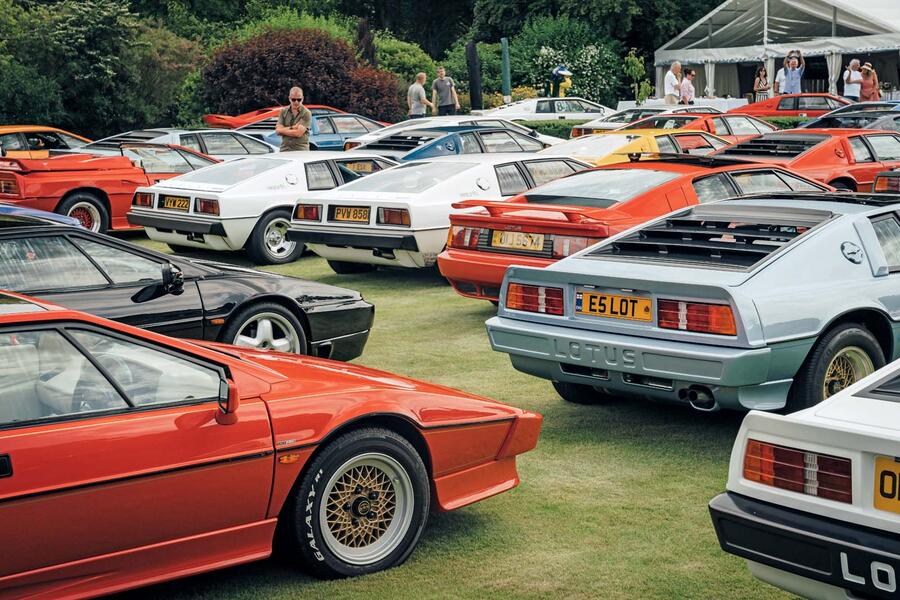
Of all the 50 (of course) Esprits gathered on East Carleton Manor’s lawns, there are just a handful of S1 cars, the purest exponent of the original ‘Silver Car’ concept’s acutely wedge-shaped lines.
Giugiaro is seated near one, with his interpreter, and I ask about his relationship with Colin Chapman: was there a language barrier? Giugiaro smiles back and replies: “Drawing was our common language.”
Engines fire up behind us, and I turn to see a mouthwatering selection of Colin Chapman’s 1960s single-seat race cars being driven out on to the manor’s front drive.
There’s Jim Clark’s Type 18, Type 32B and Type 35, among a few others. Clive Chapman, Colin’s son, has just returned in one of them and I ask him why the Esprit is so important in Lotus folklore.
“Dad was always looking forward. He saw what other companies were doing and wanted to raise Lotus’s game,” he replies. “We had gone from the Elan to the Esprit, but this extraordinary car still had (the Elan’s) handling characteristics… so you had your foot in both camps.”
Wandering around the gathered Esprits gives you a measure of how Lotus sweated the model for all it was worth with, by my reckoning, 22 derivatives produced during its life – possibly even more.
As well as the S1s, all the models from different designers are represented – X180 (Peter Stevens), S4 (Julian Thomson) and last-of-line V8 (Russell Carr) – plus special editions like the black and gold Esprit JPS and blue, red and silver Esprit Essex, both referencing Lotus’s F1 ties.
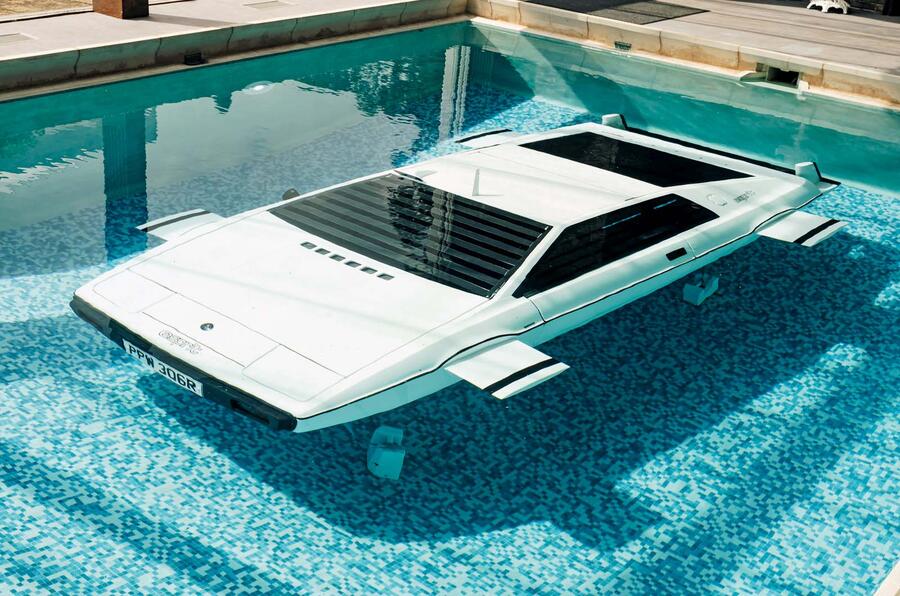
And what do we find in the manor’s swimming pool? Naturally, James Bond’s Esprit sub – aka ‘Wet Nellie’ – from the 1977 film The Spy Who Loved Me. In fact, it’s what looks to be a half-scale model, with the actual full-sized prop at the poolside, in front of the Turbo Esprit from the 1981 Bond film For Your Eyes Only.
As I leave the event, heads are turned towards Giugiaro, who is now sitting in an S1 parked next to Lotus’s 2024 Theory 1 concept car.
In 50 years’ time, I only hope that car will prove as influential to Lotus’s future as the Esprit was in 1975.
Submitted by dev_editor on
Submitted by dev_editor on
Submitted by dev_editor on
Submitted by dev_editor on
Submitted by dev_editor on
