It was quite a big weekend for motorsport. There was a Formula 1 race in Azerbaijan, which is in Europe, apparently, and of course there was the Le Mans 24 Hours, in France, which is definitely in Europe. Meanwhile, the BTCC circus pitched up at Croft, in North Yorkshire, which remains in Europe at least for the time being.

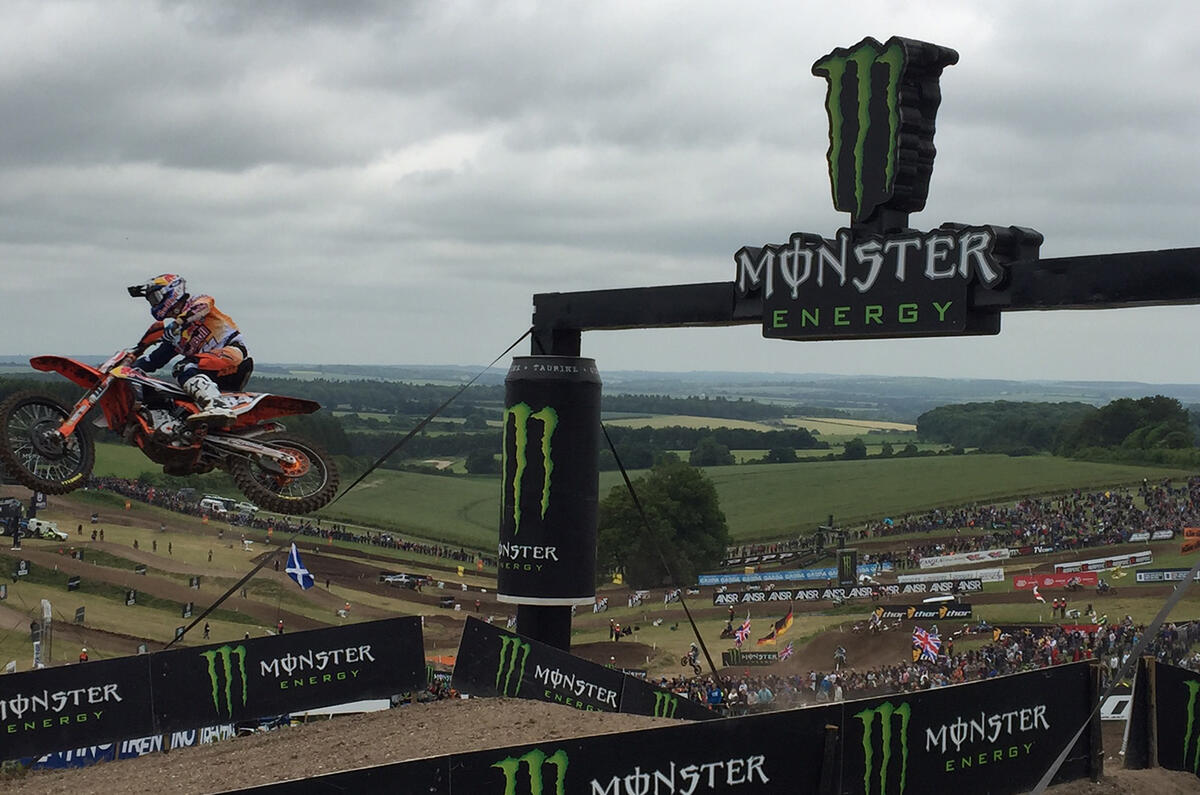
There was action on two wheels, too. The Misano circuit in Italy hosted the San Marino round of the World Superbike Championship, while back on home soil there was another world championship event – the British round of the World Motocross Championship, held at the pleasantly picturesque Matterley Basin in Hampshire.

It was this to which Autocar editor Matt Burt and I paid a visit on Sunday, courtesy of the nice people at Dunlop, who are currently in the process of helping us out with a very exciting feature coming this way soon. So watch out for that.

Anyway, the riders and drivers competing in the above events – or in any top-level motorsport – are what you might refer to as ‘quick’. They are really, really good at driving, or riding, fast. That’s a given. The thing is, there’s very often quite a bit more to it than simply steering, braking and accelerating, albeit in exactly the right way and at exactly the right time.

The stuff that you (possibly/probably) or I (definitely) would have to concentrate on 110% in order to set a personal best lap time around, say, Brands Hatch, happens on autopilot for real, actual racers. It’s the other stuff that makes the difference.

Talking to Steve Cropley before the Le Mans race, Ford drivers Marino Franchitti and Harry Tincknell both spoke of the apparent ‘serenity’ of driving down the Mulsanne Straight at 200mph in the dark.

Take Formula 1. Last year we published an interview with the British racing driver Gary Paffett, currently a DTM driver in Germany’s and test driver for the Williams F1 team. Last year he was McLaren’s test driver, and what he had to say about driving various McLaren F1 cars over the years was, frankly, astonishing. If you haven’t already read it, you really should.

It’s a fascinating and quite brilliant insight. We’re almost too familiar with F1; watch it on TV or even trackside and it’s easy to take what the drivers are doing for granted, but Paffett’s wide-eyed, fanboy-like description of what’s going on in the cockpit of an F1 car is truly enlightening. It should be essential reading for any jaded motorsport fan.

It’s not just on four wheels that the competitors go above and beyond. In motorcycle racing, riders drag along the ground bits of their bodies that most of us would be happy to keep well away from the surface of a race track.

But saving slides, and therefore crashes, on the knee – or even elbow for crying out loud – is par for the course in bike racing. Or, if you’re Marc Marquez, why not make use of pretty much everything from your ankle to your head?

During the Isle of Man TT a couple of weeks ago there was some amazing on-bike footage or multiple TT winner Ian Hutchinson, taken during the Superstock TT and broadcast on ITV4’s excellent coverage.

Following a horrific leg injury sustained in 2010, Hutchinson uses a thumb-operated rear brake, mounted on the left-hand handlebar, instead of a pedal by his right foot. (His right foot now changes gear; his left foot can’t do anything.)

Thanks to a camera mounted behind the fairing pointing back at Hutchy, we could just see how he used his rear brake around the TT course as a kind of manually operated traction control device, both to quell wheelies under acceleration and keep the bike composed over jumps and bumps.

There were times when, hard on the throttle, he was tapping repeatedly on the rear brake in a cadence-braking style; never mind the kerbs, hedgerows, houses and lampposts, Hutchy had enough brain capacity in reserve to do the job of a carefully programmed ECU. With his thumb.

Or take motocross, because that’s what prompted all this in the first place. In motocross, the bikes and riders spend quite a bit of time up in the air, but even doing that isn’t necessarily as simple as it looks. If the take-off goes awry and the front wheel is too low or too high, then the attitude of the bike can be adjusted mid-air with a bit of body English and the application of throttle (to lift the front wheel) or rear brake (to lower the front wheel). Or it might be the other way round, I’m not sure – which is one of several reasons why I must never attempt to do huge jumps on a motocross bike.

There’s another motocross technique that has developed over the past few years, and it’s called the ‘scrub’. The scrub was first used by the American motocross star James ‘Bubba’ Stewart, so it became known as the ‘Bubba Scrub’. Technically he didn’t invent the scrub, but he who honed it to such devastating effect that his rivals were forced to adopt it in order to keep up with him.

The scrub involves pitching the bike onto its side on the face of a jump, just as the bike leaves the ground – in effect almost, but not quite, crashing on purpose – so it doesn’t jump as high and lands earlier than it otherwise would for any given take-off speed. This means the rider can get back on the throttle sooner and start accelerating again, but without the loss of speed and forward momentum that would have occurred by rolling off the throttle before jumping.

How it works is a bit of a mystery, but there seems to be a general consensus that by lowering the centre of gravity just before take-off, the bike’s trajectory stays lower. It’s something to do with ballistics and physics, but no one seems to care as long as it works. Which it does.

Tim Gajser, the Slovenian rider currently leading the premier MXGP class and winner of both of his races on Sunday, is a master of the scrub, as you can see in this video:

Chuffing nora, you might say. To be fair, Gajser was perhaps showboating just a little bit there, but you get the idea.

The action at Matterley Basin was only marginally less spectacular. I’m an armchair fan of motocross and watch most of the races on Motors TV, but this was the first time both Matt and I had been to an MXGP event and we came away impressed.

It was, for us at least, a novelty at a motorsport event to have to strain our necks up to watch the competitors come past us 20-odd feet in the air, often one handed while removing a tear-off, or two or three abreast, or adjusting the attitude of their bike mid-air – or all three.

The point is that they’re not like you and me, these people. They do things that you and I perhaps didn’t even know needed to be done in order to be the best at what they do. In fact, it’s all quite humbling.