Currently reading: Updated Renault Megane brings new face and 310 miles of range

Fresh new look and bigger battery take fight to growing number of electric hatch rivals

Renault has updated its electric Megane E-Tech hatchback after four years on sale, with a new look and more range among the headline enhancements.

The mid-life nip and tuck for the firm’s first bespoke EV comes as rivals including the Volkswagen ID 3, Cupra Born, Vauxhall Astra and Peugeot e-308 also receive updates to boost their competitiveness alongside the Hyundai Ioniq 3, Kia EV4 and Mini Aceman.

The updates are signalled chiefly by a new front end that brings the Megane in line with the newer Austral and Rafale SUVs, with a more imposing grille and a lower-set Renault badge.
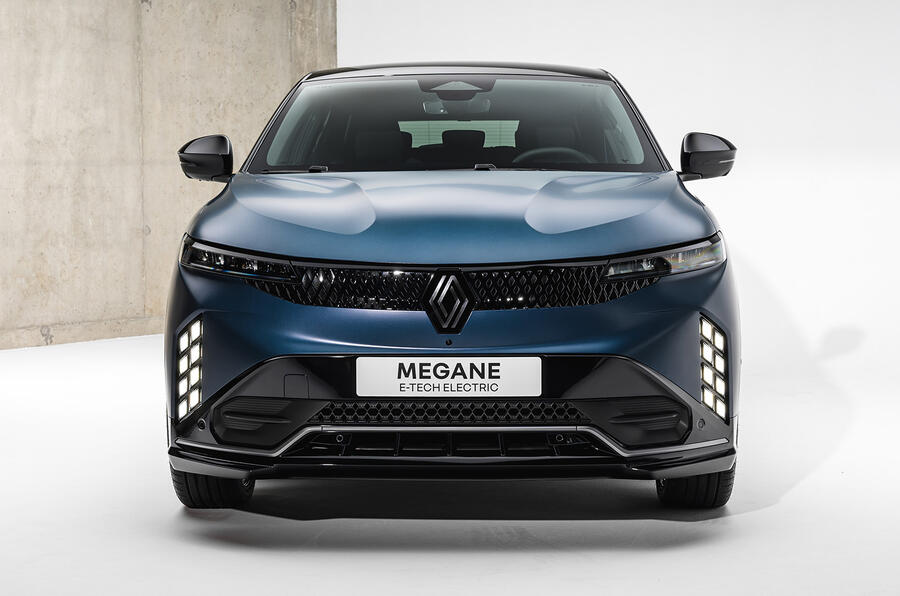
Renault boss Fabrice Cambolive previously told Autocar this refresh would seek to reposition the Megane as a “hot hatch or a hot car”, and the redesign has clearly been influenced by the brand’s previous performance models.

The lower front bumper has been restyled with chequered flag-style daytime-running lights, similar to those featured on the previous-generation Mégane RS, while a more aggressive valance adds visual width. At the rear, the bumper features a chunky integrated diffuser. New ‘power bulge’-style creases in the bonnet and 3D-effect tail-lights complete the exterior makeover.

Battery capacity has been increased to 67kWh from 60kWh, boosting the hatchback’s maximum range to 310 miles from 285 miles. This compares with 309 miles of range for the 58kWh Volkswagen ID 3 Neo.

The height of the battery has increased slightly to achieve the uplift in capacity, resulting in a 20mm increase in overall height: the Megane is now 1520mm tall (roughly 40mm lower than an ID 3 Neo). The new Megane also weighs 100kg more, at 1772kg, 75kg of which is due to the bigger battery, but that’s still more than 100kg lighter than the ID 3.

Advertisement

Read our review

Car review

French firm’s traditional hatchback gains range-extending upgrades and enhanced interior tech

Back to top

The suspension and steering have been tuned to deal with the extra weight, but the 217bhp motor powering the front wheels remains the same. Length and width also remain the same, at 4200mm and 2055mm respectively, as does the class-leading440-litre boot.

Other updates include peak DC charging speeds increasing from 130kW to 165kW, giving a 25% reduction in charge time from 15-80%, now a claimed 24 minutes. AC charging speeds remain at 11kW, or optionally 22kW, which also brings vehicle-to-load and vehicle-to-grid capability. A heat pump and battery and interior preconditioning are standard.

Inside, fewer changes have been made, with the same dual-12-inch screens remaining - although now with Gemini AI assistance. 

Pricing will start at “no more” than the current car, which kicks off at £31,295 including the £1500 Electric Car Grant. However, Renault says the new model could qualify for the full £3750 grant like its Scenic and 4 and 5 siblings, bringing it under £30,000. 

Join our WhatsApp community and be the first to read about the latest news and reviews wowing the car world. Our community is the best, easiest and most direct place to tap into the minds of Autocar, and if you join you’ll also be treated to unique WhatsApp content. You can leave at any time after joining - check our full privacy policy here.

Alex Wolstenholme

Alex Wolstenholme
Title: Editorial Assistant

Alex joined Haymarket, the publisher of Autocar, in 2023. A car fanatic, he loves to delve into the spec-sheet, especially when it concerns something obscure or quirky. He currently drives a 2007 Alpina D3 estate and a 2004 Alpina Roadster S. 

In his current position, as an editorial assistant, Alex mainly assists in managing Autocar's presence online, but also writes features and reviews for the magazine.