

With the prospect of autonomous cars for all looming eventually (please form an orderly queue), it's easy to forget that robot taxis are already on the streets in various locations and have been for a while.
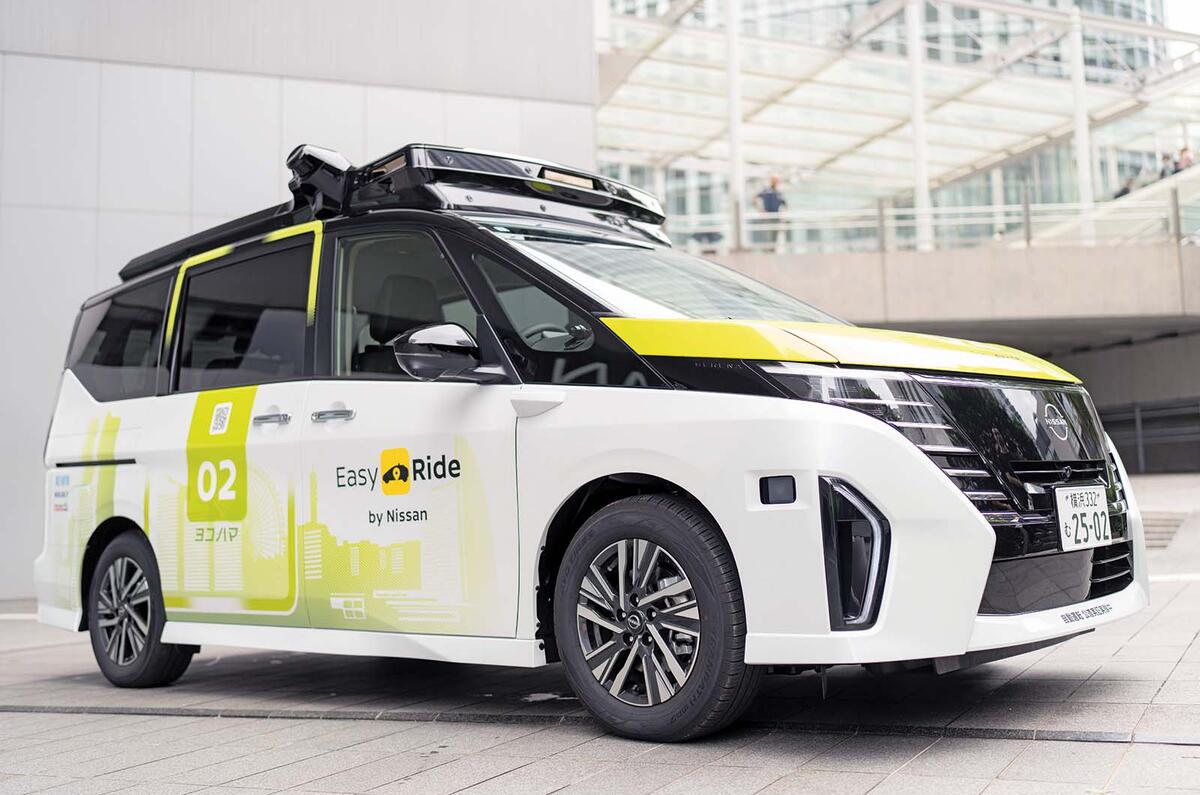
Nissan recently announced the launch of an 'autonomous mobility service pilot programme', which ends 30 January. The trial will use five autonomous Serena Minivans, which will be monitored at a control centre in the Minato Mirai district close to where the minivans will be running.
Operational services will be launched in early 2027, with 300 members of the public recruited as 'general monitors. Nissan first showcased its latest autonomous drive (AD) technology in March.
The pilot scheme is the latest development of the work Nissan has been doing to demonstrate and test AD technology since 2017. The know-how for the technology has been drawn from research in Japan, in Silicon Valley by the Nissan Advanced Technology Centre and from the UK's evolvAD project.
The vans being used in Yokohama are equipped with 14 cameras, nine radar sensors and six lidar sensors, all mounted on the roof of each vehicle. The height of the vans helps provide significantly improved detection and makes assessment of the surrounding environment that much more effective compared with earlier test vehicles.
Nissan Leafs were used in the evolvAD project in the UK, for example - those were equipped with a similar array of roof-mounted sensors and put through their paces on a variety of urban residential and complex rural roads chosen for the unique variety of challenges they provided for AD technology.
Data from the sensors is processed by software, and Nissan says Al has significantly enhanced recognition, behavioural prediction and judgement as well as control in various complicated scenarios.
The systems contain a number of redundancies - the duplication of hardware and software for back-up purposes in case one set fails. Engineers are taking no chances when it comes to safety, either: they identified a large number of possible scenarios along the test route and added an immediate stop function for emergencies.
According to market intelligence firm IDTechEx, Waymo has established itself as the leader in robotaxi services in the US using modified Jaguar I-Paces, with operations in Phoenix, San Francisco, Los Angeles and Atlanta, and it's also testing in Tokyo.
Tesla is operating robotaxis over 170 square miles in Austin, Texas; Zoox and May Mobility have also started operations in the US, with Zoox using a dedicated robotaxi built from the ground up.
According to IDTechEx, Waymo's only competitor in China in terms of scale is Apollo Go, which is running more than 1000 robotaxis in 12 cities including Beijing and Shanghai, and it has its sights set on the UK and Germany for next year.


