
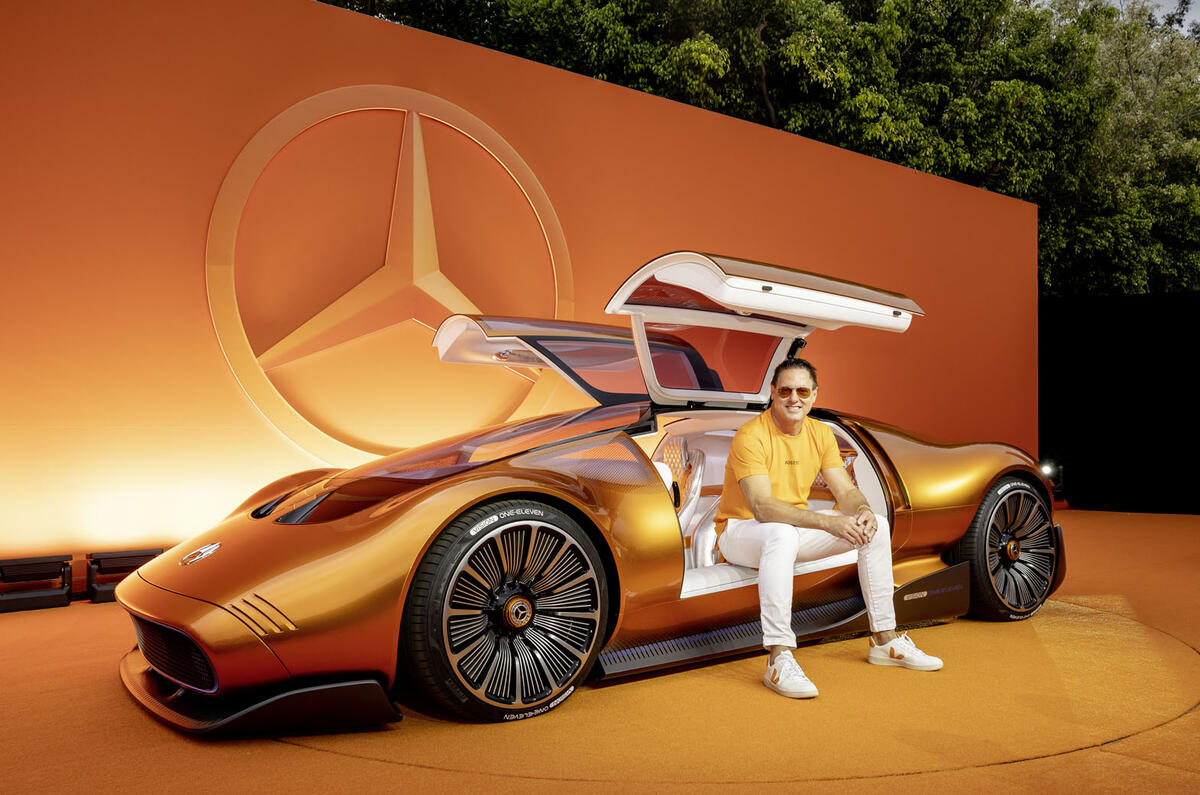
Currently reading: Mercedes-Benz design boss Wagener to leave after 28 years

Wagener's departure marks end of an era at German car maker; will be replaced by AMG design chief

Mercedes-Benz design boss Gorden Wagener will step down in January, ending a 28-year career that radically reshaped both the styling of its production models and the internal design culture at the German car maker.

The 56-year-old, who joined Mercedes in 1997 and has led its global design operations since 2008, will be replaced by Bastian Baudy, the head of Mercedes' AMG performance car design department.

Wagener will leave the German firm on 31 January. It is at his own request and by mutual agreement.

His departure closes a significant chapter in Mercedes' design history. Under his direction, the design of its production cars underwent a comprehensive overhaul, moving from the conservative, engineer-led styling of the early 2000s to the more emotional and sculptural forms that define the existing Mercedes line-up.

Mercedes CEO Ola Källenius said: “Gorden Wagener has shaped the identity of our brands with his visionary design philosophy. Over many years, he has made a decisive contribution ensuring that our innovative products are synonymous with unique aesthetics worldwide. His creativity and his sense for the future of automotive design have sustainably enriched Mercedes-Benz."

How Wagener revolutionised Mercedes design

When Wagener was appointed vice-president of Mercedes design in 2008 at age 39 (making him the youngest lead designer within the global automotive industry at the time), he inherited an operation struggling to reconcile its heritage with contemporary design trends. His predecessor, Peter Pfeiffer, had championed a more traditional design approach heavily rooted in engineering principles.

Wagener's response was to develop what he termed "sensual purity", a design philosophy introduced in 2009 that aimed to create models that would appeal to "both your head and heart". The approach prioritised clean surfaces, sculptural forms and reduced visual complexity in a marked departure from the angular, heavily detailed designs that had characterised Mercedes' core models in previous decades.

"We don't want to be conservative any more," Wagener explained in 2019. "Mercedes has to be emotional. You have to fall in love with the car before you even sit in it."

The zenith of this design lineage is arguably the AMG GT sports car, which Wagener has frequently cited as his most cherished design. "Sports cars were always my favourite design projects," he said. "The GT is pure emotion and fascination; that is what makes the GT so special for me."

Wagener is also credited with a long line of flamboyant Mercedes concept cars, the final of which, the art deco-inspired Vision Iconic, was revealed in Shanghai in October. This previewed the bold new design language set to be adopted by future key production models, including the upcoming electric C-Class and E-Class saloons, due out in 2026 and 2027 respectively.

Back to top

Born in Essen in 1968, Wagener studied industrial design at the University of Duisburg-Essen before specialising in transportation design at London's Royal College of Art. His career began with stints at Volkswagen, Mazda and General Motors before he joined Mercedes in 1997 as a transportation designer working under its then design boss, Bruno Sacco.

His rise through the ranks was rapid. By 1999, he was managing exterior and interior styling for the R-Class, ML and GL. In 2002, he moved to passenger car development, overseeing design for the A-Class, B-Class, C-Class, E-Class, CLK, CLS and McLaren SLR. A brief transfer to Mercedes' advanced design studio in California in 2006 preceded his 2007 promotion to director of design strategy and global advanced design.

When he assumed overall leadership, Wagener broke decisively with long-time Mercedes tradition and processes. His predecessors, Karl Wilfert, Friedrich Geiger, Bruno Sacco and Peter Pfeiffer, had all trained as engineers. Wagener was the first pure designer to lead Mercedes design, a distinction that those who worked under him say enabled the “sensual purity” shift he championed.

If one car exemplified Wagener's impact, it was the CLS, the four-door coupé that gave Mercedes a sleeker, more desirable model to sell alongside its more conservative saloons. From there, the brief widened with similarly styled models such as the A-Class and CLA to chase younger buyers. Other key models designed under his leadership include the gullwinged SLS and the current G-Class.

Elevated to the Mercedes board in 2016 as chief design officer, Wagener oversaw design for all group brands, including AMG, Maybach, Mercedes-Benz Vans, EQ and Smart. His remit extended beyond cars: he has led design teams on helicopters, luxury yachts and, most recently, the Mercedes-Benz Places residential towers in Dubai and Miami.

Wagener's tenure has not been without controversy. His design for Mercedes' EQ electric cars, particularly the EQS saloon, drew heavy criticism for its aerodynamically optimised but visually controversial jelly-bean form. Sales of this flagship EV failed to live up to early expectations, and subsequent EQ EVs have closely resembled their combustion counterparts – acknowledgment that Wagener's more radical design was "ahead of its time", as he himself suggested.

Back to top

The prolific use of large digital screens in the interiors of recent Mercedes models also sat awkwardly with Wagener's stated design priorities. Despite the brand's 56in Hyperscreen being among the industry's largest displays, Wagener told Autocar that "screens are not luxury" and emphasised that Mercedes would focus more on craftsmanship and sophistication in future models with what he described as a “hyper-analogue” approach.

Wagener's successor, 41-year-old Baudy, currently serves as head of design at AMG. The appointment once again places a younger designer at the helm of Mercedes design. 

Baudy, who graduated from Pforzheim University's transportation design programme in 2010, began his career at Mercedes in advanced design before progressing to team leadership roles in exterior design. His breakthrough came in 2013, when his sketch won an internal design competition to create the AMG Vision Gran Turismo concept for the PlayStation game Gran Turismo 6, drawing inspiration from the bulbous, muscular forms of 1940s Mercedes-Benz race cars.

More recently, Baudy was credited with providing the design impetus for the current EQE and E-Class.

Join our WhatsApp community and be the first to read about the latest news and reviews wowing the car world. Our community is the best, easiest and most direct place to tap into the minds of Autocar, and if you join you’ll also be treated to unique WhatsApp content. You can leave at any time after joining - check our full privacy policy here.

Join the debate

Comments
2
Add a comment…
tuga 17 December 2025
GOOD RIDDANCE.
scrap 17 December 2025

Wagener, McGovern and Lichte should do a podcast together where they tell us why we're not worthy of their genius. Van Hooydonk can join in too if he wants.

It was never the designs that were the problem, it was the silly customers who are simply unable to understand the flawless brilliance of these egos.
