

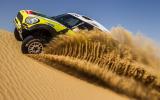
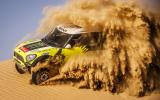
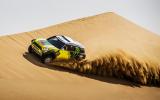


When Autocar called to ask if I’d mind trekking to the desert to test drive the most outrageous Mini ever created, I started scrabbling around for my passport before they’d even hung up the phone.
I race an eBay Motors BMW M125i M Sport in the BTCC, but I’ve competed in many other disciplines, including hot rods, stage rallying and single-seaters.
One thing I’ve never tried, though, is a four-wheel-drive cross-country rally car. And they don’t come much better than the Mini All4 Racing, which has dominated the Dakar Rally – which now takes place in South America – for the past three years.
Now X-raid, the team that runs Mini’s Dakar assault, has entrusted me to test the car in the middle of the desert outside of Dubai.
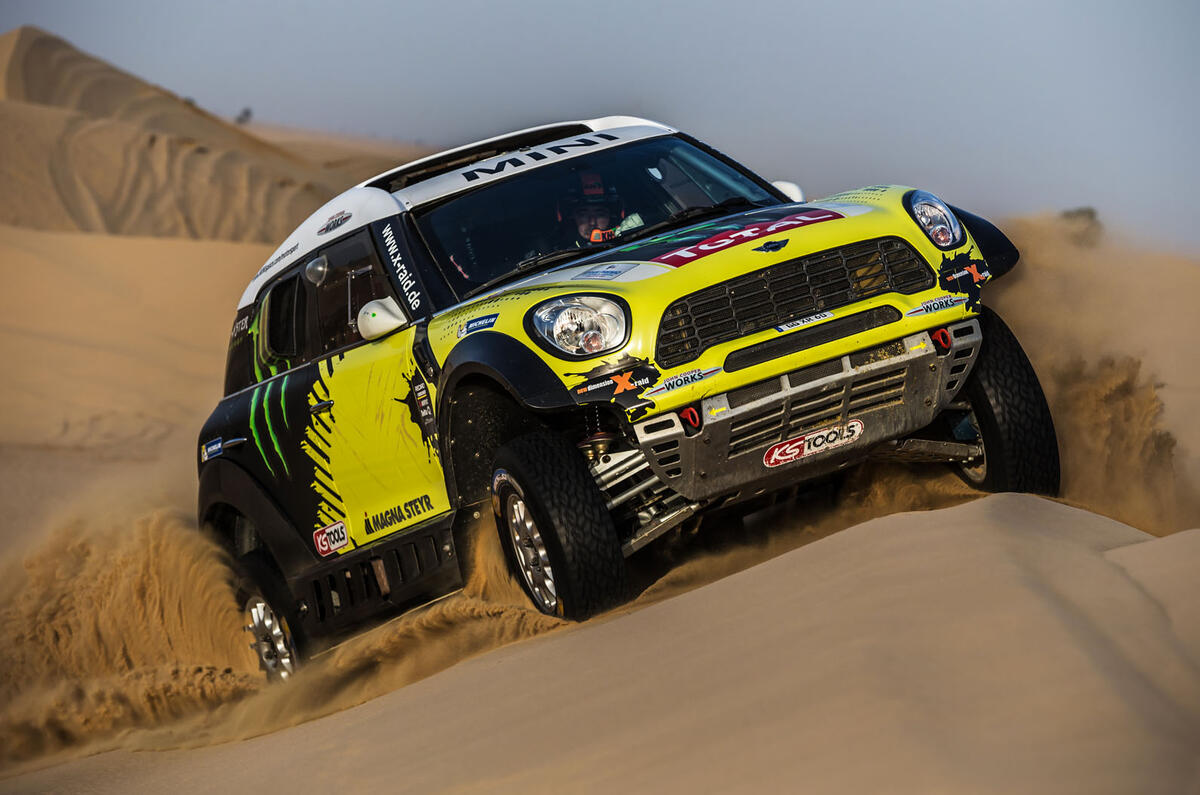
I’m itching to drive, but first I have a good poke around the Mini. It is built around a steel tubular frame, which is cloaked in carbonfibre body panels that give it the appearance of the Mini Countryman road car.
The rally car towers over the road car by more than 400mm and is 209mm wider. The wheelbase of the competition car is 300mm longer, too, at 2900mm, which is the maximum permitted wheelbase.
Read the Mini John Cooper Works Paceman All4 first drive
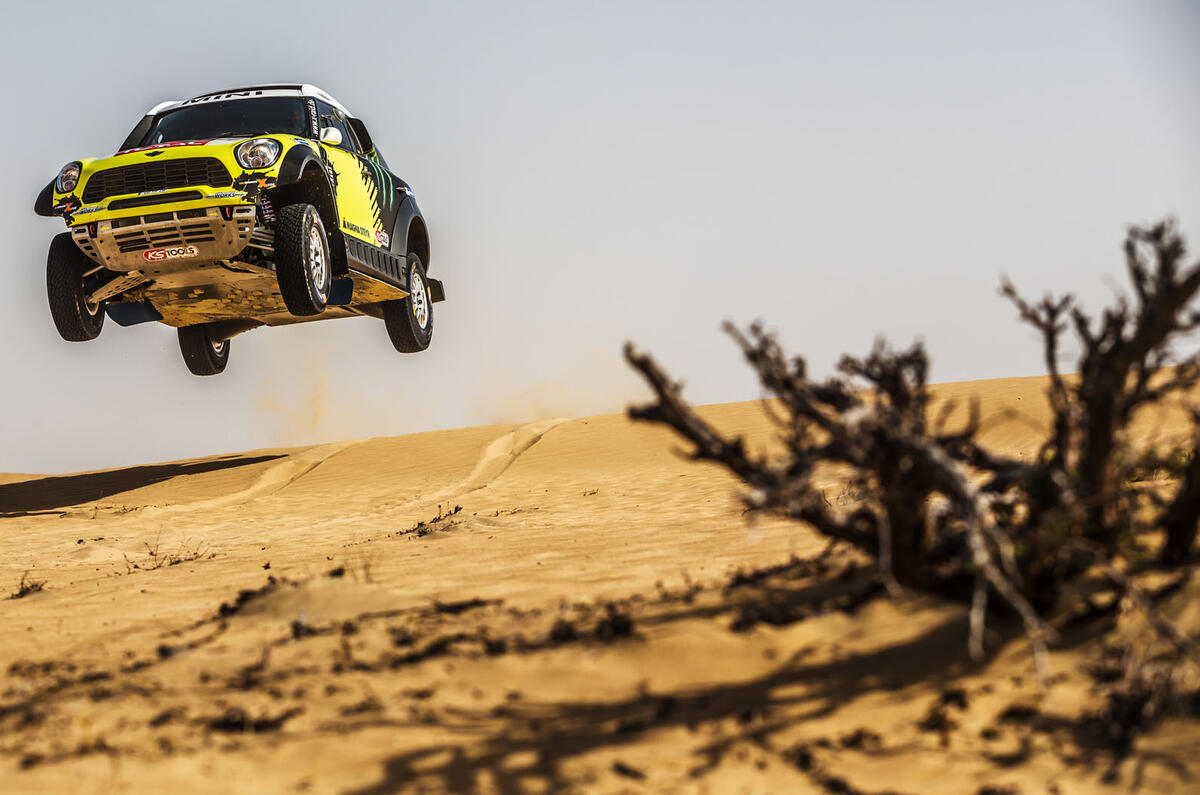
Another significant restriction is the suspension travel. Dakar prototypes are limited to 250mm, which isn’t much when you have to cope with enormous craters on rough mountain roads at high speeds.
Powering all four wheels is a straight-six BMW diesel. It is a 2993cc unit derived from that seen in the road-going BMW X3 SUV. An air restrictor limits power to around 300bhp, but more importantly there’s a whopping 516lb ft of torque.
You can feel that low-end grunt right from the moment you engage first gear from the sequential ’box and release the clutch. In some respects, the All4 Racing is like a typical rally car, in that it feels very butch and not as refined as the touring car I drive.
As soon as you pull away, though, it’s impossible to keep the smile from spreading across your face; the car whistles away as the two massive turbos start to spin up.
Driving in the dunes is so much fun. If the car is burying itself in the sand at low revs, you just keep your foot in and it lifts itself up and glides across the ruts like a hovercraft. It’s an amazing sensation.
The Mini is set up to be quite soft, so when you come off the power it pitches on the front end and you get really good turn-in, which is useful if you want to avoid a rock or a tree. I was amazed at how well the suspension coped with that kind of driving and how much precision there is. At high speeds, however, it will do lovely four-wheel drifts.
One difference to my racing BMW is the braking. The way the car is set up, it gives you no option but to use left-foot braking. The brakes didn’t feel very sharp, but that’s because I’m used to touring car brakes on a tarmac track, whereas in the Dakar car you’re trying to stop on sand. It’s a different ball game altogether.
Most competition cars I’ve driven have been stripped bare for weight saving, but the All4 Racing is different. Few production parts remain – the lights, door handles and windscreen are from the standard Countryman – but there are spare parts, tools and useful kit stowed in every available space.