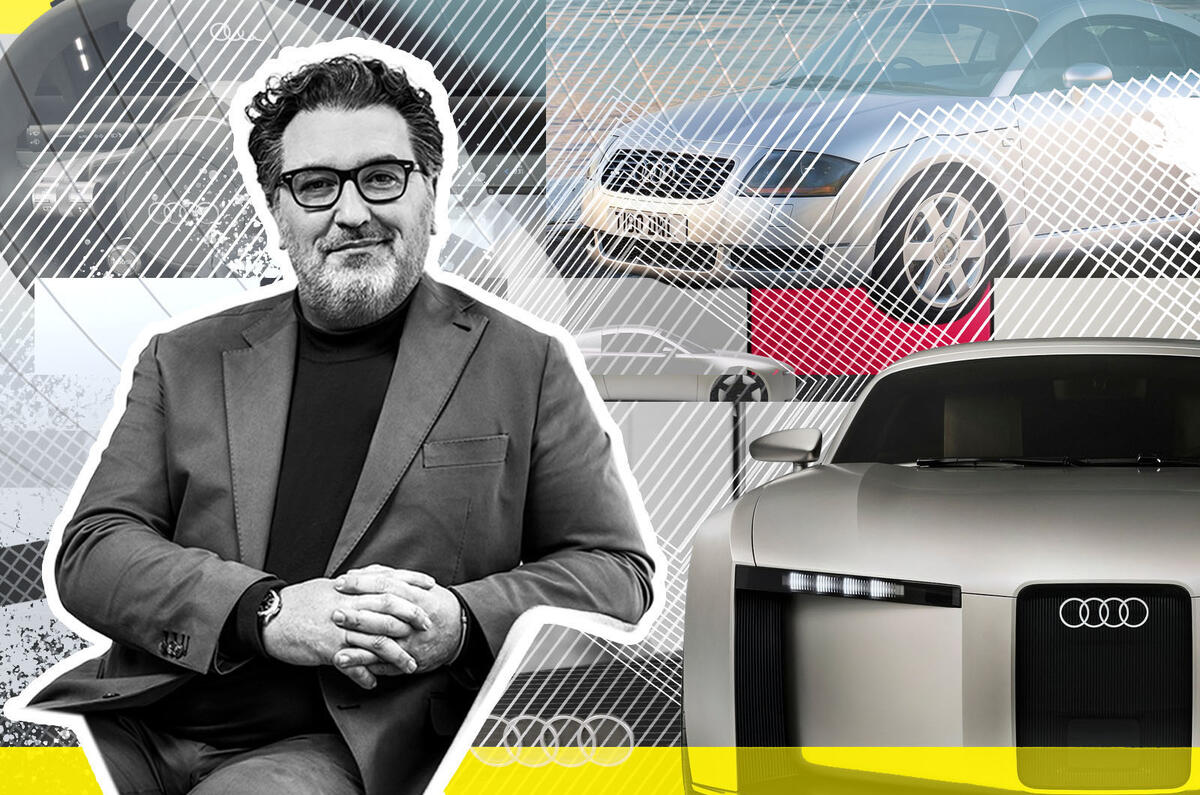
When aspiring designer Massimo Frascella took a day off work in 1998 to go and fawn over the freshly launched TT in a Turin Audi dealership, he had no idea he would one day be afforded the opportunity to reimagine the seminal sports coupé for a new era as the brand's head of design.
Once Peter Schreyer's sports coupé was unwrapped, it was so alluringly rule-breaking that it simply had to be studied in the metal. And at length.
Indeed, this early encounter with one of the most important Audis of all time instilled within Frascella a deep-seated appreciation for the attributes that define the brand and set him on a 27-year journey that would see him eventually take charge of Ingolstadt's design studio, as had been predicted by anyone familiar with his work.
He says: "What's consistent throughout my career was people feeling this association with the brand in what I was doing, and often telling me: 'Oh gosh, you should work for Audi. One day, I'm sure you will work for Audi.' And that happened."

A graduate of Turin's Institute of Applied Art and Design, Frascella began his career at Bertone before heading to Ford to work on the US-market Lincoln and Mercury brands, then settling at Kia's Californian studio for six years, during which time he led the exterior design for the Sorento, Sportage, Rio and Soul.
Frascella arrived at Jaguar Land Rover in 2011 and worked his way up to eventually becoming head of design for both brands, most famously leading the landmark revival of the Defender.
His subsequent appointment at Audi is painted as the fulfilment of a prophecy written upon his first encounter with the TT, and his manifesto – the internet-stopping Concept C – is unmistakably influenced by that era-defining car.
Indeed, Frascella points to its simplistic silhouette and straightforward styling as the factors that sucked him in but says it was but a halo for a line-up full of models that stood out for their convention-breaking cleanliness and purity.


Join the debate
Add your comment
Three questions the writer could have asked; why did we see concepts of the Defender for long instead of getting it on sale in such an exploding SUV market? Why wasn't there a baby Defender 3-5 years ago which was then like falling off a log? Is it a problem that the new face on Audis looks back to Auto Union racing cars which were built with Nazi funds?
Frascella's theoretical premise is excellent: Audi urgently needs to return to the distinctive simplicity of its lines of the past. However, what works well on a bulky SUV (a clean, smooth monolith, such as the Range Rover Velar but also the new Defender), despite the simplicity of its surfaces, doesn't work so well on a sports car like the Concept C, which completely lacks the grace of Peter Schreyer's first TT. Let's leave aside the disconcerting look of the vertical mustache-like grille at the front. -- P.S. The Type 00 is also disconcerting in my opinion.