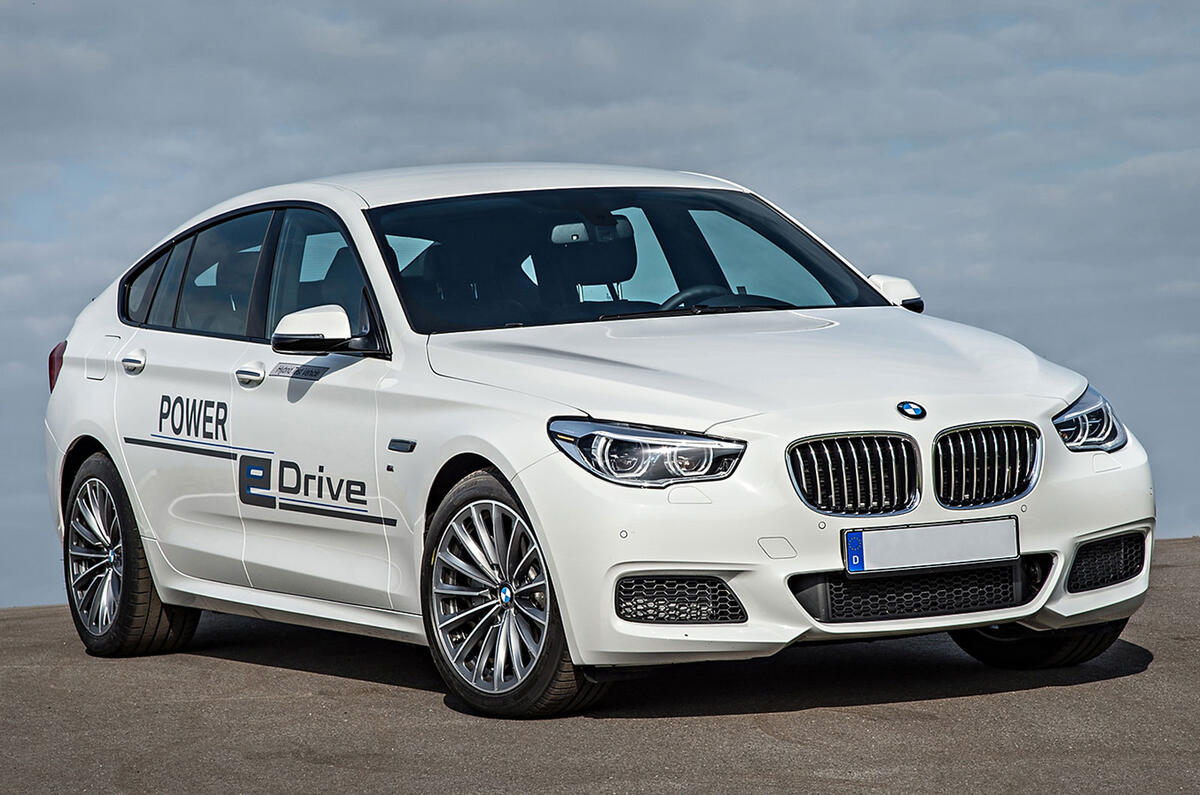

BMW has revealed an advanced new plug-in hybrid system, dubbed Power eDrive.
The new system forms part of an extended range of modular hybrid powertrains being developed in a performance-based EfficientDynamics engineering program at BMW’s research and development centre in Munich.
It's envisaged for launch on various BMW Group production models in what BMW describes as “upmarket segments”. The unveiling brings closer to reality the prospect of a four-cylinder petrol and twin electric motor-powered model from Rolls-Royce. Such a model would be capable of impressive straight-line performance and increased range.
The new hybrid system aims to provide the sort of smooth yet urgent step-off performance qualities delivered by a contemporary battery-powered electric drive systems – like that offered in the Telsa Model S.
An overall range of over 370 miles is quoted, with some 62 miles managed on electric power alone thanks to a range extender function.
Revealed in a 5-series GT-bodied prototype, the most powerful of BMW’s new modular hybrid powertrains uses its new 228bhp turbocharged 2.0-litre, four-cylinder petrol engine in combination with two electric motors.
Those motors are a modified version of the i3's synchronous unit. A 201bhp motor is mounted up front in the space usually taken up by the torque converter in the car's eight-speed automatic transmission, while another, developing 268bhp, is mounted within the rear axle assembly.
In total, the system is claimed to produce over 670bhp, along with a torque loading beyond 750lb ft – figures that easily top the 453bhp and 530lb ft of the existing naturally aspirated 6.8-litre V12 used by the 11-year-old Rolls-Royce Phantom.
The principle behind BMW’s Power eDrive system is a maximisation of electric motor performance. “The electric motors provide approximately two-thirds of the combined output, with the combustion engine accounting for the remaining third,” said Franz Drescher-Kaden, BMW concept engineer for the new petrol-electric hybrid set-up.
Energy for the electric motors is provided by a 20kWh lithium ion battery mounted both longitudinally in the rear of the 5-series GT’s centre tunnel and horizontally underneath the rear seat in a space ahead of the rear axle.
It can be charged both via plug-in means and on the run using the combustion engine in a steady state mode. The fuel tank has been reduced in size from a standard 70 litres to 30 litres.
As well as acting as a generator to produce electricity, the Power eDrive hybrid system’s petrol engine can also provide a performance boost with direct drive to the front wheels during kickdown, in which all three power sources are used for propulsion.
Drive is nominally channelled to the rear wheels via the rear electric motor, whose reserves are sent through a multi-speed gearbox.
The introduction of the front electric motor, which operates via the eight-speed automatic in which it is housed, provides all-electric four-wheel drive. This is further enhanced by the combustion engine, which also delivers its power to the front wheels.