Diminishing returns is something I used to understand well with cars.
It was a simple concept to grasp and it largely held true: the more you paid for a car, the better it was, although as they got more expensive, they got better more slowly.
A £50,000 car was lots better than a £20,000 car, for example, but a £100,000 car wasn’t so much better than the £50,000 one and a £200,000 car was a smaller amount better again.
Of course, there were exceptions and sweet spots across the market: cars that were never worth the money and some absolute bargains. But the basics were what they were for so many consumer products. You paid more, and got something better.
A manufacturer had invested more, therefore the product was superior and, as a buyer, you would feel it. A BMW 7 Series was better than a 3 Series; a Ford Mondeo was superior to a Fiesta.
I don’t know if I’ve changed or the market has changed or it’s a combination of the two, but this feels broadly much less true than it used to.
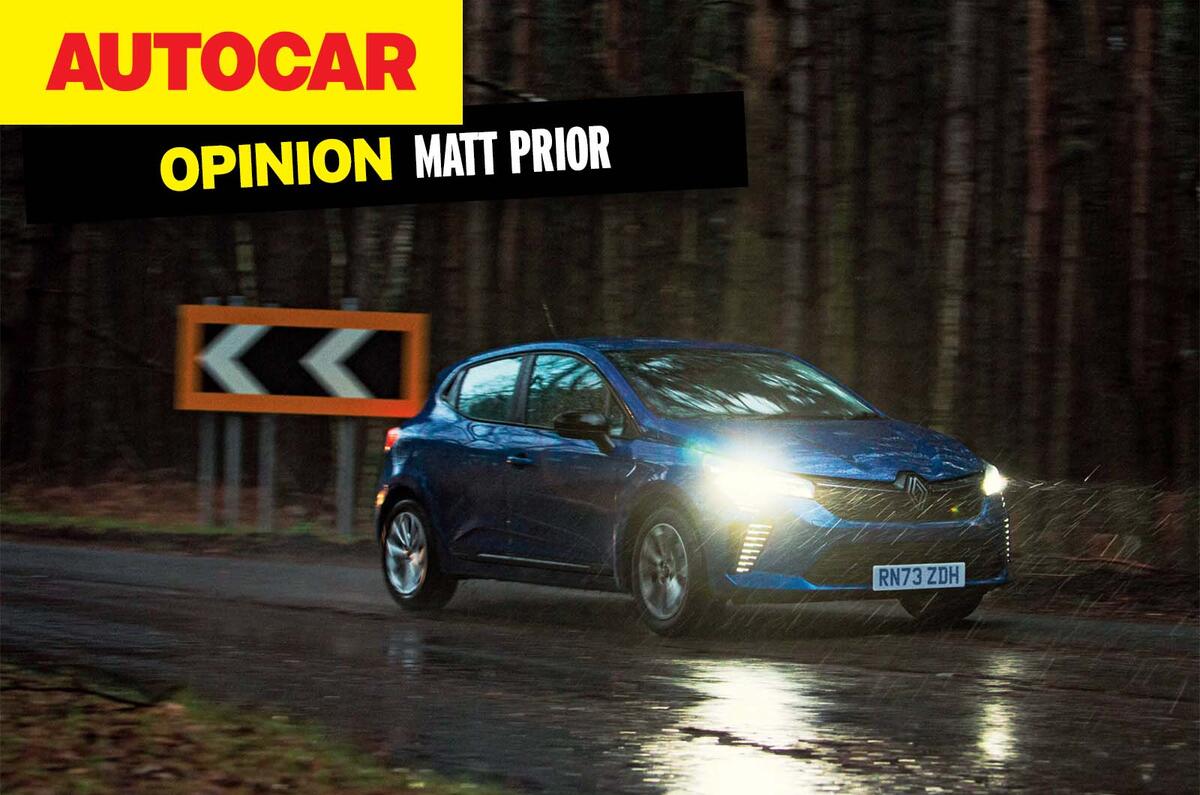
Recently I drove home in a bog-standard, sub-£18,000 Renault Clio. And I loved it. And not just ‘look at what they’ve done for the money’ loved it: I loved it regardless of its price.
It used to take an expensive car to give me all of the comfort and convenience features that I need, but the Renault has everything I can do while driving and more besides.
Fine, there’s no variable ambient lighting or massage function, but it’s a car, not a hot tub, and I’d rather not lug a function around if I’m not going to use it anyway.
Then there’s its size. It’s 4.05m long and 1.80m wide, which means it’s more useful, not less, than a car that’s 5m long and 2m wide. It’s easier to park and sneaks through gaps they can’t, therefore saving me time, and that’s the most precious thing I have. If time is money, then surely a small car is worth more, not less.
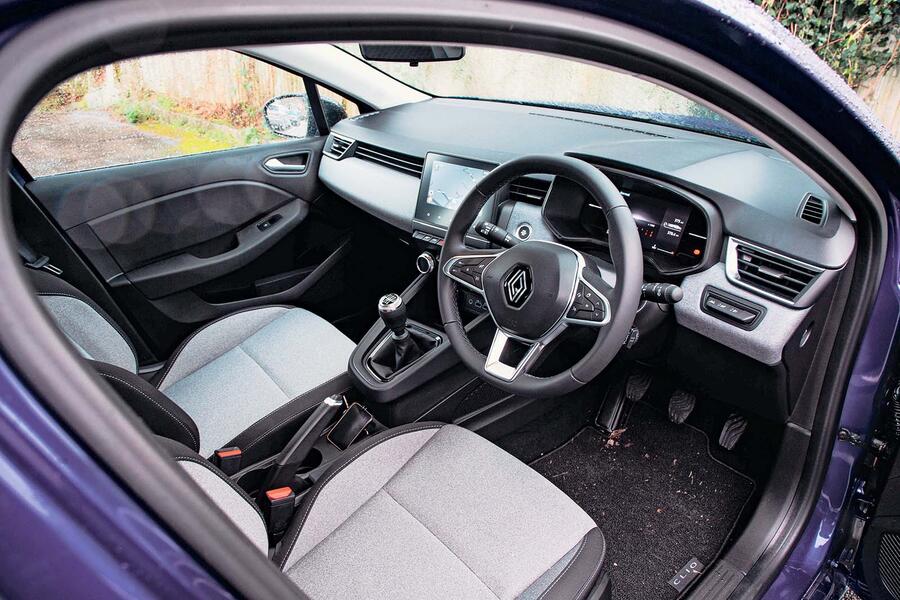
The Clio is also much more pleasant to drive than most big cars. It had been a while since I drove one, and the road testers told me it was the supermini class swot, but I didn’t realise it would ride with such deftness, be so absorbent, yet settle so quickly – and steer so nicely.
Of course I’d like it to be faster, its plastics to be softer or thicker and it to be quieter, but here some of the things money buys you still apply. Soft-feeling thick polymers and real metals cost more than scritchy-scratchy plastics, and remember that they’ve made a whole Clio for less than the price of some luxury car options.
And what clearly isn’t price-dependent is reliability and engineering-style quality – as in how often a car goes wrong. In the 2023 What Car? Reliability Survey, the top 10 most reliable cars included two Suzukis, a Ford, a Toyota and a Hyundai. Luxury stuff this is not.
This doesn’t ring true for every small or big car, but at this end of the market are products that are nicer to drive, easier to live with, practically as comfortable and even more reliable and trustworthy than cars costing three or four times as much.
I’ll go further: if the Clio and some of the market’s most expensive cars were outside my house every morning, I’d climb into the Clio more often than not.
I’m wary of saying ‘this isn’t how the world used to be’, because that way dufferhood lies. But I don’t think this is how the world used to be.
On a not entirely unrelated note: car feature subscriptions. Thankfully manufacturers seem to be backing away from plans to charge drivers to use hardware features that are already fitted to their cars.
But I have a counter-offer to any manufacturer that does request a subscription fee to turn on, say, a heated steering wheel or a cooled seat.
Look here, matey: it’s costing me money to ferry around this feature that I don’t want, and evidently you own it, not me. So either come and take it out or pay me a monthly fee for the cost of transporting it.

Join the debate
Add your comment
Possibly some joy you felt while in a bog-standard-£18,000 car is simply because it is French, they like comfort as much as anyone, however they don't really do complete rubbish for the proletariat. The sophistication of their older hot hatches and saloons should tell you that.
Nobody 'needs' electric windows, powered sunroof, powered seats, heated steering wheel, massaging seats, leather trim, highend audio, wireless charging, keyless entry, remote starting, HUD's and the list goes on. But people 'want' these items and so when one manufacturer adds one, all the others follow suit. And these higher trim versions are way more profitable to the automaker, both when sold new and through full lifetime due to additional maintenance and repairs. Here in the USA, where new car buying means walk onto the car dealers forecourt (lot) browse the inventory and drive away in your new car the same day (ordering and waiting is the exception) results in the dealers usually only stocking higher trim vehicles. Matt's right, the best value is always in the lower trim levels, avoid the options, and stay away from entry level products from 'luxury' manufacturers.
Wonder if this is an age thing?, if your over 40 you remember what we take for granted today being then the new thing in cars, well it's the same today for today's generations, they've grown up with this tech so we didn't see the need for,and we today can't get our head round the new tangle stuff, but the under forties see this stuff as essential.