Currently reading: Fiat mulls 73mph limit for 500, Panda city cars

Limiting top speeds could be a more cost-effective solution for city car safety than ADAS

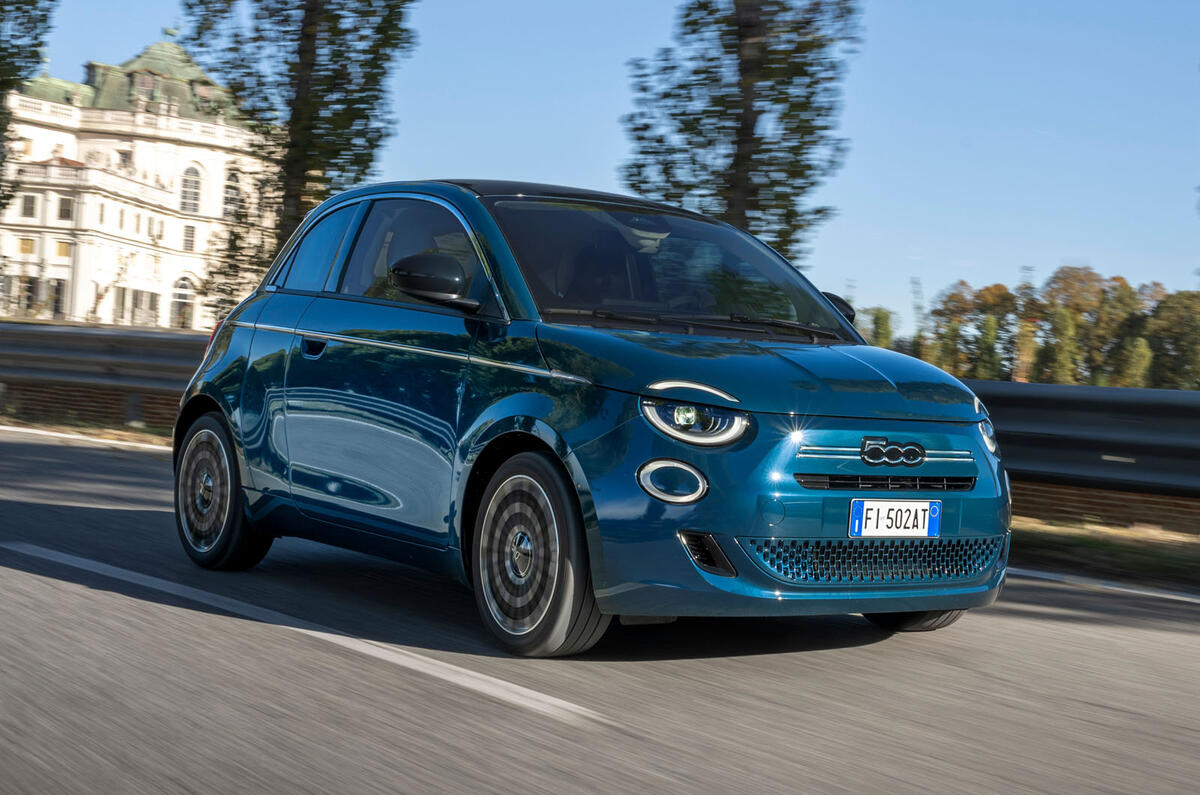
Fiat CEO Olivier François said he would "happily" limit the top speed of his company's city cars to 73mph, as an alternative to fitting them with costly safety technology that he considers unnecessary for low-speed driving.

He said that most of the ADAS technology that is mandated by current EU regulations is designed to improve safety at higher speeds so has little relevance for cars like the 500, Panda and Grande Panda, which are mainly driven around town.

Fitting this equipment is therefore unnecessarily hiking up the price of such models for little benefit to the consumer - and François thinks capping their top speed could be a more cost-effective answer. 

It wouldn't be a particularly severe limit in relative terms, because none of those models is officially capable of cracking 100mph, and the Grande Panda EV is restricted to 82mph. 

François welcomed the EU's proposals for a new 'M1E' category for small cars, because it demonstrates a recognition that the unilaterally imposed safety rules aren't appropriate in all segments.
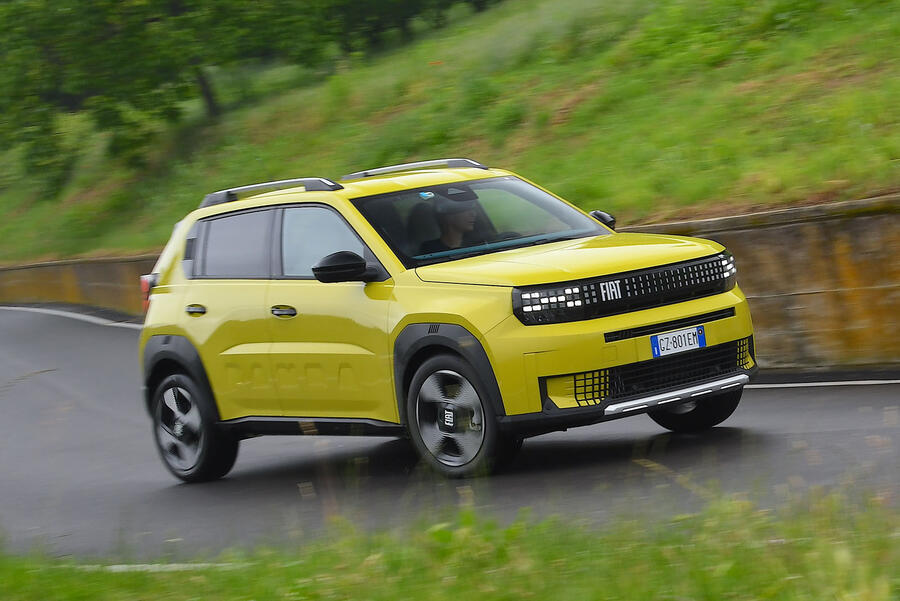
Fiat Grande Panda

"We fundamentally think that with all these rules, the most unsustainable portion lies in the city cars and urban driving, because all these cars are small, democratic and inexpensive, bought by younger people and so on for the daily commute in a city," said François. "They are driven at way slower speeds. It's not the same usage.

"I have a hard time understanding why we need to install all this super-expensive hardware: sensors, cameras, road sign recognition... All this is a little bit inadequate, a bit crazy, and has contributed to raising the average price of a city car by 60% over the last five or six years.

"I don't think that city cars in 2018 or 2019 were extremely dangerous. Our proposal was literally to say 'let's go a little bit backward from overloading cars with expensive hardware'."

For this reason, said François, Fiat "could consider lowering the maximum speed" of some of its cars.

"If you take the average legal maximum speed in Europe, it's 118kph [73mph], so above 118kph is [often] illegal, and most of the radars, ADAS and all this stuff has been developed for cars to go way above the speed limit.

"I would happily limit my city cars, my smaller cars, to what is today the maximum legal speed limit. It's already a limitation. There is something weird that I need to over-spec my cars to go above the legal speed limit."

Back to top

If Fiat were to impose a blanket speed restriction across its line-up, it would be following in the footsteps of Volvo, which in 2020 capped all of its models at 112mph as part of a push to reduce fatal accidents in its cars to zero.

Join our WhatsApp community and be the first to read about the latest news and reviews wowing the car world. Our community is the best, easiest and most direct place to tap into the minds of Autocar, and if you join you’ll also be treated to unique WhatsApp content. You can leave at any time after joining - check our full privacy policy here.

Felix Page

Felix Page
Title: Deputy editor

Felix is Autocar's deputy editor, responsible for leading the brand's agenda-shaping coverage across all facets of the global automotive industry - both in print and online.

He has interviewed the most powerful and widely respected people in motoring, covered the reveals and launches of today's most important cars, and broken some of the biggest automotive stories of the last few years. 

Join the debate

Comments
7
Add a comment…
LP in Brighton 14 January 2026
Makes eminent sense if it allows a manufacturer to produce simpler cheaper and maybe slightly lighter small cars. Quite apart from which if you chose to drive above 73mph in a 500 or Panda then you have probably purchased the wrong type of car!
cicalinarrot 14 January 2026

My 15 year old Panda felt perfectly safe at 80mph, the limit in here. Small cars, considering how incredibly expensive they got, shouldn't be limited to the city.Panda and 500 aren't the right car for long highway commuting but, for what they cost, they should definitely be able to take you for a few trips a year comfortably.The problem here isn't that you may want to drive much faster the whole time but that you lose any ability to overtake other cars on a highway.We're paying much more and getting less here, I'm not cool with it.

si73 14 January 2026

Our cars were both city cars, a mii and a 500, both were quiet and comfortable at the legal limit with scope for going faster if needed, no they weren't high performance but were both capable and often did go far beyond city limits. I totally agree with reducing adas where not required, but the logic of limiting the car to the legal maximum speed limit for most and saying that as such it doesn't require the Adas makes no sense to me, as the car is still going to achieve the legal maximum speed, so is then surely fast enough to warrant the Adas?

if it was limited to 50mph or maybe 62mph/100kmh so below the maximum speed limit, I might have understood it more. That of course would restrict the use of the car which is kind of what is implied to justify the lack of Adas.

Again I'm not pro Adas as I believe a lot of them are fussy and don't work as well as the manufacturers claim, although that is going of others as I haven't got a modern enough car to have such systems. My old 500 and my wife's mii both had 4 out of 5 NCAP stars for crash protection, so I still consider them as safe.

Jeremy 14 January 2026

I agree with the Fiat boss - sensible compromise solution that should make new small cars more affordable.

si73 14 January 2026
Is all the adas stuff really aimed at protecting cars exceeding the speed limit?
Surely even at the legal limit of around 70mph the cars are travelling fast enough to warrant the adas? I’m no fan of all the nannying control systems but don’t see the logic here. Small cars maybe nicknamed city cars, but they are often ONLY cars for those that can not afford or need bigger cars and as such are often used to travel beyond city limits and speeds.
We have a high speed dual carriageway that bisects our city, so it’s often travelled on by those just commuting from A to B, so high speeds in city cars is regularly done.
imeanreally 14 January 2026

You'd think so. EU regulations don't make any speed stipulations about when things should work but given that many exist for the benefit of pedestrians and cyclists these obstacles are not commonly found in areas you're going great guns.

So indeed NCAP tests for emergency braking begin at 10kph. That's for testing for pedestrian safety in urban environments and they'll test at higher speeds too for car-on-car collision preventions.

Things like lane keeping are tested at higher speeds but are still tested from 80kph upwards, so well below the 118kph limit proposed here.

Where there may be scope to reduce cost and hardware is to reduce things like redundency requirements or lower the standard required and say OK you can rely on radar-only or camera-only which won't be as good as a radar-camera fusion, but at least some protection is better than no protection even if radar-only or camera-only have their own weaknesses etc etc.

si73 14 January 2026
That would make more sense, the arbitrary speed restriction makes no sense to me.