Is the petrol hot hatch a spent force? Not based on this 6000-mile test

Much has been made of whether the new Mini Cooper really merits being described as such, because if you peel back the subtly updated bodywork, rip out the funky knitted dashboard and disconnect the massive circular touchscreen, you will be left with fundamentally the same chassis and body-in-white as those used by its predecessor, which went on sale way back in 2013.

While the electric Cooper is all-new, now built in China atop a platform co-engineered with Great Wall Motor, the latest version of the ICE hatch – still built in Oxford atop BMW’s front-driven FAAR platform – is more like a heavy facelift.

Unusually, despite their wildly different origins and underpinnings, the two cars look broadly identical, save for the EV’s flush-fitted door handles. That’s that cleared up, then.

Happily, the line-up of ICE models doesn’t need too much further explanation: you can still have three or five doors, a 1.5-litre turbo triple in the C or a 2.0-litre turbo four in the S or John Cooper Works, and things are made simpler still by the fact that diesel engines and manual gearboxes have fallen by the wayside across the board, for better or worse.
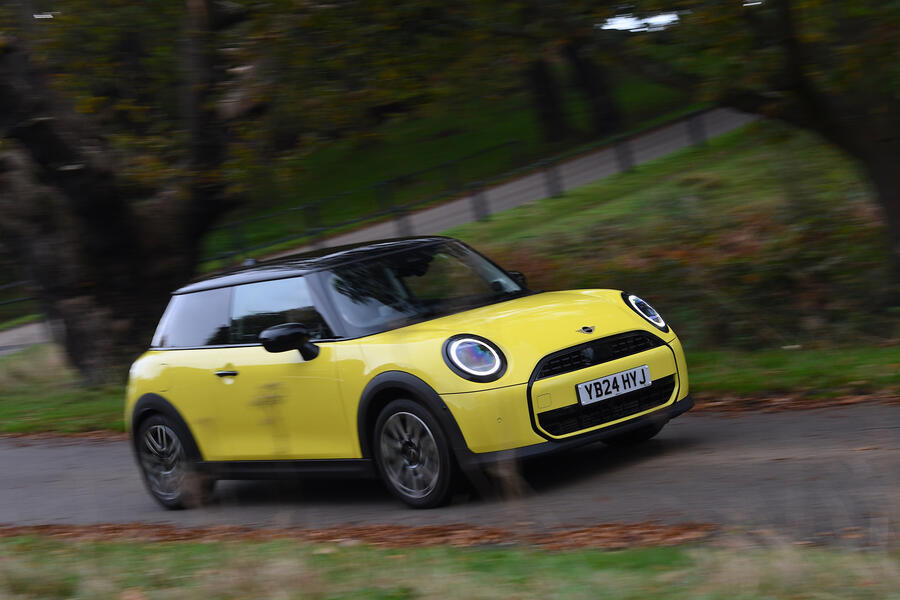
You needn’t even spend much time on the configurator any more. Pick from one of three trim packs (Sport, Classic or Exclusive), choose your paint and wheels, apply the ‘level’ of equipment you want (1, 2 or 3) and you’re there.

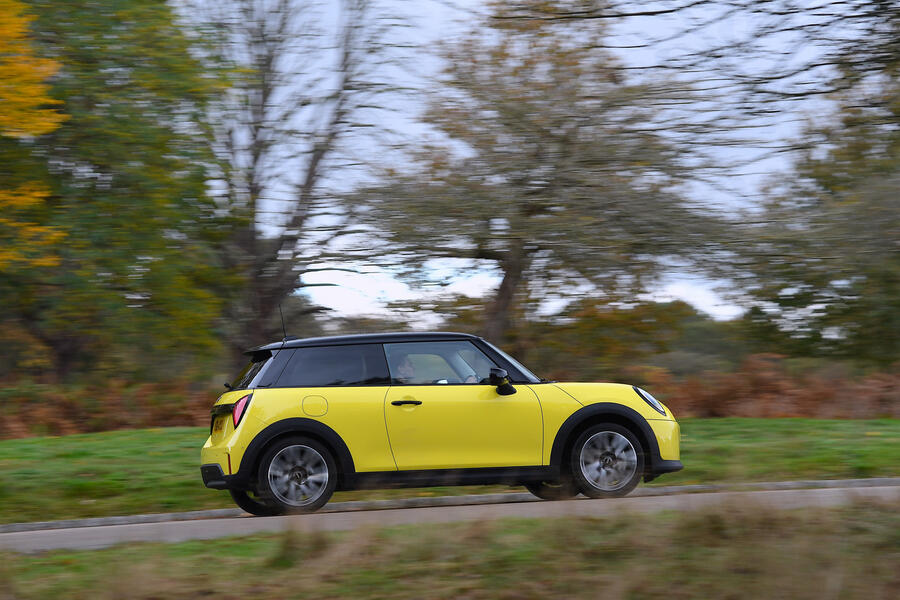
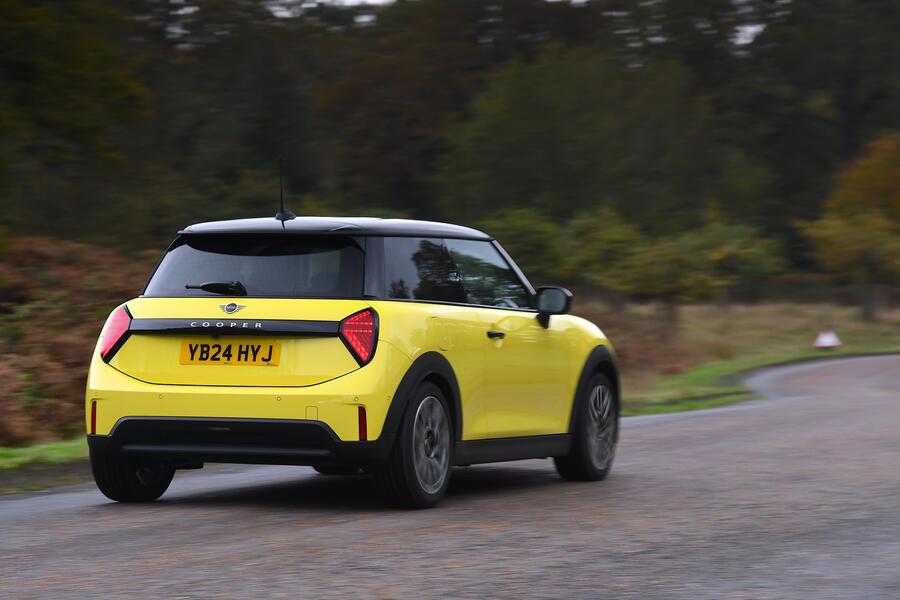
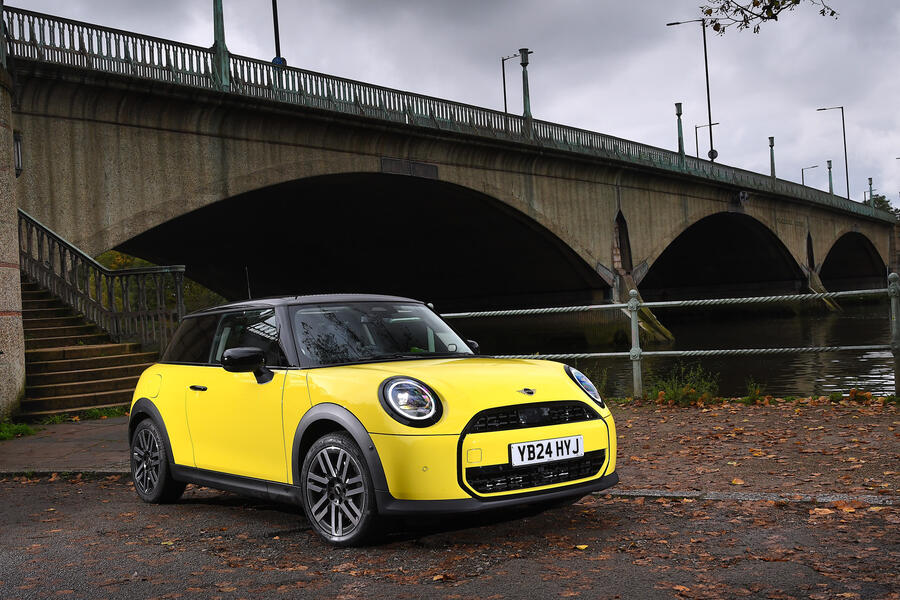
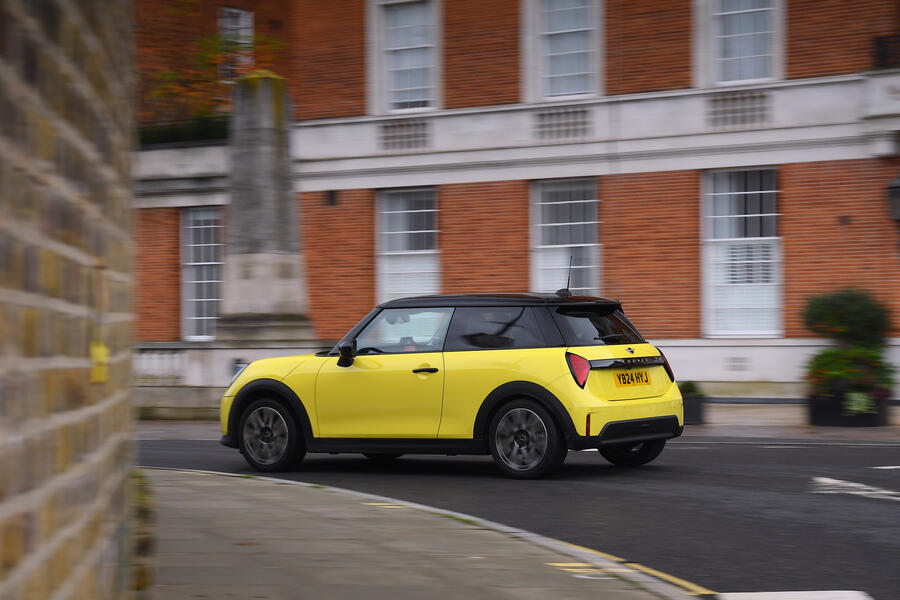
Our three-door C is an entry-level Classic but with the Level 2 pack, optional Sunnyside Yellow paint and jazzy 17in alloys, so it looks suitably high-spec without leaning towards the disingenuous connotations of sporting prowess implied by the dressed-up Sport.

Advertisement

Read our review

Car review

Petrol hatchback and convertible promise driver fun at a competitive price

Back to top

It has adaptive LED headlights, keyless entry, heated front seats, a wireless phone charger and a panoramic sunroof – and I’ve yet to find it wanting for anything else. I’m glad, even, to go without the adaptive cruise control and in-car camera you get at Level 3.

Coincidentally, the Cooper displaces another retro-styled, fashion-focused, bright-yellow small hatch from my parking space. Although I will miss my old Abarth 500e’s more overt sporting tendencies and lairier styling, I won’t miss its meagre 140-mile real-world range and 30-minute charging times.

By contrast, the Mini’s abstemious engine and chunky 44-litre fuel tank have essentially unshackled me, giving me the freedom to decide on a far-flung destination at short notice and tear out of the confines of the M25 with nary a consideration for how many stops I will need to make, or how many Netflix dramas I will need to download to keep me occupied at the Banbury Instavolt chargers.

I won’t miss them over the next few months, either, come to think of it. It’s underrated, that sense of liberation – especially as electrification and inflation conspire to make it ever more difficult to attain.

Back to top

The Cooper is one of only a few petrol-powered superminis left on sale, with previous segment stalwarts having bitten the dust as their makers ramp up the focus on larger, more profitable (and usually electric) alternatives.

But even then, it’s hardly the people’s choice: with its starting price being £23,150, you would have to overlook some much more capacious crossovers – and an increasingly competitive field of EV alternatives – to plump for the Cooper in this day and age.

It’s hardly the de facto Ford Fiesta replacement that many are calling out for. In fact, it seems to occupy a relatively precarious position in today’s market. If people want small, they tend to also want cheap, and by the same token, if people want premium, they tend to go big.

So today’s Cooper won’t have success handed to it on a plate. Especially when you consider the relative simplicity of its powertrain, the spatial limitations of its interior and some of the more controversial elements of its wide-reaching redesign (what was wrong with the traditional gauge cluster?).

But since its BMW-backed rebirth a quarter of a century ago (yep, seriously), the Mini name has carried rather more stylish and bourgeois connotations than did its 1959 namesake, and even more so in 2024. It’s probably a car you buy with your heart, rather than your head, so we must consider it in a different light to the Renault Clios and Vauxhall Corsas of this world.

Back to top

Not to pre-empt the ‘goodbye’ report that I will be writing in a few months’ time, but I might as well reveal that I’ve already grown quite fond of YB24 HYJ.

It’s agreeably peppy and easily manoeuvrable around my tight south London suburb, has as much kit as I could ever reasonably need on a daily basis and marries impressive frugality with big-car refinement on a long run.

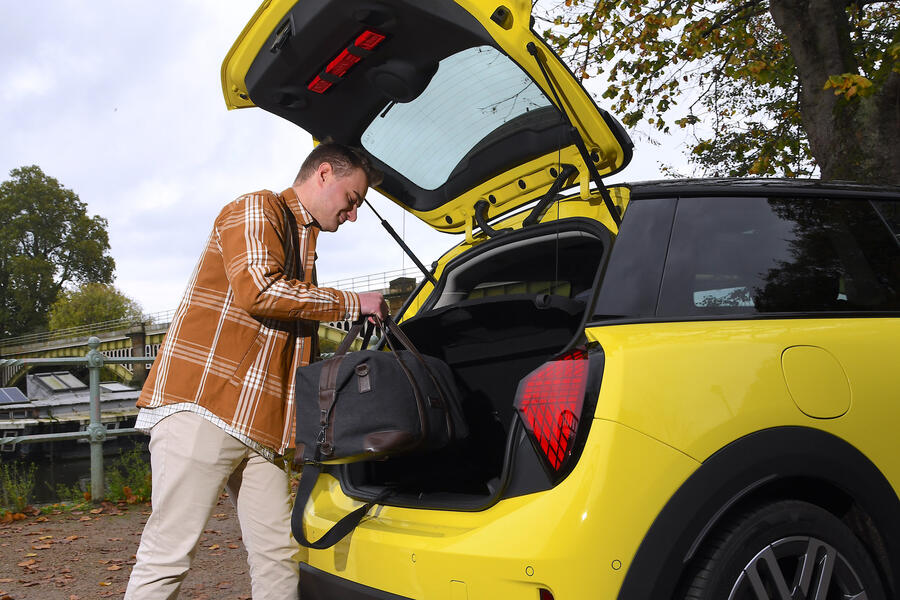
It’s pretty fun to drive quickly, too, on the right bit of road, and the boot is just about big enough for a weekly shop. I love the way it looks, as well, and that Harman Kardon sound system punches above its weight.

Whoops! Haven’t left much to the imagination there, I suppose. But as a fanatical admirer of personable, relatively affordable small cars, there wasn’t really any question about whether I would generally get on with the Cooper.

What I need to know is if it still makes sense to be hurtling around town in something this small while burning petrol – and, probably more importantly, whether I needed to have spent nearly £30,000 for the privilege. Could a £15,000 Dacia Sandero (or, whisper it, a £15,000 Dacia Spring EV) do much the same job?

Update 2 

Unlike many enthusiasts, I don’t harbour much resentment for SUVs: people buy a car to fulfil a role in their life, and if the criteria for that role include capaciousness, visibility and ease of access, then surely a tall hatchback makes the most sense.

Back to top

But I do wonder if many prospective buyers could be talked down a size or two into something a little more manoeuvrable but barely any less useful in the real world.

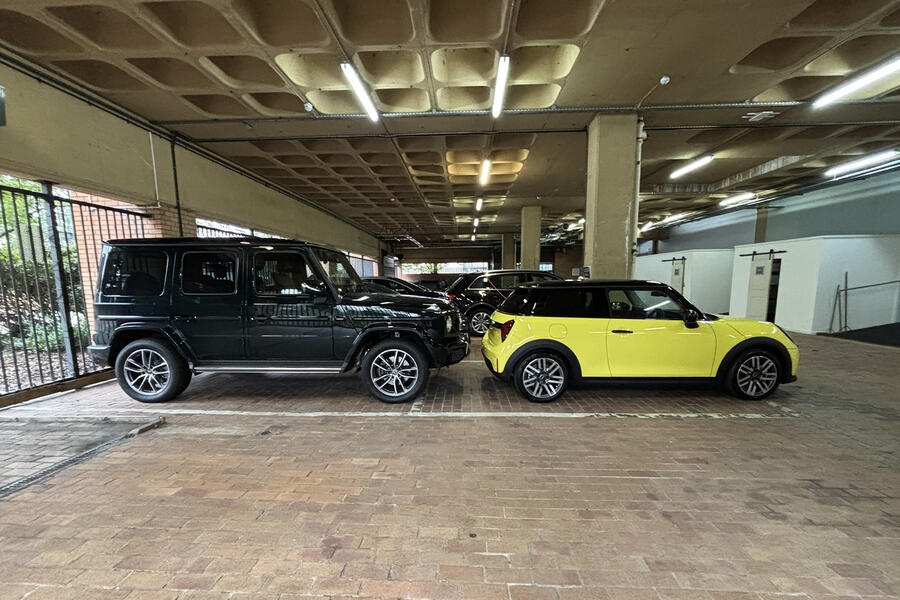
Last Sunday, I came across a car parking space so tiny, so infinitesimally narrow and so tricky to access that my fellow shoppers weren’t even slowing down to consider it as a viable option.

The Ford Kuga next door was hanging over the line and the entry ramp was on the other side, so the angles were all off, too. There was a massive queue for spaces but nobody could bring themselves to have a crack at this intimidatingly inaccessible bay. It was no less than Sutton town centre’s take on the sword in the stone. But I knew that I could do it.

And so it was, with one eye on the rear-view camera display and a hand held up in casual apology to the driver behind me, that I deftly whipped my Mini Cooper rearwards into the gap with nary an inch to spare on all sides – without any correction to my chosen line and with no undue screaming from the parking sensors.

Hordes of dazzled onlookers encircled the car to applaud my victory, an announcement came over the Tannoy to congratulate me on my dexterity and at least four admirers ran over to offer me their favourite trolley tokens. There’s even talk of me becoming a knight of the realm.

Back to top

Well, not quite: I had to sheepishly straighten up afterwards, there was no chance of opening the boot and it was only my partner who expressed admiration – and only after I asked.

But the fact remains that I simply couldn’t have parked in anything bigger. While today’s Cooper is, of course, gigantic in comparison to the classic Mini, its dimensions have barely increased over the previous generation and it’s only very slightly bigger than the original BMW Mini of 2000. It remains a resolutely tiny car in the modern context.

Yet it just doesn’t feel especially tiny. The front seats are anything but cramped, the rears can take an average-sized adult or two for short hops and I’ve even yet to find the 210-litre boot wanting for capacity.

I went to the dump last week with all my garden waste, a couple of lengthy old shelves, a coffee machine and a small cupboard – standard fare for the casual tip tripper – and once I’d folded the rear seat flat, I might as well have had a little van at my disposal (725 litres).

Of course, about 12 minutes after I’d written the first draft of this report – which concluded with the line “I can’t honestly see why you’d need anything bigger for one-, two- or even three-up motoring” – my partner sent me a celebratory text to let me know she’d bought a cabinet on Facebook marketplace. “Don’t worry, it splits into two pieces!” she reassured me.

I didn’t even need to get the tape measure out to know I had no hope of getting either of those two pieces in the Mini, and so it was with a grim sense of defeat that I reluctantly opened the Zipcar app and paid £50 for three hours in a stinking, battered Volkswagen Transporter van.

Update 3

Heartbreak and elation in equal measure this week as my jolly Sunnyside Yellow Mini Cooper 3dr is snatched away and a rather more sinister Cooper S 5dr in Legend Grey is shuffled in to fill its space — and a little more besides.

The pang of sadness as YB24 HYJ departs is short-lived, because I’m technically moving up in the world: after a few months in the purest of modern Minis, the entry Cooper C, I’m swapping into the roomier and racier range-topper, all 201bhp, five doors and £34,500 of it. Punchy.

Back to top

Of course, as well as having more kit and costing more money, this car can move more stuff around more quickly, so there’s reason to assume I will have a more engaging and more productive time behind the wheel.

But I will come back to that once I’ve had the chance to stretch its legs properly, because I don’t want to give the impression that I’m at all glad to be rid of the smaller, lower-powered Mini.

Far from it: these were some of the easiest and most cheerful miles I’ve spent in a new car. Part of that is contextual, of course — non-electrified superminis are now so critically endangered that any exposure to the breed is inevitably tinged with an air of the wistfully commemorative — but ultimately it’s just a really decent little car.

Press releases and Wikipedia entries refer to this model as the fourth-generation BMW Mini, but that’s a red herring because while the new China-built electric Cooper is a brand-new car on a brand-new platform, the UK-built ICE Cooper is more like a heavy facelift of the Mk3.

Indeed, the basic mechanicals and structure date back to that car’s launch in 2013 and the turbo triple under the bonnet is fundamentally unchanged since it was first used — fun fact alert — for the BMW i8 hybrid supercar.

Back to top

But at no point over the past few months have I identified any area in which the ‘F66’ Cooper feels conspicuously old. Maybe the engine is a bit gruff on start-up. Sure, there are rougher edges to the low-speed ride. And things do get a bit noisy at a high-speed cruise. But broadly it feels every bit as slick and fresh as its box-fresh Aceman crossover and Countryman SUV siblings.

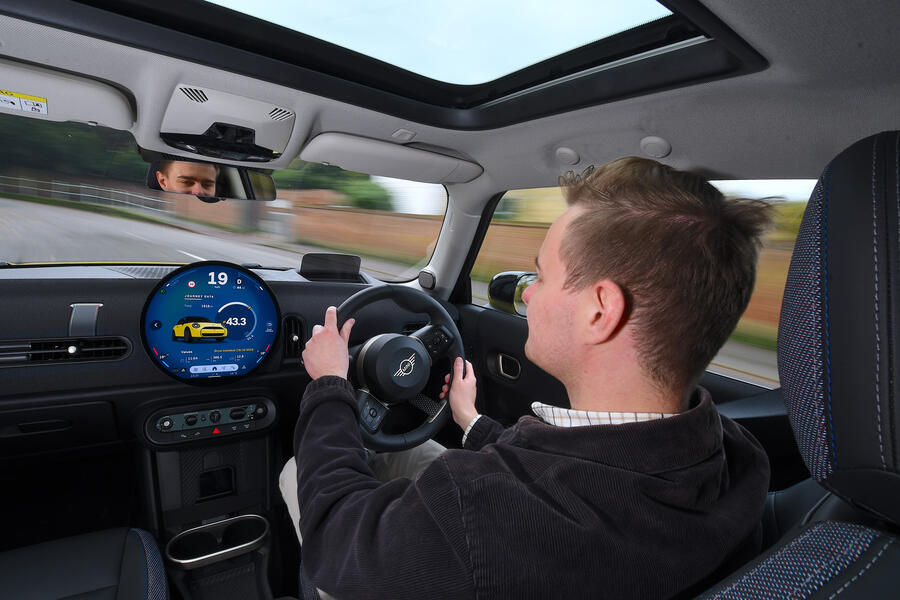
The minimalist but luxuriously appointed cabin, with its snazzy circular touchscreen (admittedly something of a bone of contention) is what most tangibly marks this out as a new-era Mini, and it always attracted admiring comments (usually accompanied by curious prods and strokes) from passengers — even if none of them could quite work out the point of that belt on the dashboard.

Mini has gone to great lengths to remove all unnecessary smockets and trimmings as part of a push to bolster its sustainability credentials and reduce manufacturing costs. 

This might have cultivated a rather more austere environment had it been handled poorly, but as it is, we’re left with a bright, contemporary cabin that’s far more aspirational than that of any other supermini on the market – and a good few cars from loftier classes.

I will concede that it took me a while to get on with that touchscreen, and I will never forgive whoever approved the shoddy integration of the Apple CarPlay interface – quite literally a square peg in a round hole. But once I had learned the shortcuts for deactivating the hesitant start-stop function and irritating speed limit warning, it was all muscle memory.

Back to top

The lack of a gearstick was a common gripe among those who tried the Mini over the past few months. With a chassis this taut, steering so engaging and a legacy so intrinsically linked to grassroots motorsport and accessible performance, surely, they argued, a Cooper should afford its driver the privilege of swapping ratios themselves.

That scene on the top of Lingotto would have been a drearier affair had Michael Caine’s Cooper S been equipped with an eight-speed DCT and the late, great Paddy Hopkirk might not have made such light work of the Monte Carlo Rally in 1964 if he hasn't been able to select the right cog for all those hairpins. 

But I can't honestly say I lamented the omission of a manual shifter at any point during my stewardship. i think we should be grateful that there's still a petrol Mini on sale, to be honest. And besides, while the S does employ a Sport DCT gearbox with paddle shifters on the column, its hardly the most engaging and authentic feeling device. 

But enough spoilers: I'm off to find out if the Cooper's prevailing strengths shine through in a more performance-focused context - and, more importantly, if its charm, honestly and everyman appeal survive a £12k price hike. 

Mini Cooper C Classic specification

Prices: List price new £22,300 List price now £23,270 Price as tested £27,400

Options: Level 2 Pack £4000, Sunnyside Yellow paint £550, 17in Parallel Spoke alloy wheels £550

Fuel consumption and range: Claimed economy 47.1mpg Fuel tank 44 litres Test average 39.7mpg Test best 43.1mpg Test worst 36.5mpg Real-world range 384 miles

Tech highlights: 0-62mph 7.7sec Top speed 140mph Engine 3 cyls in line, 1499cc, turbo, petrol Max power 154bhp Max torque 170lb ft Transmission 7-spd dual-clutch Boot capacity 210 litres Wheels 17in, alloy Tyres 215/45 R17, Nexen N Fera Sport Kerb weight 1450kg

Service and running costs: Contract hire rate £295.42 CO2 135g/km Service costs None Other costs None Fuel costs £200.50 Running costs inc fuel £200.50 Cost per mile 15 pence Faults Loose window seal

Back to top

Felix Page

Felix Page
Title: Deputy editor

Felix is Autocar's deputy editor, responsible for leading the brand's agenda-shaping coverage across all facets of the global automotive industry - both in print and online.

He has interviewed the most powerful and widely respected people in motoring, covered the reveals and launches of today's most important cars, and broken some of the biggest automotive stories of the last few years. 

Add a comment…