


BMW has moved its fuel cell electric vehicle (FCEV) development on another step with the new ‘BMW Hydrogen Flat Storage’ system – a new method of storing compressed hydrogen on board vehicles.
This new approach overcomes a major barrier because it’s modular and fits into the same space in the iX5 as the ‘Gen6’ high-voltage EV battery. There’s no intrusion into cabin space as there might be with more conventional tanks and, crucially, it allows iX5 Hydrogen models to be built on the same production line as other powertrain types.
The production X5 now supports five types of powertrain – petrol, diesel, BEV, plug-in hybrid and now FCEV – in what BMW calls a “technology-open approach”. All powertrain variants will share BMW’s new ‘Heart of Joy’ centralised control unit, combining drivetrain, braking and driving dynamics into one system.
BMW says the iX5 FCEV’s electric motor is exactly the same as the BEV version’s. But rather than one large battery, a hydrogen fuel cell stack generates electricity drawing on hydrogen stored in on-board tanks.
A small high-voltage lithium ion buffer battery provides the bursts of energy for acceleration and stores energy during regenerative braking.
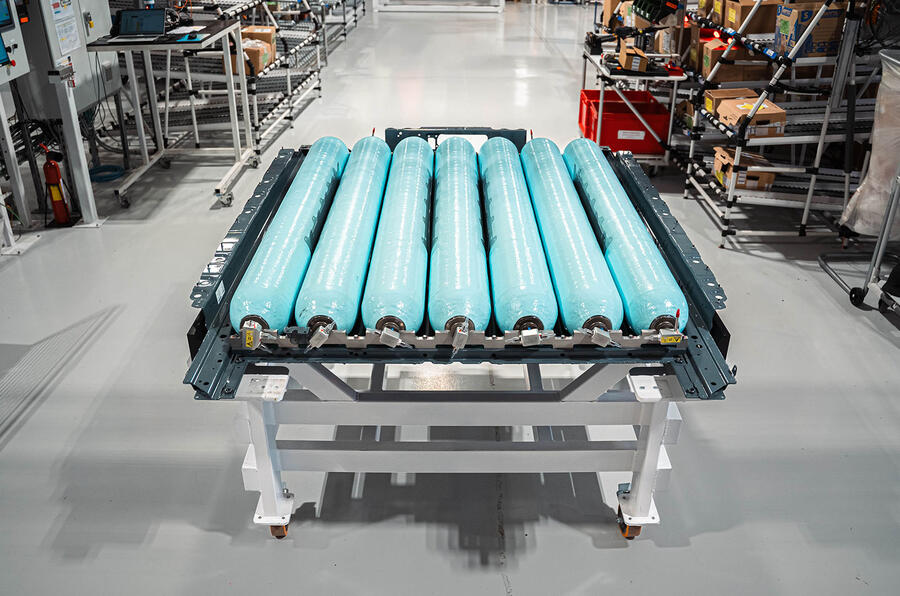
The new Hydrogen Flat Storage system holds enough compressed hydrogen at a pressure of 700 bar to give the iX5 a range of 385 miles. Early prototypes were equipped with a pair of tanks storing 6kg of hydrogen for a range of 313 miles.
Being able to produce a fuel cell car on an existing platform where a compressed gas fuel storage system fits in the same space as an EV sibling’s battery is significant for making an FCEV viable to build and sell.
Given the X5 architecture can support five different drive system variants, it should be possible to scale manufacturing to match demand rather than relying on bespoke manufacturing, which is how FCEVs have been made in the past. That should be a good fit with what is still a limited worldwide hydrogen refuelling infrastructure.
The Hydrogen Flat Storage system consists of seven slim tanks replacing the larger twin tanks of the early cars. Each one is a ‘Type 4’ design, which means it’s constructed from carbonfibre-reinforced composite wrapped around a polymer liner.
The tanks are connected in parallel, hold a total of 7kg of hydrogen and can be refilled at a hydrogen pump in under five minutes. The seven tanks are integrated into a metal frame and controlled by a single, main, central control valve rather than operating separately.


