
The Government’s announcement that it wants to end the sale of all but the longest-range plug-in hybrids by 2030 is certainly ambitious. But it might also be impossible, according to a group of scientists working in a group called SoSMinErals.
The group wrote to the government Committee on Climate Change in June 2019, expressing great concern that the raw materials needed for the UK’s switch to Electric Vehicles might not be available in the volumes needed.
One of the authors of the letter was Prof Richard Herrington, the Natural History Museum’s Head of Earth Sciences. One paragraph contained some stark figures:
“The metal resource needed to make all cars and vans electric by 2050 and all sales to be purely battery electric by 2035…(not including the LGV and HGV fleets), assuming they use the most resource-frugal next-generation NMC 811 batteries, would take 207,900 tonnes of cobalt, 264,600 tonnes of lithium carbonate (LCE), at least 7,200 tonnes of neodymium and dysprosium, in addition to 2,362,500 tonnes of copper.
According to Harrington and his fellow scientists, ‘this represents just under two times the total annual world cobalt production, nearly the entire world production of neodymium, three quarters of the world’s lithium production and at least half of the world’s copper production during 2018’. And that’s just for the UK, with 2 million car sales per year.
They also point out the huge energy requirements for battery metals extraction. ‘Energy costs for cobalt production are estimated at 7000-8000 kWh for every tonne of metal produced and for copper 9000 kWh/t’. Which shows just how battery production is so energy-intensive.
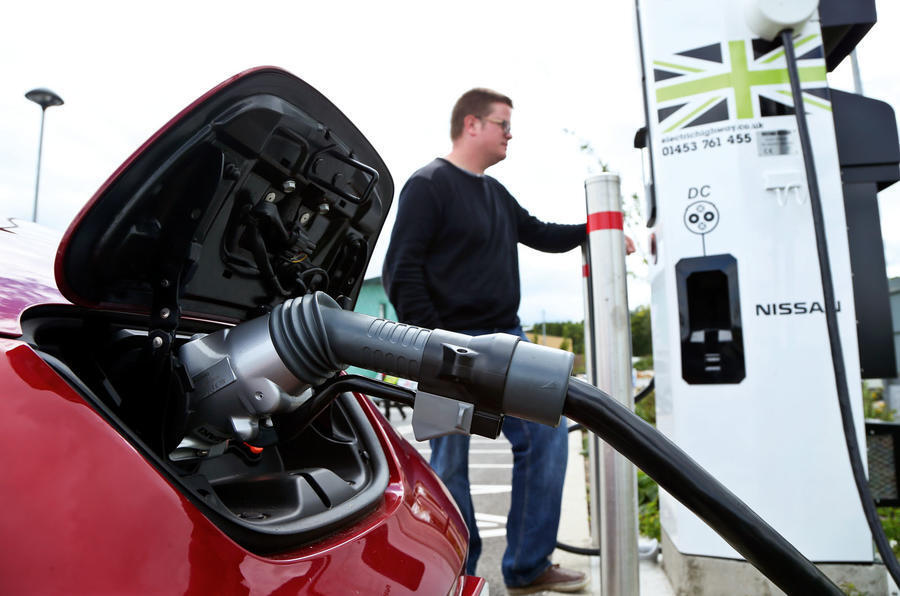
Then, as SoSMinErals points out, there’s the extra energy required to charge electric cars. ‘Using figures published for current EVs (Nissan Leaf, Renault Zoe), driving 252.5 billion miles uses at least 63 TWh of power. This will demand a 20% increase in UK generated electricity’
Doing this in mind of the UK’s ‘net zero’ electrical energy requirement would require greater wind and solar capacity.
Herrington goes on to calculate the raw material impact of expanding the UK’s solar capacity to meet EV recharging requirements.
‘With a capacity factor of only ~10%, the UK would require ~72GW of photovoltaic input to fuel the EV fleet; over five times the current installed capacity. If CdTe-type photovoltaic power is used, that would consume over thirty years of current annual tellurium supply’.
Moreover… ‘Solar power is also problematic – it is also resource hungry; all the photovoltaic systems currently on the market are reliant on one or more raw materials classed as “critical” or “near critical” by the EU and/ or US Department of Energy (high purity silicon, indium, tellurium, gallium)’. Wind turbine construction is also hungry for copper, neodymium and dysprosium, the letter says.

Of course, the UK could charge a growing EV fleet via Nuclear power, but replacements for our ageing existing plants remain gridlocked, though Rolls Royce’s plan for 16 mini-nuclear reactors looks very promising.
All of which raw-earth and mining horror backs up my personal issue with batteries as a way of storing energy. They are resource-intensive, energy hungry, heavy and expensive.
I like to look at this way: a 60-litre plastic liquid fuel tank for a car probably costs around $50 at factory prices (though you’d need to order a million a year). A 90kWh battery with a real-world 300-mile range costs at least $10,000 at factory prices.
I remain convinced Hydrogen (possibly cracked from seawater by wind power or by power from Rolls Royce’s future mini reactors) and synthetic liquid fuels made by the sun’s energy remain a far better environmental bet for de-carbonising road transport from 2030.
READ MORE
Official: Government to ban new petrol and diesel car sales in 2030

Join the debate
Add your comment
Lets be clear, these people are geologists not technologists. They want to make situation look bad to get themselves more money to study it, also dare I say it they may be more in favour of the materials they got into the business to study (oil) than the one (lithium) which is killing it. I imagine Hilton has the same biases against electric cars.
Of the materials listed:
The comments around energy cost for extraction are based on:
This article is akin to somebody in horse magazine pointing out that oil production in 1900 was insufficent for millions of these nasty new cars.
Lithium ion has already won automotive, in the process it will get to a similar size to the oil industry. The resulting scale will allow it to affect energy and virtually every other form of transport.
Comparing a fuel tank and a battery is also the wrong comparison, far better to compare the battery with the 20 tonnes of fuel which will go through the car.
Almost all materials are "isotopically relatively common in the crust". The key is finding feasibly extractible mineralisation, and a way to extract it cleanly. Hydrogen doesn't have this problem.
Re: Hydrogen, what do you think is in a fuel cell, just stuff like Paladium and Platinium stuff that actually is rare.
Also it has a terrible round trip efficiency meaning you need much more electrical generation.
There may be workaround for those two issues but the principle issue is that it is late.
BEVs are 3% of the global market doubling every 18 months, at that rate all new cars will be BEVs by 2030. There already is a charging network (the current grid and driveways) that is adequate for about 50% of western drivers ergo BEVs can get to massive scale without needing to build out a massive recharging network.
If the current Mirai was going up against the 2008 Tesla Roadster and Toyota was prepared to build out its own hydrogen network it might have stood a chance, but as it is they are 15 years late.
With regards to minerals TSLA, plan to eliminate cobalt which is one of the more diffuse elements, lithium can be extracted from a lot more places than the current brines that are used and nickel is as common as muck.
Very small quantities of those metals. Nothing like the mass of a battery pack.
The hydrogen network is being designed and approved right now. It's already happening. Batteries will be around for a long while yet, but they aren't the future.
Article is on the money. Old chemical batteries were an imprtant transition tehnology, and will be for a while to come. Hydrogen is the most energy-dense fuel, and is also the cleanest. We're working on large-scale industrial hydrogen production and storage, it's not far away, and dirty heavy inefficient chemcial batteries will be consigned to the same bin of obsolescence as fossil fuels.