
Two new teams will join Formula 1 this weekend, both owned by world-famous car makers - one built up from scratch (Cadillac), the other a significant expansion of an established midfielder (Audi).
This is an incredibly rare occurrence in the modern era and it could hardly be more different from the last time multiple newcomers arrived.
The global economy imploded in 2008, damaging the automotive industry particularly heavily – and this after a period of spiralling costs in F1. Motorsport's governing body, the FIA, had to leap into action to ensure the series would survive.
Having initially mooted a budget cap of around £140 million (half the outgoings of the biggest spenders) in January 2008, and presumably spurred on by Honda's abrupt exit at the end of that season, the FIA announced in March 2009 that a budget cap of merely £30m would be in place for 2010 – although it would be optional, rewarded by additional technical freedoms.
This enraged the Formula One Teams Association, led by Ferrari's Luca di Montezemolo, who stated: "FOTA would like to express its disappointment and concern at the fact that these [decisions] have been taken in a unilateral manner. The framework of the regulations as defined by the FIA to be applicable from 2010 runs the risk of turning on its head the very essence of Formula 1 and the principles that make it one of the most popular and appealing sports."
Enjoy full access to the complete Autocar archive at the magazineshop.com
The FIA and FOTA each refused to back down, and for a while it really did seem the establishment would act on their threat of quitting to set up their own grand prix series.
Around the same time, the FIA started tendering for fresh entrants - and, despite the all-pervading financial strife, attracted a slew of applicants, presumably encouraged by the prospect of the budget cap.
This "rag bag varied from the strongly credible to the positively laughable", opined Autocar. In the former group were Prodrive and Lola; in the latter Sky Sports Italia - yes, a TV station – and MyF1Dream, which would be run online by fans.
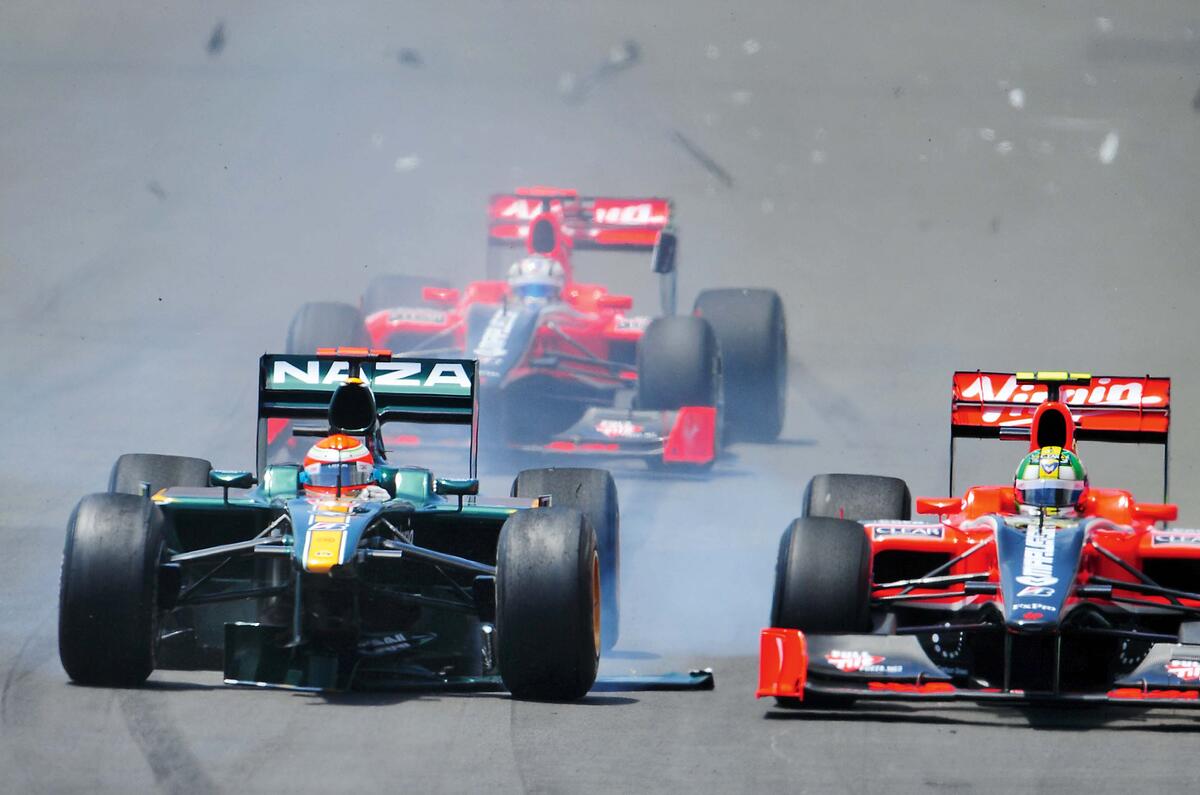
Four were accepted: Manor, a British junior series team; Lotus Racing, created by a consortium of Malaysian businesses; Campos Meta, a Spanish tie-up of a junior series team and a marketing firm; and US F1, the idea of a motorsport engineer and an F1 journalist.

It was a good thing, too, because BMW and Toyota decided to quit F1 during 2009, followed by Renault giving up full control of its team.