There are many kinds of controversy, and a car manufacturer which has been operating for 120 years, as Ford Motor Company has, will inevitably have experienced most of them.
Here are 40 examples of the company’s models which have caused disputes of one kind or another. They’re listed in chronological order, and were marketed either by Ford itself or by brands Ford owned before 1950, but not ones it acquired after that year.
Ford Model T (1908)

The Model T is now perhaps the most celebrated car Ford ever produced, but to get the full picture we have to consider how cars in general were viewed when it first appeared in 1908. Although they developed an enthusiastic following, they were also considered by many people to be noisy, smelly, frighteningly fast and terribly dangerous.
The T wasn’t necessarily a specific target, but by its very existence it was part of a large controversy, and became central to it as sales skyrocketed. Henry Ford was however criticised for hanging onto it for too long, as it stayed in production for 19 years, and during the latter half of its life General Motors overtook Ford in the US market.
Lincoln Zephyr (1936)

The Zephyr was a remarkable car for 1936, not least because it had – remarkably for its relatively low price – a V12 engine related to (but not simply an enlarged version of) the Ford flathead V8.
The V12 was the car’s most appealing, but also most controversial, feature. Its most serious flaw was that the exhaust gases were ported through the cylinder blocks, and heated up the water which the radiator was trying to cool down. Lincoln later made amends, but the Zephyr never quite lost its reputation for unreliability.
Ford Parklane (1955)

Sometimes a controversy can arise between a manufacturer and its customers. This was the case with the Parklane, a two-door station wagon which sold so poorly that Ford offered it only in the 1956 model year.
Ford tried again with the very similar Del Rio, which was more successful in the limited sense that it lasted for two whole model years (1957 and 1958) before being canned.
Ford Taunus (1957)

The P2 generation Taunus, sold from 1957 to 1960, must have come as quite a shock to people who had been accustomed to earlier German Fords of the same name. While the previous models appeared relatively staid, this one had lots of chrome, prominent tailfins, a frontal resemblance to the contemporary Mercury Monterey and in some cases two-tone paintwork, the different colours appearing above and below a line which resembled Buick’s ‘sweepspear’.
All this flamboyance led to the P2 being nicknamed Barocktaunus, or baroque Taunus, in reference to a highly decorative artistic style of the 17th and 18th centuries. More positively, it was also known as the fliegende Teppich, or flying carpet, in a tribute to its excellent ride quality.
Edsel (1958)
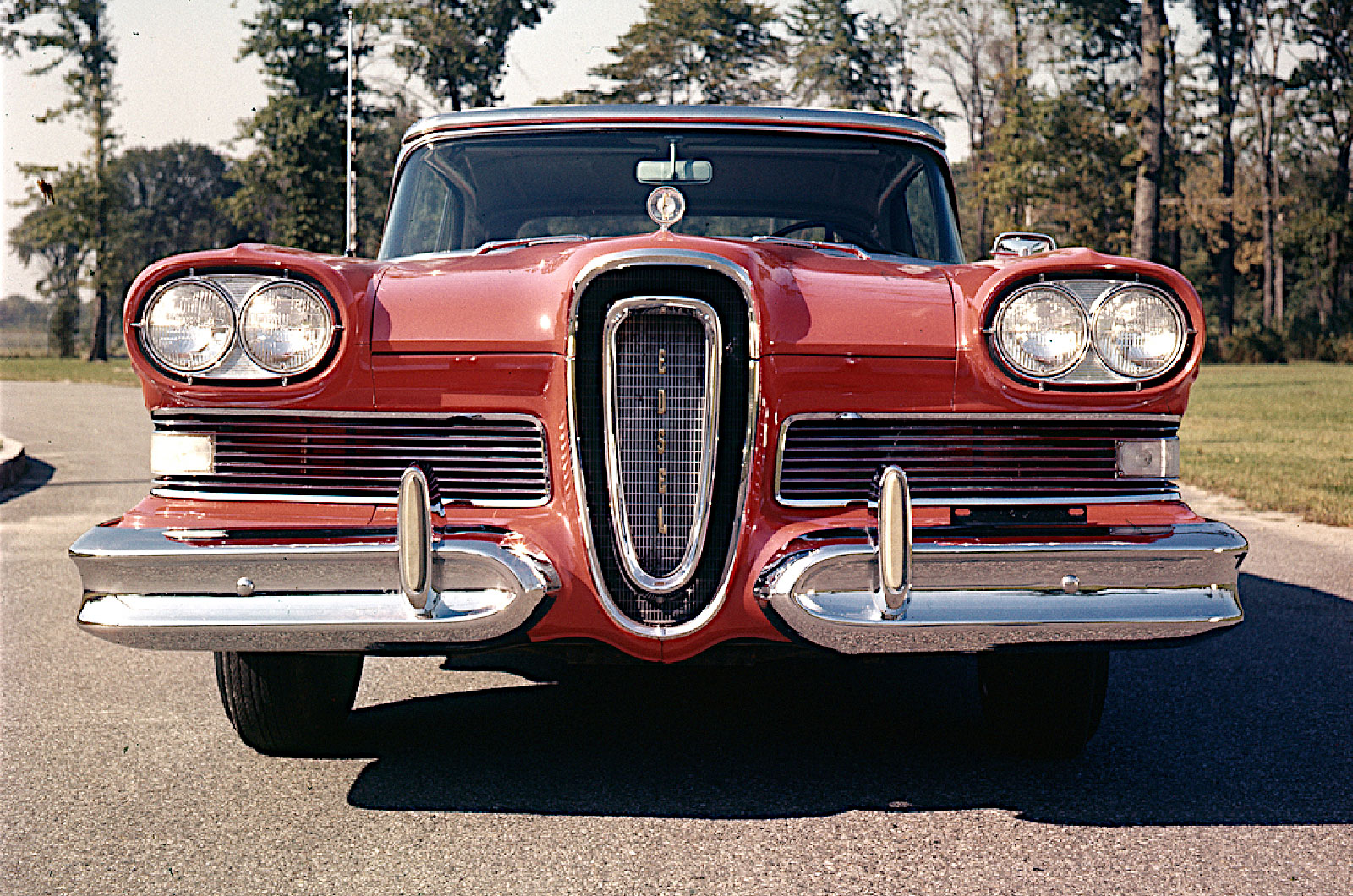
Possible reasons for the failure of Ford’s calamitous Edsel brand, which was introduced in 1958 and axed just two years later, include incoherent marketing, a change in customer preferences towards smaller cars, low quality, dubious styling and a horrendous recession in America which saw new car sales halve.