
Car makers are reporting a boost in orders and overall interest in EVs as buyers look for ways to offset the spike in petrol and diesel prices since the Iran war began.
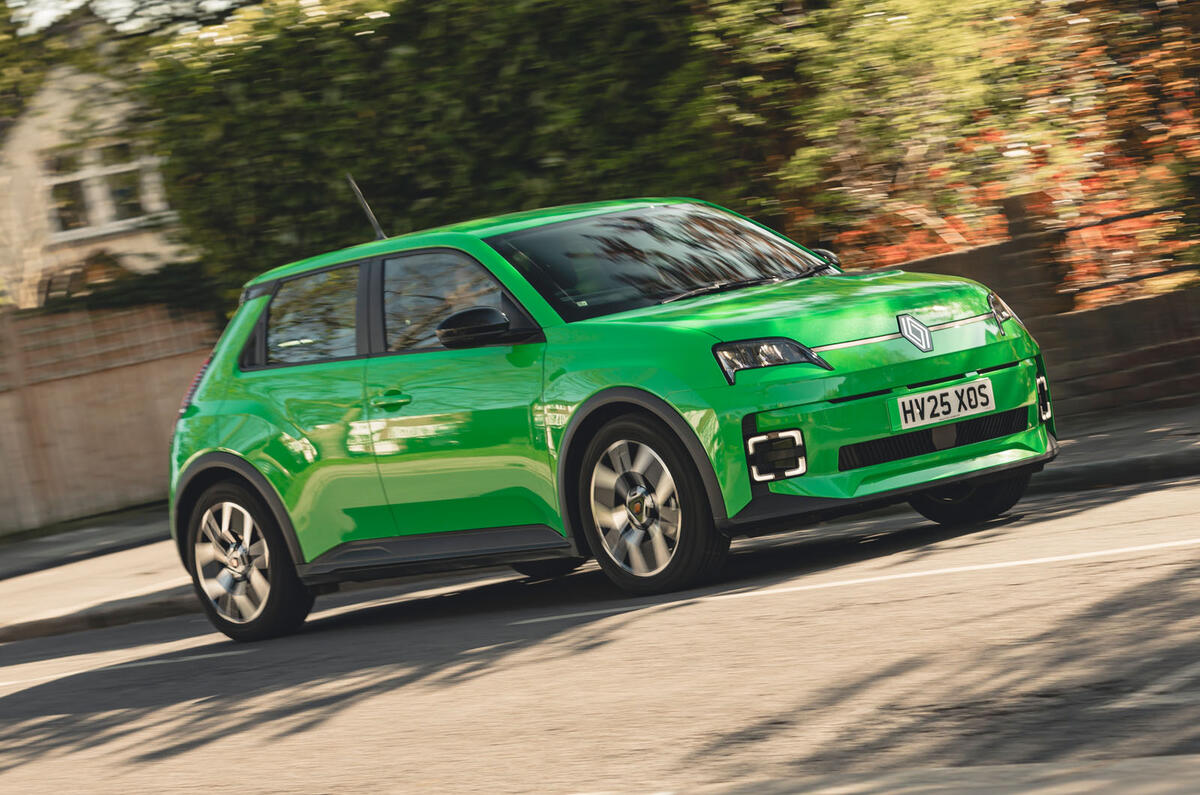
One beneficiary is Renault, which has reported that the retro-flavoured 5 supermini was the UK’s biggest-selling electric car in April.
“Interest in electric vehicles has undergone a seismic shift upwards following the spike in oil prices at the end of February,” Renault UK MD Adam Wood told Autocar.
Renault said EV enquires on its website had gone up 42% compared with January and early February, while EV sales accounted for just under half of all its UK registrations in April.
The UK's Society of Motor Manufacturers and Traders has yet to release registration figures for April.
Fuel prices have shot up by 24.3 pence per litre for petrol and 46.5ppl for diesel since the start of the Iran war in February, according to data from the RAC. That has increased the cost to fill an average 50 litre tank by £12 for petrol cars and £23 for diesel cars.
Renault’s pitch to car buyers is that switching to electric can now save them around £650 a year.
Oil prices are continuing to rise as both Iran and the US prevent oil-carrying ships from moving through the of the Strait of Hormuz - a key delivery route for Middle Eastern oil.
That’s pushing buyers to look for alternatives to ICE cars, but open questions include how long the strait will be blocked and whether the hike in EV demand will survive a fall in fuel prices once the conflict has ended.
“In terms of EV demand, for Europe definitely there’s a favourable momentum picking up with the Middle East crisis,” Mercedes Benz finance chief Harald Wilhelm told investors on the company’s first-quarter earnings call. “I cannot tell you how sustainable that is”.
Volvo is another manufacturer reporting a boost throughout the region: its EV sales grew 12% in the first quarter to give it a 24% electric sales mix, rising to 32% in Europe.
“The growth in Europe is happening through electrification. That's very clear. We see [that] clearly in the last three or four weeks, since the energy crisis started,” commercial chief Erik Severinson said on its earnings call.
In March, EV sales across Europe almost doubled compared with the same month the year before, reaching a quarter of the total (with the UK at 24%), according to data from Europe's motor trade organisation, the ACEA.
Some countries are far higher, with Norway leading at 98%, followed by Denmark at 78% and Finland at 50%.
Stellantis has also reported strong growth in EV demand, particularly for lower-cost models based on the Smart Car platform, such as the Citroën ë-C3 and Vauxhall Frontera.
“Obviously we cannot predict how long this oil price surge will stay, but [we] will manage it as an opportunity for many reasons, being one compliance, obviously,” CEO Antonio Filosa said on its Q1 earnings call.