
Eighteen months after its creation, Horse Powertrain (owned 45% by Renault, 45% by Geely and 10% by Aramco) shows no sign of tempering its aspirations.
The UK-based company was set up to design and develop both conventional combustion engines and hybrid powertrains for sale to anyone who wants them, in any application a customer chooses.
Most of its small-engined powertrains so far have implied a focus only on fuel economy and emissions, but while that still holds true, the engines are already appearing in more exciting applications.
Last summer, Autocar drove a Caterham Seven race car powered by Horse's H13 engine, a 1.3-litre turbo four that was already used by a number of mainstream manufacturers.
Producing 130bhp in that application, it had replaced the now defunct Ford Sigma engine.
In December, Horse announced that it would co-develop and supply H13 for a new pick-up truck racing category in Brazil, in partnership with Sports and Racing Brazil.
The engine is still under development but at this stage produces around 200bhp running on pure-ethanol fuel (E100).
Events will be held on asphalt and dirt tracks and all the racing trucks will share a standard chassis.
The engine has a 'Deltashaped' cylinder head, which means it's triangular in cross-section (the end-on view when cut in half), mimicking the Greek letter of the same name.
It also has an integral exhaust manifold and the direct injection system has been designed specifically with ethanol in mind, with six-hole injectors operating at a pressure of 200 bar.
Overall, the engine is described as being compact and lightweight with a low centre of gravity, which should bode well for other motorsport applications too.
In Brazil, it has been a requirement that road vehicles are run on a petrolethanol blend since 1976, starting with a modest 11% ethanol (E11). Since 2007 it has been 25%, compared with the 10% blend that is standard in the UK today.
The advantage of any blend of ethanol fuel is that, assuming the ethanol is produced using renewable feedstock, the well-to-wheel CO₂ burden is reduced when the fuel is consumed.
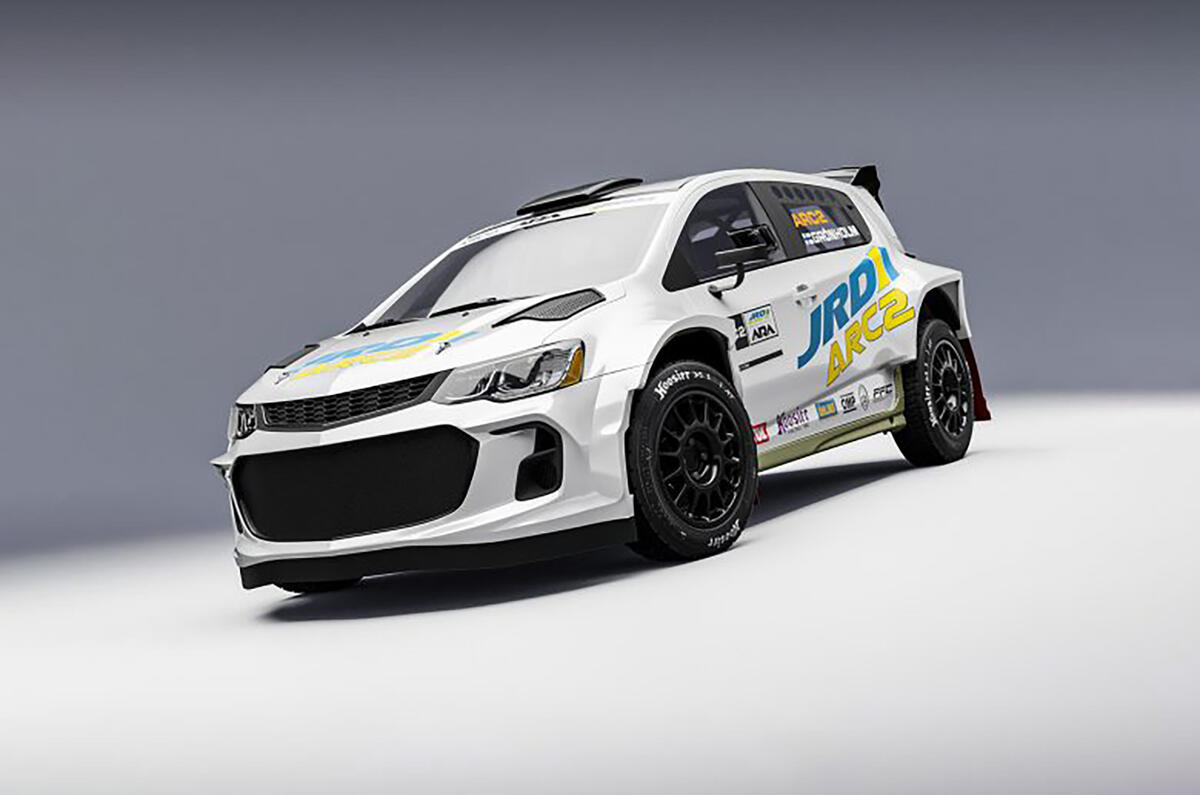
As well as the Caterham Academy and forthcoming Brazilian motorsport series, Horse last year signed an agreement to supply engines for the ARC2, a new Chevrolet Sonic-based rally car to run in the American Rally Association's RC2 class in the US.
The engine was developed by the Aurobay Technologies division of Horse and is a 2.0-litre unit driving through a five-speed sequential gearbox, which will be delivered with a locked ECU and tamper-proof seals to comply with the ARC regulations.
The first vehicles for the Horse-powered Brazilian pick-up truck category will be unveiled some time this year and run in an exhibition race once testing is completed, before proper competition begins in 2027.