Currently reading: Honda CR-Z meets Prelude: Was hybrid coupe misunderstood?

Strange CR-Z meets the equally weird Prelude and proves unexpectedly Formula 1 in feel

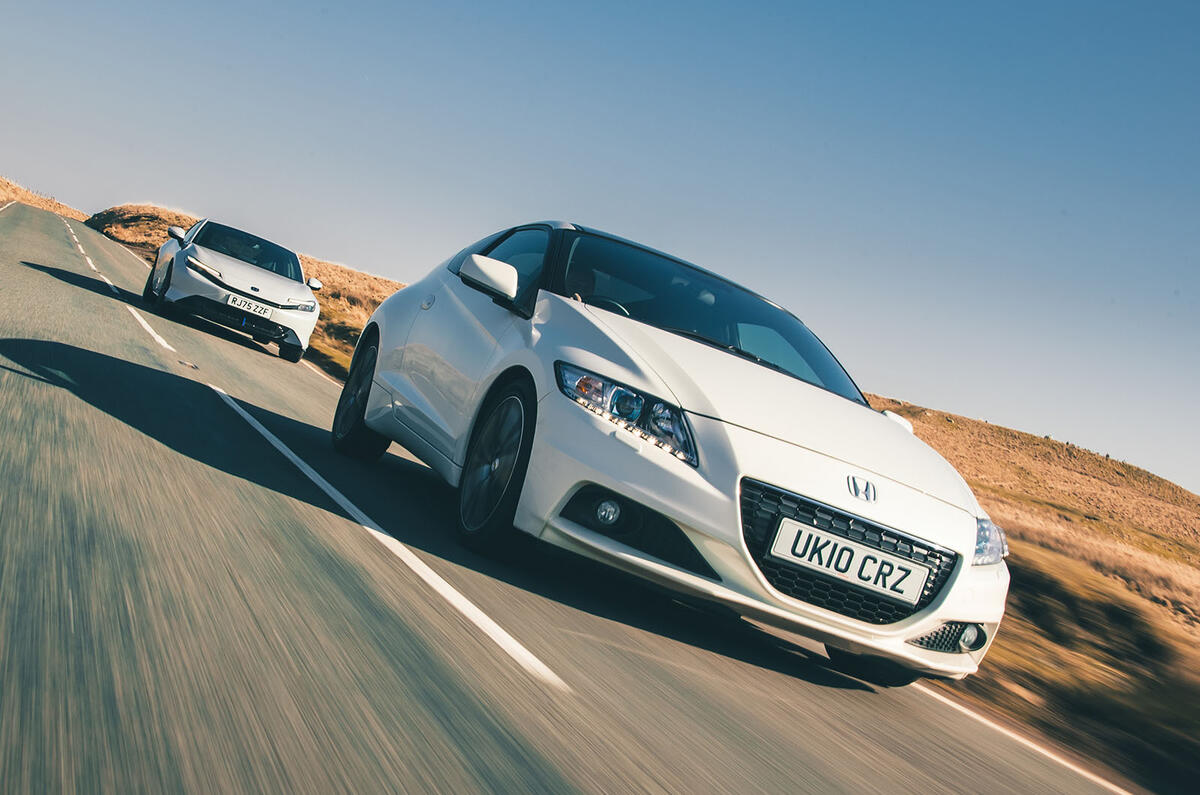
The Prelude has returned to fill a small, front-driven hybrid coupé-shaped gap in Honda's line-up - some 16 years after the launch of its spiritual forebear, the CR-Z.

The older car, while similar in conception, arrived in an entirely different era for the petrol-electric performance car.

At the time, the motoring world had yet to meet any of the much-celebrated 'holy trinity' of hybrid hypercars (Ferrari LaFerrari, McLaren P1, Porsche 918). Henrik Fisker was on the brink of launching his rare-groove Karma (remember that?). And the only really widely seen performance hybrid you could buy was the Lexus GS 450h sports saloon.

It was early days for Honda to be suggesting that petrol-electric fun could be offered fairly cheaply, when it had yet to be offered much at all - at any price. Of course, in the finest traditions of the company, that didn't discourage anyone.

The CR-Z was, quite plainly, a kind of 'son of Insight': little, affordable, modestly powerful and surprisingly simple. It was about as technically similar to a Prelude as a Prelude is similar to a carbonfibre-tubbed BMW i8 (unveiled three years after the CR-Z, since you asked).

Honda UK lent us its CR-Z GT heritage car so we could appreciate this first hand. After the Prelude, it felt relatively pedestrian - though not slow in an outright sense.

The Prelude's powertrain is a series-hybrid-style, range-extender system, with an electric motor that does most of the grunt work, backed up by a 2.0-litre Atkinson-cycle petrol engine that mostly runs as a generator but can connect to the wheels via planetary gearing when switching to higher-constant-load, parallel-hybrid running.

Honda doesn't actually claim a total system, engine-clutched-on, parallel-series torque figure, but I would estimate that it must be well beyond 250lb ft, because the Prelude certainly feels brisk. Not quite top-level hot hatchback fast, but quick enough to make a climbing, twisting, uneven mountain road in the Rhondda nicely interesting to set about.

The CR-Z is a little in want of some properly purposeful suspension tuning, perhaps, but not without a fun factor all of its own. It has three pedals and a six-speed manual gearbox for a start. Its electric motor produces only 14bhp and 58lb ft of torque - more, slightly, in later versions, yet never anything like the Prelude's electric reserves.

But you can certainly feel the hybrid torque hitting the driven axle at lower engine speeds, when the car pulls higher gears much more assertively than you expect of something with an atmospheric 1.5-litre petrol engine, and yet it still goes on to rev fairly freely.

Advertisement

Read our review

Car review

The Honda CR-Z is as intriguing and appealing to drive as hybrids currently get

Back to top

The manual gearbox really makes you engage with the CR-Z's powertrain at a fundamental level that the Prelude's never gives you access to. Filling and judiciously plundering the 0.5kWh drive battery feels like an unexpectedly analogue and involving process achieved by considered regen braking and well-timed 'deployment'.

It's all quite immediate and likeably short-cycle - unexpectedly 2026 Formula 1, funnily enough. And yet one of these formula car tribute artistes can be picked up for less than £4000 without too much scouring of the classifieds sites - and the biggest DNF threat you would need to worry about with one is probably a bit of wheel-arch rust.

Join our WhatsApp community and be the first to read about the latest news and reviews wowing the car world. Our community is the best, easiest and most direct place to tap into the minds of Autocar, and if you join you’ll also be treated to unique WhatsApp content. You can leave at any time after joining - check our full privacy policy here.

Matt Saunders

Matt Saunders Autocar
Title: Road test editor

As Autocar’s chief car tester and reviewer, it’s Matt’s job to ensure the quality, objectivity, relevance and rigour of the entirety of Autocar’s reviews output, as well contributing a great many detailed road tests, group tests and drive reviews himself.

Matt has been an Autocar staffer since the autumn of 2003, and has been lucky enough to work alongside some of the magazine’s best-known writers and contributors over that time. He served as staff writer, features editor, assistant editor and digital editor, before joining the road test desk in 2011.

Since then he’s driven, measured, lap-timed, figured, and reported on cars as varied as the Bugatti Veyron, Rolls-Royce PhantomTesla RoadsterAriel Hipercar, Tata Nano, McLaren SennaRenault Twizy and Toyota Mirai. Among his wider personal highlights of the job have been covering Sebastien Loeb’s record-breaking run at Pikes Peak in 2013; doing 190mph on derestricted German autobahn in a Brabus Rocket; and driving McLaren’s legendary ‘XP5’ F1 prototype. His own car is a trusty Mazda CX-5.

Join the debate

Comments
1
Add a comment…
si73 19 April 2026
This reads like an unfinished article.