
The plug-in hybrid powertrain has had its critics in recent years but, like it or not, its breakthrough moment looks to have arrived.
PHEV tech puts a future-proofed car on your driveway that meets your needs without asking you to adapt your habits and journeys to it. That saves on petrol and, of course, carbon dioxide - in much of your daily motoring without making the rest of it any harder. A slightly inflated price, and the ballast of some mechanical redundancy, is probably a reasonable trade-off for a solution that just works.
According to figures from the Society of Motor Manufacturers and Traders, the UK's PHEV market grew by 35% in 2025 and almost 50% in January 2026. As EV growth wavers and the HEV segment stagnates, PHEVs could become the closest challenger to pure-petrol options before the year is out.
Time for a real-world progress check, then. Imagine you need a new family car in 2026. You might have a big family, or maybe a younger, smaller one. You might be inclined to splash plenty of budget, or to root out a bargain.
Either way - and counting only PHEVs with enough electric range to qualify for a low benefit-in-kind tax band over the coming years (which means 70 lab test Equivalent All-Electric Range WLTP miles or more) - what are your options? What compromises still arise in these cars in 2026, and continue to damn the poorer ones? And just how well are the better ones beginning to avoid them?

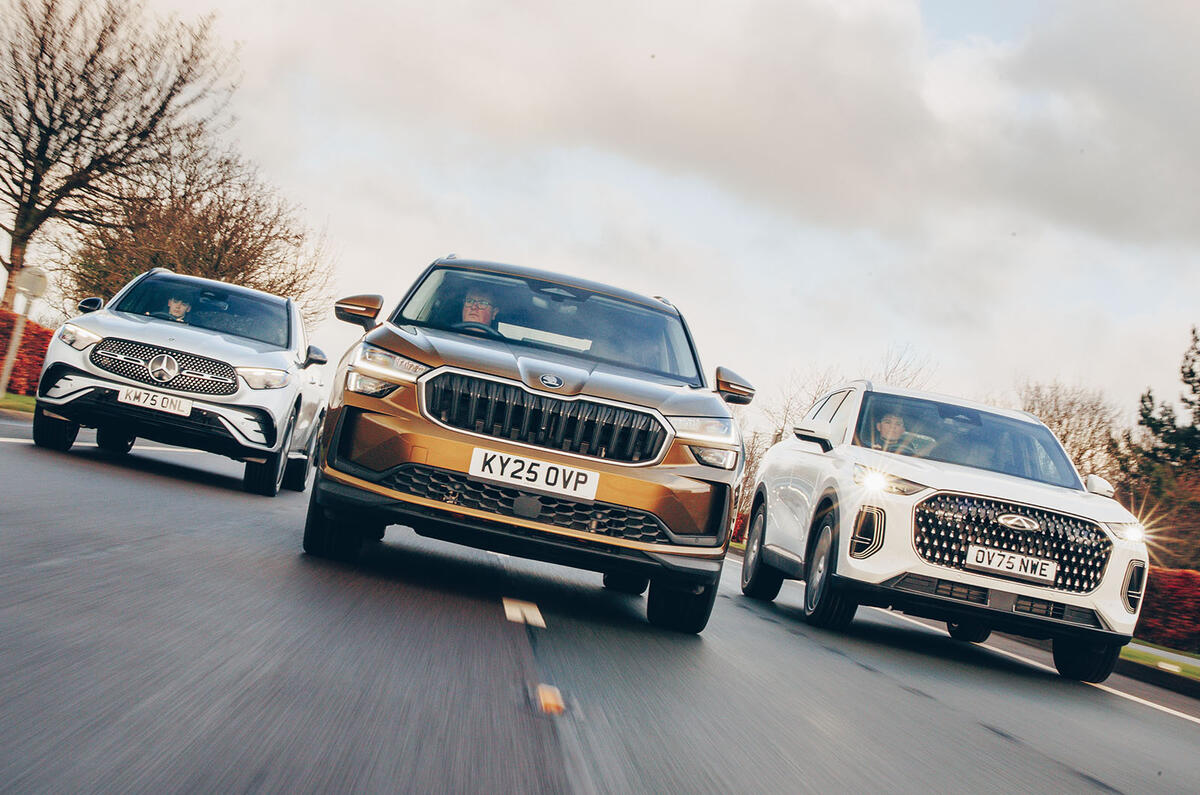
The five SUV and SUV-adjacent new cars picked to answer those questions, in descending order of price, are these. A mid-sized executive option bringing luxury appeal and mechanical four-wheel drive to the table, for a price: the Mercedes-Benz GLC 300 4Matic. The biggest member of a family of SUVs highly rated for their fuss-free functional agenda: the Skoda Kodiaq iV.
A smaller, sportier PHEV option from the Volkswagen Group's Latinate fashion brand: the Cupra Formentor eHybrid. A bigger and even more powerful, technically interesting SUV from a Chinese brand still emerging on the UK scene: the Chery Tiggo 9. And finally, ready to demonstrate that longer-range PHEV power needn't come with a premium price in 2026: the MG HS Plug-in Hybrid.
Let's talk value
It seems the obvious place to start. The most conspicuous value now comes imported from China. You might personally be more or less open to that kind of value, but either way, if plug-in hybrids do overtake EVs and 'self-charging' hybrids for UK market share this year, Chinese brands will be driving the uptake. Consider the showroom prices of the MG HS and Chery Tiggo 9.


Join the debate
Add your comment
Also I often wonder when I read about the ease of switching off ADAS systems as to the legality of switching these systems off, can this void your insurance if something happens?, Believing as I do that insurance companies will use any excuse not to pay out.
PHEV's are a con. Designed for BIK tax purposes. Neither a light ice vehicle or an efficient ev.
Maintenance costs are higher then plain ice or ev too.
