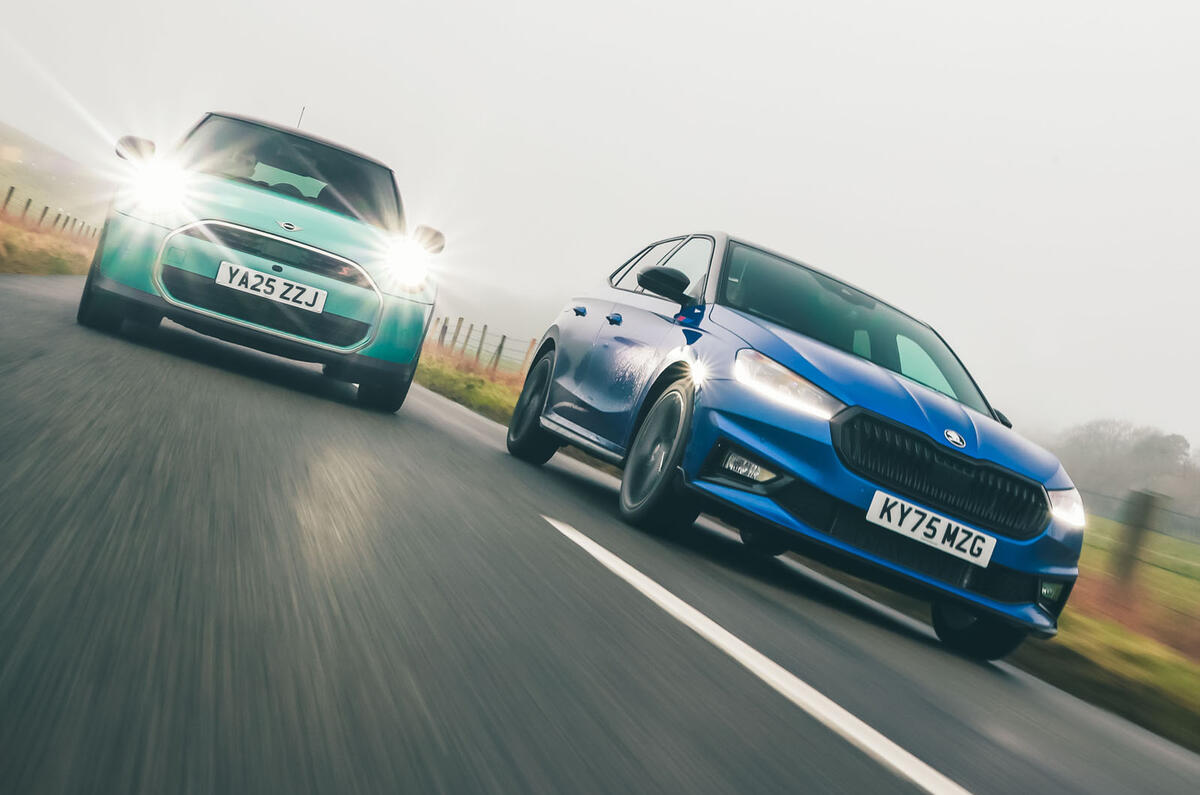
Fast versions of modern Minis are the sort of cars about which reviewers can't seem to make up their minds. They've won group tests on about as many occasions as they've gone down in flames. Even this latest-generation one appears to shapeshift between tests. I remember the five-door Cooper S we ran as a long-termer about a year ago having an insufferably firm and brittle ride and an automatic gearbox with all the clutch control of a learner driver operating the pedals with a broomstick. Yet the one I'm driving right now is fine. In fact, I'm rather enjoying it. It's cheery; it's sprightly; it's fun. It's the curse of the power of choice. With so many bodystyles, trims and wheel, tyre and suspension combinations on offer through the years, one Mini is not like another. For the latest generation, the customisation has been reined in a bit, but then it is already the fourth generation of the 'new', 21st-century Mini, having evolved from a primarily Rover-developed project in 2001 to a tightly integrated part of the BMW platform ecosystem today. If there has been one constant about the moderately sporting Mini, it's that it has existed. That's no small feat if you think about it. The retro experiment could have ended along with the Chrysler PT Cruiser and the Volkswagen Beetle. More than that, small petrol cars are under pressure, particularly if they dare to be fun and have a largish engine. Witness the recent death march of hot hatches. In the previously bustling field of small but moderately practical cars with a bit of poke, there's now next to nothing left, at least not if you want a petrol engine. The Mini Cooper SE and the Alpine A290 are good but won't work for everyone. The Mazda MX-5 provides immeasurably more thrills but lacks a back seat. In comes Skoda with the Fabia 130. The brand isn't known for brilliant driver's cars, but it has built up a reputation as the voice of reason. So while the Superb, Octavia, Elroq and Enyaq aren't the most exciting things going, their fitness for purpose is beyond doubt. And actually, the way they drive demonstrates that Skoda's chassis engineers know damn well what they're doing. Could they apply themselves to keeping alive the beleaguered hot hatch genre? I went to pick up our test car from the UK launch in the Peak District, and after an enjoyable day razzing around some excellent driving roads, and then driving it several hours home in remarkable comfort, I was feeling hopeful. But can this subtly sportified sensible hatchback beat the perennial Mini? That's why we have gathered at some of our favourite Oxfordshire testing roads on a streaming wet day. Getting into the Mini from the Fabia is a bit of a shock, because many things are not where you expect them to be. Simply climbing into a modern BMW Group product and setting off down the road is as inadvisable as slapping a leash onto an unfamiliar German shepherd dog and expecting it to willingly join you for a cross-country run. First, you need to sign in to the car with your Mini profile, because if you don't, things like the voice activation and the custom shortcuts won't work. It's not hard to do, and owners will only have to do it once, but it feels like being coerced into agreeing to data mining for no good reason. Then you need to configure the 'Go-kart' drive mode (ie sport mode) to give you a combination of lighter steering and looser stability control. It's also the only way to get a rev counter on the central dinner-plate touchscreen. Then it's onto the displays. I can't bear the head-up display, because it's one of those little flip-up screens that give me a headache, but others find it preferable to having to look left at the big screen to see your speed. Oh, and unless you've read the owner's manual cover to cover, it might take you a while to discover that holding the SET button on the steering wheel turns off the speed warning bong and holding the settings button turns off the engine start/stop, because that's logical? A lot of this is a once-only operation, and the rest of it you do get used to, but I hate that we're in an era when it's somehow acceptable for £30,000 consumer products to be annoying. It might well make you run for the Skoda, with its knobs and switches, simple digital dials and big levers for the gear selector and handbrake. But I can just about forgive the Mini, because once you get set up and settled, it's an utterly charming driving environment. Whereas the Fabia's dashboard is just a fairly generic black-and-dark-grey economy car effort, one that I can't picture in my head now a week after the test car was taken away, the Mini's is unmistakably that of a Mini. The big round screen, the houndstooth pattern on the knitted-fabric dash, the retro button panel, the copper-coloured accents, the chunky wheel with the round centre boss. There's a sense of delight and joyfulness to it. The fun of driving doesn't always have to be about going sideways at 100mph. The Mini also has the most purposeful driving position of any small hatchback. In a way, it feels closer to the BMW 3 Series than to the Fabia. If you wish, you can sit properly low, with your legs outstretched and the wheel close to your chest. The seats aren't the most aggressively bolstered, and you need to step up to the top trim level to get adjustable lumbar and thigh support, which feels a little mean, but they are pretty comfortable. Not that Skoda gives you church pews. Its manually adjustable buckets actually feel a little sportier than those in the Mini and you get adjustable lumbar with a little lever on the side of the backrest. Compared with the Mini, you're sat a little high and upright, although that's simply closer to the norm of a smallish hatchback. But, yes, the environment in the Fabia is rather drab and largely made of hard plastic. On the lower-rung Monte Carlo trim level of the regular Fabia, you at least get a flash of orange here and there, but in the 130 it's all grey. For all that, you could give this car to anyone who has a driving licence without any explanations and they would get along fine with it. The heated seats, the temperature, the start/stop system all get clearly labelled buttons. Meanwhile, the infotainment touchscreen is relatively small and neatly integrated, and intelligible even if your technological literacy halted at Ceefax. Practicality? The Skoda wins that easily as well. Adults can genuinely sit in the back seats without holding a grudge against whoever put them there and there's 380 litres of space in the boot. Having said that, the Mini is not as cramped as some people think, and much better than the early-2000s ones. Rear leg room is passable for a small car and 210 litres is enough for some groceries. For an extra £1000, you can get it as a five-door, but that isn't actually any roomier - the back seats are just a bit easier to access. And those two extra doors simply don't look right, do they? That the Fabia is no longer available as a three-door is sort of academic, but looks are essential to a Mini. Anyway, we're here to determine whether there's still some life in the warm hatch market, so let's get to driving. Immediately it's obvious these cars come from different places, and I don't mean Oxford and Mladá Boleslav. One is an entry-level supermini with an injection of power, sports suspension and good intentions, the other is the affordable-ish tearaway version of a premium car platform that's primarily designed for cars like BMW's X1 and M135i. They meet roughly in the middle, but there's a distinctly different vibe. I like the way the Fabia 130 goes down the road. For something that tries to be sporty, it's not uncomfortable at all. And yet there's quite a bit of grip, strong body control, some bite to the front axle that lets you settle the car into a corner and - if you're feeling frisky - give it an extra bung while lifting off the accelerator for some proper hot hatch lift-off oversteer. The 130 version gets an ESC Sport mode that will turn a blind eye to such shenanigans. It will intervene in the end, but often not before you have dialled in some opposite lock. The disappointments here are the steering and the engine. Both are fine: they absolutely do the job of respectively making the car go in a different direction and faster, yet neither musters much enthusiasm in the process. The steering has some weight to it and feeds back enough information that you don't feel completely on your own, but it's a little numb and artificial. Although the 'EA211' 1.5 TSI may have more power here than in any other application, thanks to a different intake, among other things, it's fundamentally an engine designed for efficiency. The spec says the maximum power is developed at 5750-6000rpm, yet subjectively it feels like nothing particularly interesting happens after 2000rpm. The unique exhaust pipes add a bit of burble, but mostly the engine moos like a hungry cow if you prod it. With a quarter more swept capacity and an extra 26bhp and 371b ft of torque, the 'B48' in the Cooper S does feel like a more serious sort of engine. It pulls harder towards the redline with no notable lag and sounds more lustful while doing it. This is in large part thanks to the augmentation that comes through the speakers. As much as that sort of trickery feels ideologically objectionable, it does work. It takes the harshness out, even if there's a hint of Ford V4 to the resultant sound. Although this is just the Cooper S rather than the 'proper' John Cooper Works, it feels more finely honed in its ride and handling too. The steering is lighter than in the Fabia but weights up more forcefully as you approach the limit of grip. The chassis is even more playful, particularly in DSC Sport Plus mode, where the system is clearly nipping at the inside brakes to rotate the car. If you wish, you can turn everything off as well. You are bounced around a bit on bumpy roads, as BMW has gained a taste for overly stiff suspension recently, but on the sensible 17in wheels of our test car impacts aren't too harsh. There's no doubt here that the Mini is more fun. It's quicker, pointier and more interactive, even if there is one key element missing from the interaction. Unless you go for the Mini's Sport trim, which comes with a bunch of ugly spoilers and black wheels, you don't get a manual mode for the gearbox. There are no paddles and no stick to push back and forth. It's slightly bizarre. The sport mode works reasonably well, and because the very progressive brakes invite you to use your left foot, it does fit with Mini's 'go-kart' shtick, but Mini should offer paddles as an option. The Fabia 130 also comes with a seven-speed dual-clutch automatic gearbox whether you want it or not, but at least Skoda also gives you manual control. It's a shame neither offers a proper manual gearbox, which used to be a hallmark of a good hot hatch. Customer preferences have only been going one way, and it's towards two-pedal cars. Still, I bet there would have been demand in cars like this. After all, in both cases, it wouldn't have required much development: there are manual Fabias and a six-speed transmission exists for its Volkswagen Group 1.5 - you can have it in the Golf. Meanwhile, the Mini uses the same platform and powertrains as its predecessor, and that came with a manual. Clearly neither of these cars will ever be named in the same breath as the Ford Fiesta ST, Renault Clio RS Cup, Hyundai i20 N or Mini Cooper GP. The era of great hot hatches appears to be over, and the Mini Cooper S and Skoda Fabia 130 are valiant survivors. At around £30,000-£35,000, depending on how many options you pick, they're kind of expensive, and they lack truly memorable powertrains. But there's still plenty to like. The 130 is as practical and easy to live with as any Fabia and can be good fun if the mood takes you. The Mini can be a bit annoying, but is a fabulous piece of design, is as quick as some of those greats and has a properly entertaining chassis. The Mini still serves up driving fun in a compact package, as it has been doing for more than 70 years.