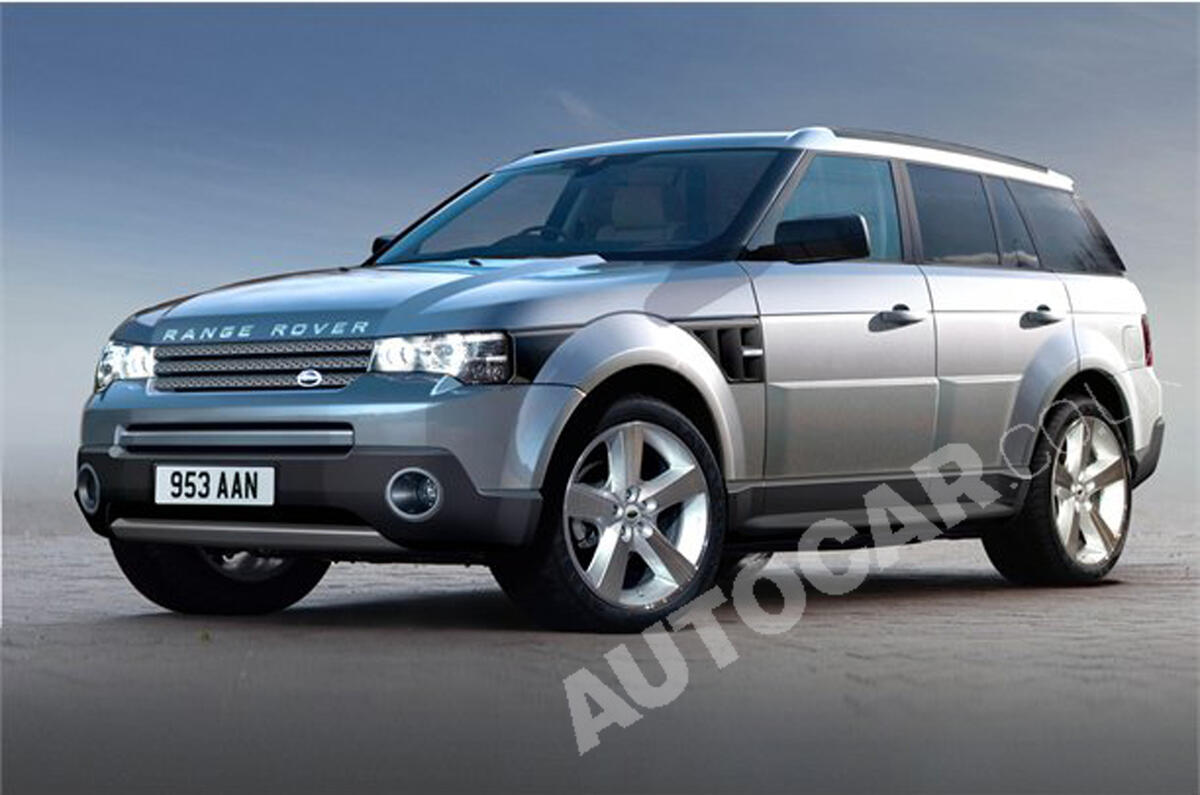

A new, lightweight Range Rover featuring a roomier, super-luxury interior and 40mpg fuel economy is due in autumn 2012.
The all-alloy Range Rover will also form the basis of a new Range Rover Sport which, for the first time, will also be offered with a seven-seat interior; that variant will become the successor to the current Discovery.
Read 'The future of Land Rover'
Hilton Holloway blog: Gas guzzlers learn to sip politely
Both of the new Range Rover models are in the final stages of their engineering definition and the styling of the Range Rover (project L405) will be signed off in the middle of this year.
The new Range Rover will have a similar footprint to today’s car — it grows by around 25mm to a shade under five metres long — so the main change is a lower roofline. That will reduce the Range Rover’s perceived bulk and also cut aerodynamic drag.
Styling and construction
Land Rover’s styling team, led by chief Gerry McGovern, is working with a similar palette of design details to today’s car. So expect an imposing upright nose and horizontal, multi-bar grille, oblong headlights, together with a flat beltline and airy glasshouse, topped by the characteristic floating roof.
The all-new, pressed-alloy platform has given engineers the freedom to create a more spacious interior package. The wheels have been pushed closer to the front and rear corners, extending the wheelbase by around 25mm. Thanks to this gain, the extra 25mm in overall length and internal packaging improvements, the new car will feature much improved rear legroom, up by 125mm.
“The feedback from existing customers was [that they wanted] more rear legroom, so that’s what we’re going to give them,” said one insider. Although the roofline is lower, packaging improvements will ensure similar headroom to today’s Range Rover.
Land Rover’s design team is working on Bentley levels of cabin quality with a harmonious mix of leather, wood and metallic finishes. “The level of workmanship in the interior will really knock out the opposition,” said another well placed insider.
Under the skin, the new alloy bodyshell of riveted pressings has some commonality with Jaguar’s new XJ, although JLR counts the two structures as separate platforms. Similarly, the electrical system is shared between the two.
Alloy construction will bring huge weight benefits. Land Rover is understood to be targeting a kerb weight saving of 450kg, which will cut the new Range Rover down to 2150kg.
Around half that loss is understood to come from the alloy bodyshell, while the other half comes from detailed engineering improvements, lighter components and advanced materials.
Some of the body panels are understood to be made of composite materials, including the front wings and possibly the rear tailgate.
Engines
The new lightweight Range Rover will record some spectacular improvements in economy, C02 and performance.
Two diesel engines will be offered at launch: a 300bhp TDV8 and a 260bhp TDV6, mated to eight-speed ZF gearboxes with stop-start. Petrol V8s will be available soon after. The extra power and lower kerb weight means that the V8 diesel will offer a 0-60mph time of less than 8.0sec and close to 30mpg.