Currently reading: Ford bucking Bronco tradition with Europe launch plan – will it work?

Ford's resurrected off-roader is a big deal across the pond, and the badge could soon be a common sight over here

For many Brits, Ford doesn't feel like a particularly American brand.

On these islands, the Blue Oval is associated not with big pick-ups or muscle cars but, depending on your vintage, Cortinas and Escorts, Fiestas and Focuses. Distinctly British-flavoured cars (and Transit vans) that were designed, engineered and often built here. But as Ford has ditched conventional hatchbacks and saloons in recent years in favour of SUVs and EVs, it has started to lean into its American roots as a point of differentiation from European rivals.

It isn't quite offering cars with a Stars and Stripes vinyl wrap and ADAS functions that chant 'U-S-A' instead of beeping, but it is embracing its US-born heritage. That doesn't mean Ford is preparing to import its US line-up to Europe (aside from the Mustang) which is perhaps good news given the chaos that would probably ensue from a bevy of F-150s invading the Cotswolds. Instead, Ford is sprinkling the names and DNA of some of those models on its European range.

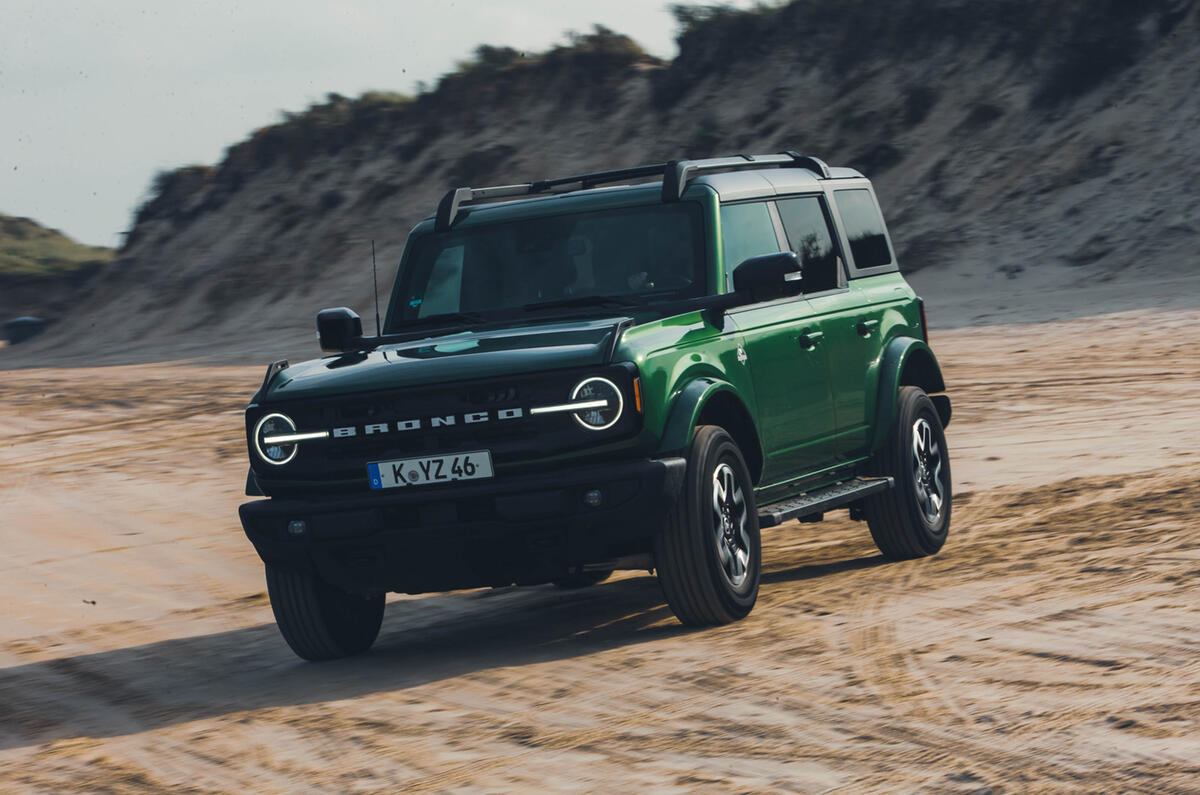
The Explorer badge is already here (albeit on an electric SUV riding on a Volkswagen Group platform), and there are plans for more valuable Ford IP to follow. Nothing is official yet but, as you might have read in Autocar, the firm is working on a new European-focused combustion-engined SUV that will be built in Spain alongside the Kuga and most likely be called Bronco (pictured below).

That name may not have much resonance here in the UK but, having been revived in 2021 after a 25-year absence, the Jeep Wrangler rival has rapidly become one of Ford's most important models.

The Bronco sits on a body-on-frame platform (shared with the Ranger pick-up), and close to 150,000 of them were sold last year. It is a core part of Ford's pitch to become, as CEO Jim Farley puts it, "the Porsche of off-road". And the Bronco is no longer just a single model. In the US there's the Bronco Sport, which retains all-wheel drive and some off-road ability but uses a road-focused architecture (Ford's C2 platform, on which the Kuga is based), while in China there's an unrelated Bronco New Energy, offered as an EV and a range-extender.

As Farley noted recently: "The Bronco line-up is filling out globally." He added that the firm has "great plans" for the range. So what is the ethos behind the Bronco? To find out, you need to visit the home of the Bronco. Except, well, there are two. One of them is in Johnson Valley, California a vast, 96,000-acre -desert crossed by numerous rocky off-road trails, where the Bronco's development team travels regularly to test new versions of the machine to its limits.

The Bronco's other home is stamped on the plate bolted to the transmission tunnel of every car: 'Designed and engineered in Dearborn, Michigan'. Given that my first action on clambering into the Bronco I've secured is to crank up the heating and turn on the seat warmers, you can probably surmise that I'm not in California. But while the crowded highways of suburban Detroit aren't the best canvas on which to sample the Bronco's abilities, the weather is doing its best: it's bitterly cold and there is heavy snow falling.

Advertisement

Read our review

Car review

Dearborn’s reborn off-road adventurer is now available in the UK as a grey import. Most likely works better overseas than it does here but is still good fun, if irrational

Back to top

At this stage I'm quite glad that, while it is clearly utilitarian with lots of physical switches and hard-wearing floor mats, the Bronco is still well-appointed and very comfortable inside. Plus, the Bronco's four-wheel drive system and low-ratio gearbox might come in useful after all. Besides, being in wintry Dearborn gives me a chance to meet the people who have led the off-roader's revival.

They include Ed Krenz, the Bronco's chief engineer and a man who, if he weren't making Broncos, you sense would probably own one anyway. First, let's go back. You may have been wondering why, if the Bronco is such a cultural phenomenon and key part of Ford's line-up, did it disappear for 25 years? "When it went out of production in 1996 it had, in my opinion, lost its way a bit," says Krenz. "It migrated into a really big vehicle, because customers were looking for a four-door. It really lost its connection with its roots as an off-road vehicle."

However, like the Land Rover Defender, the Volkswagen bus and the Renault 5, the core concept of the Bronco never really went away, and the desire for a truly capable off-roader remained alive within the firm. Krenz says there was "a solid decade of a group of people within Ford continuing to make proposals and studio renderings" for a Bronco revival. The biggest obstacle? "There was always that hurdle of Jeep," says Krenz.

"The Wrangler was just so dominant in that market. If you're going to go into a relatively limited market that is dominated by another model, you have to have a plan to succeed." When the Bronco's revival was finally approved, Ford's engineers embraced the challenge of taking on the ubiquitous Wrangler. Krenz says: "The secret sauce was that our engineers became part of the Jeep community." That said, he insists: "We don't consider Jeep owners a separate community: it's an off-road community. We're all into this off-road thing: it's a culture that exists beyond a brand."

Back to top

The aim was to really understand both the Jeep's appeal and if Ford could do it better, says Krenz: Jeep owners don't complain about their cars, because they have a high tolerance for what their product is. But we kept asking: 'How do we objectively do everything better?"

Two examples that Krenz gives are the handling "which is why we don't use a solid front axle" and the removable doors. "When Jeep owners take the doors off, they can't store them in the vehicle, so they end up chaining them to a cactus or something," says Krenz. "And because the mirrors are on the doors, when they take them off they don't have mirrors."

As a result, the Bronco's doors are designed to fit in the boot, while the mirrors are mounted on the front wings, so they stay in place when the doors come off. "It was never going to be good enough to show up with a replica and convince the market to buy something other than the Jeep they loved," says Krenz.

From behind the wheel, a Bronco offers an undeniably similar experience to that of a Wrangler, especially in my car's Badlands spec, with more ground clearance, upgraded HOSS suspension, Bilstein dampers and 33in off-road tyres. As an aside, most Bronco variants are named after US national parks and other wild locations, so Badlands sits above Big Bend and Outer Banks.

You can add a Sasquatch package with extra off-road bits to any of those or, for the most hardcore variant, opt for Raptor spec. It's all very rugged and outdoorsy.

Back to top

As with a Wrangler, there's a fair degree of wobble due to the ladder-on-frame chassis and off-road tyres. Isolation and road noise are both compromised, too, and the steering lacks a bit of feel. Our Bronco is powered by a 2.7-litre twin-turbo V6 with 311bhp and 410lb ft (there's also a 2.3-litre inline four and a 3.0 V6). Driven via a 10-speed auto, it's a bit gruff and takes a while to get up to speed, but it cruises happily once there.

Still, it's eminently likeable and those on-road compromises are a price many are happy to pay for the immense off-road capability - which I don't really get to sample touring Dearborn. Still, the Bronco offers GOAT drive modes (a reference to the original 1960s development goal for a vehicle that 'goes over all terrain'), and the Slippery setting comes in helpful powering through heavy snow. It locks in four-wheel drive, offering enough traction to not just eliminate any sliding but even leave me slightly worried I'm going to rip chunks out of the road.

Krenz doesn't seem to mind me pointing out the Bronco's compromises on the road. In fact, he describes the Bronco as "unapologetically" compromised. He says: "It knows what it's designed to do, and it does that well. But in order to do some things great, there are other things it needs to do less great."

The need to do some great things, he notes, applies to every machine that carries the Bronco name. "We've written down exactly what the Bronco must do, and we replicate it on Bronco Sport or with New Energy Bronco - it's a Bronco," he says. "If the Bronco portfolio grows, we know what the recipe is and the product has to be right. Otherwise, it can't be a Bronco.

Back to top

"Within the segment it's in, it has to meet and exceed the off-road expectations for a product in that class. If it's a unibody front-drive architecture like Bronco Sport, it's not going to do everything a Bronco can do, but it needs to do more than everything else in that segment."

Krenz won't be drawn on the prospect of a European Bronco, but speaking more broadly he notes that "we're actively trying to protect the brand". He adds: "It's easy to monetise this and just put a Bronco badge on something. Maybe some of our competitors have used their brand liberally, and maybe with some regret."

Given some of the disquiet when Ford used the Capri name on an electric SUV, that passion is refreshing. And since the Wrangler has a small but loyal following in the UK, it's a shame the full Bronco is only available over here through specialist importers (you can probably thank the vagaries of emissions regulations and ZEV mandates for that).

But, as with the Wrangler, the Bronco's appeal is tied up in the sense of American adventure it conveys, that urge to take off the doors and drive into the wilderness. Then I remember how cold it is in Michigan and decide just to keep touring the sights in comfort.

Still, a less hardcore but still off-road-capable machine tuned for Europe could carry the Bronco name and find some success here. It would be a very different sort of Ford from those many Brits grew up with, but it could be a welcome taste of off-road Americana.

Join our WhatsApp community and be the first to read about the latest news and reviews wowing the car world. Our community is the best, easiest and most direct place to tap into the minds of Autocar, and if you join you’ll also be treated to unique WhatsApp content. You can leave at any time after joining - check our full privacy policy here.

James Attwood

James Attwood, digital editor
Title: Associate editor

James is Autocar’s associate editor, and has more than 20 years of experience of working in automotive and motorsport journalism. He has been in his current role since September 2024, and helps lead Autocar's features and new sections, while regularly interviewing some of the biggest names in the industry. Oh, and he once helped make Volkswagen currywurst. Really.

Before first joining Autocar in 2017, James spent more than a decade in motorsport journalist, working on Autosport, autosport.com, F1 Racing and Motorsport News, covering everything from club rallying to top-level international events. He also spent 18 months running Move Electric, Haymarket's e-mobility title, where he developed knowledge of the e-bike and e-scooter markets. 

Join the debate

Comments
1
Add a comment…
Arthur Sleep 26 April 2026

The Bronco may come to Europe, but not the UK.  Bizarrely, Ford has missed out on many European sales to the likes of the Defender and the Jeep Wrangler.  I think it's a cracker, and I would almost certainly buy a UK Bronco with the steering wheel on the correct side, but I guess Ford doesn't feel RHD sales would be high enough to warrant the effort, despite UK, Japanese, Australian, Indian, South African sales.