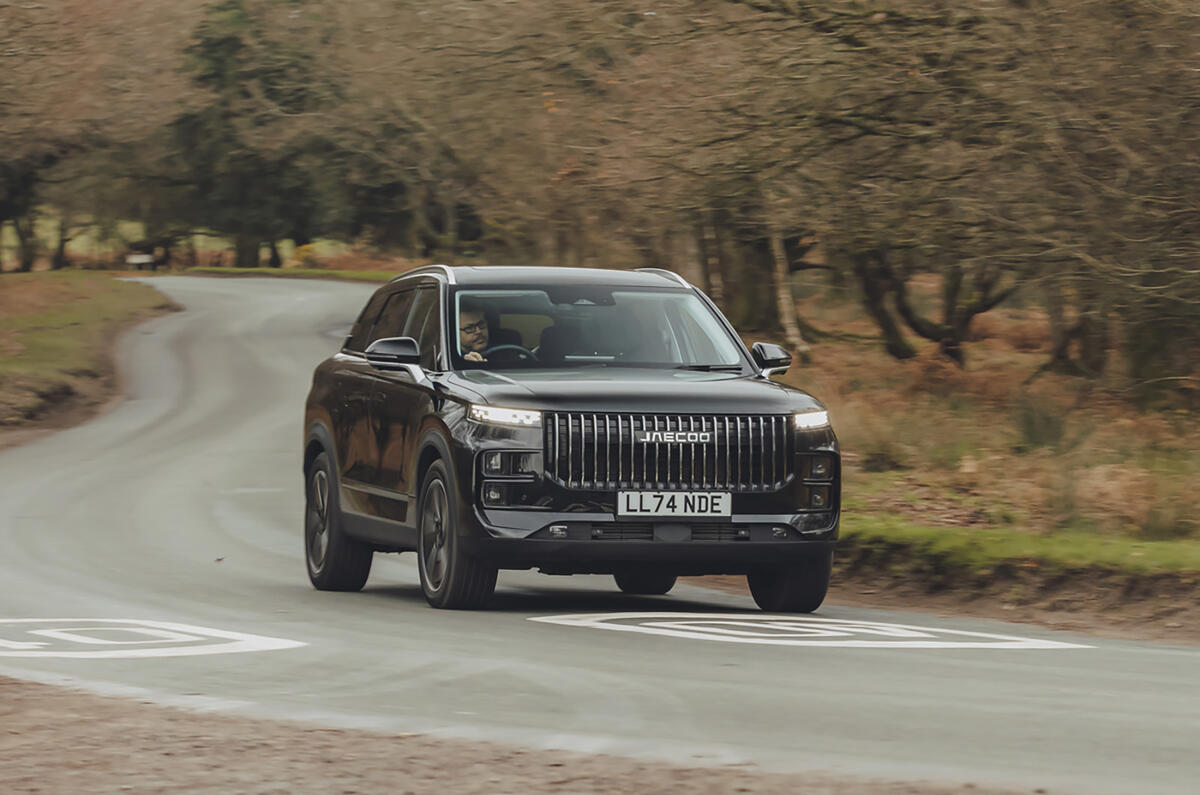
Currently reading: Jaecoo 7 - the ultimate test: My family holiday in £30k Chinese SUV

We load up this 1.6-litre Chinese SUV with kids, dogs and kit to find out if it’s more than just a bargain price

I'm on a mission to discover how the Jaecoo 7 stands up to the rigours of family life over the next few months, and I got off to a good start with a trip to Somerset to visit my parents for a few days.

That meant kids, dogs, bags, walking gear and more, which would provide a stern test for the 145bhp 1.6-litre turbocharged petrol engine. With those 'kids' now aged 19 and 16, the prospect of a long motorway journey in the back seats is usually greeted with groans, but both daughters were impressed by the Jaecoo.

Although the rear bench is fairly low-set, they were pleased with both how much elbow and leg room they had and the amount of creature comforts: even rear-seat passengers get heated seats and a pair of USB charging ports. And in spite of their maturing years, they were thrilled to discover the additional set of controls on the side of the front passenger seat (in China, being chauffeured in your car is a sign of success), which meant they could move Mum's seat into uncomfortable positions while she dozed to give her a surprise upon waking.

The dog in the boot was a bit less happy. Although it's a nice, square shape and easily big enough for day-to-day use, its 412 litres are quite quickly filled with bags, leaving his bed hemmed into the corner and him with a very high load lip to negotiate. It isn't helped by the load-bay cover, which makes it shallow and is mounted a good few inches aft of the rear seatback, leaving a gap through which the contents it's supposed to conceal can be seen.

Up front, it's a game of two halves. No complaints about the luxury of the heated and ventilated seats (standard on the AWD version, it being tied to Luxury trim), the heated steering wheel or the light pouring in from the glass roof, but the climate control could be more responsive and, although there is four-way electrically adjustable lumbar support, I find the front seats flat and unsupportive, leading to an ache in my lower back after a long drive.

All loaded up with somewhere to go, I could immediately feel the difference in the way the Jaecoo drives. Because it's softly sprung, when fully laden it rolls like a boat in corners, forcing me to take it easy on country lanes. The weight makes a noticeable difference on the motorway too, with the drivetrain struggling to maintain 70mph in the Eco mode to which it defaults every time the car is turned on.

Advertisement

Read our review

Car review

Chery’s SUV brand hits the UK with a family PHEV that’s big on value

Back to top

Often such modes don't mean much, but in the Jaecoo they make a huge difference: Sport is a bit too aggressive in town, while Normal makes it feel much livelier off the line and quicker to downshift to maintain momentum once up to speed without a big drop in MPG. On which subject, both the official claims and those made by the car's on-board computer appear pretty accurate: the 35.3mpg WLTP figure is disappointing, but on varied roads on a long drive I got close at just over 33mpg on a fill-to-fill test, which was corroborated by the dashboard readout.

Presumably the plug-in hybrid Jaecoo would do much better (even the FWD Deluxe version of the pure-petrol model will do 37.7mpg). It would also cure one of my other gripes about the car: without even a mild-hybrid element, it's slow to react to the engine start-stop system; and with no auto-hold function, on an incline it will roll back an alarming distance before the engine fires and the gearbox takes up drive unless you're nimble on the pedals or engage the electronic parking brake each time.

However, while I arrived at our destination a little disappointed as a driver, I was happy enough as a father and a husband, because the rest of the family had enjoyed the journey without complaint.

Join our WhatsApp community and be the first to read about the latest news and reviews wowing the car world. Our community is the best, easiest and most direct place to tap into the minds of Autocar, and if you join you’ll also be treated to unique WhatsApp content. You can leave at any time after joining - check our full privacy policy here.

Join the debate

Comments
7
Add a comment…
jason_recliner 9 March 2026
Less than 110kW for a family car is a joke. Will be awful to drive and borderline unsafe - forget about overtaking. What happened to Chinese cars giving more for less?
scotty5 7 March 2026

When electronic park brakes first appeared ( first I saw was in a Passat I was interested in approx 20 years ago ), the salesman advised to add the optional auto-hold which from memory was around £50.   Went for a test drive thru Glasgow City west end which is like San Francisco in places. What a pain with no autohold, that £50 was a no brainer. VW made it std soon after.

For someone to  sell an electronic braked car without autohold in 2026 is unbelievable. The only way to overcome this would be to practice using the brake pedal with your left foot. 

xxxx 8 March 2026

Not so fast, had an Audi with an electric handbrake but without the optional Auto hold button, it was all the better for it because the car is held in place, without touching the button, until you release the clutch and go forwards.

Problem I had was the learning curve because, from memory, you needed to have the seat belt plugged in else you couldn't let the car roll in neutral when parking, OR, foot on brake and pull the button up to override it.

So it all depends on how Jaecoo have implemented it.

Will86 8 March 2026

Why would a car be better without autohold? And what you've described is auto hold - it holds the car without you having to do anything until you release the clutch. Plus in most cars it's the driver's choice whether they activate the system.

Very few, if any, Stellantis cars have autohold which immediately rules one out for me, though that is perhaps no great loss.

xxxx 8 March 2026

Better in the sense it was optional and cost money. And what I described is what it was, there was no autohold button.

As a footnote another difference was it didn't apply the hand brake automatically when you turned the engine off, we've now got a car that can do that, as it has an autohold button, but the problem is our two other cars don't and I don't want to get into the habit of getting out of a car that may or may not apply the handbrake automatically.

xxxx 7 March 2026

Cheap to buy expensive to run.