











What is it?
This is the Hyundai Genesis, the rear-wheel driven executive saloon that the Korean firm is offering up to rival BMW’s 5-series, Mercedes’ new E-class, Audi’s A6 and Lexus’ GS. A brave car indeed, then. But is it a sacrificial lamb or a revelation?
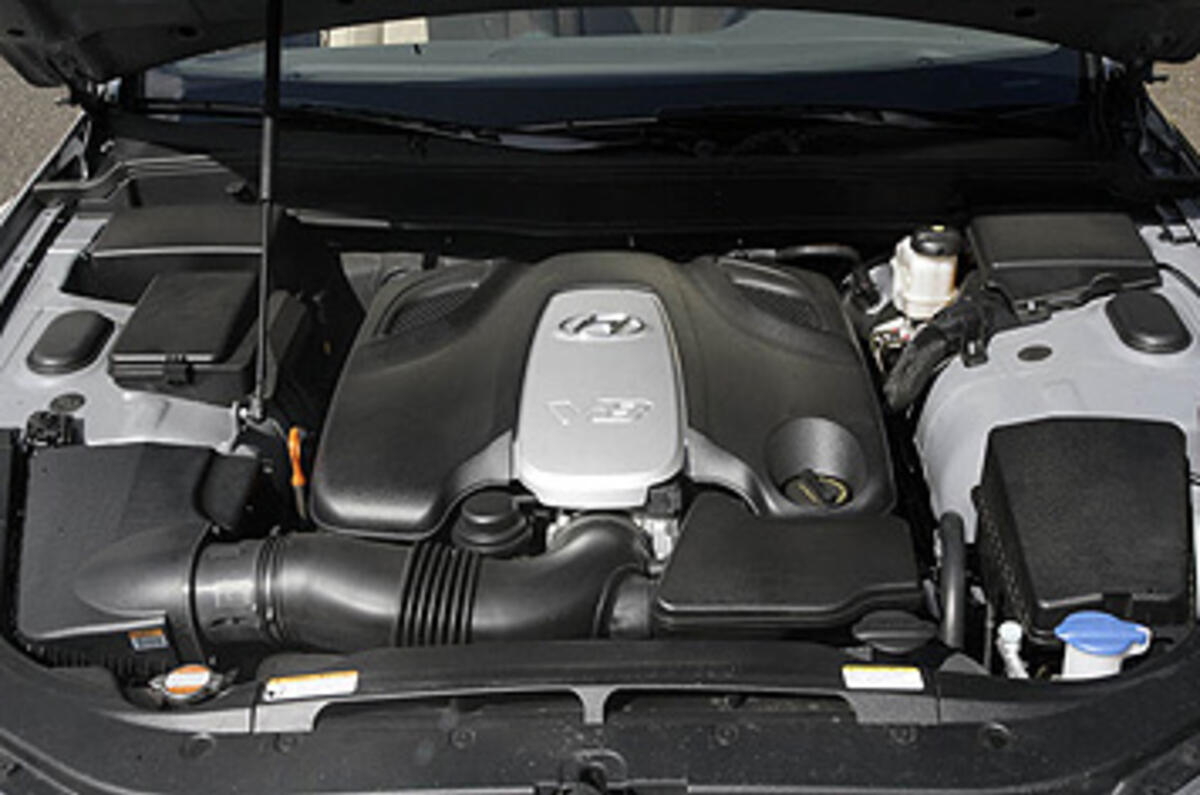
Hyundai launched this car in other parts of the world a year ago, but because it won’t be officially sold in Europe, now is our first chance to drive one in Britain. It’s a range-topping 375bhp 4.6-litre V8 that Hyundai Motor Europe has brought over for evaluation purposes.
What’s it like?
Hyundai’s marketing material described this car as “5-series sized, with a 7-series-sized cabin and a 3-series-sized price tag”. It’s certainly roomy and, in the US, is priced from $37,250 – that’s just under £24,000 at the current exchange rate – where a V8-powered BMW 5-series or Mercedes E-class costs a clear $60k without options.
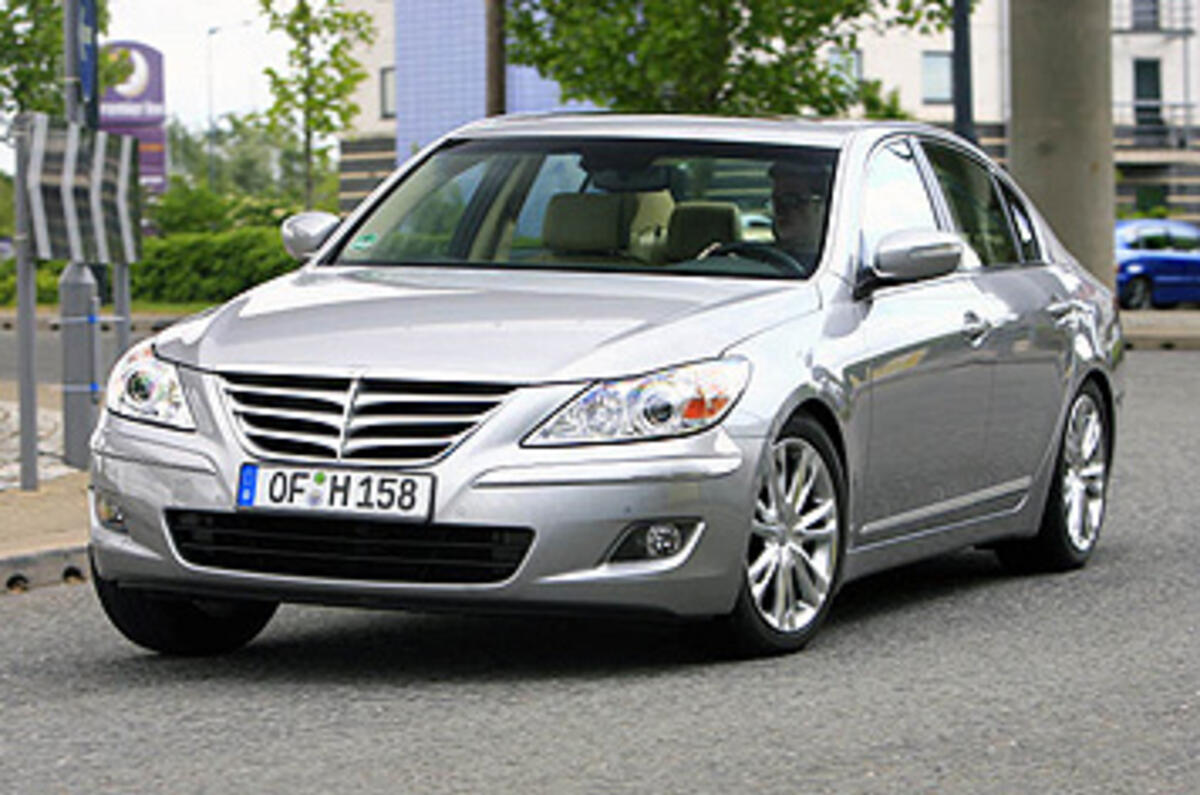
From the kerbside, the Genesis certainly looks a bit forgettable though. That’s not to say it isn’t smart and contemporary, but the aesthetic does absolutely nothing to attract your attention. But that’s probably exactly as Hyundai intended; it must want nothing more than for this car to be accepted as ‘one of the crowd’. If you look carefully, you’ll notice that they didn’t even bother to put a badge on the front of it.
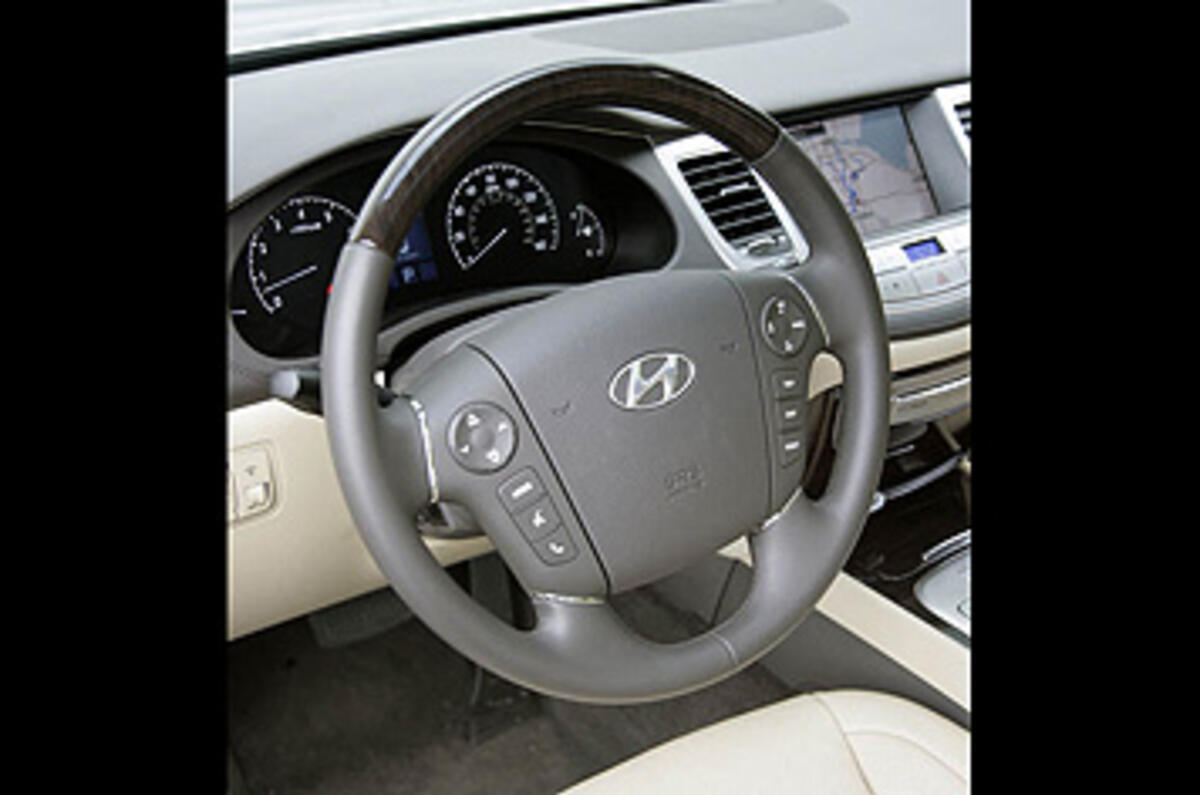
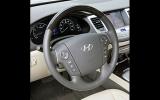
But slide aboard and the driver’s door thunks shut behind you with an expensive-sounding air of authority. A large leather and veneer steering wheel juts towards you in front of a two-tone grey and cream dashboard wrapped in leather and soft-touch plastics. Every surface has a costly-looking grain; every stalk and button moves with tactile impressiveness. So far, so very good indeed.
Thumb the starter button and the car’s 4.6-litre ‘Tau’ V8 starts to spin away distantly. Drag the gearlever down into ‘D’, release the footbrake. The wheel feels slow, heavy and inert at low speeds, but it’s precise and consistent, and effectively reminds you of the size of the five-metre hulk you’re steering.
There’s remarkably little noise from either the chassis or the engine while you’re bumbling around town; little more when you’re coursing down the motorway. At both urban and cross-country cruising speeds, in fact, the Genesis produces the same vault-like feel as a petrol-powered Lexus LS or Mercedes S-class. Ninety-nine per cent of the time you simply can’t hear either its motor or its suspension in action; there’s a little road and tyre roar and the faintest suggestion of wind noise – that’s all. Thank what Hyundai describes as an exceptionally stiff bodyshell for that.
Head off the multi-lane stuff and seek out some curves and bumps to challenge this car’s dynamic repertoire that bit more. Our test car isn’t altogether happy to be hustled along a back road; it’s on US chassis settings that leave it too softly sprung and under-damped for British roads. Still, it turns in well, and has decent balance for such a big car. The powertrain’s commendable too, with plenty of power high up in the rev range, and the same excellent six-speed ZF automatic gearbox you’ll find in so many other premium saloons.





Join the debate
Add your comment
Re: Hyundai Genesis 4.6 V8
Thanks, VocalistBob, for your positive message. Your assessment above is almost 100% accurate representation of me as a recent Genesis buyer.
I own a 2009 Genesis 4.6 w/ the Tech pkg and a few add-ons - nost recently the Genesis winged badges for my wheels, trunk lid and hood (which I will not use - that's too far and tacky). Now the stylized Hyundai "H" is nowhere visible on "Gen's" sleek black exterior. I've tinted the windows and take childish delight in raising and lowering my rear sunscreen at various times.
And before I go on, let me say that the performance of this car is all I need and more in my New England lifestyle - every bit as satisfying and more, sometimes in compensatory ways, than what I have come to enjoy with my two previous 8-cylinder 5 Series BMWs.
I had a HUGE struggle in parting from the "brand" of BMW. The whole image thing is so powerful, implicitly and explicitly, that it took me almost a year to finally trade in my 2004 545i for my new Korean upstart. The final push? Once the warranties on the vaunted BMWs (and Mercedes - had one of those, too - much prefer the BMW) expire, the bill for every trip to the dealer exceeds $800 - usually closer to $1200. Mind you, I owned BMWs for the past 12 years, so I speak from my experience as well as the experience of many fellow bimmer drivers. Habitual drivers of these machines typically earn or otherwise have access to enough funds so that the price tag isn't the #1 consideration. Ergo, I purchased my 2004 after a wonderful time with my earlier 540 - and not too long after that warranty expired, I might add.
My plan for the past 2 years was to take European delivery on a 2010 550i - drive the Autobahn, visit with friends and business acquaintances I've met in Europe, and continue my BMW relationship. But then, while I am financially comfortable, I'm not immune or invulnerable to the economic tsunami: no bonus, no increase, steady growing family, yada, yada - and after my last $1800.00 repair bill, with a known future expense of $1200.00 looming - and MUCH research and at least 4 extended test drives - I moved to my V8 Genesis.
Now hear me: I am not saying that the Genesis is an equal to the BMW 545, or that it is the best car I've ever driven or will drive. I'd much prefer to drive the Autobahn in a tight and exquisitely crafted Bavarian driving machine that I've come to love. But my daily driving experience is just the same and in some ways (due to toys) better than it was before the trade.
So, if I had endless funds and absolutely no worries about economic stability, I'd've purchased a new 550. But, given:
* the 10 year, 100,000 mile bumper-to-bumper warranty (I paid a little extra for TOTAL coverage;
* the volume of valid and reliable impressive road and performance test results that have been published;
* the really excellent quality interior and exterior details (I took it to my trusted BMW-only mechanic, who was blown away by the attention to detail and quality in the engine compartment);
* the fact that it can burn premium or regular - the hp drops to 365 on regular, although I'll never burn anything but premium in it;
* and my own personal experience as an owner for almost a month now
I am very happy to have defied strong automotive brand paradigms and purchased my Genesis 4.6.
As I read elsewhere in the string: it's a new world, folks. "Global" entails expanded mindsets and paradigms. Don't knock so strongly that which you have no direct experience with.
Nice site, by the way!
Cheers,
Vlad
Re: Hyundai Genesis 4.6 V8
The problem is that in the UK rough roads is everyday driving. The sh1t that passes for a road here these days has to be seen to be believed.
The Genesis is a nice enough looking car and I'm glad you are enjoying yours. Unfortunately there are an awefull lot of people here for who the badge on the car is everything, That's why the Genesis will never be a success (or sold) here.
Re: Hyundai Genesis 4.6 V8
Okay, you've taken enough cheap shots at American cars and American drivers. Believe it or not, some of us actually know how to drive and know what constitutes a good/competent car.
Unless you've driven one, you can't really appreciate how good this car is. The luxury and build quality are obvious. The interior is gorgeous and made with high-quality materials (no, not Mercedes quality). On the road, it accelerates quickly and smoothly and cornered much better than I expected. The ride is a bit jittery on rough roads - no argument here - but for everyday driving it's a dream. When I compared it against almost every other car available in that price range, it was no contest. No other car could come close to matching that level of quality and performance at that price. And the 296 HP 6 cyl is an even better value at $36,000.
No question that the styling is derivative - but they took solid design cues and created a very handsome car. The back end is very 7-Series and the front is very E-class. The profile could be Lexus, Infiniti M45 or BMW.
This car will appeal to a broad range of buyers; those that have been buying similarly-priced cars (Lexus ES, BMW 3, Mercedes C) and who realize the amazing value this car represents and owners of prestige brands who can no longer afford to pay $65,000 to replace their current rides, but don't want to give up the amenities they've come to love.
In 1990, I bough an original Lexus LS400 for $41,000. People made plenty of jokes because I had "foolishly" spent $41,000 on a Toyota. Last month, I spent $42,000 on a Hyundai, and no one's laughing - at least not on this side of the pond.
In the interim, I have owned several Acura (Honda) Legends and TL's as well as a 2000 Audi A6 4.2. The car I traded on the Genesis was a 305 HP 2007 Infiniti G35.
This is the best car I have ever owned - period.