What is it?
The Outlander is significant for a number of reasons, chief of which is that it is the first step of Mitsubishi’s ‘next frontier’ which will drive the replacement of its entire range over the next four years. It is also the first series production model from a mainstream manufacturer to be designed with internal combustion and plug-in hybrid technology at the outset.
One variant will be available to UK buyers at launch; a 4WD, 2.2-litre diesel with a six-speed automatic or six-speed manual as tested here. The engine was launched in 2010 in the previous Outlander, but ditches the complex MIVEC valve timing system and sees turbo pressure and geometry recalibrated. With a small power and torque penalty, the new Outlander delivers improved emissions, and with a 100kg weight reduction it is 0.1sec faster to 62mph than the car it replaces.
What's it like?
Engine refinement is good, even when starting from cold. Occupants are effectively insulated from road and wind noise. The 2.2-litre is gutsy but the driver fails to benefit from the wave of torque usually associated with diesels; it is more like a petrol engine in that regard.
Steering is adequately responsive, and both ride and body control is improved over the old model. It features a MacPherson strut front suspension with a multi-link rear. Mitsubishi has introduced a twin subframe to increase stiffness and its passive rear toe-steer gives the handling a pleasing level of fluidity. A 4WD Eco mode shifts power fore-and-aft and incorporates a yaw rate sensor to sharpen the steering.
Interior fit and finish is far improved, and is the most polished in Mitsubishi’s range by some margin. Tactile soft-touch materials have replaced the patchwork of plastics, although a little low-rent materials remain. Mitsubishi will market the Outlander as a full seven-seater, rather than the 5+2 of the old car.
The rearmost seats pop up and drop easily, but as ever, legroom is limited. Better is the second row, which can split 60:40 and slide, but the sunroof fitted to our test car robbed a vital inch-and-a-half of rear headroom which will be a problem for six-footers.
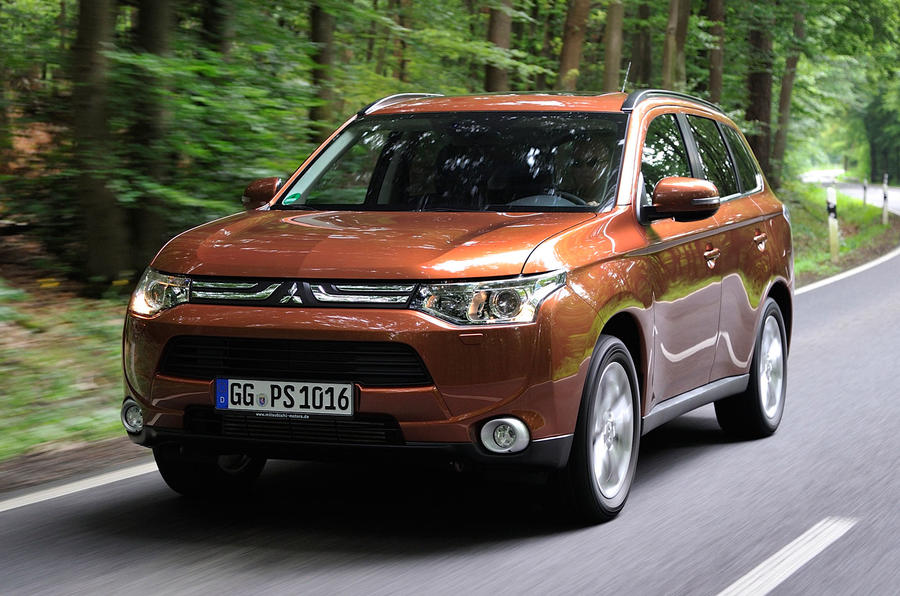
Mitsubishi says the new Outlander is an engineers’ car, and it looks like one. The drive to reduce its drag co-efficient (down to 0.33 from 0.36) endows it with largely featureless lines. Equipment levels are yet to be finalised, but Mitsubishi claims a price increase of around £500-1000 will be offset by an increase in kit.
Should I buy one?
With the third attempt, Mitsubishi may have objectively cracked the D-segment crossover. It is decent to drive, comfortable and refined, but crucially it lacks that emotional spark. And although it has two fewer seats, the elephant in the room is the cheaper and more efficient Mazda CX-5. Roll on the plug-in hybrid.
Mitsubishi Outlander 2.2 DiD 4WD GX4
Price: £32,000 (est); 0-62mph: 9.7sec (est); Top speed: 124mph (est); Economy: 50.4mpg (combined, est); CO2: 146g/km (est); Kerbweight: 1590kg (est); Engine type, cc: in-line four cylinder, 2268cc; Power: 148bhp @ 3500rpm; Torque: 280lb ft @ 1750rpm; Gearbox: six-speed manual







Join the debate
Add your comment
Mitsubishi's decline continues...
...and this will do nothing to arrest it. What a completely uninspiring car. Slab-sided, featureless, with rear lights that look like cheap after-market efforts. I've been a proud owner of a Colt Ralliart since 2010 which has bags of character & great performance. However, with this new dull Outlander, and the even more insipid Mirage which replaces the Colt next year, Mitsubishi appear to be waving an automotive white flag. No manufacturing presence in Europe by the end of the year, shrinking market share in Asia & the US, and no sign of creative flair to spark the punters interest. What a shame.
It is admirable that
It is admirable that Mitsubishi pushed the boat out on engineering the Outlander.It is also a pity that they gave the designers the day off when signing off this design!! I agree with Harry P on the Mazda CX5.
One ugly duckling
If this is an indication of Mitsubishi's new styling frontier and the style of design for the new models due in the next 4 years, then their future in the UK will be very uncertain.
When I saw the initial pictures for this vehicle, I assumed it was only a prototype and that the ugly duckling would emerge as an attactive swan in production. Alas the ugly duckling has made it to production! I hope for Mitsubishi sake, that the other new models due are rather more succesful in the styling department.
I do not think much to the frontal styling of the new Mazda CX5 either!
Harry P wrote: I do not
I agree. I saw one for the first time the other day and that big, black plastic grill just looked cheap.
Mazda's styling has really gone down hill of late. I won't say the same of Mitsubishi because it's never been that good.