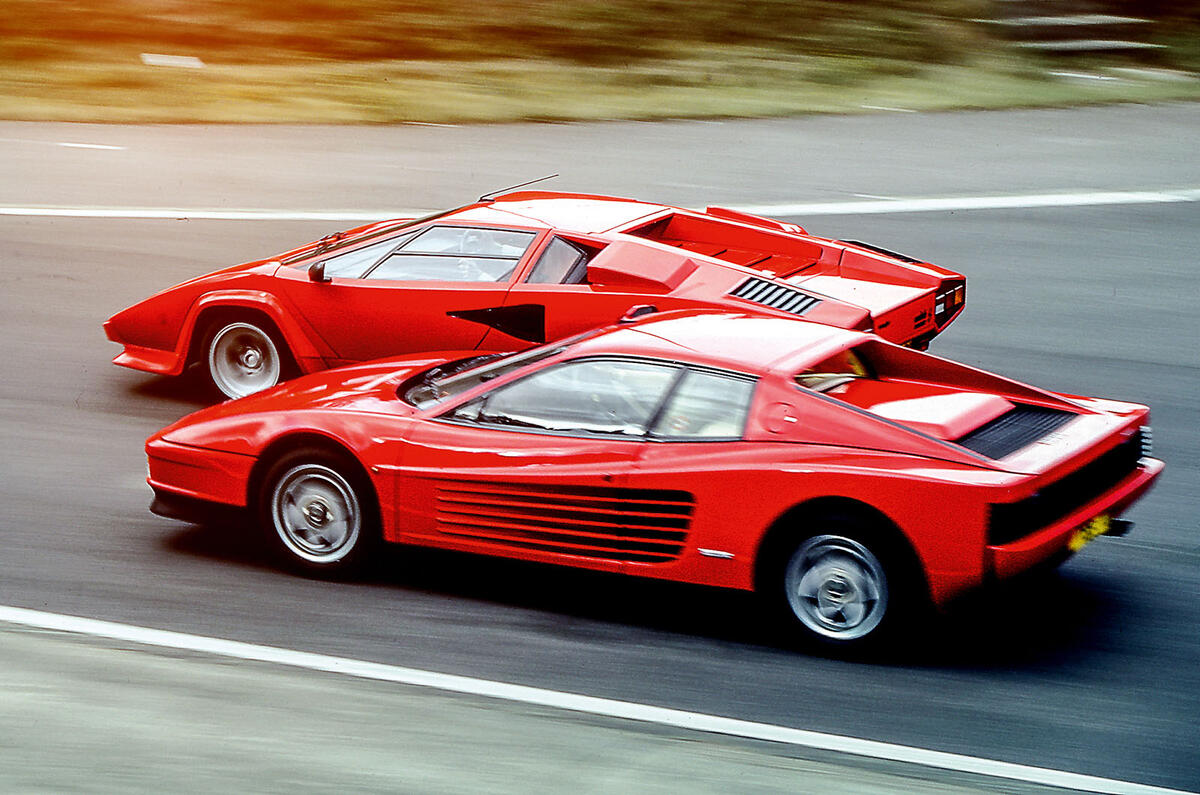

What, exactly, is a supercar? It used to be obvious. It was a car whose engine was in its middle and whose cylinders numbered at least eight, but ideally 12. It had just two seats, a power output starting no lower than a four and a top speed of at least 180mph.
It was wide, it was low, it was impractical, you couldn’t see out of it properly and you had a poster of it on your wall.
It was also expensive and exclusive, so it was probably red. Certainly, Audi didn’t make one.
Today, though, Audi does. Even the least powerful R8 of all, the original V8, met the performance criteria – only you could see out of it and it was no harder to drive than a TT. The supercar, of late, has been democratised.
Which is fine, unless you want to precisely define what one is, and I do. At this mag, we keep a series of ‘Top Fives’ updated – our favourite cars in each market segment. Knowing what qualifies, then, is handy.
A dictionary is no help. The Oxford dictionary thinks it’s “a high-performance sports car”, which would mean an Ariel Atom is a supercar, which clearly it isn’t (even in V8 form).
The Collins dictionary thinks a supercar is “a very expensive fast or powerful car with a centrally located engine”, a tighter definition but no more helpful. A ‘centrally located engine’ would rule out any Aston Martin, which is clearly nonsense if you’ve driven a Aston Martin V12 Vantage S, and any Porsche 911.
Although here, actually, I’m half with Collins. I know most 911s are supercar fast and handle rather better than most of them, too, but I wouldn’t define a GT3 RS as a supercar. A 911 Turbo? Perhaps, but only on a technicality on account of its sheer speed; the 911 is the greatest sports car of all time, not the greatest supercar of all time.
Collins’ definition would also rule out the Mercedes SLS AMG, which is obviously a supercar. Is, though, the new Mercedes-AMG GT? Like a 911, it might be a sports car, in the way that an Aston Martin DB9, despite having the speed, price and power of a supercar, is a grand tourer. A Nissan GT-R is… well, I don’t even know where to start with the GT-R.
In the end, defining whether a car is a supercar comes down, as it always did, to blind prejudice. A supercar isn’t about stats; it’s about a mindset. Does it make you go a bit tingly? Yes? It’s probably a supercar.
Today’s archetypal supercar, then, looks not that dissimilar to what it always did.
Which means it’s a Lamborghini Aventador SV, although that’s so powerful and fast that it’s almost a hypercar, whatever one of those is. Thankfully, Collins and Oxford have not yet attempted that one.
Get the latest car news, reviews and galleries from Autocar direct to your inbox every week. Enter your email address below: