

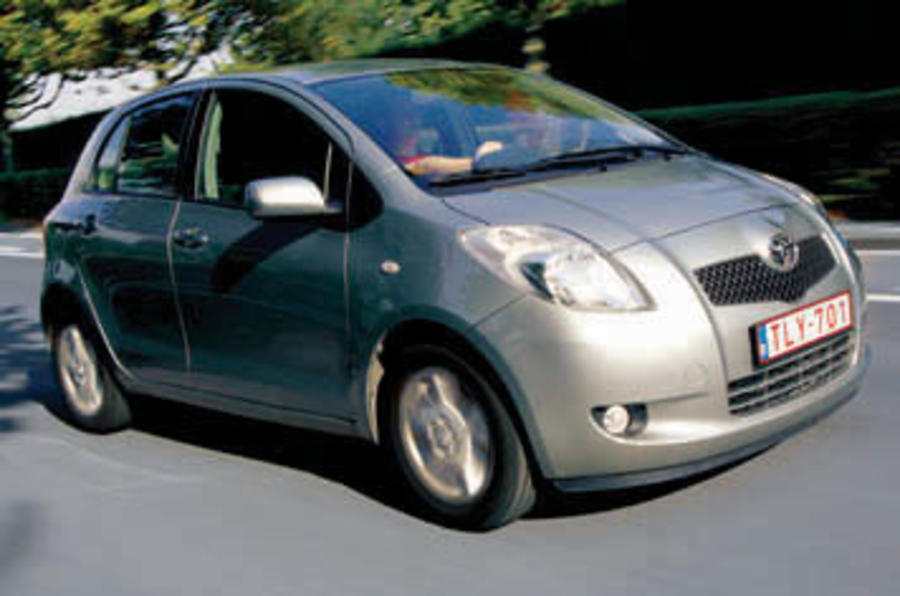




There’s no mistaking this Toyota for anything other than a Yaris – even though it’s virtually all-new. That’s no accident; one of Toyota’s aims for this new version was to maintain the DNA of the old one, and with good reason: the outgoing model is selling better than ever in its sixth and final year, and it scores higher-than-average ratings from its owners for styling, technology, quality and reliability.According to the German TUV, which performs the equivalent of the MoT test on cars in Germany, the Yaris is the most reliable four-to-five-year-old car you can buy.Still, every car can be improved: these days, the outgoing Yaris is looking slightly cheap inside, and it’s also small for its class – small enough that it sits too close to the Aygo. It’s 11cm longer now, and just over an 2.5cm taller and wider, but like the last car, impressive for its space-efficiency.Toyota also wanted to polish its sophistication, refinement and quality, from the way it drives to the sound the doors make when they’re closed, as well as improving its versatility, comfort, safety and performance.Despite its growth, the new Yaris remains usefully shorter than the opposition, particularly the new Fiat Punto and Renault Clio. But you’re not short of room aboard the Toyota, in part because you sit quite upright, two decently sized adults sitting comfortably behind two similarly dimensioned companions. This is all the more impressive considering the struggle manufacturers are having with the new pedestrian impact test, which is creating cars with unusually long noses. The Yaris is an exception, its bonnet mounted high over the engine to provide the necessary crush zone. Toyota anticipates three stars for pedestrian protection and five for occupant protection, incidentally.Winning extra space has clearly been a major preoccupation. A flatter floor tunnel improves comfort for the middle-rear occupant, the front seat runners are spread further apart for extra rear footroom, the seats are thinner, the folding rear bench employs Toyota’s neat Easy Flat system – liberating the largest seats-down stowage area of any supermini, it’s claimed – and there’s 18.2 litres of stowage in the fascia. Oh, and the rear bench is split 60:40, each section sliding back and forth independently.There’s been progress elsewhere too. The bodyshell is 50 per cent stiffer, the suspension has been redesigned, the electrically assisted steering delivers the tightest turning circle in the class, the doors are double-sealed for improved refinement, its drag coefficient has been chiselled to an excellent 0.30, it’s easier to repair post-shunt, the top-of-the-range versions have keyless-go and climate control and the cupholders are 12 per cent closer now. If this last suggests pedantry, well, that gives you a clue to the thoroughness of this renewal.Propulsion comes from two petrol engines – a 1.0 three-cylinder and a 1.3 four – or a 1.4 turbodiesel, and each can be had with either a five-speed manual or a five-speed auto. The 1.0 is new, the others carry over. But the best-seller is expected to be the 1.3 manual five-door in T3 trim – there will be T2 and high-spec Spirit versions besides – and it was this model we tried first.Climb aboard and you’re confronted by an unusual dash, as with the last car. The instruments still lie deep within an angled well in the dash’s centre, but there’s more of a 3-D effect and you also get a trip computer. The fascia is neatly fashioned from hard-feel plastics, with splashes of aluminium, but the effect isn’t quite as classy as the new Clio’s or as colourful as the Punto’s.The comfortable driving position, the airily deep screen, the Yaris’s compactness and the ease of driving it make it an excellent city car, tainted only by an over-sharp clutch. Yes, you can tell that the steering is electrically assisted – it feels slightly artificial – and the gearchange is a little willowy, but the brakes feel good and the whole thing gels well.The 1.3 engine pulls with some verve, and if it gets thrashy towards the top end it’s pretty civil most of the time, including at a cruise.The Yaris’s road behaviour is slightly less advanced than its packaging. It’s capable, but far from a riot to drive – roll and an occasional sharpness over bumps ensuring that it’s nothing to get excited about. The same was true of its refinement, we thought, until we tried the Japanese-built 1.0-litre, which was noticeably more civil than the 1.3. Toyota says the 1.3 is at an earlier stage in the pilot-build process. If the 1.0 turns out to be typical, then the Yaris’s refinement is impressive. The three-cylinder thrum is endearing, and if your motoring is mostly one-up and city bound, it’ll be all you need. The chattery oil-burner will only make sense if diesel prices fall or if you travel huge distances.In its more likely mode as a city car, the Yaris is effective because it’s so practical, easy to live with and cheap to run. It’s a little short of dynamic character, the cabin still falls behind the best in terms of finish and the seats, which ultimately lack give, eventually becoming uncomfortable. But if you can live with this, the Yaris has to be one of the canniest buys in the class.


Add your comment