

Nissan Leaf

What is it?

The Leaf is the gateway to a brave new electric world from Nissan. Forget the Mitsubishi i-MiEV and Mini E, and even the dorky G-Wiz. The five-seater Leaf is the world’s first, purpose-built mass-produced electric car.

And it could very well be a defining moment in automotive history on the way to cleaning up emissions and weaning us off fossil fuels. As it’s purpose-built, the Leaf employs its own unique platform and body that meet all C-segment safety regulations.

It’s powered by 48 laminated lithium-ion battery modules and a high-response synchronous electric motor that generates 107bhp and 206lb ft of torque. The battery pack is located directly beneath the front and rear rows of seats to keep weight low and central for greater on-road stability and handling.

It’ll travel 100 miles on a full charge claims Nissan, takes around eight hours to recharge using 220-240V power supply and produces – need we say – zero tailpipe emissions.

See test pics of the Nissan Leaf

What’s it like?

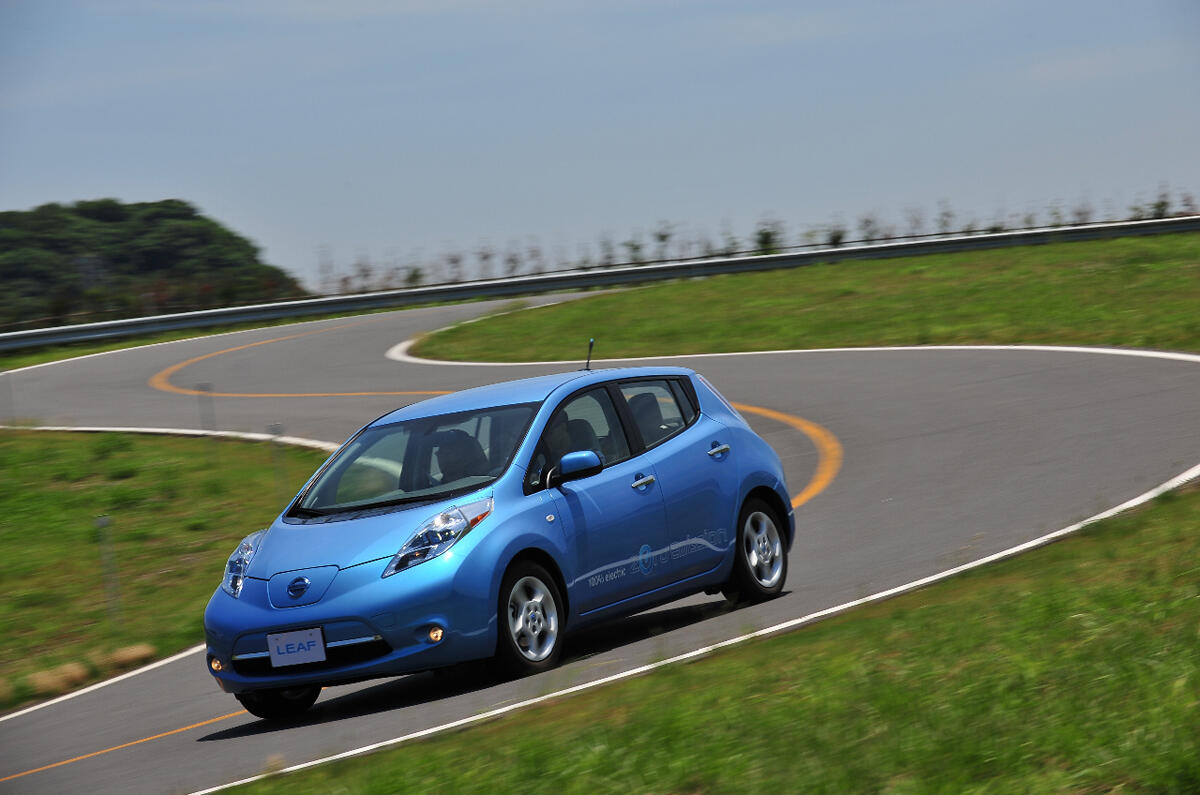
It certainly looks better in the flesh than in photos. Designers were able to differentiate the Leaf’s styling from conventional hatchbacks and give it a unique, short-nosed, rakish front end simply because the car doesn’t have a bulky engine up front.

In the driver’s seat, the Leaf feels like any other hatchback. Push the starter button and a three to four second long computer-like ‘reboot’ jingle plays to inform that the vehicle is ready for action. Flick the mouse-shaped gear selector to “D” mode, floor the throttle and you have 100 per cent instant torque on tap.

From zero to 30mph, the Leaf accelerates faster than a V6 but progress slows as revs rise. The Leaf will reach 60 mph from rest in 11.5 seconds which is comparable to a base-spec petrol Golf. Top speed is 90mph, but then the Leaf was not designed for loads of motorway miles.

Power delivery from the CVT is silky smooth, effortless and above all, whisper quiet apart from a barely audible whir from the motor. To warn pedestrians of its presence, engineers have fitted an engine bay mounted speaker that sounds a low-pitched whistle at speeds of up to 30km/h and in reverse. This is clever and answers early critics of EVs.

Flick the mouse to “Eco” mode and the on-board computer automatically switches its programming to dial down the air-con and throttle response while boosting regenerative braking, thus improving driving range by as much as 10 percent.

We remember smiling as we took our first corner, because the Leaf handles with surprising poise and purpose of mission. With the heavy battery pack positioned nice and low in the platform, the Nissan turns in with precision and well-weighted steering while exhibiting almost no body roll and no understeer.

Ride quality was firm and comfortable on Nissan’s Oppama proving ground, although we reserve our verdict on ride until we can get onto some worthy B-roads. But even on Nissan’s smooth test track, we were not so sure about the choice of eco-tyres.

While they maximise mileage and minimise rolling resistance, the all-weather rubber do not grip as well as summer tyre option and tend to squeal in corners. But even with the eco-rubber, the Leaf’s brakes deliver excellent stopping power with a healthy helping of regenerative effort on the side.


As the first kid on the electric block, Nissan has really made an effort to make the Leaf as appealing to as many buyers as possible. While the car looks very approachable from the outside, its interior is finished in a bright stylish trim with wave-like contours and blue-hued illumination, highlighting the car’s planet-conscious slant.

Seats are comfortable, head and legroom are sufficient and the rear luggage space, which houses the charging plug and cord, will take one large suitcase.

Should I buy one?

If you don’t drive more than 70 or 80 miles a day, and evidence from Nissan suggests that more than 80 percent of us don’t, then the Leaf might just be the perfect planet-friendly transport for you. While slightly more expensive than a Golf for example (even with the government grant), Nissan claims that the price difference will recoup itself after around three years of use, taking into account the lack of having to visit a petrol pump.

We think it’ll generate strong sales when it lands in showrooms early next year, but there will also be thousands of potential buyers waiting in the wings to see how the car performs and how the infrastructure issue pans out.

Peter Lyon

See all the latest Nissan reviews, news and video

Join the debate

Comments
29

Re: Nissan Leaf

1 year 48 weeks ago

Its odd that the report says in the flesh it has a short nosed front end, in the pictures it certainly looks to have a pretty substantial front overhang.

Re: Nissan Leaf

1 year 48 weeks ago

This is only as eco-friendly as the power stations that power it: and then there is the additional environmental impact of production to consider (thinking especially of the batteries). For the cost of one of these, I could get myself a nice, tidy E38 BMW 750i, possibly swap out the autobox for a manual, and run my 20mpg barge around, knowing that I was still doing more for the environment than these sanctimonious hippies in their Priuses and Leafs and Insights and suchlike. Oh, and I'd have a hell of a lot of change.

Re: Nissan Leaf

1 year 48 weeks ago

Here Here!!!!

There is an argument to say an H2 Hummer is better for the environment than a Nissan Leaf! (and its quite a convincing argument as well!!!)

Re: Nissan Leaf

1 year 48 weeks ago

Vidge 123 wrote:

Here Here!!!!

There is an argument to say an H2 Hummer is better for the environment than a Nissan Leaf! (and its quite a convincing argument as well!!!)

Well, that's probably pushing things... and I wouldn't be seen dead in a Hummer of any description.

Re: Nissan Leaf

1 year 48 weeks ago

EVs are coming whether we like the earliest ones or not. And the Leaf would seem to be a genuine attempt to create a workable commercially-viable EV with as few compromises as is possible using current battery technology.


We all know oil is a finite resource; we should also all know that a car-based engine is far less efficient at converting that energy than a large power station. There's equal pressure on improving that conversion efficiency and on improving battery technology to the point where an EV and a conventional car become directly comparable.


In the meantime, please can I have an electric car that's decent to drive but one that also has a small on-board petrol/diesel powered generator for range extension so that I only need one car for everything still? Lotus seems to have the right idea here: cruising needs only comparatively few kW.

Re: Nissan Leaf

1 year 48 weeks ago

Straight Six Man wrote:

This is only as eco-friendly as the power stations that power it: and then there is the additional environmental impact of production to consider (thinking especially of the batteries). For the cost of one of these, I could get myself a nice, tidy E38 BMW 750i, possibly swap out the autobox for a manual, and run my 20mpg barge around, knowing that I was still doing more for the environment than these sanctimonious hippies in their Priuses and Leafs and Insights and suchlike. Oh, and I'd have a hell of a lot of change.

But your 20mpg barge will never reduce its emissions. We have the technology and ability to reduce our CO2 emissions from power stations (which is already significantly lower than using an internal combustion engine - power stations are far more efficient). If we make a proper move towards nuclear and/or renewable we can reduce our CO2 from electricity production to near zero - making the running of this vehicle almost CO2 free. Tell me another way of managing that? Add to that zero tailpipe emissions and you have a perfect city and suburbs vehicle.

I think the car looks alright, the styling is nothing special, but then very few cars are right now. More interesting is that it's good to drive, looks spacious (although I noticed you can't fold the rear seats down) AND it's a proper effort that's going to sell - unlike previous attempts. This is just the start, it won't be for everyone, but give it time.

Re: Nissan Leaf

1 year 48 weeks ago

As i see it, the range issue is the only real problem with this car. Even as a commuter or city car, it removes the possibility of doing something spontaneous and just going for a long drive when you feel like it, thus killing the whole point of having a car, imo. Cars that have range extenders, like the Volt, seem to me a better solution.


Re: Nissan Leaf

1 year 48 weeks ago

Vidge 123 wrote:

There is an argument to say an H2 Hummer is better for the environment than a Nissan Leaf!

I'm sure there there is.

There are also arguments to say that Elvis didn't die, that the moon is made of cheese and that the earth is flat.

Re: Nissan Leaf

1 year 48 weeks ago

I think these EV cars can suit certain users very well. However, for about half of the journeys I, and many other people make a 2nd, more conventional car, is still needed. That's not very 'green'.

Honda CR-V ES 2.2 i-DTEC/Citroen DS3 1.6 VTi DStyle Plus

Re: Nissan Leaf

1 year 48 weeks ago

anyone want to try and calculate how much my electric bill is gonna be if i run one of these things?the fact is that they still use fossil fuels, it does'nt really matter wether it's at the beginning or the end,and on a much bigger picture,these vehicles are never gonna make a difference to the world coz of the amount of cars now(and planning to be)on the road in India and China and all the other developing countries that don't give a monkies about co2 levels.

Please register or login to post a comment.

Our Verdict

The electric Nissan Leaf has its work cut out competing with cheaper mainstream cars

  • First Drive

    Nissan Leaf

    Too pricey for private buyers, but still proof that electric cars can be comfortable, safe and practical daily transport
  • First Drive

    Nissan Leaf

    First European test reveals a promising future for the electric car, if range is addressed

Driven this week