What is it?
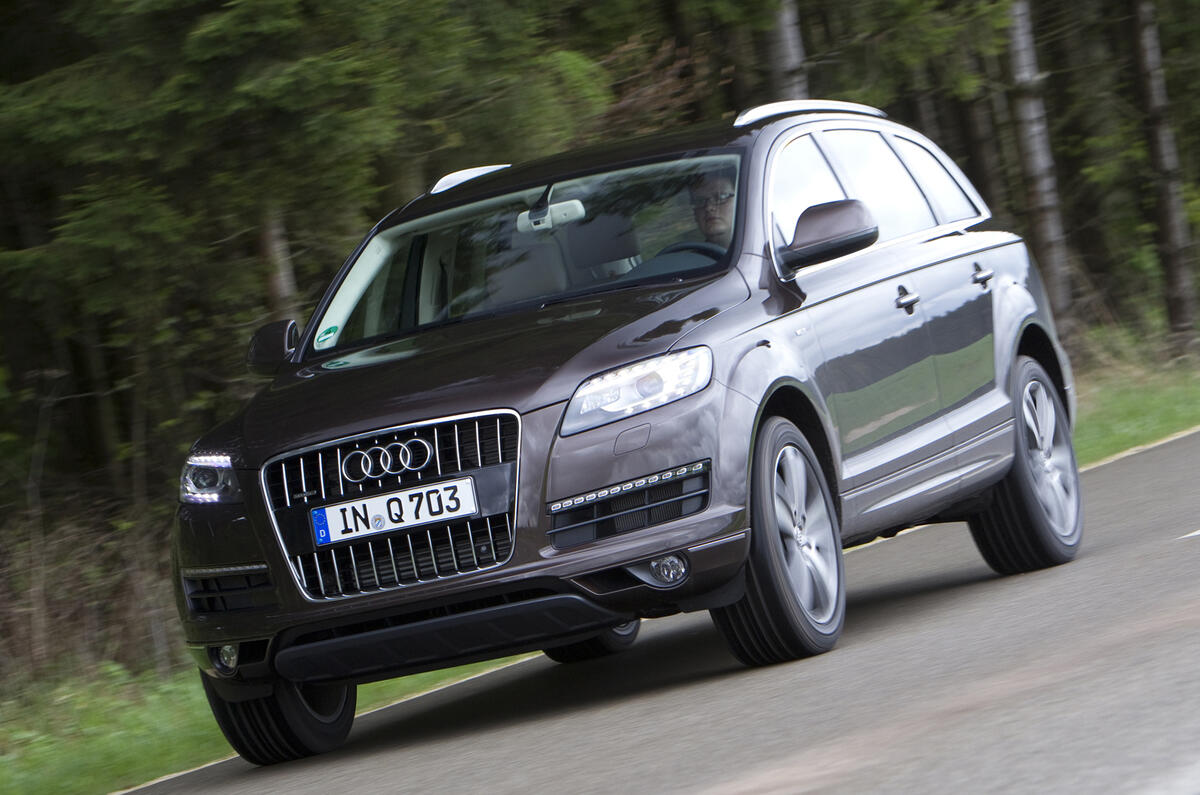
The 2011-model-year Audi Q7. In a bid to slash emissions and fuel consumption, while marginally improving performance, Ingolstadt has rung the changes under the big 4x4’s bonnet, and overhauled its transmission and four-wheel drive system too. There isn’t a single powertrain configuration carried over.
The most interesting addition to the Q7 range is a new petrol version powered by the same 3.0-litre V6 you’ll find in the S4 sports saloon. Fitted with two intercoolers, a supercharger and FSI direct injection, it produces 328bhp, as well as 325lb ft of torque between 2900- and 5300rpm.
As part of Audi’s engine downsizing program, this car replaces the 4.2-litre naturally aspirated V8 petrol Q7. A slightly lower-strung 268bhp version running the same mechanical package will sit beneath this model, as a replacement for the 3.6-litre V6.
This Q7 also benefits from a concept called ‘downspeeding’ as well as ‘downsizing’: that’s Audi shorthand for fitting a torquier engine and a taller set of gear ratios.
Along with all of its rangemates, it gets an eight-speed automatic gearbox capable of full transmission lock-up even at urban speeds. The ‘box has a broad spread of ratios, and allows the car to cruise at lower engine revs than it might otherwise, improving emissions and economy without sacrificing performance.
The new Q7 also has a more efficient, self-lubricating low range transfer case for that new transmission, as well as a heat exchanger designed to scavenge heat from the engine’s cooling system to warm the gearbox oil up to operating temperature more quickly.
All of which makes this particular V6 Q7 19 per cent more frugal than the V8 it replaces, as well as quicker to 62mph.
What’s it like?
Smooth, quiet, spacious and substantial – and, at the same time, responsive. Mildly sporty even.
That eight-speed box is programmed to change up and hold onto its higher gears if you keep the selector lever in ‘D’. At motorway cruising speed, with no more than 2200rpm on the tacho, you’ll find the engine hushed and totally vibration free. Excellent insulation from wind and road noise completes a close-to flawless performance on refinement.
Move the gear lever into ‘S’ mode and that ‘box will immediately kick down into sixth. As the engine revs climb, that engine pours forth a song that doesn’t have the multi-layered appeal of a proper V8, but is free from supercharger whine and not unpleasant to listen to.
Throttle response is excellent throughout this engine’s rev range, and there’s enough flexibility of performance to pile on speed with as much urgency as any two-and-a-half tonne SUV really requires.
Our test car’s brakes didn’t seem as strong: if there’s one thing a car this size has to do to inspire confidence, it’s stop, and our test car required a firmer stab of the pedal than we were strictly comfortable with.
Considering its size and heft, the Q7 handles well. It’s more firmly suspended than most luxury SUVs, and has good body control, resisting the body roll and understeer that so often afflicts cars of this type particularly well.
The trade-off is a restless, slightly fidgety motorway ride, which sacrifices cabin comfort in a way unbecoming of a car so spacious, upmarket and otherwise refined.
Should I buy one?
Depends if you can make room in your life for any petrol-powered luxury SUV. There’s no doubt that the new Q7 is a good one – quick enough, refined enough, and given the 25.5mpg return for our test car, just about economical enough. It’s even well priced: almost £10k cheaper than a Mercedes ML500.
Trouble is, that engine doesn’t offer the same burbling mechanical charm of a proper V8. In a big, luxury SUV, many expect a big ‘premium’ engine. Compact, downsized and efficient it may be, but some may simply feel a bit short-changed by a 3.0-litre V6.
Those who don’t may stumble over the fact that, for all the added economy that this car offers relative to the old 4.2-litre V8, the Q7 TFSI is still not quite justifiable as a ‘sensible’ option. Audi’s 2010-model-year 3.0-litre TDi Q7 has a brand new diesel engine that’ll top 38mpg. It’s cheaper to buy than the TFSI too.
Which is why we can’t help thinking that the 3.0 TDi will be the Q7 for most UK buyers, and this one of fringe interest only.
Matt Saunders
Join the debate
Re: Audi Q7 3.0 TFSi Quattro SE
"There isn’t a single powertrain configuration carried over."
Are you sure? The V12 Diesel hasnt recieved any changes.
Re: Audi Q7 3.0 TFSi Quattro SE
the 25.5mpg return for our test car, just about economical enough.
the most astounding fuel consumption figure and the most ridiculous comment on it. A 2.5 tonne, full-sized SUV, that can crack 7 secs. 0-60, has over 300 bhp and runs over 150 mph and this tester reckons that's 'just economical enough'! Jesus wept, the man, Mr Saunders, has no concept of real, technological achievement. Ten years ago small exec petrol-engined cars, like a six-cylinder BMW 3-series, would have been happy to be credited with such a real test fuel consumption figure, yet a car weighing not far off twice as much as an E46 3 series, with 4WD, and approx. twice the power of a 325i is cast aside as 'just about economical enough'. That 25.5mpg figure is utterly, utterly astounding. It might not have much market relevance here in derv-dominated UK and Europe but that engine will be big news in the US and Asian markets. That's why that figure is so important. A landmark figure.
Re: Audi Q7 3.0 TFSi Quattro SE
You're quite right, Quattro: the V12 is still on offer, interestingly with the old 6-speed auto 'box. Oddly, it wasn't mentioned in any of Audi's press material on the Q7 facelift. Become a bit of a dirty secret next to an efficiency-boosted rest-of-the-range, clearly.
And Nick - I take your point about the economy. My qualified praise was mainly because it'll still be measured against the economy of diesel engined options in the UK and Europe - which is where this website is mainly read. As such, 25mpg is 'just about good enough' because there are plenty of big oil-burner 4x4s that return something similar.
Re: Audi Q7 3.0 TFSi Quattro SE
Ten years ago small exec petrol-engined cars, like a six-cylinder BMW 3-series, would have been happy to be credited with such a real test fuel consumption figure, yet a car weighing not far off twice as much as an E46 3 series, with 4WD, and approx. twice the power of a 325i is cast aside as 'just about economical enough'. That 25.5mpg figure is utterly, utterly astounding.
Erm, no. As I remember 10 years ago my 325 gave out 193hp so not half the output, did 0-60 in 7 seconds and real world economy was 33mpg on 1.5 ton car... so 25mpg on the Q7 is not really astounding...
Re: Audi Q7 3.0 TFSi Quattro SE
Ten years ago small exec petrol-engined cars, like a six-cylinder BMW 3-series, would have been happy to be credited with such a real test fuel consumption figure, yet a car weighing not far off twice as much as an E46 3 series, with 4WD, and approx. twice the power of a 325i is cast aside as 'just about economical enough'. That 25.5mpg figure is utterly, utterly astounding.
Erm, no. As I remember 10 years ago my 325 gave out 193hp so not half the output, did 0-60 in 7 seconds and real world economy was 33mpg on 1.5 ton car... so 25mpg on the Q7 is not really astounding...
There's always one, isn't there. Okay, for those who can see the broader picture, not some nitpicker, I referred to a six-cylinder small exec car. I had in mind the 2.5 litre engine, and mistakenly called it the 325i, whereas it was launched as the badged BMW 323i(2.5 litre capacity, BMW M52TUB25 engine designation). That kicked out 170 horsepower, roughly half the Q7 TFSI's output, did 0-60 in around 8 secs, weighed around 1.35 tonnes, around one tonne less than a base spec Q7, and from memory claimed do to around 31-33 mpg, but in reality, on a combined cycle would struggle to do more than 27-28 mpg.
So yes, 25.5 mpg for an Autocar first drive test - where I'm sure Mr Prior didn't hang about - of a 2.5 tonne, 333 bhp, 4wd, coefficient of drag 0.36? vehicle, that cracks 7 secs for 0-60 and 150 mph is utterly, utterly, (repeat to absudity) astounding. Compare this figure to the 15 mpg that Autocar got on test for the R/R Sport Supercharged when it first came out - a car slower, 7.2 s 0- 60 mph, 140 mph Vmax. http://www.autocar.co.uk/CarReviews/RoadTestsData/Land-Rover-Range-Rover-Sport-4.2-V8-Supercharged/215636/
Re: Audi Q7 3.0 TFSi Quattro SE
There's always one, isn't there.
yes, captain pedantic, it's usually you.
the point you made that "ten years ago small exec petrol-engined cars, like a six-cylinder BMW
3-series, would have been happy to be credited with such a real test
fuel consumption figure" makes me wonder if you're not posting these messages through a wormhole to the 1970s.
take a 330i or a 530i from ten years ago and you'll find them offering 231bhp and booking at 31mpg and 29mpg respectively. now assuming you had a manual, these cars were easily capable of that level of economy - i should know, i had both.
really no idea where you get the idea they would "struggle" to match official claims, though no doubt you will come back and wriggle some more with an even more baffling set of numbers and links to out of date road tests you found by hammering Google.
the idea that this 328bhp Q7 is "utterly, utterly, (repeat to absudity) astounding" is utterly astounding in itself, in that its power output, performance and economy figures are broadly on a par with the normally aspirated V8 it replaces, not to mention much worse than the V8 TDI (335bhp, 0-60mph 6.8 secs, 29mpg, plus a whole mountain more torque).
Re: Audi Q7 3.0 TFSi Quattro SE
its power output, performance and economy figures are broadly on a par with the normally aspirated V8 it replaces, not to mention much worse than the V8 TDI (335bhp, 0-60mph 6.8 secs, 29mpg, plus a whole mountain more torque).
Tee hee and all very amusing for a Friday afternoon.
In fairness, hedgecreep, comparing the 3.0 petrol V6 to the 4.2 diesel V8 is rather unfair. The whole point of replacing the petrol V8 with the smaller blown V6 wasn't to improve performance but to improve economy and emissions.
Otherwise no argument.
Re: Audi Q7 3.0 TFSi Quattro SE
its power output, performance and economy figures are broadly on a par with the normally aspirated V8 it replaces,
no it's not: V8: 22.2 mpg, 0-60 mph 7.4s V6: 26.4 mpg, 0-60 mph 6.9s. You seem to have terminal difficulty reading straightforward things and understanding(2010 not 2013 previously) - most seven year olds have attained this ability. What age are you?
To repeat, a ten year old 3-series BMW, a E46 323i(1998-2001), had approximately half the power of this Q7, approx. only 55% of the weight, better aerodynamics, yet managed only about the same fuel economy - BMW official 31.4 mpg combined, realistic, with urban driving or driven as per a Autocar test, about 10-20% less, so 25-28 mpg, which puts it very close to the figure of the Q7's. This engine in the Q7, the 3 litre supercharged, shows how far Audi has come with efficiency. I gave the example of the 4.2 V8 supercharged Range Rover Sport, which less than five years ago managed only 15 mpg on Autocar's test, and yet was slower than the Q7. If that's not astounding - how far the Audi is ahead - then it's pointless arguing. As to comparing with the diesels, that is pointless, as we all know diesels produce better fuel economy, due to diesel's higher calorific value, and the point that this vehicle, the Q7 TFSI, will be sold mainly in diesel-phobic markets, like the US and China.
Re: Audi Q7 3.0 TFSi Quattro SE
its power output, performance and economy figures are broadly on a par with the normally aspirated V8 it replaces,
no it's not: V8: 22.2 mpg, 0-60 mph 7.4s V6: 26.4 mpg, 0-60 mph 6.9s. You seem to have terminal difficulty reading straightforward things and understanding(2010 not 2013 previously) - most seven year olds have attained this ability. What age are you?
look chump, those economy and performance figures are broadly on a par - I never claimed they were identical, just in the same ballpark. don't understand what that means? it means that you spending your fading years hammering the `Google Search` button for decimal point variations on figures nobody but you cares about is a wholly meaningless exercise since the information varies from source to source and from car to car anyway. plus it'll make your arthritis worse.
i told you that my own experience of BMW's 3.0L engine in the 1990s was that it was easily capable of 30mpg plus and thus does not vary from the official figures. that said, you are arguing a point of variation yourself in the next paragraph, you massive dodo, so never mind my age - have you (re)applied for your licence yet?
the real problem here is not your text book old fart pernickety view of the world, but that the term `economical` applied to this Q7 is purely a matter of opinion, and you are such a rabid slave to all things German that it's pointless even asking what your opinion is - we already know it, because you keep bleating it. the Germans are best, the Germans are best, rinse, repeat etc.
Re: Audi Q7 3.0 TFSi Quattro SE
2.5 tonne, 333 bhp, 4wd, coefficient of drag 0.36? vehicle, that cracks 7 secs for 0-60 and 150 mph is utterly, utterly, (repeat to absudity) astounding. Compare this figure to the 15 mpg that Autocar got on test for the R/R Sport Supercharged when it first came out - a car slower, 7.2 s 0- 60 mph, 140 mph Vmax.
That's a good point Nick, I agree with you that the figures for this vehicle are very impressive and I am a BMW fan.