

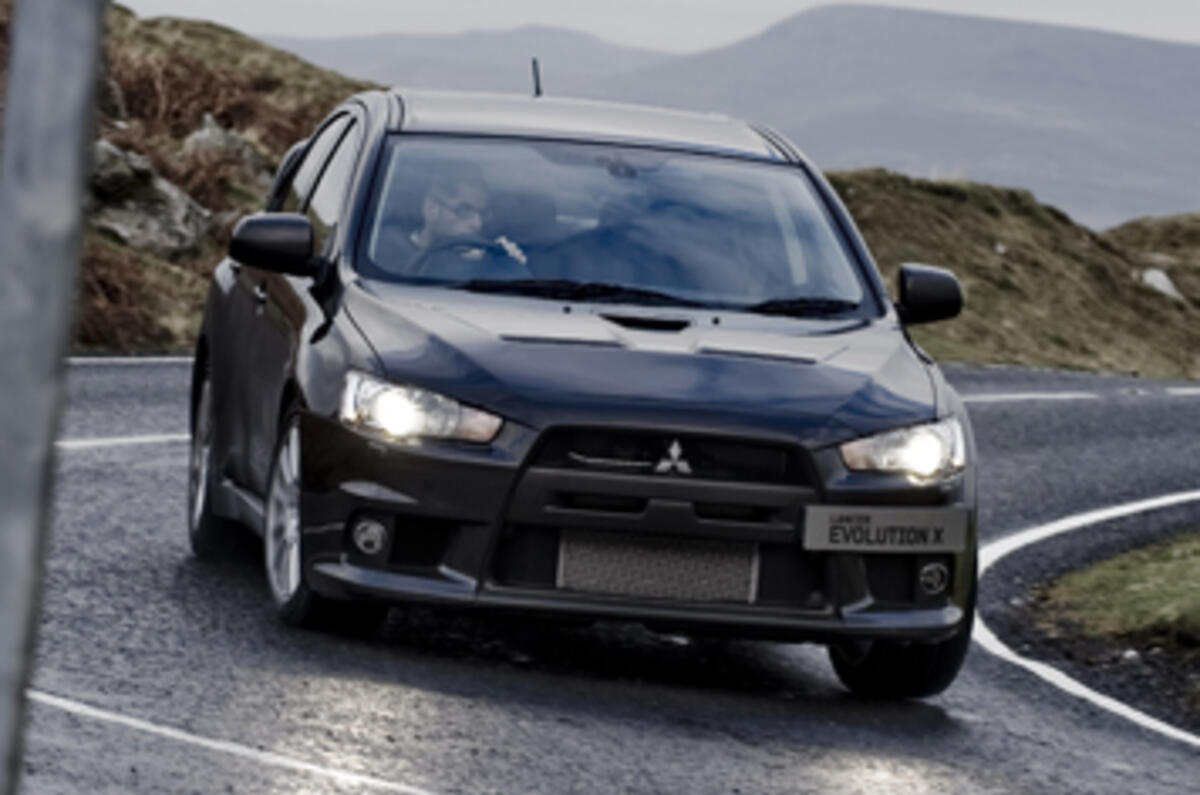




What is it?
Version 10 of the car that was supposed to provide the same halo effect to Mitsubishi’s dowdy range of cars as the VW Golf GTi does to the Golf model line-up. But never managed anything like the same success.
This is the first time anyone has driven the Evo X in the UK; its performance on our roads will be the benchmark against which the new Subaru Impreza STi will be measured when it comes to Britain in February.
Historically the Evo has always been a sharper driving machine than the Subaru, but will this new version, tested here in base GS 300 guise, and with a predicted price of around £27,000, have lost some of the sparkle that characterised its progenitors?
What’s it like?
Not far from what you’d expect. This was a pre-homologation version with no miles on the clock, and it was tighter than Colin Goodwin in a pricy restaurant. The motor was smooth, throttle response good and the boost arrived so calmly that it barely felt turbocharged. So much for the histrionics of Evos past.
The Evo X gearchange feels identical to that of the last car, and the five before that. And the interior, now with attractive instruments and a large sat-nav screen plonked on the dash, still has an air of budget-ness about it that leaves the Evo feeling far cheaper than any VW group hot hatch.
Awesome handling was always this car's trade for questionable interior quality, though, and this new one still offers the kind of all-weather abilities that will allow the Evo X driver to disappear from most other road cars at this time of year.
Using Mitsubishi’s AYC (anti yaw control) differentials, the car can simply be pointed at a turn, steered to the apex and then driven away. If it senses understeer you can feel it trim the axle at fault. Likewise, if the car wants to oversteer, torque shifts forwards and the car slings forwards with little drama. This used to be the Evo's USP; today, many other all-wheel drive systems manage such tricks. But what still sets the Evo apart is how neutral and unaffected it feels from behind the wheel.
The steering rack is fast-paced – about as quick as most of us can manage in a saloon car without it seeming too pointy. However, the ride comfort is poor: the car is busy everywhere, and the dampers only seem to work at higher speeds. In town, it crashes about with little compliance.
And the fuel tank is still too small, making for a range that's quite pathetic. But on the plus side, the car now has 12,500 mile service intervals, which is a huge improvement over the outgoing model.
Should I buy one?
The world of the budget performance car has changed beyond recognition in the past few years. An Audi S3 feels just as quick as this car (even if the numbers suggest it shouldn’t) and yet its fit and finish are in a different league.
Despite some clean lines and an impressive jawline, this new Evo has somehow lost most of the homologation appeal of versions five, six and seven, too; it's just not as dramatic to look at as Evos have been. The twin outlet exhaust box is especially apologetic.
So you'll need to really love the Evo X's full-blooded, maximum adrenaline character to justify buying one. And you’ll need to be committed, too. It’ll be expensive to run, and the performance no longer blows your mind – although experience tells us that these cars do loosen considerably with age.


Join the debate
Add your comment
Re: Mitsubishi Evo X
As correctly pointed out the Audi S3 is four wheel drive. Where it does win is that it's a prestige brand which will keep it's residual value. You can also get a performance boost easily, and Audi garages will do it with a warranty too. However, the S3 and the whole of the A3 range is in desperate need of a ground up refresh. I looked at one and the fantastic sports seats and nimble little steering wheel were both extras adding 3k to the car’s cost. The Golf R32 looks better than the A3 if you must go VAG.
Main competition for the Evo X is, as it always seems to be, the Subaru Impreza STi. Both are new models, but where as Mitsubishi have gone with a known format Subaru have decided to move their focus to the world of hatch backs. The new Impreza isn’t distinctive enough a model to compete in such a busy market, basic WRX looks no better than a Mazda 3 and aFocus ST
I’m in the process of buying a new car after driving a Subaru WRX with PPP for a number of years. As pleased with the car as I am, I just can’t bring myself to buy the STi. I’m giving serious consideration to the Evo X, it’s current the favourite option. Sorry Subaru, but you did raise the white flag to Mitsubishi.
Re: Mitsubishi Evo X
Not wanting to stick up for a fancy Golf here, but the Audi S3 does have four wheel drive...
Re: Mitsubishi Evo X
i guess this is a quite a biased report agains Evos. How can you compare an Evo with an S3? Any Evo handles much better and performs better. Evos are four wheel drive and S3s are front wheel drive. Evos are rally bred and S3s are just hatchbacks with stranger engines. So case dismissed